
 Hackers & Painters: Big Ideas from the Computer Age
Quotes from the Book
Over the years, I've learned that the first idea you have is irrelevant. It's just a catalyst for you to get started. Then you figure out what's wrong with it and you go through phases of denial, panic, regret. And then you finally have a better idea and the second idea is always the important one.
9
The goal - at least the way I think about entrepreneurship - is you realize one day that you can't really work anyone else. You have to start your own thing. It almost doesn't matter what the thing is. We had six different business plan changes, and then the last one was PayPal. If that one didn't work out, if we still had the money and the people, obviously we would not have given up. We would have iterated on the business model and done something else. I don't think there was ever clarity as to who we were until we knew it was working. By then, we'd figured out our PR pitch and told everyone what we do and who we are. But between the founding and the actual PayPal, it was just like this tug-of-war where it was like, "We're trying this, this week." Every week you go to investors and say, "We're doing this, exactly this. We're really focused. We're going to be huge." The next week you're like, "That was a lie.
7
the less energy people expend on performance, the more they expend on appearances to compensate.
7
I think there are very few people who have a capacity to see the future. So it can be difficult when you are talking about something where nothing about it exists yet.
4
Paul Buchheit: I'm suddenly reminded that, for a while, I asked people if they were playing Russian Roulette with a gun with a billion barrels (or some huge number, so in other words, some low probability that they would actually be killed), how much would they have to be paid to play one round? A lot of people were almost offended by the question and they'd say, "I wouldn't do it at any price." But, of course, we do that everyday. They drive to work in cars to earn money and they are taking risks all the time, but they don't like to acknowledge that they are taking risks. They want to pretend that everything is risk-free.
4
Much better to figure out where the marketplace is going to be in a few years, focus on providing a solution to that, and let the market forces catch up to you.
3
Venture capitalists, with the exception of people like Don Valentine, would tell you that they'd rather fund a great team than a great idea. The reason is that if they have a bad idea, great teams can figure out a better one. Mediocre people even with a great idea can screw it up in its execution. Or if they have a bad idea, then they aren't going to be in a position to think about how to change it. They're just going to pursue it blindly.
2
I didn't really want to patent it because, for one, I don't like software patents, and, two, if you patent it, you make it public. Even if you don't know someone's infringing, they will still be getting the benefit. Instead, we just chose to keep it a trade secret and not show it to anyone.
2
Wozniak: Well, we added up to the total everything that was needed. If there was anything that neither one of us knew how to do, Steve would do it. He'd just find a way to do it. He was just gung ho and pressing for this company to be successful. And me, I was pretty much only in my technical head with the circuits.
2
Livingston: What is the key to excellence for an engineer? Wozniak: You have to be very diligent. You have to check every little detail. You have to be so careful that you haven't left something out. You have to think harder and deeper than you normally would.
1
A startup is a company that builds some kind of technology that people want. The mistake that a lot of founders make is to build something they think users want, but that users don’t actually want." - Paul Graham
1
Because you'll go through so many changes, I don't think it pays off to overanalyze the first business plan, for example. The first business plan is there to make sure you can use Microsoft Word.
1
..determination is the most important quality in a founder, open-mindedness and willingness to change your idea are key, and all startups face rejection at first.
1
In big companies, there's always going to be more politics and less scope for individual decisions. But seeing what startups are really like will at least show other organizations what to aim for. The time may soon be coming when instead of startups trying to seem more corporate, corporations will try to seem more like startups. That would be a good thing.
1
Some famous person said, "Success is 50 percent luck and 50 percent preparedness for that luck." I think that's a lot of it. It's being ready to take advantage of opportunities when they arise.
1
Fred Brooks said that the second system is always late; sometimes years later than you expect. And in fact, because of the ambition, usually it won't solve any of the problems. They've got a long list of things, and it will solve almost none of them in the end. So that's exactly what happened with these guys. They told customers, "Don't use the old system, because we have a new one that should be shipping in 3 months and it will be better." It actually took them more than a year and a half. So they suffered all these sales losses because the thing was late. They killed demand for the old product by telling them the new product was "just around the corner." Then, when the new product finally came out, some critical pages were literally a thousand times slower than the old system.
1
A company that is not designed to create high-tech products is very unlikely to have the culture or the DNA that it takes to create high-tech products. So if you are a high-tech person in that company, then you're basically a glorified typist in some sense. It's very unlikely that the kind of people who would be successful in an entertainment company would even understand what programmers do that makes them more than typists.
1
Livingston: Some aspects of business turned out to be less of a mystery than you had thought. What did you find you were better at than you thought? Graham: I found I could actually sell moderately well. I could convince people of stuff. I learned a trick for doing this: to tell the truth. A lot of people think that the way to convince people of things is to be eloquent—to have some bag of tricks for sliding conclusions into their brains. But there's also a sort of hack that you can use if you are not a very good salesman, which is simply tell people the truth. Our strategy for selling our software to people was: make the best software and then tell them, truthfully, "this is the best software." And they could tell we were telling the truth. Another advantage of telling the truth is that you don't have to remember what you've said. You don't have to keep any state in your head. It's a purely functional business strategy. (Hackers will get what I mean.)
1
I'd say determination is the single most important quality in a startup founder. If the founders I spoke with were superhuman in any way, it was in their perseverance.
1
Apparently sprinters reach their highest speed right out of the blocks, and spend the rest of the race slowing down. The winners slow down the least. It's that way with most startups too. The earliest phase is usually the most productive. That's when they have the really big ideas. Imagine what Apple was like when 100% of its employees were either Steve Jobs or Steve Wozniak.
1
when you build only software that you absolutely need, you don't get more software than you'll actually use.
1
Innovations seem inevitable in retrospect, but at the time it's an uphill battle.
1
Pick a big enough project, something that's really hard, something that over the years you can work on.
1
People like the idea of innovation in the abstract, but when you present them with any specific innovation, they tend to reject it because it doesn't fit with what they already know.
1
Paul Buchheit: Then you have what we do with PCs, and that's technically pretty challenging—to take this big network of machines that are unreliable and build a big, reliable storage system out of it.
1
A lot of the machines that Google is built on—commodity is the polite word for them—they're regular PCs and so they're not always the most reliable.
1
some of the founders are just hardcore geeks that are never going to develop into good managers of a large company. Some of them are founders precisely because they wouldn't be good managers of a large company. So in those kinds of companies, you probably do want to bring in better management, if you can find it.
Why things happen, I just don't know. Maybe somebody has a need and, in our case, we had a need. That's what triggered the idea. Sometimes ideas are born out of necessity: you solve a problem for yourself, and you hopefully solve it for a number of other people too.
Second is, don't try to change user behavior dramatically. If you are expecting people to dramatically change the way they do things, it's not going to happen. Try to make it such that it's a small change, yet an important one.
It's better to be young because you can spend a lot more nights, very, very late. Because you have to get things done, and there's almost no other way to get around that. When the times come, they are critical.
Watch on YouTube
About Jessica Livingston
We have collected 30 quotes from 1 book by Jessica Livingston on BookQuoters.
More about the author →About the book
Founders at Work recounts the early struggles for independence and acceptance of many of modern technology’s giants, through personal interviews that are at times hilarious, at times painful, and always inspiring. As human-interest stories they will interest the same audience that enjoys reading about the Google founders in PEOPLE magazine. These stories are exceptionally interesting, because they're about the early stages, when the founders were younger and inexperienced. Most readers know startup founders only as confident millionaires. As novices trying to find their way by trial and error, they're more human, and easier for the reader to identify with.
Book details
- First published
- 2001
- Author
- Jessica Livingston
- Genre
- Nonfiction
- Goodreads rating
- 4.04 (39k ratings)
Keep reading
Hackers & Painters: Big Ideas from the Computer Age
 Zero to One: Notes on Startups, or How to Build the Future
 Invent and Wander: The Collected Writings of Jeff Bezos
 Amp It Up: Leading for Hypergrowth by Raising Expectations, Increasing Urgency, and Elevating Intensity
 Managing Humans: Biting and Humorous Tales of a Software Engineering Manager
 Chaos Monkeys: Obscene Fortune and Random Failure in Silicon Valley
 The E-myth Revisited
 I, Steve: Steve Jobs In His Own Words
 Smartcuts: How Hackers, Innovators, and Icons Accelerate Success
 The Hard Thing About Hard Things: Building a Business When There Are No Easy Answers―Straight Talk on the Challenges of Entrepreneurship
 Stay Hungry Stay Foolish
 Things a Little Bird Told Me: Confessions of the Creative Mind
 The Art of the Start: The Time-Tested, Battle-Hardened Guide for Anyone Starting Anything
 The $100 Startup: Reinvent the Way You Make a Living, Do What You Love, and Create a New Future
 Lean Analytics: Use Data to Build a Better Startup Faster
 Rework
 Pour Your Heart Into It: How Starbucks Built a Company One Cup at a Time
 Built to Last: Successful Habits of Visionary Companies
 How To Get Rich
 The 1-Page Marketing Plan: Get New Customers, Make More Money, And Stand out From The Crowd
 Getting Real: The Smarter, Faster, Easier Way to Build a Web Application
 Good to Great: Why Some Companies Make the Leap... and Others Don't
 The Startup of You: Adapt to the Future, Invest in Yourself, and Transform Your Career
 The Lean Startup
 The Monk and the Riddle: The Education of a Silicon Valley Entrepreneur
 The Innovator's Solution: Creating and Sustaining Successful Growth
 Software Engineering at Google: Lessons Learned from Programming Over Time
 Creativity, Inc.: Overcoming the Unseen Forces That Stand in the Way of True Inspiration
 EntreLeadership: 20 Years of Practical Business Wisdom from the Trenches
 Steve Jobs
 Becoming Steve Jobs: The Evolution of a Reckless Upstart into a Visionary Leader
 Running Lean: Iterate from Plan A to a Plan That Works
 In the Beginning...Was the Command Line
 Innovation and Entrepreneurship
 Just for Fun: The Story of an Accidental Revolutionary
 Think Like a Rocket Scientist: Simple Strategies You Can Use to Make Giant Leaps in Work and Life
 Lab Rats: How Silicon Valley Made Work Miserable for the Rest of Us
 Getting There: A Book of Mentors
 Idea Man
 Making Ideas Happen: Overcoming the Obstacles Between Vision and Reality
 Barking Up the Wrong Tree: The Surprising Science Behind Why Everything You Know About Success Is (Mostly) Wrong
 How to Fly a Horse: The Secret History of Creation, Invention, and Discovery
 Ignore Everybody: and 39 Other Keys to Creativity
 The Art of Startup Fundraising
 Originals: How Non-Conformists Move the World
 The Ride of a Lifetime: Lessons Learned from 15 Years as CEO of the Walt Disney Company
 The Art of Thinking Clearly
 Don't Make Me Think, Revisited: A Common Sense Approach to Web Usability
 Elon Musk: Inventing the Future
 Trump: The Art of the Deal
 The Pragmatic Programmer: From Journeyman to Master
 The Soul of a New Machine
 Principles: Life and Work
 The Mom Test: How to talk to customers & learn if your business is a good idea when everyone is lying to you
 Measure What Matters
 Smarter Faster Better: The Secrets of Being Productive in Life and Business
 How to Fail at Almost Everything and Still Win Big: Kind of the Story of My Life
 The Halo Effect: ... and the Eight Other Business Delusions That Deceive Managers
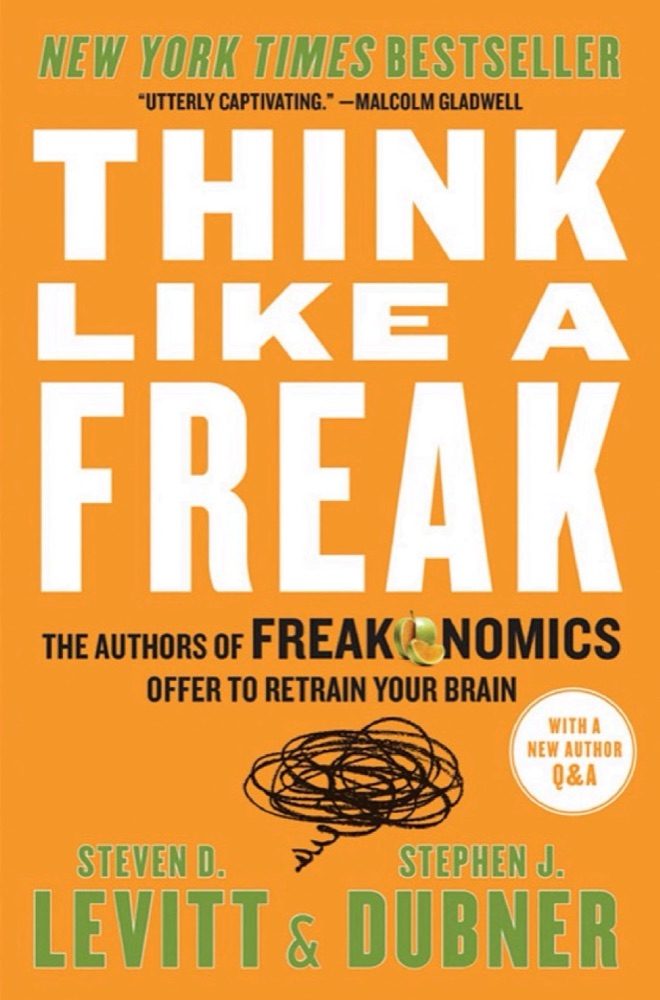 Think Like a Freak