
 Quicksilver
Quotes from the Book
I use emacs, which might be thought of as a thermonuclear word processor.
14
A few dud universes can really clutter up your basement.
14
What would the engineer say, after you had explained your problem and enumerated all of the dissastisfactions in your life? He would probably tell you that life is a very hard and complicated thing; that no interface can change that; that anyone who believes otherwise is a sucker; and that if you don’t like having choices made for you, you should start making your own.
5
Hacker with Bullhorn: "Save your money! Accept one of our free tanks! It is invulnerable, and can drive across rocks and swamps at ninety miles an hour while getting a hundred miles to the gallon!" Prospective Station Wagon Buyer: "I know what you say is true...but...er...I don't know how to maintain a tank!" Bullhorn: "You don't know how to maintain a station wagon either!" Buyer: "But this dealership has mechanics on staff. If something goes wrong with my station wagon, I can take a day off work, bring it here, and pay them to work on it while I sit in the waiting room for hours, listening to elevator music." Bullhorn: "But if you accept one of our free tanks, we will send volunteers to your house to fix it for free while you sleep!" Buyer: "Stay away from my house, you freak!
3
think that the message is very clear here: somewhere outside of and beyond our universe is an operating system, coded up over incalculable spans of time by some kind of hacker-demiurge. The cosmic operating system uses a command line interface. It runs on something like a teletype, with lots of noise and heat; punched-out bits flutter down into its hopper like drifting stars. The demiurge sits at his teletype, pounding out one command line after another, specifying the values of fundamental constants of physics: universe -G 6.672e-11 -e 1.602e-19 -h 6.626e-34 -protonmass 1.673e-27…. and when he’s finished typing out the command line, his right pinky hesitates above the enter key for an aeon or two, wondering what’s going to happen; then down it comes—and the whack you hear is another Big Bang.
1
If Microsoft ever makes a software package that I use and like, then it really will be time to dump their stock, because I am a market segment of one.
1
The ability to make judgments, to believe things, is the entire point of having a culture. I
1
Humans are conversant in many media (music, dance, painting), but all of them are analog except for the written word, which is naturally expressed in digital form (i.e. it is a series of discrete symbols—every letter in every book is a member of a certain character set, every “a” is the same as every other “a,” and so on). As any communications engineer can tell you, digital signals are much better to work with than analog ones because they are easily copied, transmitted, and error-checked. Unlike analog signals, they are not doomed to degradation over time and distance. That
1
it comes out of the fact that during this century, intellectualism failed, and everyone knows it. In places like Russia and Germany, the common people agreed to loosen their grip on traditional folkways, mores, and religion, and let the intellectuals run with the ball, and they screwed everything up and turned the century into an abattoir. Those wordy intellectuals used to be merely tedious; now they seem kind of dangerous as well.
1
Disney and Apple/Microsoft are in the same business: short-circuiting laborious, explicit verbal communication with expensively designed interfaces. Disney is a sort of user interface unto itself—and more than just graphical. Let’s call it a Sensorial Interface. It can be applied to anything in the world, real or imagined, albeit at staggering expense.
1
The cathedral as a whole is awesome and stirring in spite, and possibly because, of the fact that we have no idea who built it. When we walk through it, we are communing not with individual stone carvers but with an entire culture.
1
Lewis Carroll and J. M. Barrie were very strange men, and such is the nature of the written word that their personal strangeness shines straight through all the layers of Disneyfication like X-rays through a wall. Probably
1
Americans’ preference for mediated experiences is obvious enough, and I’m not going to keep pounding it into the ground. I’m not even going to make snotty comments about it—after all, I was at Disney World as a paying customer. But it clearly relates to the colossal success of GUIs, and so I have to talk about it some. Disney does mediated experiences better than anyone. If they understood what OSes are, and why people use them, they could crush Microsoft in a year or two.
1
GUIs tend to impose a large overhead on every single piece of software, even the smallest, and this overhead completely changes the programming environment. Small utility programs are no longer worth writing. Their functions, instead, tend to get swallowed up into omnibus software packages.
1
Apple has always insisted on having a hardware monopoly, except for a brief period in the mid-1990s when they allowed clone-makers to compete with them, before subsequently putting them out of business. Macintosh hardware was, consequently, expensive. You didn’t open it up and fool around with it because doing so would void the warranty. In fact, the first Mac was specifically designed to be difficult to open—you needed a kit of exotic tools, which you could buy through little ads that began to appear in the back pages of magazines a few months after the Mac came out on the market. These ads always had a certain disreputable air about them, like pitches for lock-picking tools in the backs of lurid detective magazines.
1
A string of ones and zeroes was not a difficult thing for Bill Gates to distribute, once he’d thought of the idea. The hard part was selling it—reassuring customers that they were actually getting something in return for their money. Anyone who has ever bought a piece of software in a store has had the curiously deflating experience of taking the bright shrink-wrapped box home, tearing it open, finding that it’s ninety-five percent air, throwing away all the little cards, party favors, and bits of trash, and loading the disk into the computer. The end result (after you’ve lost the disk) is nothing except some images on a computer screen, and some capabilities that weren’t there before. Sometimes you don’t even have that—you have a string of error messages instead. But your money is definitely gone. Now we are almost accustomed to this, but twenty years ago it was a very dicey business proposition.
1
Why are we rejecting explicit word-based interfaces, and embracing graphical or sensorial ones—a trend that accounts for the success of both Microsoft and Disney? Part of it is simply that the world is very complicated now—much more complicated than the hunter-gatherer world that our brains evolved to cope with—and we simply can’t handle all of the details. We have to delegate. We have no choice but to trust some nameless artist at Disney or programmer at Apple or Microsoft to make a few choices for us, close off some options, and give us a conveniently packaged executive summary.
But it’s easy to find the whole environment a little creepy, because something is missing: the translation of all its content into clear explicit written words, the attribution of the ideas to specific people.
Rather than go see a real small town for free, he had paid money to see a pretend one, and rather than see it with the naked eye, he was watching it on television.
Arbitrage,” in the usual sense, means to make money by taking advantage of differences in the price of something between different markets. It is spatial, in other words, and hinges on the arbitrageur knowing what is going on simultaneously in different places. Microsoft is making money by taking advantage of differences in the price of technology in different times. Temporal arbitrage, if I may coin a phrase, hinges on the arbitrageur knowing what technologies people will pay money for next year, and how soon afterwards those same technologies will become free.
In his book The Life of the Cosmos, which everyone should read, Lee Smolin gives the best description I’ve ever read of how our universe emerged from an uncannily precise balancing of different fundamental constants. The mass of the proton, the strength of gravity, the range of the weak nuclear force, and a few dozen other fundamental constants completely determine what sort of universe will emerge from a Big Bang. If these values had been even slightly different, the universe would have been a vast ocean of tepid gas or a hot knot of plasma or some other basically uninteresting thing—a dud, in other words.
But most of them must have the wit to understand that phenomena like these are maddeningly unstable, and that there’s no telling what weird, seemingly inconsequential event might cause the system to shift into a radically different configuration.
Mindshare dominance is, in other words, a really odd sort of beast, something that the framers of our antitrust laws couldn’t possibly have imagined. It looks like one of these modern, wacky chaos-theory phenomena, a complexity thing, in which a whole lot of independent but connected entities (the world’s computer users), making decisions on their own, according to a few simple rules of thumb, generate a large phenomenon (total domination of the market by one company) that cannot be made sense of through any kind of rational analysis. Such phenomena are fraught with concealed tipping-points and all a-tangle with bizarre feedback loops, and cannot be understood; people who try, end up going crazy, forming crackpot theories, or becoming high-paid chaos-theory consultants.
Here, instead, the dominance is inside the minds of people who buy software. Microsoft has power because people believe it does. This power is very real. It makes lots of money. Judging from recent legal proceedings in both Washingtons, it would appear that this power and this money have inspired some very peculiar executives to come out and work for Microsoft, and that Bill Gates should have administered saliva tests to some of them before issuing them Microsoft ID cards. But this is not the sort of power that fits any normal definition of the word “monopoly,” and it’s not amenable to a legal fix. The courts may order Microsoft to do things differently. They might even split the company up. But they can’t really do anything about a mindshare monopoly, short of taking every man, woman, and child in the developed world and subjecting them to a lengthy brainwashing procedure.
But possession of this psychological high ground is different from a monopoly in any normal sense of that word, because here the dominance has nothing to do with technical performance or price. The old robber-baron monopolies were monopolies because they physically controlled means of production and/or distribution. But in the software business, the means of production is hackers typing code, and the means of distribution is the Internet, and no one is claiming that Microsoft controls those.
As I’ve explained, selling OSes for money is a basically untenable position, and the only way Apple and Microsoft can get away with it is by pursuing technological advancements as aggressively as they can, and by getting people to believe in, and to pay for, a particular image: in the case of Apple, that of the creative free thinker, and in the case of Microsoft, that of the respectable techno-bourgeois. Just like Disney, they’re making money from selling an interface, a magic mirror. It has to be polished and seamless, or else the whole illusion is ruined and the business plan vanishes like a mirage.
Joint stock corporations are wonderful inventions that have given us many excellent goods and services. They are good at many things. Admitting failure is not one of them. Hell, they can’t even admit minor shortcomings.
It is written in Lisp, which is the only computer language that is beautiful.
In trying to understand the Linux phenomenon, then, we have to look not to a single innovator but to a sort of bizarre Trinity: Linus Torvalds, Richard Stallman, and Bill Gates. Take away any of these three and Linux would not exist.
Watch on YouTube
About Neal Stephenson
We have collected 355 quotes from 14 books by Neal Stephenson on BookQuoters.
More about the author →
About the book
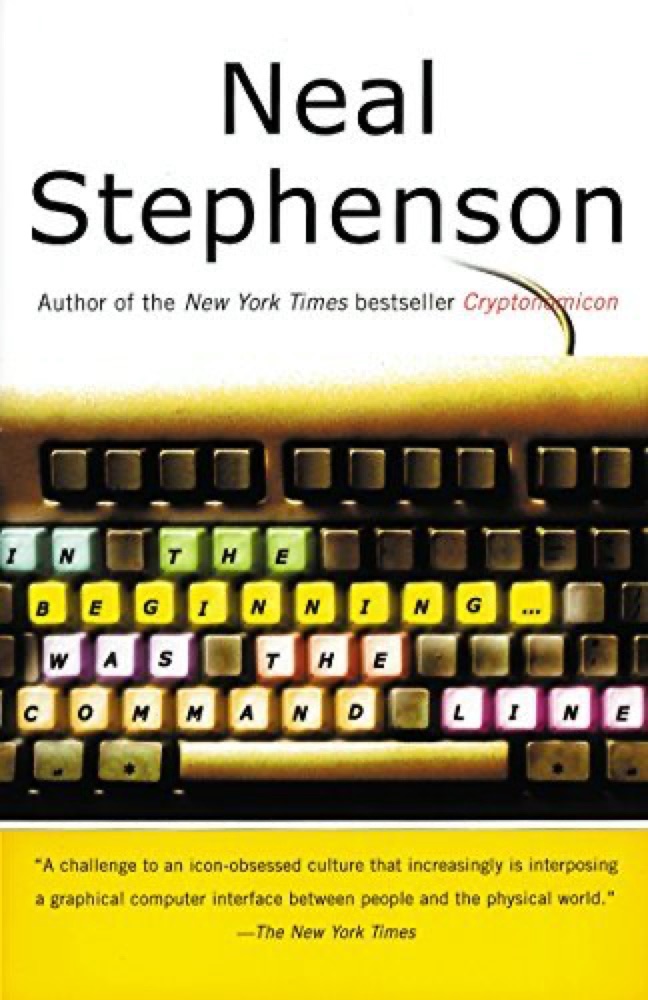
This is "the Word" -- one man's word, certainly -- about the art (and artifice) of the state of our computer-centric existence. And considering that the "one man" is Neal Stephenson, "the hacker Hemingway" (Newsweek) -- acclaimed novelist, pragmatist, seer, nerd-friendly philosopher, and nationally bestselling author of groundbreaking literary works (Snow Crash, Cryptonomicon, etc., etc.) -- the word is well worth hearing. Mostly well-reasoned examination and partial rant, Stephenson's In the Beginning... was the Command Line is a thoughtful, irreverent, hilarious treatise on the cyber-culture past and present; on operating system tyrannies and downloaded popular revolutions; on the Internet, Disney World, Big Bangs, not to mention the meaning of life itself.
Book details
- First published
- 1999
- Author
- Neal Stephenson
- Genre
- Nonfiction
- Goodreads rating
- 3.81 (8k ratings)
Keep reading
 Hackers & Painters: Big Ideas from the Computer Age
 Distrust That Particular Flavor
 You Are Not a Gadget
 Just for Fun: The Story of an Accidental Revolutionary
 Steve Jobs
 Chaos Monkeys: Obscene Fortune and Random Failure in Silicon Valley
 Cryptonomicon
 The Salmon of Doubt
 The Futurological Congress: From the Memoirs of Ijon Tichy
 Who Owns the Future?
 The Most Human Human: What Talking with Computers Teaches Us About What It Means to Be Alive
 Founders at Work: Stories of Startups' Early Days
 Fall; or, Dodge in Hell
 Gödel, Escher, Bach: An Eternal Golden Braid
 The Soul of a New Machine
 The New New Thing: A Silicon Valley Story
 The State of the Art
 A Slip of the Keyboard: Collected Non-Fiction
 Bleeding Edge
 Microserfs
 Makers
 Little Brother
 Managing Humans: Biting and Humorous Tales of a Software Engineering Manager
 Echopraxia
 The World Is Flat: A Brief History of the Twenty-first Century
 Invent and Wander: The Collected Writings of Jeff Bezos
 The Wave in the Mind: Talks and Essays on the Writer, the Reader and the Imagination
 Wired
Wired
 The Ultimate Hitchhiker's Guide
 Understanding Media: The Extensions of Man
 Half Asleep in Frog Pajamas
 Eating the Dinosaur
 The Information: A History, a Theory, a Flood
 Humble Pi: A Comedy of Maths Errors
 The Rise and Fall of D.O.D.O.
 The Lost World
 Prey
Prey
 Bicycle Diaries
 Idea Man
 The Art of Thinking Clearly
 The Innovators: How a Group of Hackers, Geniuses and Geeks Created the Digital Revolution
 The Ghost
 Hit Makers: The Science of Popularity in an Age of Distraction
 Gnomon
 Wampeters, Foma and Granfalloons
 What the Dog Saw and Other Adventures
 Homeland
 Invisible Planets: Contemporary Chinese Science Fiction in Translation
 Jurassic Park
 Maelstrom
 Math with Bad Drawings
 Burning Questions: Essays and Occasional Pieces, 2004 to 2021
 Zero to One: Notes on Startups, or How to Build the Future
 The Medium is the Massage
 Year Zero
 The Pragmatic Programmer: From Journeyman to Master
 I Hate the Internet
 Hocus Pocus
 Blueprints Of The Afterlife
 Arcadia