
 Strength in What Remains: A Journey of Remembrance and Forgiveness
Quotes from the Book
It became apparent that communications and computing served each other so intimately that they might actually become the same thing;
12
Yet it is a fact, not entirely lost on management consultants, that some people would rather work twelve hours a day of their own choosing than eight that are prescribed. Provided, of course, that the work is interesting. That was the main thing.
11
Part of the fascination,” he said, “is just little boys who never grew up, playing with Erector sets. Engineers just don’t lose that, and if you do lose it, you just can’t be an engineer anymore.
10
I think I wanted to see how complicated things happen,” West said years later. “There’s some notion of control, it seems to me, that you can derive in a world full of confusion if you at least understand how things get put together. Even if you can’t under stand every little part, how infernal machines get put together.
9
A YOUNG COMPUTER ENGINEER, known to be one of the most skillful in Westborough’s basement, said he had a fantasy about a better job than his. In it, he goes to work as a janitor for a computer company whose designs leave much to be desired. There, at night, disguised by mop and broom, he sneaks into the offices of the company’s engineers and corrects the designs on their blackboards and desks.
8
Above all, Rasala wanted around him engineers who took an interest in the entire computer, not just in the parts that they had designed.
8
a professor of computer science at MIT named Joseph Weizenbaum writes of a malady he calls “the compulsion to program.” He describes the afflicted as “bright young men of disheveled appearance, often with sunken, glowing eyes,” who play out “megalomaniacal fantasies of omnipotence” at computer consoles; they sit at their machines, he writes, “their arms tensed and waiting to fire their fingers, already poised to strike, at the buttons and keys on which their attention seems to be as riveted as a gambler’s on the rolling dice.
7
Executives might make the final decisions about what would be produced, but engineers would provide most of the ideas for new products. After all, engineers were the people who really knew the state of the art and who were therefore best equipped to prophesy changes in it.
7
IBM and other mainframe companies spent more money selling their products and serving their customers than they did in actually building their machines. They sold their computers to people who were actually going to use them, not to middlemen, and this market required good manners. Microcomputer companies sold equipment as if it were corn, in large quantities; they spent most of their money making things and competed not by being polite but by being aggressive.
7
In the early days, computers inspired widespread awe and the popular press dubbed them giant brains. In fact, the computer’s power resembled that of a bulldozer; it did not harness subtlety, though subtlety went into its design.
7
No one keeps track of the hours we work,” said Ken Holberger. He grinned. “That’s not altruism on Data General’s part. If anybody kept track, they’d have to pay us a hell of a lot more than they do.” Yet it is a fact, not entirely lost on management consultants, that some people would rather work twelve hours a day of their own choosing than eight that are prescribed. Provided, of course, that the work is interesting. That was the main thing.
6
He liked the “casual” look of the basement of Westborough. “The jeans and so on.” Several talked about their “flexible hours.” “No one keeps track of the hours we work,” said Ken Holberger. He grinned. “That’s not altruism on Data General’s part. If anybody kept track, they’d have to pay us a hell of a lot more than they do.” Yet it is a fact, not entirely lost on management consultants, that some people would rather work twelve hours a day of their own choosing than eight that are prescribed. Provided, of course, that the work is interesting. That was the main thing.
6
It was the sort of work that gave meaning to life.
5
A great deal has been written on the question of how to motivate industrial workers. Presumably such literature arises because so many jobs have been made so trivial that few people can find any meaning at all in them.
5
The little room was a forest of equipment now. A couple of months had passed since Eagle had been cloned. Rasala had named the two new prototypes Tartis and Gallifrey, after the home planet and time machine of Dr. Who, the protagonist of a science fiction show on public TV. The two new machines were the first to run with the normal, full-speed 220-nanosecond clock. Like Dr. Who, Rasala explained, the purpose of these new prototypes was “to conquer time.” Mag tapes were spinning. There were disk drives everywhere.
5
When the veterans in the group were growing up, computers were quite rare and expensive, but Veres went to school in the age when anyone with a little money and skill could make up a small personal system. Veres says that what he does at home is different enough from what he does at work to serve as recreation for him. At work he deals with hardware; when he’s at home, he focuses on software—reading programming manuals and creating new software for his own computer.
5
About ten other young, male undergraduates regularly attended these sessions of midnight programming. “It was a whole subculture. It’s been popularized now, but it was a secret cult in my days,” said Alsing. “The game of programming—and it is a game—was so fascinating. We’d stay up all night and experience it. It really is like a drug, I think.” A few of his fellow midnight programmers began to ignore their girlfriends and eventually lost them for the sake of playing with the machine all night. Some started sleeping days and missed all their classes, thereby ruining their grades. Alsing and a few others flunked out of school.
5
Engineers want to produce something,” said Wallach. “I didn’t go to school for six years just to get a paycheck. I thought that if this is what engineering’s all about, the hell with it.” He went to night school, to get a master’s in business administration. “I was always looking for the buck. I’d get the M.B.A., go back to New York, and make some money,” he figured. But he didn’t really want to do that. He wanted to build computers.
5
One winter night, at his home, while he was stirring up the logs in his fireplace, he muttered, “Computers are irrelevant.” Building
5
In the sixties there was proposed a “National Data Bank,” which would, theoretically, improve the government’s efficiency by allowing agencies to share information. The fact that such a system could be abused did not mean it would be, proponents said; it could be constructed in such a way as to guarantee benign use. Nonsense, said opponents, who managed to block the proposal; no matter what the intent or the safeguards, the existence of such a system would inevitably lead toward the creation of a police state.
5
Several talked about their “flexible hours.” “No one keeps track of the hours we work,” said Ken Holberger. He grinned. “That’s not altruism on Data General’s part. If anybody kept track, they’d have to pay us a hell of a lot more than they do.” Yet it is a fact, not entirely lost on management consultants, that some people would rather work twelve hours a day of their own choosing than eight that are prescribed. Provided, of course, that the work is interesting.
5
Looking into the VAX, West had imagined he saw a diagram of DEC’s corporate organization. He felt that VAX was too complicated. He did not like, for instance, the system by which various parts of the machine communicated with each other; for his taste, there was too much protocol involved. He decided that VAX embodied flaws in DEC’s corporate organization. The machine expressed that phenomenally successful company’s cautious, bureaucratic style. Was this true? West said it didn’t matter, it was a useful theory.
4
Because if you’re going to make a small inexpensive computer you have to sell a lot of them to make a lot of money. And we intend to make a lot of money.
4
When you burn out, you lose enthusiasm. I always loved computers. All of a sudden I just didn’t care. It was, all of a sudden, a job.
4
Often, they said, it is the most talented engineers who have the hardest time learning when to stop striving for perfection. West
4
Adopting a remote, managerial point of view, you could say that the Eagle project was a case where a local system of management worked as it should: competition for resources creating within a team inside a company an entrepreneurial spirit, which was channeled in the right direction by constraints sent down from the top. But it seems more accurate to say that a group of engineers got excited about building a computer.
4
Much of the engineering of computers takes place in silence, while engineers pace in hallways or sit alone and gaze at blank pages.
4
On the contrary, a company was more likely to asphyxiate on its own success.
4
Watch on YouTube
About Tracy Kidder
We have collected 60 quotes from 3 books by Tracy Kidder on BookQuoters.
More about the author →More by Tracy Kidder
Strength in What Remains: A Journey of Remembrance and Forgiveness
 Mountains Beyond Mountains: The Quest of Dr. Paul Farmer, A Man Who Would Cure the World
About the book
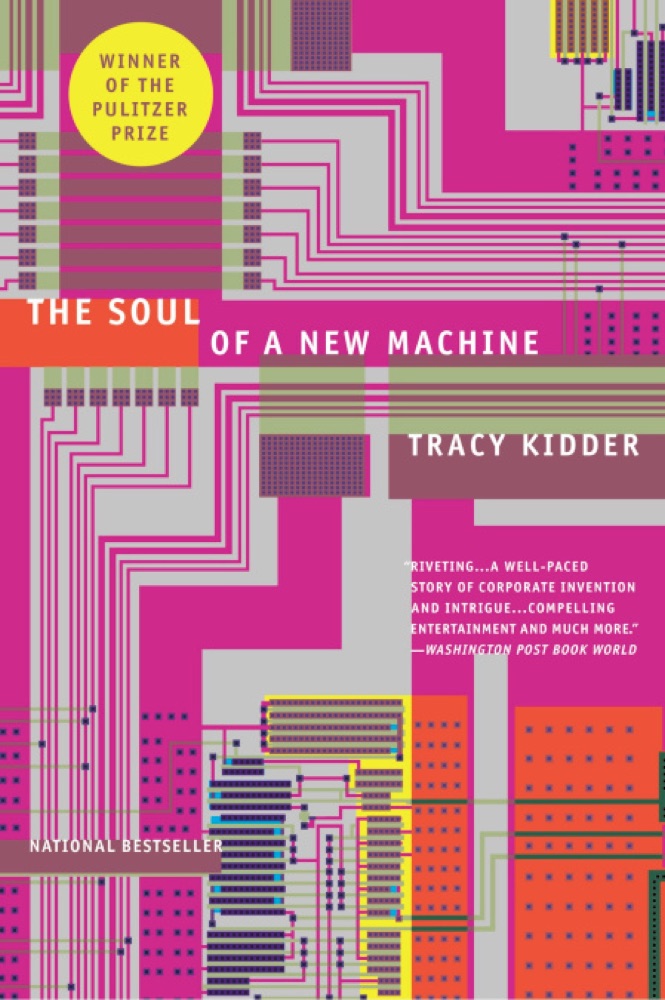
The computer revolution brought with it new methods of getting work done—just look at today's news for reports of hard-driven, highly-motivated young software and online commerce developers who sacrifice evenings and weekends to meet impossible deadlines. Tracy Kidder got a preview of this world in the late 1970s when he observed the engineers of Data General design and build a new 32-bit minicomputer in just one year. His thoughtful, prescient book, The Soul of a New Machine, tells stories of 35-year-old "veteran" engineers hiring recent college graduates and encouraging them to work harder and faster on complex and difficult projects, exploiting the youngsters' ignorance of normal scheduling processes while engendering a new kind of work ethic.
These days, we are used to the "total commitment" philosophy of managing technical creation, but Kidder was surprised and even a little alar
Book details
- First published
- 1981
- Author
- Tracy Kidder
- Genre
- Nonfiction
- Goodreads rating
- 4.12 (10k ratings)
Keep reading
 The New New Thing: A Silicon Valley Story
 Hackers & Painters: Big Ideas from the Computer Age
 The Innovators: How a Group of Hackers, Geniuses and Geeks Created the Digital Revolution
 In the Beginning...Was the Command Line
 Founders at Work: Stories of Startups' Early Days
 Hackers: Heroes of the Computer Revolution
 Managing Humans: Biting and Humorous Tales of a Software Engineering Manager
 Chaos Monkeys: Obscene Fortune and Random Failure in Silicon Valley
 Software Engineering at Google: Lessons Learned from Programming Over Time
 Peopleware: Productive Projects and Teams
 Steve Jobs: The Man Who Thought Different: A Biography
 Prey
Prey
 Becoming Steve Jobs: The Evolution of a Reckless Upstart into a Visionary Leader
 Pragmatic Thinking and Learning: Refactor Your Wetware
 Uncanny Valley
 I, Steve: Steve Jobs In His Own Words
 Smartcuts: How Hackers, Innovators, and Icons Accelerate Success
 Distrust That Particular Flavor
 Elon Musk
 Loonshots: How to Nurture the Crazy Ideas That Win Wars, Cure Diseases, and Transform Industries
 Steve Jobs
 Player Piano
 Invent and Wander: The Collected Writings of Jeff Bezos
 Shop Class as Soulcraft: An Inquiry Into the Value of Work
 Company
 The Pragmatic Programmer: From Journeyman to Master
 How We Got to Now: Six Innovations That Made the Modern World
 Cryptonomicon
 The Technological Republic: Hard Power, Soft Belief, and the Future of the West
 Makers
 Zero to One: Notes on Startups, or How to Build the Future
 The E-myth Revisited
 The World Is Flat: A Brief History of the Twenty-first Century
 Just for Fun: The Story of an Accidental Revolutionary
 Service Model
 Elon Musk: Inventing the Future
 A World Without Email: Reimagining Work in an Age of Communication Overload
 Fall; or, Dodge in Hell
 Lab Rats: How Silicon Valley Made Work Miserable for the Rest of Us
 Built to Last: Successful Habits of Visionary Companies
 Machine Man
 Idea Man
 Early Retirement Extreme: A Philosophical and Practical Guide to Financial Independence
 Hit Refresh: The Quest to Rediscover Microsoft's Soul and Imagine a Better Future for Everyone
 The Rhesus Chart
 Physics of the Future: How Science Will Shape Human Destiny and Our Daily Lives by the Year 2100
 The Pleasures and Sorrows of Work
 Adapt: Why Success Always Starts with Failure
 Sid Meier's Memoir!: A Life in Computer Games
 The Pentagon's Brain
 Where Good Ideas Come From: The Natural History of Innovation
 You Are Not a Gadget
 The Undoing Project: A Friendship That Changed Our Minds
 Machines like Me
 Bullshit Jobs: A Theory
 Pour Your Heart Into It: How Starbucks Built a Company One Cup at a Time
 Bellwether
 Humble Pi: A Comedy of Maths Errors
 The Most Human Human: What Talking with Computers Teaches Us About What It Means to Be Alive
 A Whole New Mind: Why Right-Brainers Will Rule the Future