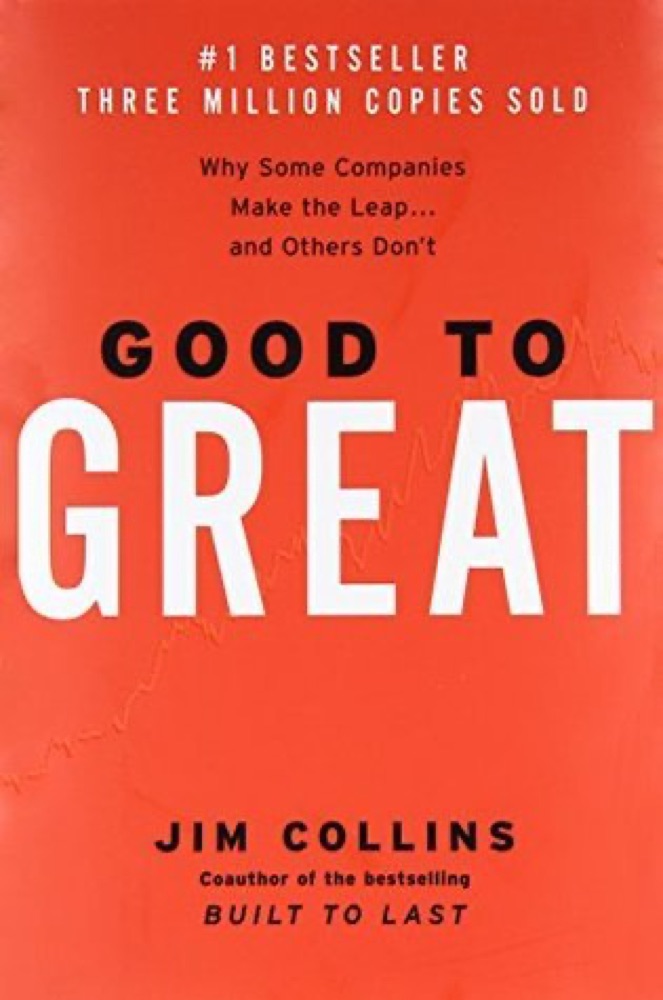
 Good to Great: Why Some Companies Make the Leap... and Others Don't
Quotes from the Book
ZERO TO ONE EVERY MOMENT IN BUSINESS happens only once. The next Bill Gates will not build an operating system. The next Larry Page or Sergey Brin won’t make a search engine. And the next Mark Zuckerberg won’t create a social network. If you are copying these guys, you aren’t learning from them.
151
The best entrepreneurs know this: every great business is built around a secret that’s hidden from the outside. A great company is a conspiracy to change the world; when you share your secret, the recipient becomes a fellow conspirator.
125
Tolstoy opens Anna Karenina by observing: “All happy families are alike; each unhappy family is unhappy in its own way.” Business is the opposite. All happy companies are different: each one earns a monopoly by solving a unique problem. All failed companies are the same: they failed to escape competition.
106
What important truth do very few people agree with you on?
101
Elite students climb confidently until they reach a level of competition sufficiently intense to beat their dreams out of them. Higher education is the place where people who had big plans in high school get stuck in fierce rivalries with equally smart peers over conventional careers like management consulting and investment banking. For the privilege of being turned into conformists, students (or their families) pay hundreds of thousands of dollars in skyrocketing tuition that continues to outpace inflation. Why are we doing this to ourselves?
85
The most valuable businesses of coming decades will be built by entrepreneurs who seek to empower people rather than try to make them obsolete.
81
Monopoly is the condition of every successful business.
76
Madness is rare in individuals—but in groups, parties, nations, and ages it is the rule,
69
All failed companies are the same: they failed to escape competition.
67
In the most dysfunctional organizations, signaling that work is being done becomes a better strategy for career advancement than actually doing work (if this describes your company, you should quit now).
63
If your goal is to never make a mistake in your life, you shouldn’t look for secrets. The prospect of being lonely but right—dedicating your life to something that no one else believes in—is already hard. The prospect of being lonely and wrong can be unbearable.
59
Ralph Waldo Emerson captured this ethos when he wrote: “Shallow men believe in luck, believe in circumstances…. Strong men believe in cause and effect.
57
If your product requires advertising or salespeople to sell it, it’s not good enough: technology is primarily about product development, not distribution.
56
You should focus relentlessly on something you’re good at doing, but before that you must think hard about whether it will be valuable in the future.
54
Customers won’t care about any particular technology unless it solves a particular problem in a superior way. And if you can’t monopolize a unique solution for a small market, you’ll be stuck with vicious competition.
53
the single most powerful pattern I have noticed is that successful people find value in unexpected places, and they do this by thinking about business from first principles instead of formulas.
51
By the time a student gets to college, he's spent a decade curating a bewilderingly diverse resume to prepare for a completely unknowable future. Come what may, he's ready--for nothing in particular.
49
you’ve invented something new but you haven’t invented an effective way to sell it, you have a bad business—no matter how good the product.
40
moving first is a tactic, not a goal.
35
Every culture has a myth of decline from some golden age, and almost all peoples throughout history have been pessimists. Even today pessimism still dominates huge parts of the world. An indefinite pessimist looks out onto a bleak future, but he has no idea what to do about it. This describes Europe since the early 1970s, when the continent succumbed to undirected bureaucratic drift. Today the whole Eurozone is in slow-motion crisis, and nobody is in charge. The European Central Bank doesn’t stand for anything but improvisation: the U.S. Treasury prints “In God We Trust” on the dollar; the ECB might as well print “Kick the Can Down the Road” on the euro. Europeans just react to events as they happen and hope things don’t get worse.
35
The best projects are likely to be overlooked, not trumpeted by a crowd; the best problems to work on are often the ones nobody else even tries to solve.
34
CREATIVE MONOPOLY means new products that benefit everybody and sustainable profits for the creator. Competition means no profits for anybody, no meaningful differentiation, and a struggle for survival.
33
Instead of pursuing many-sided mediocrity and calling it “well-roundedness,” a definite person determines the one best thing to do and then does it.
28
Most of a tech company’s value will come at least 10 to 15 years in the future.
28
Unless you have perfectly conventional beliefs, it’s rarely a good idea to tell everybody everything that you know.
26
When Yahoo! offered to buy Facebook for $1 billion in July 2006, I thought we should at least consider it. But Mark Zuckerberg walked into the board meeting and announced: “Okay, guys, this is just a formality, it shouldn’t take more than 10 minutes. We’re obviously not going to sell here.” Mark saw where he could take the company, and Yahoo! didn’t.
26
All Rhodes Scholars had a great future in their past.
26
Even in engineering-driven Silicon Valley, the buzzwords of the moment call for building a “lean startup” that can “adapt” and “evolve” to an ever-changing environment. Would-be entrepreneurs are told that nothing can be known in advance: we’re supposed to listen to what customers say they want, make nothing more than a “minimum viable product,” and iterate our way to success. But leanness is a methodology, not a goal. Making small changes to things that already exist might lead you to a local maximum, but it won’t help you find the global maximum. You could build the best version of an app that lets people order toilet paper from their iPhone. But iteration without a bold plan won’t take you from 0 to 1. A company is the strangest place of all for an indefinite optimist: why should you expect your own business to succeed without a plan to make it happen? Darwinism may be a fine theory in other contexts, but in startups, intelligent design works best.
25
In a world of scarce resources, globalization without new technology is unsustainable.
24
That’s why hiring consultants doesn’t work. Part-time employees don’t work. Even working remotely should be avoided, because misalignment can creep in whenever colleagues aren’t together full-time, in the same place, every day. If you’re deciding whether to bring someone on board, the decision is binary. Ken Kesey was right: you’re either on the bus or off the bus.
22
Did you know?
- The book is a condensed and updated version of class notes Blake Masters took as a student in Peter Thiel's CS183 startup course at Stanford in spring 2012.
- Its title refers to Thiel's distinction between creating something new (0 to 1) and copying things that already work (1 to n).
- It opens around Thiel's favorite contrarian interview question: 'What important truth do very few people agree with you on?'
- Thiel argues that successful startups should aim to build monopolies through unique value rather than compete in crowded markets.
- It was first published by Crown Business on September 16, 2014.
About Peter Thiel
About the book
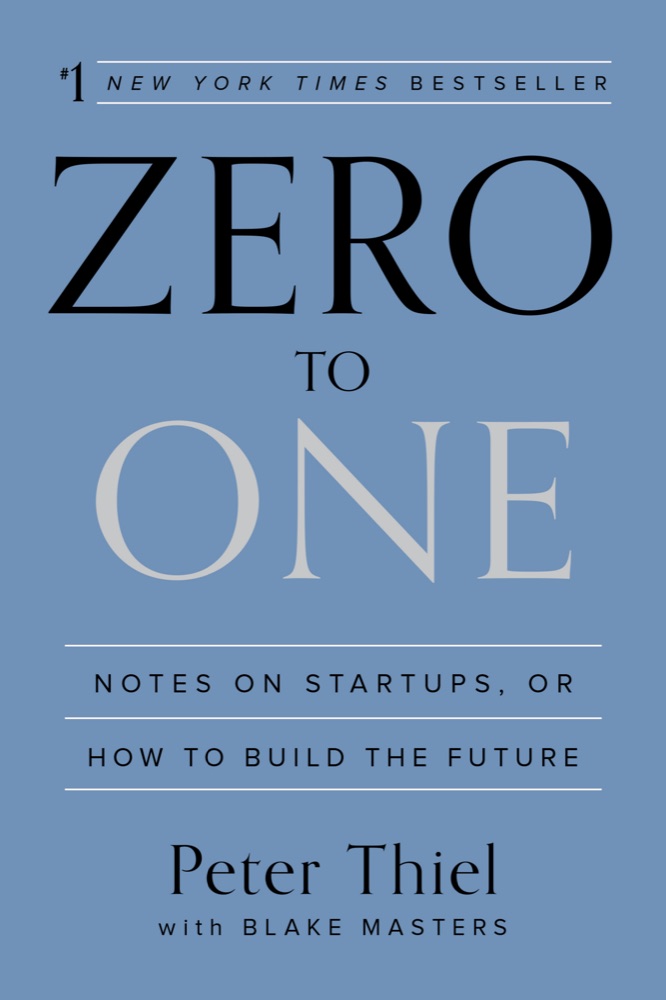
Zero to One: Notes on Startups, or How to Build the Future is a 2014 book by entrepreneur and investor Peter Thiel, co-written with Blake Masters. It grew out of a set of online notes that Masters took as a student in Thiel's CS183 startup course at Stanford in spring 2012, later condensed and updated into book form. Its central argument is that real progress comes from creating something genuinely new (going from 0 to 1) rather than copying what already works and merely improving on it incrementally (going from 1 to n).
Thiel frames the book around a contrarian interview question he favors: 'What important truth do very few people agree with you on?' From that starting point he develops his core themes, arguing that successful startups aim to build durable monopolies through unique, proprietary value rather than competing in crowded markets, and distinguishing between 'definite' and 'indefinite' optimism about the future. He stresses the importance of uncovering 'secrets', important truths that others overlook, and of thinking independently rather than following conventional wisdom.
The book became a bestseller and a widely cited text in the startup and tech communities. Reception was mixed but largely favorable: Derek Thompson of The Atlantic praised it as among the best business books he had read for its articulation of capitalism and innovation, while critics such as Timothy B. Lee at Vox argued that some of its advice was more conventional than its contrarian framing suggested. It remains one of the most influential popular books on entrepreneurship from the 2010s.
Book details
- First published
- 2014
- Length
- 224 pages
- Reading time
- 3 hours
- Author
- Peter Thiel
- Genre
- Nonfiction
- Goodreads rating
- 4.14 (412k ratings)
Critical reception
- Became a New York Times bestseller and a widely read text in startup and tech circles.
- Derek Thompson of The Atlantic praised it as among the best business books he had read.
- Timothy B. Lee of Vox argued some of its advice was more conventional than its contrarian framing implied.
Keep reading
Good to Great: Why Some Companies Make the Leap... and Others Don't
 Built to Last: Successful Habits of Visionary Companies
 Smartcuts: How Hackers, Innovators, and Icons Accelerate Success
 Founders at Work: Stories of Startups' Early Days
 Hackers & Painters: Big Ideas from the Computer Age
 Chaos Monkeys: Obscene Fortune and Random Failure in Silicon Valley
 The E-myth Revisited
 The Art of the Start: The Time-Tested, Battle-Hardened Guide for Anyone Starting Anything
 The Hard Thing About Hard Things: Building a Business When There Are No Easy Answers―Straight Talk on the Challenges of Entrepreneurship
 Amp It Up: Leading for Hypergrowth by Raising Expectations, Increasing Urgency, and Elevating Intensity
 The Startup of You: Adapt to the Future, Invest in Yourself, and Transform Your Career
 Invent and Wander: The Collected Writings of Jeff Bezos
 The Monk and the Riddle: The Education of a Silicon Valley Entrepreneur
 Blue Ocean Strategy: How to Create Uncontested Market Space and Make the Competition Irrelevant
 Same as Ever: A Guide to What Never Changes
 Pour Your Heart Into It: How Starbucks Built a Company One Cup at a Time
 The Lean Startup
 Barking Up the Wrong Tree: The Surprising Science Behind Why Everything You Know About Success Is (Mostly) Wrong
 The 1-Page Marketing Plan: Get New Customers, Make More Money, And Stand out From The Crowd
 Things a Little Bird Told Me: Confessions of the Creative Mind
 The Price of Tomorrow: Why Deflation is the Key to an Abundant Future
 The Innovator's Solution: Creating and Sustaining Successful Growth
 Conscious Capitalism
 Creativity, Inc.: Overcoming the Unseen Forces That Stand in the Way of True Inspiration
 Your Next Five Moves: Master the Art of Business Strategy
 Getting There: A Book of Mentors
 Think Like a Freak
 The World Is Flat: A Brief History of the Twenty-first Century
 Great by Choice: Uncertainty, Chaos, and Luck—Why Some Thrive Despite Them All
 EntreLeadership: 20 Years of Practical Business Wisdom from the Trenches
 Rework
 The $100 Startup: Reinvent the Way You Make a Living, Do What You Love, and Create a New Future
 The Art of Thinking Clearly
 Principles: Life and Work
 The Ride of a Lifetime: Lessons Learned from 15 Years as CEO of the Walt Disney Company
 The Halo Effect: ... and the Eight Other Business Delusions That Deceive Managers
 The 80/20 Principle: The Secret to Achieving More with Less
 Becoming Steve Jobs: The Evolution of a Reckless Upstart into a Visionary Leader
 Think Like a Rocket Scientist: Simple Strategies You Can Use to Make Giant Leaps in Work and Life
 Hit Refresh: The Quest to Rediscover Microsoft's Soul and Imagine a Better Future for Everyone
 How To Get Rich
 Originals: How Non-Conformists Move the World
 How to Fail at Almost Everything and Still Win Big: Kind of the Story of My Life
 Stay Hungry Stay Foolish
 Lean Analytics: Use Data to Build a Better Startup Faster
 Who Owns the Future?
 The Art of Startup Fundraising
 Delivering Happiness: A Path to Profits, Passion, and Purpose
 Adapt: Why Success Always Starts with Failure
 The Dip: A Little Book That Teaches You When to Quit (and When to Stick)
 The Leader Who Had No Title: A Modern Fable on Real Success in Business and in Life
 Managing Humans: Biting and Humorous Tales of a Software Engineering Manager
 Winning
 The Art of Creative Thinking
 The Fifth Discipline: The Art & Practice of The Learning Organization
 The Everything Store: Jeff Bezos and the Age of Amazon
 The Success Principles: How to Get from Where You Are to Where You Want to Be
 Making Ideas Happen: Overcoming the Obstacles Between Vision and Reality
 The Millionaire Fastlane: Crack the Code to Wealth and Live Rich for a Lifetime!
 The Algebra of Wealth: A Simple Formula for Financial Security