
 Drive: The Surprising Truth About What Motivates Us
Quotes from the Book
I say, 'Get me some poets as managers.' Poets are our original systems thinkers. They contemplate the world in which we live and feel obligated to interpret, and give expression to it in a way that makes the reader understand how that world runs. Poets, those unheralded systems thinkers, are our true digital thinkers. It is from their midst that I believe we will draw tomorrow's new business leaders." --Sidney Harman, CEO Multimillionaire of a stereo components company
27
Asking “Why?” can lead to understanding. Asking “Why not?” can lead to breakthroughs.
21
change is inevitable, and when it happens, the wisest response is not to wail or whine but to suck it up and deal with it.
18
Leadership is about empathy. It is about having the ability to relate and to connect with people for the purpose of inspiring and empowering their lives.
17
Empathy is an essential part of living a life of meaning.
13
Good design is a renaissance attitude that combines technology, cognitive science, human need, and beauty to produce something that the world didn’t know it was missing.” —PAOLA ANTONELLI, curator of architecture and design, Museum of Modern Art
12
We are moving from an economy and a society built on the logical, linear, computerlike capabilities of the Information Age to an economy and a society built on the inventive, empathic, big-picture capabilities of what’s rising in its place, the Conceptual Age.
9
A calling is the most satisfying form of work because, as gratification, it is done for its own sake rather than for the material benefits it brings,
6
A genuine smile involves two facial muscles: (1) the zygomatic major muscle, which stretches from the cheekbone and lifts the corners of the mouth; and (2) the outer part of the obicularis oculi muscle, which orbits the eye, and is involved in “pulling down the eyebrows and the skin below the eyebrows, pulling up the skin below the eye, and raising the cheeks.”7 Artificial smiles involve only the zygomatic major.
6
The Queen died. The King died.” “The Queen died. And the King died of a broken heart.” The first line was fact. The second line was a story. It placed the facts in context, added emotion and made us connect to it by making it memorable.
5
The future belongs to a very different kind of person with a very different kind of mind—creators and empathizers, pattern recognizers, and meaning makers.
5
Here’s Ohga: “At Sony, we assume that all products of our competitors have basically the same technology, price, performance, and features. Design is the only thing that differentiates one product from another in the marketplace.
4
Mastery of design, empathy, play, and other seemingly “soft” aptitudes is now the main way for individuals and firms to stand out in a crowded marketplace.
4
business writer Polly LaBarre notes, “The United States spends more on trash bags than ninety other countries spend on everything.
4
Metaphor is the lifeblood of all art.” —TWYLA THARP
3
The democratization of design has altered the competitive logic of businesses. Companies traditionally have competed on price or quality, or some combination of the two. But today decent quality and reasonable price have become merely table stakes in the business game—the entry ticket for being allowed into the marketplace. Once companies satisfy those requirements, they are left to compete less on functional or financial qualities and more on ineffable qualities such as whimsy, beauty, and meaning.
2
Today, the defining skills of the previous era—the “left brain” capabilities that powered the Information Age—are necessary but no longer sufficient. And the capabilities we once disdained or thought frivolous—the “right-brain” qualities of inventiveness, empathy, joyfulness, and meaning—increasingly will determine who flourishes and who flounders.
2
He argues that “man’s main concern is not to gain pleasure or to avoid pain but rather to see a meaning in his life.”2 Our fundamental drive, the motivational engine that powers human existence, is the pursuit of meaning. Frankl’s approach—called “logotherapy,” for “logos,” the Greek word for meaning—quickly became an influential movement in psychotherapy.
1
All great entrepreneurs are Systems Thinkers. All who wish to become great entrepreneurs need to learn how to become a Systems Thinker…to develop their innate passion for seeing things whole.
1
Most inventions and breakthroughs come from reassembling existing ideas in new ways.
1
They have an intuitive sense of what I call the “Reese’s Peanut Butter Cup Theory of Innovation”: sometimes the most powerful ideas come from simply combining two existing ideas nobody else ever thought to unite.
1
Boundary crossers reject either/or choices and seek multiple options and blended solutions. They lead hyphenated lives filled with hyphenated jobs and enlivened by hyphenated identities.
1
Symphony, as I call this aptitude, is the ability to put together the pieces. It is the capacity to synthesize rather than to analyze; to see relationships between seemingly unrelated fields; to detect broad patterns rather than to deliver specific answers; and to invent something new by combining elements nobody else thought to pair. Symphony is also an attribute of the brain’s right hemisphere in the literal, as well as the metaphorical, sense. As I explained in Chapter 2, the neuroscience research conducted with functional MRIs has shown that the right hemisphere operates in a simultaneous, contextual, and symphonic manner. It concerns itself not with a particular spruce but with the whole forest—not with the bassoon player or the first violinist but with the entire orchestra.
1
To oversimplify just a bit, the left hemisphere handles what is said; the right hemisphere focuses on how it’s said—the nonverbal, often emotional cues delivered through gaze, facial expression, and intonation.
1
about 48 percent of GE’s software is developed in India.
1
Design—that is, utility enhanced by significance—has become an essential aptitude for personal fulfillment and professional success
1
humor represents one of the highest forms of human intelligence.
sorts, has reached similar conclusions: “All great entrepreneurs are Systems Thinkers. All who wish to become great entrepreneurs need to learn how to become a Systems Thinker…to develop their innate passion for seeing things whole.
Watch on YouTube
About Daniel H. Pink
We have collected 110 quotes from 4 books by Daniel H. Pink on BookQuoters.
More about the author →More by Daniel H. Pink
Drive: The Surprising Truth About What Motivates Us
 The Power of Regret: How Looking Backward Moves Us Forward
 To Sell is Human: The Surprising Truth About Moving Others
About the book
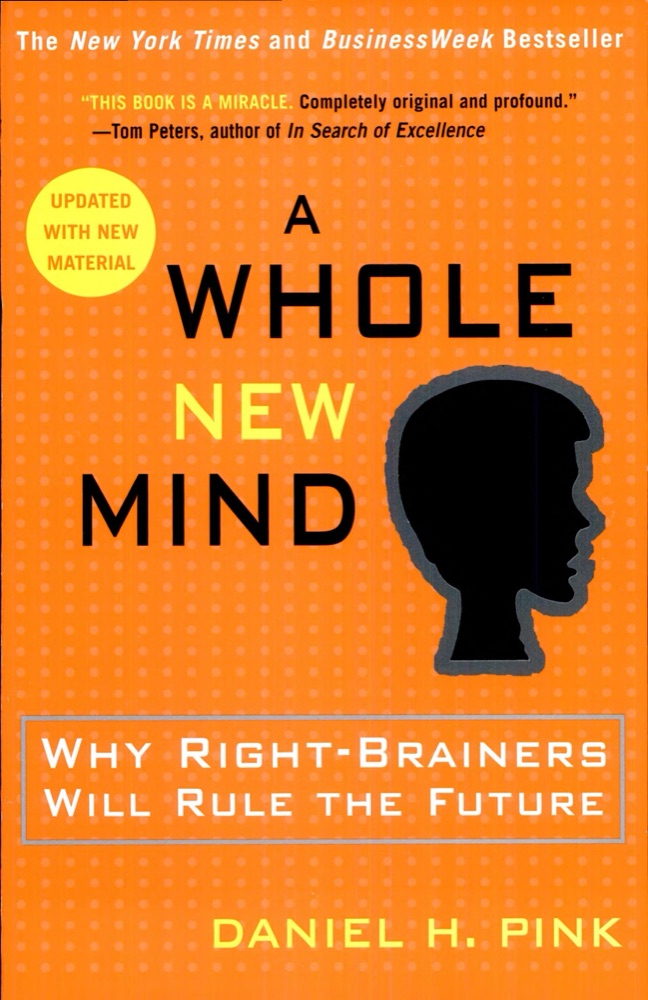
The future belongs to a different kind of person with a different kind of mind: artists, inventors, storytellers-creative and holistic "right-brain" thinkers whose abilities mark the fault line between who gets ahead and who doesn't.
Drawing on research from around the world, Pink (author of To Sell Is Human: The Surprising Truth About Motivating Others) outlines the six fundamentally human abilities that are absolute essentials for professional success and personal fulfillment--and reveals how to master them. A Whole New Mind takes readers to a daring new place, and a provocative and necessary new way of thinking about a future that's already here.
Book details
- First published
- 2004
- Author
- Daniel H. Pink
- Genre
- Nonfiction
- Goodreads rating
- 3.92 (30k ratings)
Keep reading
 The Art of Creative Thinking
 Emotional Design: Why We Love (or Hate) Everyday Things
 The Element: How Finding Your Passion Changes Everything
 Creativity: Flow and the Psychology of Discovery and Invention
 The Social Animal: The Hidden Sources of Love, Character, and Achievement
 Please Understand Me II: Temperament, Character, Intelligence
 Originals: How Non-Conformists Move the World
 Linchpin: Are You Indispensable?
 Smartcuts: How Hackers, Innovators, and Icons Accelerate Success
 Imagine: How Creativity Works
 Delivering Happiness: A Path to Profits, Passion, and Purpose
 Where Good Ideas Come From: The Natural History of Innovation
 Things a Little Bird Told Me: Confessions of the Creative Mind
 The Fifth Discipline: The Art & Practice of The Learning Organization
 The Medium is the Massage
 Mastery
 Shop Class as Soulcraft: An Inquiry Into the Value of Work
 The Art of Impossible: A Peak Performance Primer
 Hit Refresh: The Quest to Rediscover Microsoft's Soul and Imagine a Better Future for Everyone
 Conscious Capitalism
 Invent and Wander: The Collected Writings of Jeff Bezos
Drive: The Surprising Truth About What Motivates Us
Invent and Wander: The Collected Writings of Jeff Bezos
Drive: The Surprising Truth About What Motivates Us
 The Future of the Mind: The Scientific Quest to Understand, Enhance, and Empower the Mind
 The World Is Flat: A Brief History of the Twenty-first Century
 Chaos Monkeys: Obscene Fortune and Random Failure in Silicon Valley
 Smarter Faster Better: The Secrets of Being Productive in Life and Business
 Made to Stick: Why Some Ideas Survive and Others Die
 How to Fly a Horse: The Secret History of Creation, Invention, and Discovery
 The Innovators: How a Group of Hackers, Geniuses and Geeks Created the Digital Revolution
 From Bacteria to Bach and Back: The Evolution of Minds
 Talk Like TED: The 9 Public-Speaking Secrets of the World's Top Minds
 The Art of Thinking Clearly
 The 7 Habits of Highly Effective People: Personal Workbook
 The Geography of Genius: A Search for the World's Most Creative Places from Ancient Athens to Silicon Valley
 The E-myth Revisited
 Making Ideas Happen: Overcoming the Obstacles Between Vision and Reality
 Range: Why Generalists Triumph in a Specialized World
 The Tipping Point: How Little Things Can Make a Big Difference
 What Technology Wants
 Understanding Media: The Extensions of Man
 Social Intelligence: The New Science of Human Relationships
 The Happiness Hypothesis: Finding Modern Truth in Ancient Wisdom
 The New Drawing on the Right Side of the Brain
 Hackers & Painters: Big Ideas from the Computer Age
 Hit Makers: The Science of Popularity in an Age of Distraction
 Built to Last: Successful Habits of Visionary Companies
 Think Like a Rocket Scientist: Simple Strategies You Can Use to Make Giant Leaps in Work and Life
 Psych: The Story of the Human Mind
 The Elephant in the Brain: Hidden Motives in Everyday Life
 The Rise of Superman: Decoding the Science of Ultimate Human Performance
 The Master and His Emissary: The Divided Brain and the Making of the Western World
 The Icarus Deception: How High Will You Fly?
 The Pleasures and Sorrows of Work
 Curious: The Desire to Know and Why Your Future Depends On It
 Steve Jobs
 Barking Up the Wrong Tree: The Surprising Science Behind Why Everything You Know About Success Is (Mostly) Wrong
 Creative Quest
 The Ride of a Lifetime: Lessons Learned from 15 Years as CEO of the Walt Disney Company
 What the Dog Saw and Other Adventures