
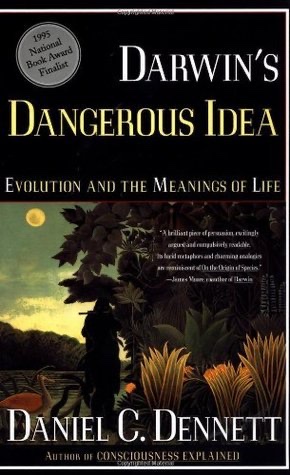
 Darwin's Dangerous Idea: Evolution and the Meanings of Life
Quotes from the Book
Darwin’s “strange inversion of reasoning” and Turing’s equally revolutionary inversion were aspects of a single discovery: competence without comprehension. Comprehension, far from being a Godlike talent from which all design must flow, is an emergent effect of systems of uncomprehending competence: natural selection on the one hand, and mindless computation on the other. These twin ideas have been proven beyond a reasonable doubt, but they still provoke dismay and disbelief in some quarters, which I have tried to dispel in this chapter. Creationists are not going to find commented code in the inner workings of organisms, and Cartesians are not going to find an immaterial res cogitans “where all the understanding happens".
10
That's a rhetorical question, and trying to answer rhetorical questions instead of being cowed by them is a good habit to cultivate.
9
Don’t be afraid of a little metaphor; it won’t bite you, but you should always make sure you know how to cash it in for unvarnished fact when you feel the urge.
7
Asked by a student for an example of infectious cultural junk that is hard to eradicate, I replied, "Well, it's like, when, like, you use a phrase which, like, isn't really, like, doing any serious work, but, like you go on, like, using it." To which the student replied, "I, like, understand the point, but I wanted, like, an example.
6
Perhaps we are just apes with brains being manipulated by memes in much the way we are manipulated by the cold virus. Instead of looking only at the prerequisite competences our ancestors needed to have in order for language to get under way, perhaps we should also consider unusual vulnerabilities that might make our ancestors the ideal hosts for infectious but nonvirulent habits (memes) that allowed us to live and stay mobile long enough for them to replicate through our populations.
5
We Homo sapiens are the only species (so far) with richly cumulative culture, and the key ingredient of culture that makes this possible is language.
4
If I burst into a house and yell to all assembled, “Put on the kettle!” I have uttered an imperative English sentence, but some will probably infer that I would like to have a cup of tea or other hot beverage, while another may further surmise that I feel myself at home here, and may in fact be the occupant of this house. Yet another person present, a monoglot Hungarian, may infer only that I speak English, and so does whomever I am addressing (well, it sounds like English to her), while somebody really in the know will be instantly informed that I have decided after all to steam open that sealed envelope and surreptitiously read the letter inside in spite of the fact that it isn’t addressed to me; a crime is about to be committed. What semantic information can be gleaned from the event depends on what information the gleaner already has accumulated. Learning that somebody speaks English can be a valuable update to your world knowledge, a design improvement that may someday pay big dividends.
4
The politicians, the judges, the bankers, the industrialists, the journalists, the professors—the leaders of our society, in short—are much more like the average motorist than you might like to think: doing their local bit to steer their part of the whole contraption, while blissfully ignorant of the complexities on which the whole system depends.
3
The Absolute Ignorance of evolution by natural selection is indeed capable of creating not just daisies and fish but also human beings who in turn have the competence to build cities and theories and poems and airplanes, and computers, which in turn could in principle achieve Artificial Intelligence with even higher levels of creative skill than their human creators.
3
As I have often noted, a wagon with spoked wheels doesn’t just carry grain or freight from place to place; it carries the brilliant idea of a wagon with spoked wheels. The
3
Competence without comprehension is the way of life of the vast majority of living things on the planet and should be the default presumption until we can demonstrate that some individual organisms really do, in one sense or another, understand what they are doing.
2
The real danger, I think, is not that machines more intelligent than we are will usurp our role as captains of our destinies, but that we will over-estimate the comprehension of our latest thinking tools, prematurely ceding authority to them far beyond their competence.
2
Words, I will argue, are the best example of memes, culturally transmitted items that evolve by differential replication—that is, by natural selection.
2
Over billions of years, on a unique sphere, chance has painted a thin covering of life—complex, improbable, wonderful and fragile. Suddenly we humans … have grown in population, technology, and intelligence to a position of terrible power: we now wield the paintbrush.
1
Evolution is all about turning "bugs" into "features," turning "noise" into "signal," and the fuzzy boundaries between these categories are not optional; the opportunistic open-endedness of natural selection depends on them.
1
Evolution is all about turning "bugs" into "features", turning "noise" into "signal", and the fuzzy boundaries between these categories are not optional; the opportunistic open-endedness of natural selection depends on them.
1
We applaud intelligent design in all arenas, and aspire from infancy to achieve recognition for our creations. Among artifacts we have created is the concept of God, the Intelligent Designer, in our own image. That's how much we value the intelligent designers in our societies.
1
The manifest image that has been cobbled together by genetic evolutionary processes over billions of years, and by cultural evolutionary processes over thousands of years, is an extremely sophisticated system of helpful metaphorical renderings of the underlying reality uncovered in the scientific image. It is a user-illusion that we are so adept at using that we take it to be unvarnished reality, when in fact it has many coats of intervening interpretive varnish on it.
1
Quantity isnt to be equated with quality, but success in propagation is, in the end, as necessary for memes (however excellent) as it is for organisms. Most organisms leave no issue, and most published books have readerships in the dozens, not thousands, before going out of print for good. Even the greatest works of genius must still pass the test of differential replication.
1
There is a general generous tendency to credit innovators with more prior comprehension than they actually deserve, and this helps perpetuate the myth of the Godlike powers of our famous geniuses, and by extension, to all of us.
1
The claim that I defend is that human culture started out profoundly Darwinian, with uncomprehending competences yielding various valuable structures in roughly the way termites build their castles, and then gradually de-Darwinized, becoming ever more efficient in its ways of searching Design Space. In short, as human culture evolved, it fed on the fruits of its own evolution, increasing its design powers by utilizing information in ever more powerful ways.
1
Comprehension is not the source of competence or the active ingredient in competence; comprehension is composed of competences.
1
What Darwin and Turing did was envisage the most extreme version of this point: all the brilliance and comprehension in the world arises ultimately out of uncomprehending competences compounded over time into ever more competent—and thus comprehending—systems.
1
It’s just that it would be nice to hear someone accidentally whistle something of mine, somewhere, just once.
1
IN ORDER TO BE A PERFECT AND BEAUTIFUL COMPUTING MACHINE, IT IS NOT REQUISITE TO KNOW WHAT ARITHMETIC IS.
1
does require anyone who makes the trip to abandon some precious intuitions, but I think that I have at last found ways of making the act of jettisoning these “obvious truths” not just bearable but even delightful: it turns your head inside out, in a way, yielding some striking new perspectives on what is going on.
1
Watch on YouTube
About Daniel C. Dennett
We have collected 82 quotes from 4 books by Daniel C. Dennett on BookQuoters.
More about the author →More by Daniel C. Dennett
Darwin's Dangerous Idea: Evolution and the Meanings of Life
 Freedom Evolves
 Breaking the Spell: Religion as a Natural Phenomenon
About the book
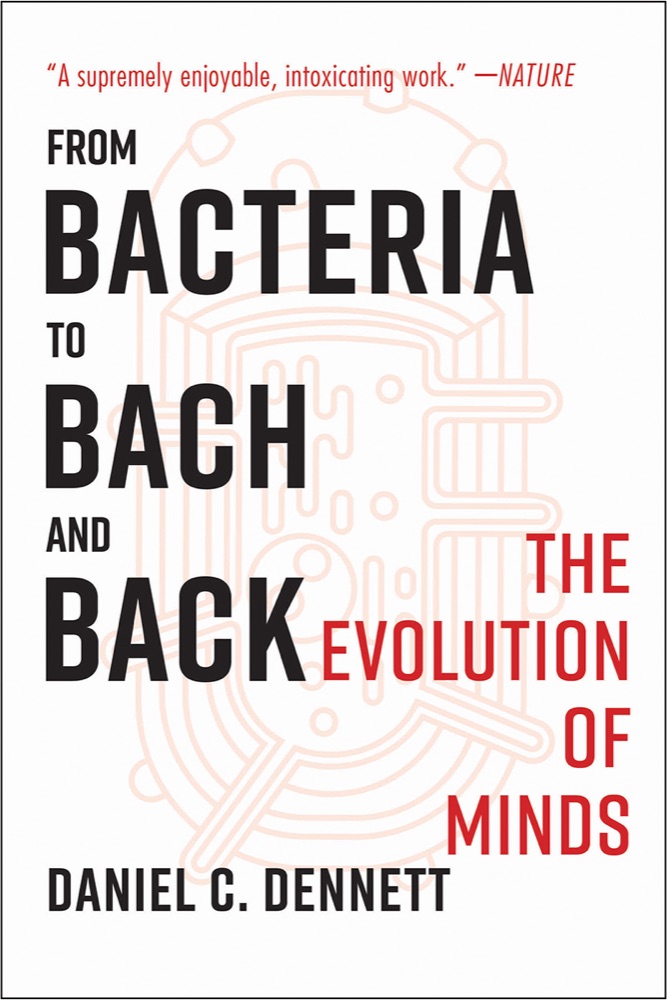
How did we come to have minds? For centuries, poets, philosophers, psychologists, and physicists have wondered how the human mind developed its unrivaled abilities. Disciples of Darwin have explained how natural selection produced plants, but what about the human mind?
In From Bacteria to Bach and Back, Daniel C. Dennett builds on recent discoveries from biology and computer science to show, step by step, how a comprehending mind could in fact have arisen from a mindless process of natural selection. A crucial shift occurred when humans developed the ability to share memes, or ways of doing things not based in genetic instinct. Competition among memes produced thinking tools powerful enough that our minds don’t just perceive and react, they create and comprehend.
An agenda-setting book for a new generation of philosophers and scientists, From Bacteria to Bach and Back will delight
Book details
- First published
- 2017
- Author
- Daniel C. Dennett
- Genre
- Nonfiction
- Goodreads rating
- 3.79 (4k ratings)
Keep reading
Darwin's Dangerous Idea: Evolution and the Meanings of Life
 How the Mind Works
 The Blind Watchmaker: Why the Evidence of Evolution Reveals a Universe Without Design
 The Tell-Tale Brain: A Neuroscientist's Quest for What Makes Us Human
 A Devil's Chaplain: Reflections on Hope, Lies, Science, and Love
 Dragons of Eden: Speculations on the Evolution of Human Intelligence
 Echopraxia
 The Information: A History, a Theory, a Flood
 The Ascent of Man
 The Big Picture: On the Origins of Life, Meaning, and the Universe Itself
 Superintelligence: Paths, Dangers, Strategies
 Are We Smart Enough to Know How Smart Animals Are?
 The Singularity is Near: When Humans Transcend Biology
 The Gene: An Intimate History
 The Lost World
 An Appetite for Wonder: The Making of a Scientist
 Undeniable: Evolution and the Science of Creation
 Consilience: The Unity of Knowledge
 The Code Breaker: Jennifer Doudna, Gene Editing, and the Future of the Human Race
 The Stuff of Thought: Language as a Window into Human Nature
 Curious: The Desire to Know and Why Your Future Depends On It
 The Social Animal: The Hidden Sources of Love, Character, and Achievement
 Understanding Media: The Extensions of Man
 The Future of the Mind: The Scientific Quest to Understand, Enhance, and Empower the Mind
 Shadows of Forgotten Ancestors
 The Master and His Emissary: The Divided Brain and the Making of the Western World
 A Hunter-Gatherer's Guide to the 21st Century: Evolution and the Challenges of Modern Life
 Genome
 The Case Against Reality: Why Evolution Hid the Truth from Our Eyes
 The Social Conquest of Earth
 What Technology Wants
 Where Good Ideas Come From: The Natural History of Innovation
 The Lives of a Cell: Notes of a Biology Watcher
 Gödel, Escher, Bach: An Eternal Golden Braid
 Life 3.0: Being Human in the Age of Artificial Intelligence
 God's Debris: A Thought Experiment
 Science and Sanity: An Introduction to Non-Aristotelian Systems and General Semantics
 A Thousand Brains: A New Theory of Intelligence
 The Origin of Consciousness in the Breakdown of the Bicameral Mind
 The Language Instinct: How the Mind Creates Language
 Genome: the Autobiography of a Species in 23 Chapters
Freedom Evolves
Genome: the Autobiography of a Species in 23 Chapters
Freedom Evolves
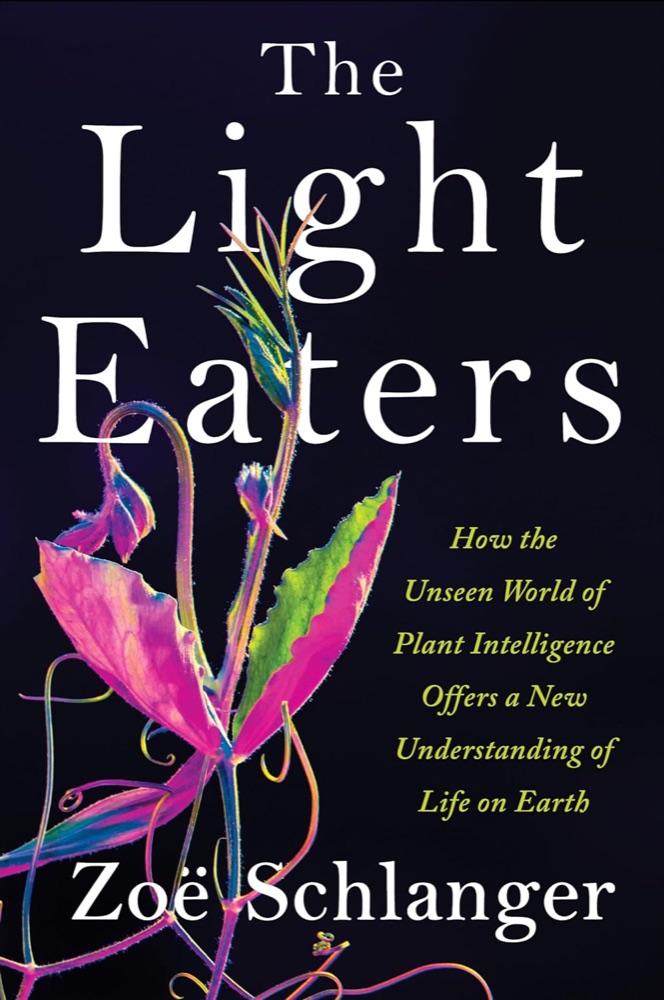 The Light Eaters: How the Unseen World of Plant Intelligence Offers a New Understanding of Life on Earth
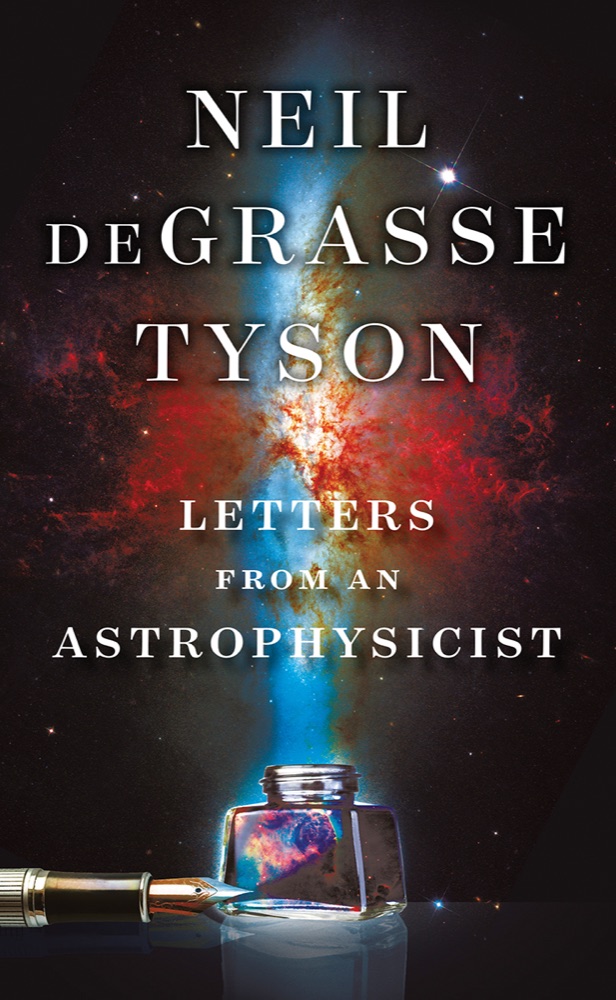 Letters from an Astrophysicist
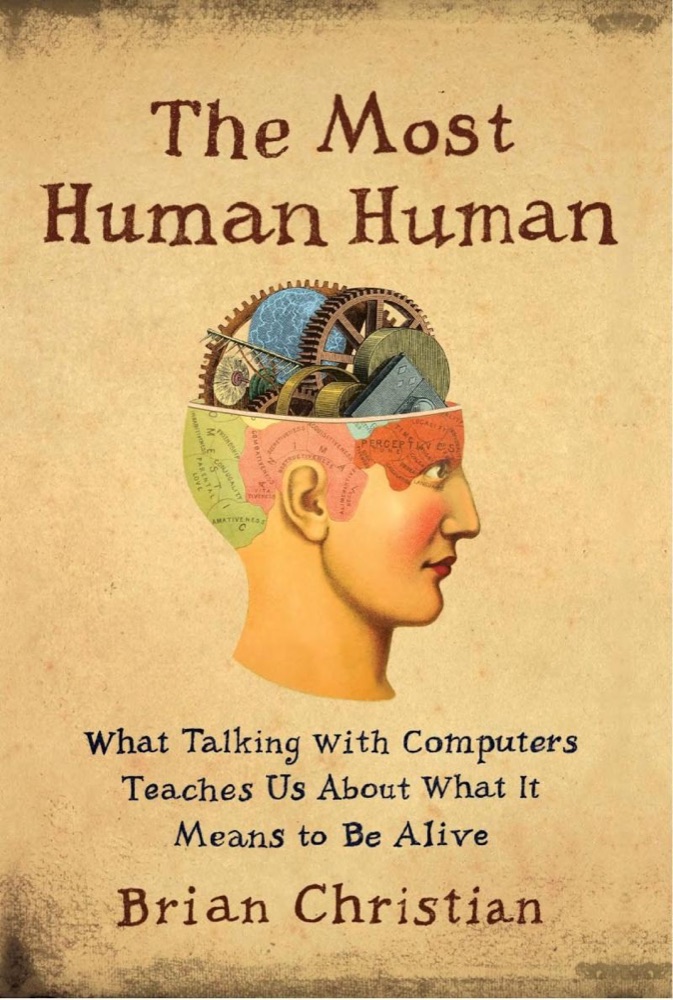 The Most Human Human: What Talking with Computers Teaches Us About What It Means to Be Alive
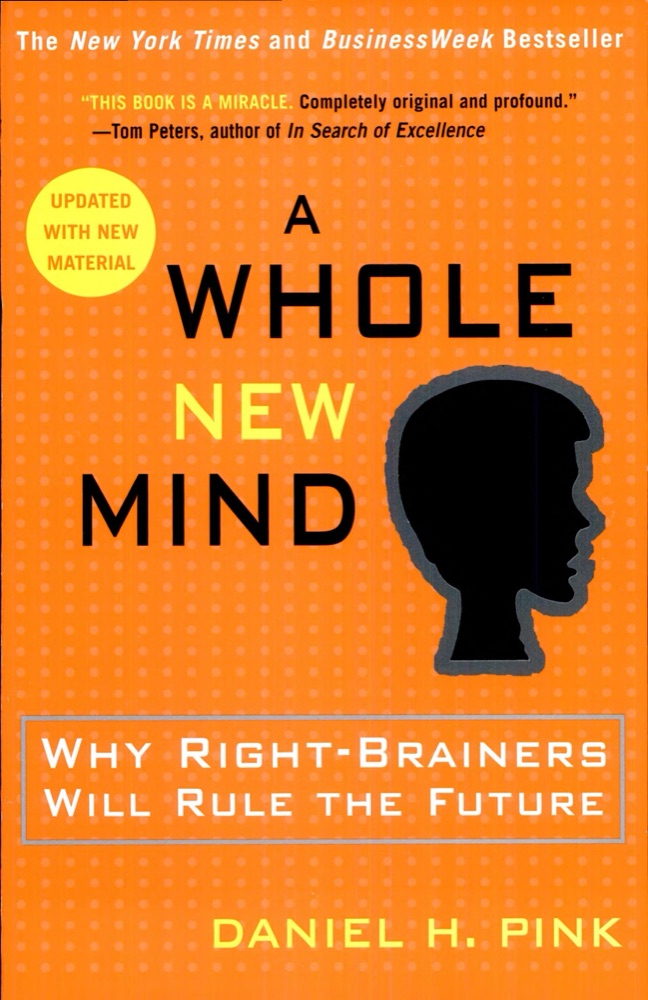 A Whole New Mind: Why Right-Brainers Will Rule the Future
 Darwin's Black Box: The Biochemical Challenge to Evolution
 The Meaning of It All: Thoughts of a Citizen-Scientist
 What the Dog Saw and Other Adventures
 The Mountain in the Sea
 You Are Not a Gadget
 21 Lessons for the 21st Century
 The Moral Animal: Why We Are the Way We Are - The New Science of Evolutionary Psychology
 The Grand Design
 Psych: The Story of the Human Mind
 Why Fish Don’t Exist: A Story of Loss, Love, and the Hidden Order of Life
 From Dawn to Decadence: 500 Years of Western Cultural Life, 1500 to the Present
 An Enquiry Concerning Human Understanding
 The Cosmic Serpent: DNA and the Origins of Knowledge
 The Elephant in the Brain: Hidden Motives in Everyday Life