
 Excellent Advice for Living: Wisdom I Wish I'd Known Earlier
Quotes from the Book
Humans are the reproductive organs of technology.
60
...the proper response to a lousy idea is not to stop thinking. It is to come up with a better idea.
27
Our mission as humans is not only to discover our fullest selves in the technium, and to find full contentment, but to expand the possibilities for others. Greater technology will selfishly unleash our talents, but it will also unselfishly unleash others: our children, and all children to come.
13
The smallest thought could not exist unless the entire universe and the laws of physics were in some way encouraging it.
8
If you watch the curve of science and everything we know, it shoots up like a rocket. We’re on this rocket and we’re going perfectly vertical into the stars. But the emotional intelligence of humankind is equally if not more important than our intellectual intelligence. We’re just as emotionally illiterate as we were 5,000 years ago; so emotionally our line is completely horizontal. The problem is the horizontal and the vertical are getting farther and farther apart. And as these things grow apart, there’s going to be some kind of consequence of that.
5
Humans are the reproductive organs of technology. We multiply manufactured artifacts and spread ideas and memes.
5
As a practical matter I’ve learned to seek the minimum amount of technology for myself that will create the maximum amount of choices for myself and others. The cybernetician Heinz von Foerster called this approach the Ethical Imperative, and he put it this way: “Always act to increase the number of choices.” The way we can use technologies to increase choices for others is by encouraging science, innovation, education, literacies, and pluralism. In my own experience this principle has never failed: In any game, increase your options.
4
Most new ideas and new inventions are disjointed ideas merged.
3
The web holds about a trillion pages. The human brain holds about a hundred billion neurons. Each biological neuron sprouts synaptic links to thousands of other neurons, while each web page on average links to 60 other pages. That adds up to a trillion “synapses” between the static pages on the web. The human brain has about 100 times that number of links—but brains are not doubling in size every few years. The global machine is.
3
the laws of nature are rigged in favor of life.” In this view, “life emerges from a soup in the same dependable way that a crystal emerges from a saturated solution,
2
We are reaching deep within ourselves to adjust the master knob.
2
When people maximize their set of talents, they shine because no one can do what they do. People fully inhabiting their unique mixture of skills are inimitable
1
An exploding nuclear bomb has a much higher power density than the sun because it is an unsustainable out-of-control flow of energy. A one-megaton nuclear bomb will release 1017 ergs, which is a lot of power. But the total lifetime of that explosion is only a hyperblink of 10-6 seconds. So if you “amortized” a nuclear blast so that it spent its energy over a full second instead of microseconds, its power density would be reduced to only 1011 ergs per second per gram, which is about the intensity of a laptop computer chip. Energywise, a Pentium chip may be better thought of as a very slow nuclear explosion.
1
We are blind to this massive eruption of minds into the technium because humans have a chauvinistic bias against any kind of intelligence that does not precisely mirror our own.
How many geniuses at the level of Bach and Van Gogh died before the needed technologies were available for their talents to take root?
The power of self-replication is now found in four fields of high technology: geno, robo, info, and nano.
Every idea that is made real (technology) enlarges the space we have to construct our lives.
Life is less a miracle than a necessity for matter and energy
The hydrogen atoms in a human body completely refresh every seven years. As we age we are really a river of cosmically old atoms. The carbons in our bodies were produced in the dust of a star. The bulk of matter in our hands, skin, eyes, and hearts was made near the beginning of time, billions of years ago. We are much older than we look. For
Seeing our world through technology’s eyes has, for me, illuminated its larger purpose. And recognizing what it wants has reduced much of my own conflict in deciding where to place myself in its embrace. This book is my report on what technology wants. My hope is that it will help others find their own way to optimize technology’s blessings and minimize its costs.
As we turn from the galaxies to the swarming cells of our own being, which toil for something, some entity beyond their grasp, let us remember man, the self-fabricator who came across an ice age to look into the mirrors and magic of science. Surely he did not come to see himself or his wild visage only. He came because he is at heart a listener and a searcher for some transcendent realm beyond himself.
Our existence here, he says, is a case of “not we the accidental but we the expected.” Mathematician Manfred Eigen wrote in 1971, “The evolution of life, if it is based on a derivable physical principle, must be considered an inevitable process.
Woven deep into the vast communication networks wrapping the globe, we also find evidence of embryonic technological autonomy. The technium contains 170 quadrillion computer chips wired up into one mega-scale computing platform. The total number of transistors in this global network is now approximately the same as the number of neurons in your brain. And the number of links among files in this network (think of all the links among all the web pages of the world) is about equal to the number of synapse links in your brain. Thus, this growing planetary electronic membrane is already comparable to the complexity of a human brain. It has three billion artificial eyes (phone and webcams) plugged in, it processes keyword searches at the humming rate of 14 kilohertz (a barely audible high-pitched whine), and it is so large a contraption that it now consumes 5 percent of the world’s electricity. When computer scientists dissect the massive rivers of traffic flowing through it, they cannot account for the source of all the bits. Every now and then a bit is transmitted incorrectly, and while most of those mutations can be attributed to identifiable causes such as hacking, machine error, or line damage, the researchers are left with a few percent that somehow changed themselves. In other words, a small fraction of what the technium communicates originates not from any of its known human-made nodes but from the system at large. The technium is whispering to itself.
Watch on YouTube
About Kevin Kelly
We have collected 53 quotes from 2 books by Kevin Kelly on BookQuoters.
More about the author →More by Kevin Kelly
Excellent Advice for Living: Wisdom I Wish I'd Known Earlier
About the book
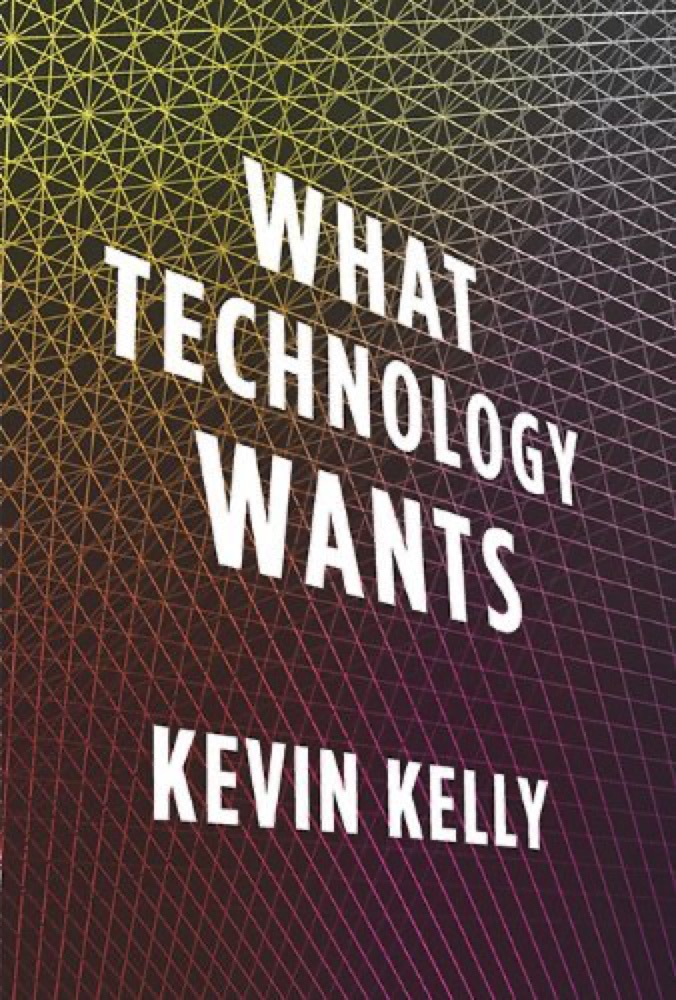
"Verbalizing visceral feelings about technology, whether attraction or repulsion, Kelly explores the “technium,” his term for the globalized, interconnected stage of technological development. Arguing that the processes creating the technium are akin to those of biological evolution, Kelly devotes the opening sections of his exposition to that analogy, maintaining that the technium exhibits a similar tendency toward self-organizing complexity. Having defined the technium, Kelly addresses its discontents, as expressed by the Unabomber (although Kelly admits to trepidation in taking seriously the antitechnology screeds of a murderer) and then as lived by the allegedly technophobic Amish. From his observations and discussions with some Amish people, Kelly extracts some precepts of their attitudes toward gadgets, suggesting folk in the secular world can benefit from the Amish approach of tre
Book details
- First published
- 2010
- Author
- Kevin Kelly
- Genre
- Nonfiction
- Goodreads rating
- 3.74 (7k ratings)
Keep reading
 The Singularity is Near: When Humans Transcend Biology
 Physics of the Future: How Science Will Shape Human Destiny and Our Daily Lives by the Year 2100
 The Age of Spiritual Machines
 Life 3.0: Being Human in the Age of Artificial Intelligence
 The Future of Humanity: Terraforming Mars, Interstellar Travel, Immortality and Our Destiny Beyond Earth
 The Information: A History, a Theory, a Flood
 The Code Breaker: Jennifer Doudna, Gene Editing, and the Future of the Human Race
 Superintelligence: Paths, Dangers, Strategies
 My Inventions
 Wired
Wired
 The Grand Design
 The Big Picture: On the Origins of Life, Meaning, and the Universe Itself
 Space Chronicles: Facing the Ultimate Frontier
 You Are Not a Gadget
 The Tell-Tale Brain: A Neuroscientist's Quest for What Makes Us Human
 Understanding Media: The Extensions of Man
 A Devil's Chaplain: Reflections on Hope, Lies, Science, and Love
 Genome
 From Bacteria to Bach and Back: The Evolution of Minds
 The Gene: An Intimate History
 The Social Conquest of Earth
 Technopoly: The Surrender of Culture to Technology
 The Medium is the Massage
 Soonish: Ten Emerging Technologies That'll Improve and/or Ruin Everything
 The Future of the Mind: The Scientific Quest to Understand, Enhance, and Empower the Mind
 The Mountain in the Sea
 How We Got to Now: Six Innovations That Made the Modern World
 Dragons of Eden: Speculations on the Evolution of Human Intelligence
 Homo Deus: A History of Tomorrow
 The Lost World
 The Biology of Belief: Unleashing the Power of Consciousness, Matter and Miracles
 The Ascent of Man
 The Blind Watchmaker: Why the Evidence of Evolution Reveals a Universe Without Design
 A Short History of Nearly Everything
 Echopraxia
 Until the End of Time: Mind, Matter, and Our Search for Meaning in an Evolving Universe
 The Fifth Science
 2312
2312
 How the Mind Works
 To Be a Machine : Adventures Among Cyborgs, Utopians, Hackers, and the Futurists Solving the Modest Problem of Death
 Where Good Ideas Come From: The Natural History of Innovation
 Exhalation
 A Whole New Mind: Why Right-Brainers Will Rule the Future
 Destination: Void
 Death's End
 Consilience: The Unity of Knowledge
 Astrophysics for People in a Hurry
 Ways of Being: Animals, Plants, Machines: The Search for a Planetary Intelligence
 Machinehood
 The Lives of a Cell: Notes of a Biology Watcher
 The Price of Tomorrow: Why Deflation is the Key to an Abundant Future
 The Wizard and the Prophet: Two Remarkable Scientists and Their Dueling Visions to Shape Tomorrow's World
 Distrust That Particular Flavor
 A Thousand Brains: A New Theory of Intelligence
 The Futurological Congress: From the Memoirs of Ijon Tichy
 The Rational Optimist: How Prosperity Evolves
 If Anyone Builds It, Everyone Dies: Why Superhuman AI Would Kill Us All
 The Technological Republic: Hard Power, Soft Belief, and the Future of the West
 Bewilderment
 Influx