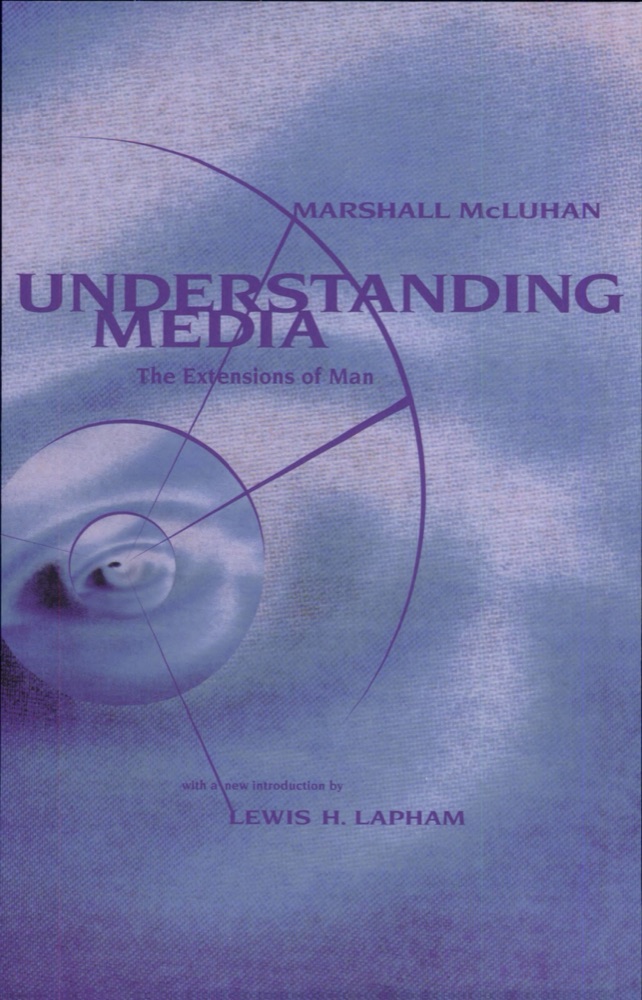
 Understanding Media: The Extensions of Man
Quotes from the Book
There is absolutely no inevitability as long as there is a willingness to contemplate what is happening.
Whence did the wond'rous mystic art arise, / Of painting SPEECH, and speaking to the eyes? / That we by tracing magic lines are taught, / How to embody, and to colour THOUGHT?
The poet, the artist, the sleuth - whoever sharpens our perception tends to be antisocial; rarely "well-adjusted", he cannot go along with currents and trends. A strange bond often exists between antisocial types in their power to see environments as they really are. This need to interface, to confront environments with a certain antisocial power is manifest in the famous story "The Emperor's New Clothes".
Art is whatever you can get away with.
The wheel… is an extension of the foot. The book… is an extension of the eye… Clothing, an extension of the skin… Electric circuitry, an extension of the central nervous system.
All through his life, he swung between the ridiculous and the sublime,
The ear favours no particular “point of view.” We are enveloped by sound. It forms a seamless web around us. We say, “Music shall fill the air.” We never say, “Music shall fill a particular segment of the air.”We hear sounds from everywhere, without ever having to focus. Sounds come from “above,” from “below,” from in “front” of us, from “behind” us, from our “right,” from our “left.” We can‘t shut out sound automatically. We simply are not equipped with earlids. Where a visual space is an organised continuum of a uniformed connected kind, the ear world is a world of simultaneous relationships.
Until writing was invented, man lived in acoustic space: boundless, directionless, horizonless, in the dark of the mind, in the world of emotion, by primordial intuition, by terror. Speech is a social chart of this bog.
The past went a-way. When faced with a totally new situation, we tend always to attach ourselves to the objects, to the flavor of the most recent past. We look at the present through a rear-view mirror.
Humor as a system of communications and as a probe of our environment—of what's really going on—affords us our most appealing anti-environmental tool. It does not deal in theory, but in immediate experience, and is often the best guide to changing perceptions.
Professionalism is environmental. Amateurism is anti-environmental.
Until writing was invented, man lived in an acoustic space: boundless, directionless, horizonless, in the dark of the mind, in the world of emotion, by primordial intuition, by terror. Speech is a social chart of this bog. The goose quill put an end to talk. It abolished mystery; it gave architecture and towns; it brought roads and armies, bureaucracy. It was the basic metaphor with which the cycle of civilization began, the step from the dark into the light of the mind. The hand that filled the parchment page built a city. Whence did the wond'rous mystic art arise, Of painting SPEECH, and speaking to the eyes? That we by tracing magic lines are taught, How to embody, and to colour THOUGHT?
Homer’s Iliad was the cultural encyclopedia of pre-literate Greece, the didactic vehicle that provided men with guidance for the management of their spiritual, ethical, and social lives.
Television completes the cycle of the human sensorium. With the omnipresent ear and the moving eye, we have abolished writing, the specialized acoustic-visual metaphor that established the dynamics of Western civilization.
Innumerable confusions and a profound feeling of despair invariably emerge in periods of great technological and cultural transitions. Our "Age of Anxiety" is, in great part, the result of trying to do today's job with yesterday's tools—with yesterday's concepts.
Today's child is growing up absurd, because he lives in two worlds, and neither of them inclines him to grow up.
The Newtonian God—the God who made a clock-like universe, wound it, and withdrew—died a long time ago. This is what Nietzsche meant and this is the God who is being observed.
Education must shift from instruction, from imposing of stencils, to discovery—to probing and exploration and to the recognition of the language of forms.
Our electrically-configured world has forced us to move from the habit of data classification to the mode of pattern recognition.
All media are extensions of some human faculty- psychic or physical.
48
The "child" was an invention of the seventeenth century; he did not exist in, say, Shakespeare's day. He had, up until that time, been merged in the adult world and there was nothing that could be called childhood in our sense. Today's child is growing up absurd, because he lives in two worlds, and neither of them inclines him to grow up. Growing up - that is our new work, and it is total. Mere instruction will not suffice.
10
In the "Republic," Plato vigorously attacked the oral, poetized form as a vehicle for communicating knowledge. He pleaded for a more precise method of communication and classification ("The Ideas"), one which would favor the investigation of facts, principles of reality, human nature, and conduct. What the Greeks meant by "poetry" was radically different from what we mean by poetry. Their "poetic" expression was a product of a collective psyche and mind. The mimetic form, a technique that exploited rhythm, meter and music, achieved the desired psychological response in the listener. Listeners could memorize with greater ease what was sung than what was said. Plato attacked this method because it discouraged disputation and argument. It was in his opinion the chief obstacle to abstract, speculative reasoning - he called it "a poison, and an enemy of the people.
7
Environments are not passive wrappings, but are, rather, active processes which are invisible. The groundrules, pervasive structure, and over-all patterns of environments elude easy perception
7
Our time is a time to cross barriers, for erasing old categories — for probing around. When two seemingly disparate elements are imaginatively poised, put in apposition in new and unique ways, startling discoveries often result
4
Electrical information devices for universal, tyrannical womb-to-tomb surveillance are causing a very serious dilemma between our claim to privacy and the community's need to know.
2
The stars are so big, The Earth is so small, Stay as you are.
1
Real, total war has become information war. It is being fought by subtle electric informational media- under cold conditions, and constantly. The cold war is the real war front – a surround- involving everybody- all the time- everywhere. Whenever hot wars are necessary these days, we conduct them in the backyards of the world with the old technologies. These wars are happenings, tragic games. It is no longer convenient, or suitable, to use the latest technologies for fighting our wars, because the latest technologies have rendered war meaningless. The hydrogen bomb is history’s exclamation point. It ends an age-long sentence of manifest violence!
Science-fiction writing today presents situations that enable us to perceive the potential of new technologies. Formerly, the problem was to invent new forms of labor-saving devices. Today, the reverse is the problem. Now we have to adjust, not to invent. We have to find the environments in which it will be possible to live with our new inventions. Big Business has learned to tap the s-f writer.
Watch on YouTube
About Marshall McLuhan
We have collected 57 quotes from 2 books by Marshall McLuhan on BookQuoters.
More about the author →More by Marshall McLuhan
Understanding Media: The Extensions of Man
About the book
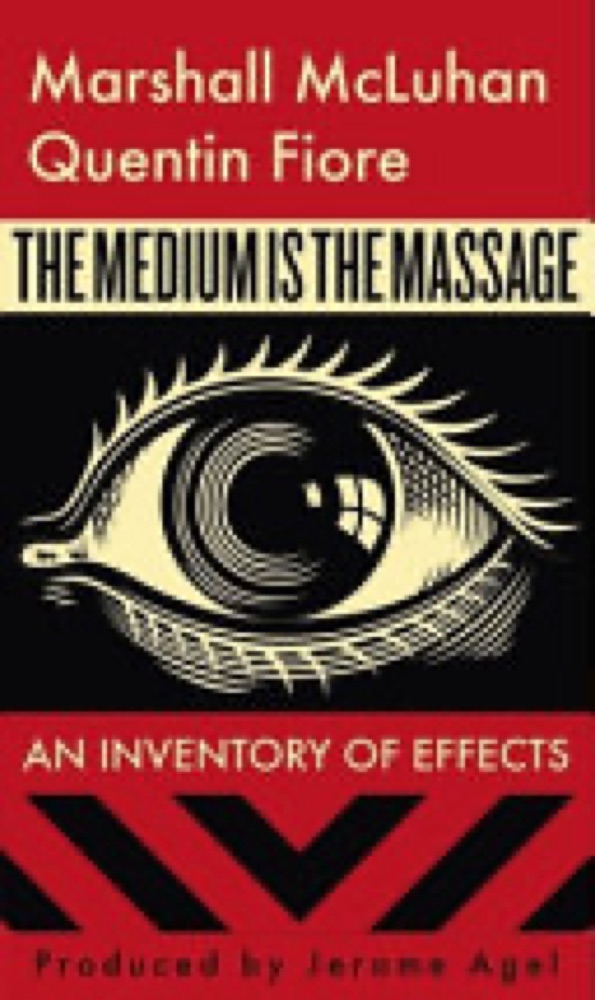
The Medium is the Massage is Marshall McLuhan's most condensed, and perhaps most effective, presentation of his ideas. Using a layout style that was later copied by Wired, McLuhan and coauthor/designer Quentin Fiore combine word and image to illustrate and enact the ideas that were first put forward in the dense and poorly organized Understanding Media. McLuhan's ideas about the nature of media, the increasing speed of communication, and the technological basis for our understanding of who we are come to life in this slender volume. Although originally printed in 1967, the art and style in The Medium is the Massage seem as fresh today as in the summer of love, and the ideas are even more resonant now that computer interfaces are becoming gateways to the global village.
Book details
- First published
- 1967
- Author
- Marshall McLuhan
- Genre
- Philosophy
- Goodreads rating
- 3.98 (18k ratings)
Keep reading
Understanding Media: The Extensions of Man
 The Master and His Emissary: The Divided Brain and the Making of the Western World
 Distrust That Particular Flavor
 The Atrocity Exhibition
 The Origin of Consciousness in the Breakdown of the Bicameral Mind
 The Doors of Perception & Heaven and Hell
 The Information: A History, a Theory, a Flood
 The Spell of the Sensuous: Perception and Language in a More-Than-Human World
 From Dawn to Decadence: 500 Years of Western Cultural Life, 1500 to the Present
 Myths to Live By
 The Big Picture: On the Origins of Life, Meaning, and the Universe Itself
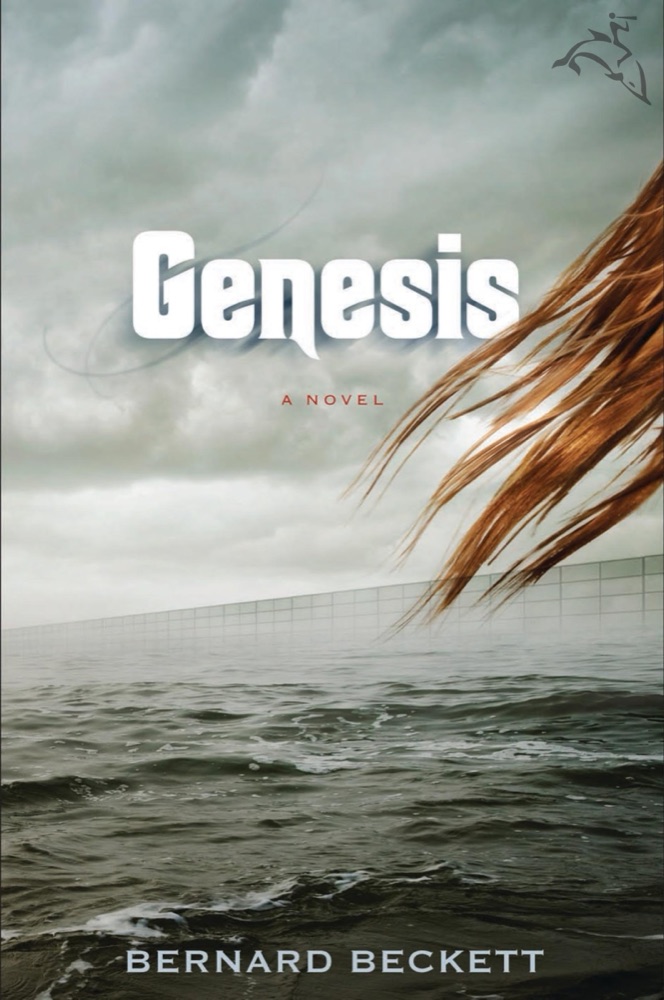 Genesis
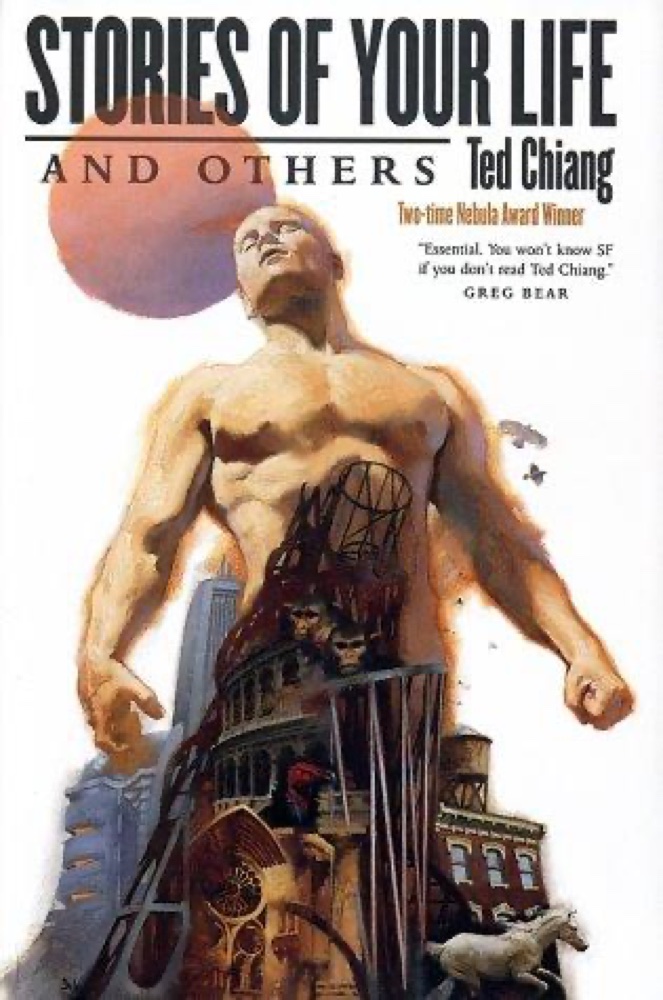 Stories of Your Life and Others
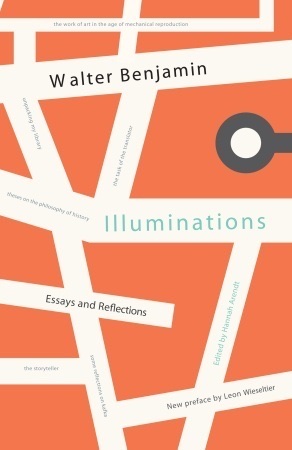 Illuminations: Essays and Reflections
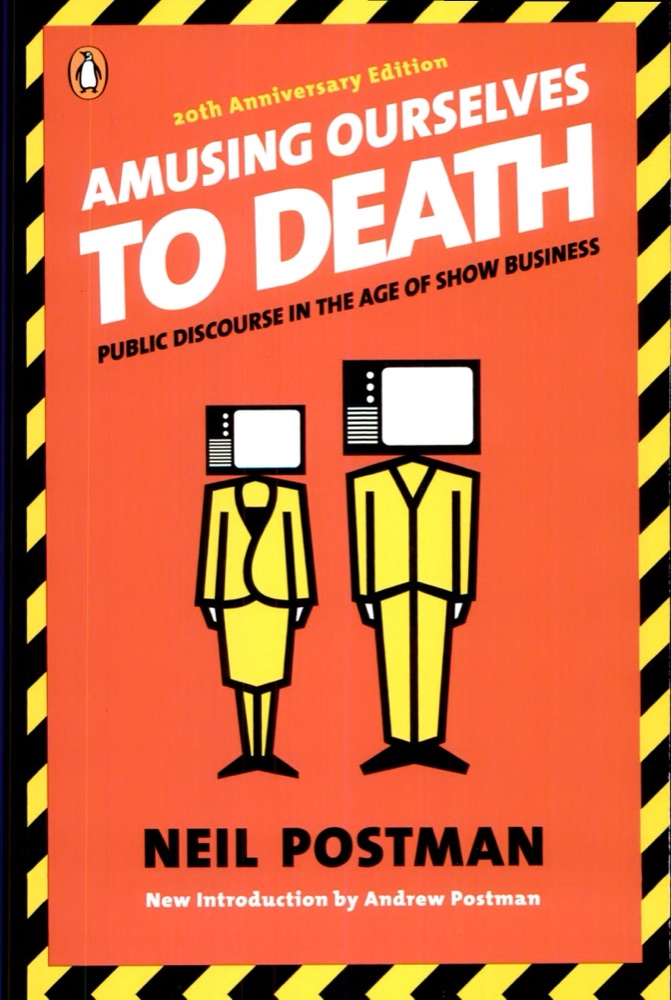 Amusing Ourselves to Death: Public Discourse in the Age of Show Business
 Phenomenology of Perception
 The Occult
 Irrational Man: A Study in Existential Philosophy
 The Futurological Congress: From the Memoirs of Ijon Tichy
 Figuring
 Winter
 The Attention Merchants: The Epic Scramble to Get Inside Our Heads
 You Are Not a Gadget
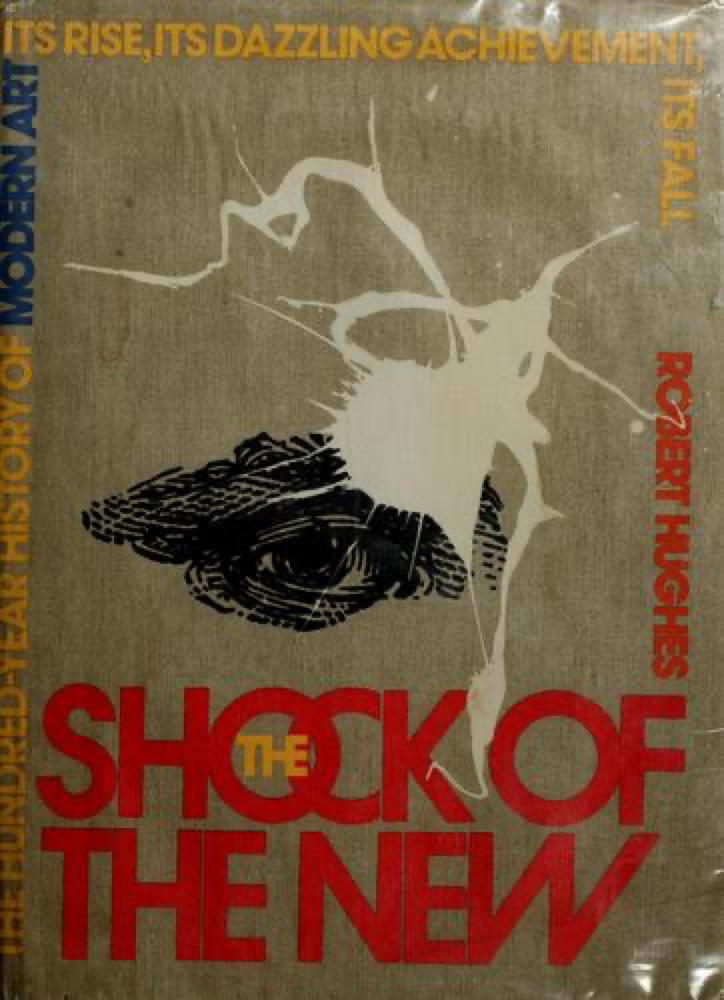 The Shock of the New
 The Stuff of Thought: Language as a Window into Human Nature
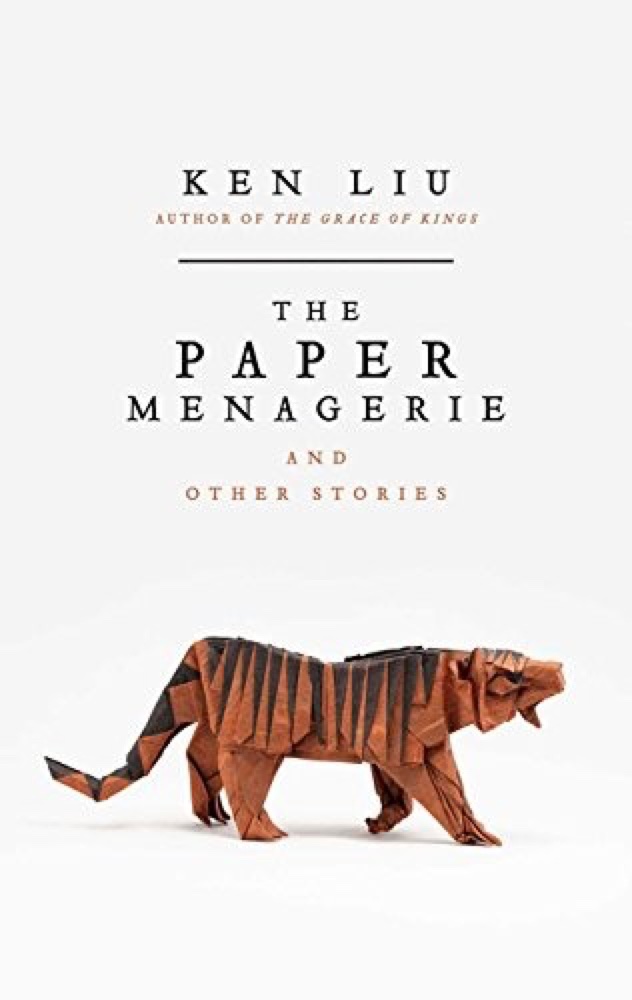 The Paper Menagerie and Other Stories
 Flights
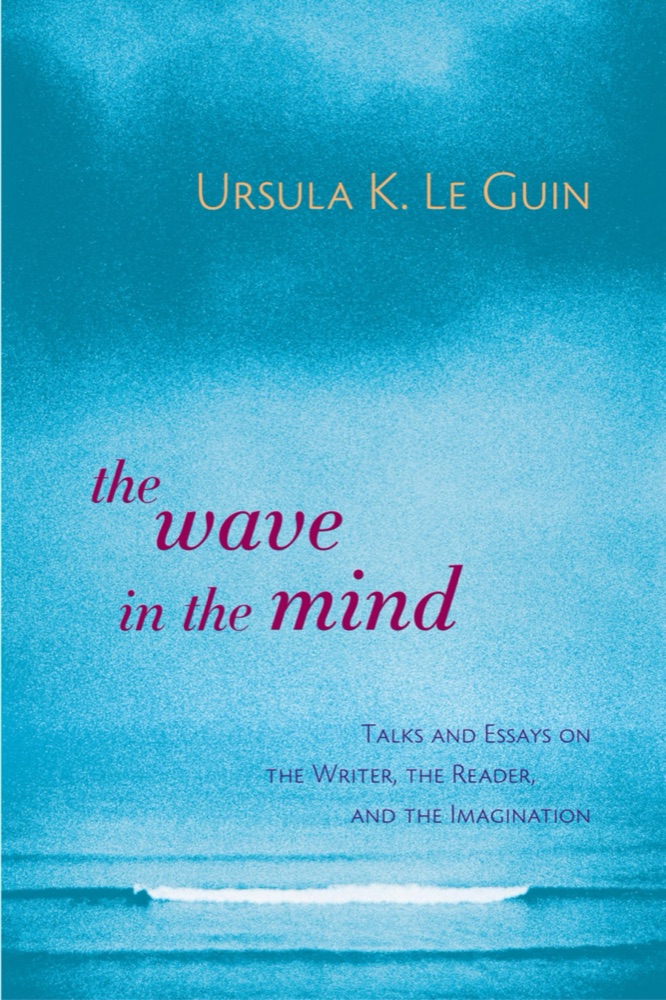 The Wave in the Mind: Talks and Essays on the Writer, the Reader and the Imagination
 The Abundance
 2312
2312
 The Braindead Megaphone
 The Ascent of Man
 Arcadia
 The Names
 A Language Older Than Words
 The Language of the Night: Essays on Writing, Science Fiction, and Fantasy
 The Most Human Human: What Talking with Computers Teaches Us About What It Means to Be Alive
 Maps of Meaning: The Architecture of Belief
 The Fifth Science
 Zen and the Art of Motorcycle Maintenance
 One Way Street And Other Writings
 The Book of Form and Emptiness
 The Pleasures and Sorrows of Work
 Slow Learner
 The Arcades Project
 On Truth and Lies in a Nonmoral Sense
 Burning Questions: Essays and Occasional Pieces, 2004 to 2021
 The Courage to Create
 Skinny Legs and All
 The Essays of Ralph Waldo Emerson
 The Poetics of Space
 Until the End of Time: Mind, Matter, and Our Search for Meaning in an Evolving Universe
 Point Omega
 Selected Non-Fictions
 Reality Hunger: A Manifesto
 Mao II
 Creativity: Flow and the Psychology of Discovery and Invention
 The Case Against Reality: Why Evolution Hid the Truth from Our Eyes
 A Fisherman of the Inland Sea
 Living with a Wild God: A Nonbeliever's Search for the Truth about Everything