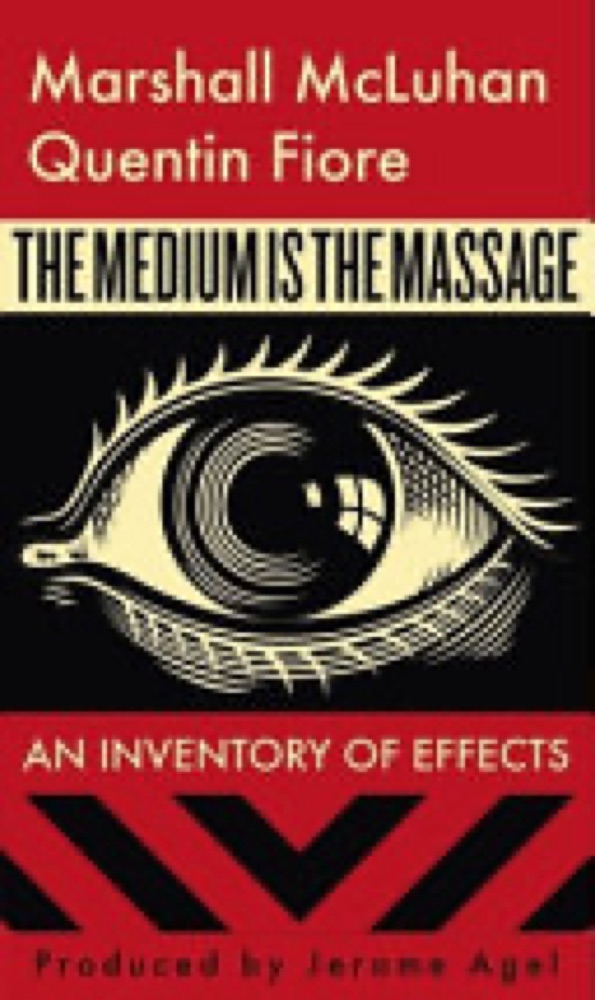
 The Medium is the Massage
Quotes from the Book
The medium is the message.
103
Art is anything you can get away with.
92
Language does for intelligence what the wheel does for the feet and the body. It enables them to move from thing to thing with greater ease and speed and ever less involvement.
47
With the arrival of electric technology, man has extended, or set outside himself, a live model of the central nervous system itself. To the degree that this is so, it is a development that suggests a desperate suicidal autoamputation, as if the central nervous system could no longer depend on the physical organs to be protective buffers against the slings and arrows of outrageous mechanism.
39
The artist is always engaged in writing a detailed history of the future because he is the only person aware of the nature of the present.
16
Man becomes, as it were, the sex organs of the machine world, as the bee of the plant world, enabling it to fecundate and to evolve ever new forms. The machine world reciprocates man’s love by expediting his wishes and desires, namely, in providing him with wealth
14
To see a man slip on a banana skin is to see a rationally structured system suddenly translated into a whirling machine.
14
The Greek myth of Narcissus is directly concerned with a fact of human experience, as the word Narcissus indicates. It is from the Greek word narcosis, or numbness. The youth Narcissus mistook his own reflection in the water for another person. This extension of himself by mirror numbed his perceptions until he became the servomechanism of his own extended or repeated image. The nymph Echo tried to win his love with fragments of his own speech, but in vain. He was numb. He had adapted to his extension of himself and had become a closed system. Now the point of this myth is the fact that men at once become fascinated by any extension of themselves in any material other than themselves. There have been cynics who insisted that men fall deepest in love with women who give them back their own image. Be that as it may, the wisdom of the Narcissus myth does not convey any idea that Narcissus fell in love with anything he regarded as himself. Obviously he would have had very different feelings about the image had he known it was an extension or repetition of himself. It is, perhaps, indicative of the bias of our intensely technological and, therefore, narcotic culture that we have long interpreted the Narcissus story to mean that he fell in love with himself, that he imagined the reflection to be Narcissus!
13
In accepting an honorary degree from the University of Notre Dame a few years ago, General David Sarnoff made this statement: “We are too prone to make technological instruments the scapegoats for the sins of those who wield them. The products of modern science are not in themselves good or bad; it is the way they are used that determines their value.
12
The visible world is no longer a reality and the unseen world is no longer a dream.
10
Rationality or consciousness is itself a ratio or proportion among the sensuous components of experience, and is not something added to such sense experience. Subrational beings have no means of achieving such a ratio or proportion in their sense lives but are wired for fixed wave lengths, as it were, having infallibility in their own area of experience. Consciousness, complex and subtle, can be impaired or ended by a mere stepping-up or dimming-down of any one sense intensity, which is the procedure in hypnosis. And the intensification of one sense by a new medium can hypnotize an entire community.
8
Delegated authority is lineal, visual, hierarchical. The authority of knowledge is nonlineal, nonvisual, and inclusive.
7
The price of eternal vigilance is indifference.
7
Once we have surrendered our senses and nervous systems to the private manipulation of those who would try to benefit from taking a lease on our eyes and ears and nerves, we don't really have any rights left.
6
War and the fear of war have always been considered the main incentives to technological extension of our bodies. Indeed, Lewis Mumford, in his The City in History, considers the walled city itself an extension of our skins, as much as housing and clothing. More even than the preparation for war, the aftermath of invasion is a rich technological period; because the subject culture has to adjust all its sense ratios to accommodate the impact of the invading culture.
6
In the age of instant information man ends his job of fragmented specializing and assumes the role of information-gathering. Today information-gathering resumes the inclusive concept of “culture” exactly as the primitive food-gatherer worked in complete equilibrium with his entire environment. Our quarry now, in this new nomadic and “workless” world, is knowledge and insight into the creative processes of life and society.
5
Jack Paar mentioned that he once had said to a young friend, “Why do you kids use ‘cool’ to mean ‘hot’?” The friend replied, “Because you folks used up the word ‘hot’ before we came along.
3
Why? The answer is central to any understanding of media. Why does a child like to chatter about the events of its day, however jerkily? Why do we prefer novels and movies about familiar scenes and characters? Because for rational beings to see or re-cognize their experience in a new material form is an unbought grace of life. Experience translated into a new medium literally bestows a delightful playback of earlier awareness. The press repeats the excitement we have in using our wits, and by using our wits we can translate the outer world into the fabric of our own beings.
2
Physiologically there are abundant reasons for an extension of ourselves involving us in a state of numbness. Medical researchers like Hans Selye and Adolphe Jonas hold that all extensions of ourselves, in sickness or in health, are attempts to maintain equilibrium. Any extension of ourselves they regard as “autoamputation,” and they find that the autoamputative power or strategy is resorted to by the body when the perceptual power cannot locate or avoid the cause of irritation. Our language has many expressions that indicate this self-amputation that is imposed by various pressures. We speak of “wanting to jump out of my skin” or of “going out of my mind,” being “driven batty” or “flipping my lid.” And we often create artificial situations that rival the irritations and stresses of real life under controlled conditions of sport and play.
2
The same nursery rhyme comments on the consequences of the fall of Humpty-Dumpty. That is the point about the King’s horses and men. They, too, are fragmented and specialized. Having no unified vision of the whole, they are helpless. Humpty-Dumpty is an obvious example of integral wholeness. The mere existence of the wall already spelt his fall. James Joyce in Finnegans Wake never ceases to interlace these themes, and the title of the work indicates his awareness that “a-stone-aging” as it may be, the electric age is recovering the unity of plastic and iconic space, and is putting Humpty-Dumpty back together again.
1
Humpty-Dumpty is the familiar example of the clown unsuccessfully imitating the acrobat. Just because all the King’s horses and all the King’s men couldn’t put Humpty-Dumpty together again, it doesn’t follow that electromagnetic automation couldn’t have put Humpty-Dumpty back together. The integral and unified egg had no business sitting on a wall anyway. Walls are made of uniformly fragmented bricks that arise with specialisms and bureaucracies. They are the deadly enemies of integral beings like eggs. Humpty-Dumpty met the challenge of the wall with a spectacular collapse.
1
Satire,” said Swift, “is a glass in which we see every countenance but our own.
1
… my father thought the whole idea was absurd. He refused to identify the stream he had crossed at Bomako, where it is no deeper, he said, than a man is high, with the great widespread waters of the vast Niger delta. Distances as measured in miles had no meaning for him … Maps are liars, he told me briefly. From his tone of voice I could tell that I had offended him in some way not known to me at the time. The things that hurt one do not show on a map. The truth of a place is in the joy and the hurt that come from it. I had best not put my trust in anything as inadequate as a map, he counseled … I understand now, although I did not at the time, that my airy and easy sweep of map-traced staggering distances belittled the journeys he had measured on tired feet. With my big map-talk, I had effaced the magnitude of his cargo-laden, heat-weighted treks.
1
The person who falls suddenly experiences immunity to all pain or sensory stimuli because the central nervous system has to be protected from any intense thrust of sensation. Only gradually does he regain normal sensitivity to sights and sounds, at which time he may begin to tremble and perspire and to react as he would have done if the central nervous system had been prepared in advance for the fall that occurred unexpectedly.
1
Typical of the reversing that occurs at break boundaries is the paradox that nomadic mobile man, the hunter and food-gatherer, is socially static. On the other hand, sedentary, specialist man is dynamic, explosive, progressive. The new magnetic or world city will be static and iconic or inclusive.
1
It is, however, no time to suggest strategies when the threat has not even been acknowledged to exist. I am in the position of Louis Pasteur telling doctors that their greatest enemy was quite invisible, and quite unrecognized by them. Our conventional response to all media, namely that it is how they are used that counts, is the numb stance of the technological idiot. For the “content” of a medium is like the juicy piece of meat carried by the burglar to distract the watchdog of the mind. The effect of the medium is made strong and intense just because it is given another medium as “content.” The content of a movie is a novel or a play or an opera. The effect of the movie form is not related to its program content. The “content” of writing or print is speech, but the reader is almost entirely unaware either of print or of speech.
1
In modern thought, (if not in fact) Nothing is that doesn’t act, So that is reckoned wisdom which Describes the scratch but not the itch.
1
For the fragmented man creates the homogenized Western world, while oral societies are made up of people differentiated, not by their specialist skills or visible marks, but by their unique emotional mixes.
1
The electric technology is within the gates, and we are numb, deaf, blind and mute about its encounter with the Gutenberg technology, on and through which the American way of life was formed.
1
Watch on YouTube
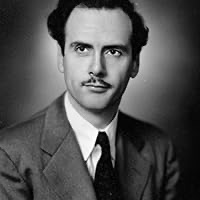
About Marshall McLuhan
We have collected 57 quotes from 2 books by Marshall McLuhan on BookQuoters.
More about the author →More by Marshall McLuhan
The Medium is the Massage
About the book
Terms and phrases such as "the global village" and "the medium is the message" are now part of the lexicon, and McLuhan's theories continue to challenge our sensibilities and our assumptions about how and what we communicate.
This reissue of Understanding Media marks the thirtieth anniversary (1964-1994) of Marshall McLuhan's classic expose on the state of the then emerging phenomenon of mass media. Terms and phrases such as "the global village" and "the medium is the message" are now part of the lexicon, and McLuhan's theories continue to challenge our sensibilities and our assumptions about how and what we communicate.
There has been a notable resurgence of interest in McLuhan's work in the last few years, fueled by the recent and continuing conjunctions between the cable companies and the regional phone companies, the appearance of magazines such as WiRed, and the development of
Book details
- First published
- 1964
- Author
- Marshall McLuhan
- Genre
- Philosophy
- Goodreads rating
- 4.10 (4k ratings)
Keep reading
The Medium is the Massage
 The Master and His Emissary: The Divided Brain and the Making of the Western World
 The Atrocity Exhibition
 The Futurological Congress: From the Memoirs of Ijon Tichy
 The Origin of Consciousness in the Breakdown of the Bicameral Mind
 Genesis
 The Occult
 Distrust That Particular Flavor
 On Truth and Lies in a Nonmoral Sense
 Amusing Ourselves to Death: Public Discourse in the Age of Show Business
 Stories of Your Life and Others
 Myths to Live By
 A Language Older Than Words
 Man and His Symbols
 The Attention Merchants: The Epic Scramble to Get Inside Our Heads
 From Dawn to Decadence: 500 Years of Western Cultural Life, 1500 to the Present
 The Most Human Human: What Talking with Computers Teaches Us About What It Means to Be Alive
 The Doors of Perception & Heaven and Hell
 The Information: A History, a Theory, a Flood
 Maps of Meaning: The Architecture of Belief
 You Are Not a Gadget
 The Blank Slate: The Modern Denial of Human Nature
 Irrational Man: A Study in Existential Philosophy
 The Fifth Science
 Fall; or, Dodge in Hell
 Gnomon
 Drive Your Plow Over the Bones of the Dead
 Power vs. Force
 Introductory Lectures on Psychoanalysis
 The Shock of the New
 The Big Picture: On the Origins of Life, Meaning, and the Universe Itself
 The Ascent of Man
 Phenomenology of Perception
 The Shockwave Rider
 Illuminations: Essays and Reflections
 Arcadia
 Last and First Men
 The Lost World
 Echopraxia
 Genome
 2312
2312
 Brave New World Revisited
 Wired
Wired
 The Mountain in the Sea
 The State of the Art
 The Spell of the Sensuous: Perception and Language in a More-Than-Human World
 Eyeless in Gaza
 The Braindead Megaphone
 Simulacra and Simulation
 Homo Deus: A History of Tomorrow
 The Empusium
 Villa Incognito
 The Human Condition
 The Stuff of Thought: Language as a Window into Human Nature
 The Social Animal: The Hidden Sources of Love, Character, and Achievement
 Point Omega
 21 Lessons for the 21st Century
 The Gone-Away World
 The Magic Mountain
 The Western Lands