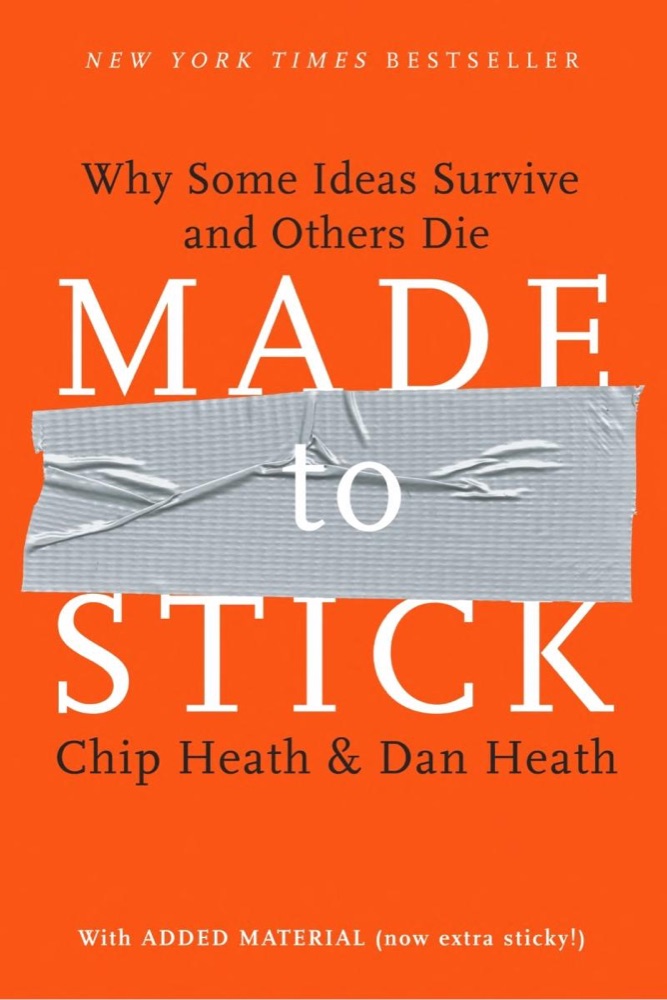
 Made to Stick: Why Some Ideas Survive and Others Die
Quotes from the Book
To sell something familiar, make it surprising. To sell something surprising, make it familiar.
12
People gravitate toward products that are bold, but instantly comprehensible: Most Advanced Yet Acceptable--MAYA.
11
People prefer paintings that they’ve seen before. Audiences like art that gives them the jolt of meaning that often comes from an inkling of recognition.
11
It is the simplest phrase you can imagine,” Favreau said, “three monosyllabic words that people say to each other every day.” But the speech etched itself in rhetorical lore. It inspired music videos and memes and the full range of reactions that any blockbuster receives online today, from praise to out-of-context humor to arch mockery. Obama’s “Yes, we can” refrain is an example of a rhetorical device known as epistrophe, or the repetition of words at the end of a sentence. It’s one of many famous rhetorical types, most with Greek names, based on some form of repetition. There is anaphora, which is repetition at the beginning of a sentence (Winston Churchill: “We shall fight on the beaches, we shall fight on the landing grounds, we shall fight in the fields”). There is tricolon, which is repetition in short triplicate (Abraham Lincoln: “Government of the people, by the people, and for the people”). There is epizeuxis, which is the same word repeated over and over (Nancy Pelosi: “Just remember these four words for what this legislation means: jobs, jobs, jobs, and jobs”). There is diacope, which is the repetition of a word or phrase with a brief interruption (Franklin D. Roosevelt: “The only thing we have to fear is fear itself”) or, most simply, an A-B-A structure (Sarah Palin: “Drill baby drill!”). There is antithesis, which is repetition of clause structures to juxtapose contrasting ideas (Charles Dickens: “It was the best of times, it was the worst of times”). There is parallelism, which is repetition of sentence structure (the paragraph you just read). Finally, there is the king of all modern speech-making tricks, antimetabole, which is rhetorical inversion: “It’s not the size of the dog in the fight; it’s the size of the fight in the dog.” There are several reasons why antimetabole is so popular. First, it’s just complex enough to disguise the fact that it’s formulaic. Second, it’s useful for highlighting an argument by drawing a clear contrast. Third, it’s quite poppy, in the Swedish songwriting sense, building a hook around two elements—A and B—and inverting them to give listeners immediate gratification and meaning. The classic structure of antimetabole is AB;BA, which is easy to remember since it spells out the name of a certain Swedish band.18 Famous ABBA examples in politics include: “Man is not the creature of circumstances. Circumstances are the creatures of men.” —Benjamin Disraeli “East and West do not mistrust each other because we are armed; we are armed because we mistrust each other.” —Ronald Reagan “The world faces a very different Russia than it did in 1991. Like all countries, Russia also faces a very different world.” —Bill Clinton “Whether we bring our enemies to justice or bring justice to our enemies, justice will be done.” —George W. Bush “Human rights are women’s rights and women’s rights are human rights.” —Hillary Clinton In particular, President John F. Kennedy made ABBA famous (and ABBA made John F. Kennedy famous). “Mankind must put an end to war, or war will put an end to mankind,” he said, and “Each increase of tension has produced an increase of arms; each increase of arms has produced an increase of tension,” and most famously, “Ask not what your country can do for you; ask what you can do for your country.” Antimetabole is like the C–G–Am–F chord progression in Western pop music: When you learn it somewhere, you hear it everywhere.19 Difficult and even controversial ideas are transformed, through ABBA, into something like musical hooks.
10
Quality, it seems, is a necessary, but insufficient attribute for success.
7
It is not merely the feeling that something is familiar. It is one step beyond that. It is something new, challenging, or surprising that opens a door into a feeling of comfort, meaning, or familiarity. It is called an aesthetic aha.
6
A new scientific truth does not triumph by convincing its opponents and making them see the light, but rather because its opponents eventually die, and a new generation grows up that is familiar with it.” In
6
When people read, they hear voices and see images in their head. This production is total synesthesia and something close to madness. A great book is an hallucinated IMAX film for one. The author had a feeling, which he turned into words, and the reader gets a feeling from those words—maybe it’s the same feeling; maybe it’s not. As Peter Mendelsund wrote in What We See When We Read, a book is a coproduction. A reader both performs the book and attends the performance. She is conductor, orchestra, and audience. A book, whether nonfiction of fiction, is an “invitation to daydream.
5
In the psychology of aesthetics, there is a name for the moment between the anxiety of confronting something new and the satisfying click of understanding it. It is called an 'aesthetic aha.
4
The trick is learning to frame your new ideas as tweaks of old ideas, to mix a little fluency with a little disfluency—to make your audience see the familiarity behind the surprise.
4
When something becomes hard to think about, people transfer the discomfort of the thought, to the object of their thinking.
4
The line from psychologists is, if you’ve seen it before, it hasn’t killed you yet.
3
Some consumers buy products not because they are ‘better” in any way, but simply because they are popular. What they’re buying is not just a product, but also a piece of popularity itself.
3
Most consumers are simultaneously neophilic, curious to discover new things, and deeply neophobic, afraid of anything that is too new. The best hit makers are gifted at creating moments of meaning by marrying new and old, anxiety and understanding. They are architects of familiar surprises.
3
People have all day to talk about what makes them ordinary. It turns out that they want to share what makes them weird.
2
Initially [my favorite books] seem to immerse me in another life, but ultimately they immerse me in me; I am looking through the window into another person’s home, but it is my face that I see in the reflection.
2
Picking a few hits requires a tolerance for many bad ideas, mediocre ideas, and even good ideas cursed with bad timing. Above all, it requires a business model that supports the inevitability that most new things fail; the most promising ideas often attract a chorus of skeptics; and one big hit can pay for a thousand flops.
1
In 2012, Spanish researchers released a study that looked at 464,411 popular recordings around the world between 1955 and 2010 and found the difference between new hits and old hits wasn’t more complicated chord structures. Instead, it was new instrumentation bringing a fresh sound to “common harmonic progressions.
1
Cultural products will spread faster and wider when everybody can see what everybody else is doing. It suggests that the future of many hit-making markets will be fully open, radically transparent, and very, very unequal.
1
In all sorts of markets—music, film, art, and politics—the future of popularity will be harder to predict as the broadcast power of radio and television democratizes and the channels of exposure grow.... The gatekeepers had their day. Now there are simply too many gates to keep.
1
It is an economic fact that predicting the future is most valuable when everybody thinks you are wrong
1
This long-tail distribution of returns is why it's important to be bold. Big winners pay for so many experiments.
1
The mere observation that something is popular, or even that it became so rapidly, is not sufficient to establish that it spread in a manner that resembles a virus. Popularity on the internet is driven by the size of the largest broadcast. Digital blockbusters are not about a million one-to-one moments as much as they are about a few one-to-one-million moments.
1
It begs for a gospel of perseverance through inevitable failure... There is no antidote to the chaos of creative markets. Only the brute doggedness to endure it.
1
this cultural chaos is governed by certain rules: the psychology of why people like what they like, the social networks through which ideas spread, and the economics of cultural markets.
You take twenty-five things that are in any successful genre, and you reverse one of them,” he said. “Reverse too many, and you get genre confusion. It’s a muddle, and nobody knows how to place it. Invert all the elements, and it’s a parody.” But one strategic tweak? Now you’ve made something that is perfectly new, like a classic western adventure story, but set in space.
all stories, the hero is the average of his friends, and the hero’s journey is a challenge to unite these ingredients in victory—Might and Right.
The point of these games is neither to make players tear out their hair nor to give away the secret too easily, but rather to design what the neurologist Judy Willis calls an “achievable challenge.” Most advanced yet achievable—MAYA.
Watch on YouTube
About Derek Thompson
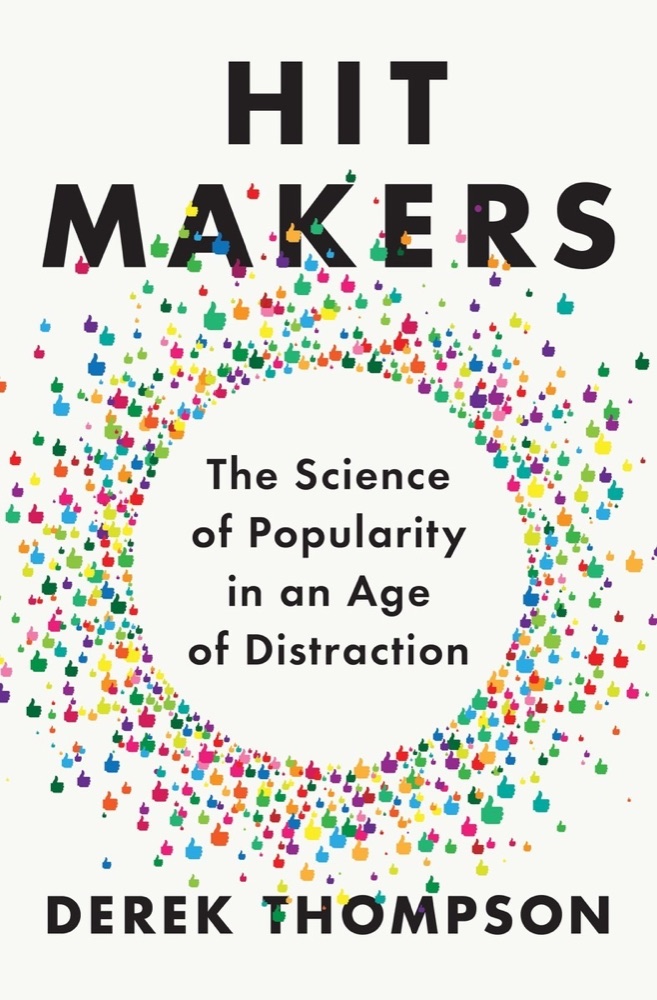
About the book
Nothing "goes viral." If you think a popular movie, song, or app came out of nowhere to become a word-of-mouth success in today's crowded media environment, you're missing the real story. Each blockbuster has a secret history--of power, influence, dark broadcasters, and passionate cults that turn some new products into cultural phenomena. Even the most brilliant ideas wither in obscurity if they fail to connect with the right network, and the consumers that matter most aren't the early adopters, but rather their friends, followers, and imitators--the audience of your audience.
In his groundbreaking investigation, The Atlantic senior editor Derek Thompson uncovers the hidden psychology of why we like what we like and reveals the economics of cultural markets that invisibly shape our lives. Shattering the sentimental myths of hit-making that dominate pop culture and business, Thompson s
Book details
- First published
- 2017
- Author
- Derek Thompson
- Genre
- Nonfiction
- Goodreads rating
- 3.90 (7k ratings)
The buzz
- The Washington PostReview in The Washington Postprofessional review (via Book Marks)
- The GuardianReview in The Guardianprofessional review (via Book Marks)
- VoxReview in Voxprofessional review (via Book Marks)
- UsatodayReview in Usatodayprofessional review (via Book Marks)
- FtReview in Ftprofessional review (via Book Marks)
Keep reading
Made to Stick: Why Some Ideas Survive and Others Die
 What the Dog Saw and Other Adventures
 The Tipping Point: How Little Things Can Make a Big Difference
 Eating the Dinosaur
 Originals: How Non-Conformists Move the World
 The Attention Merchants: The Epic Scramble to Get Inside Our Heads
 The Art of Thinking Clearly
 Think Like a Freak
 Math with Bad Drawings
 Chaos Monkeys: Obscene Fortune and Random Failure in Silicon Valley
 Hackers & Painters: Big Ideas from the Computer Age
 Hooked: How to Build Habit-Forming Products
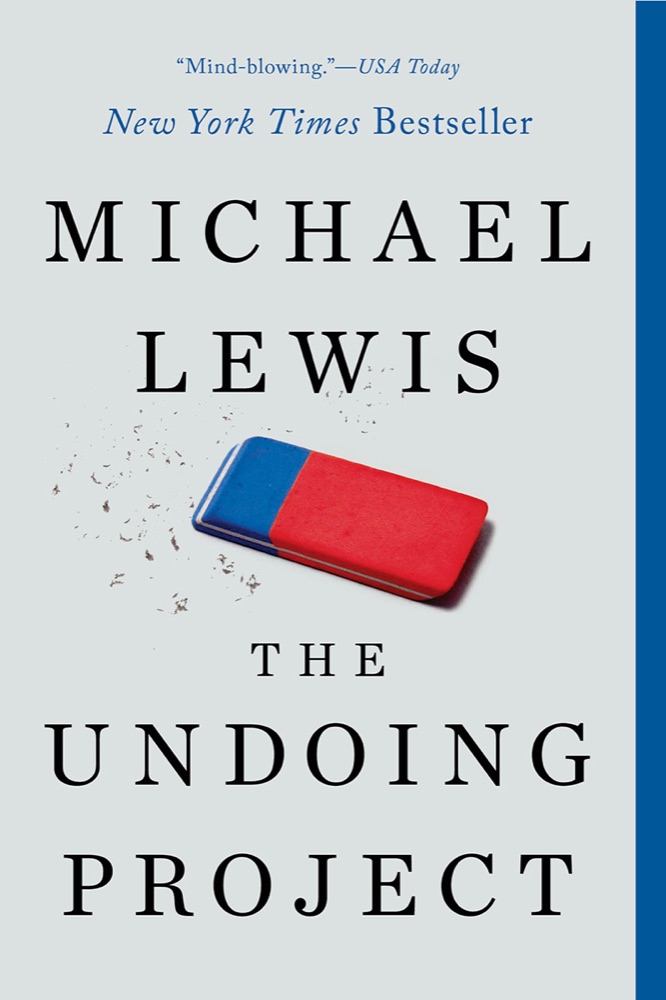 The Undoing Project: A Friendship That Changed Our Minds
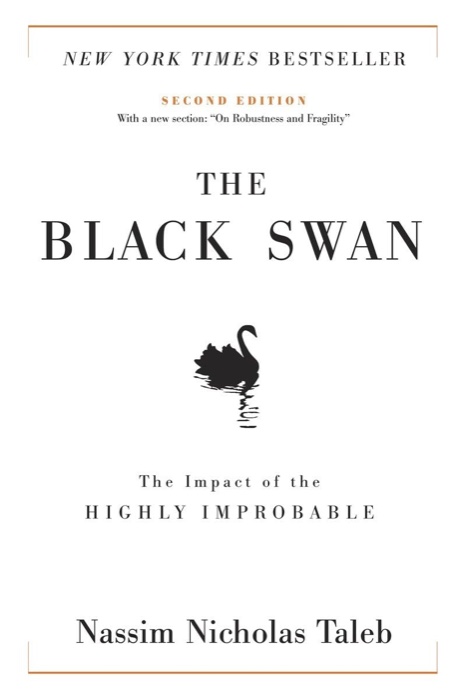 The Black Swan: The Impact of the Highly Improbable
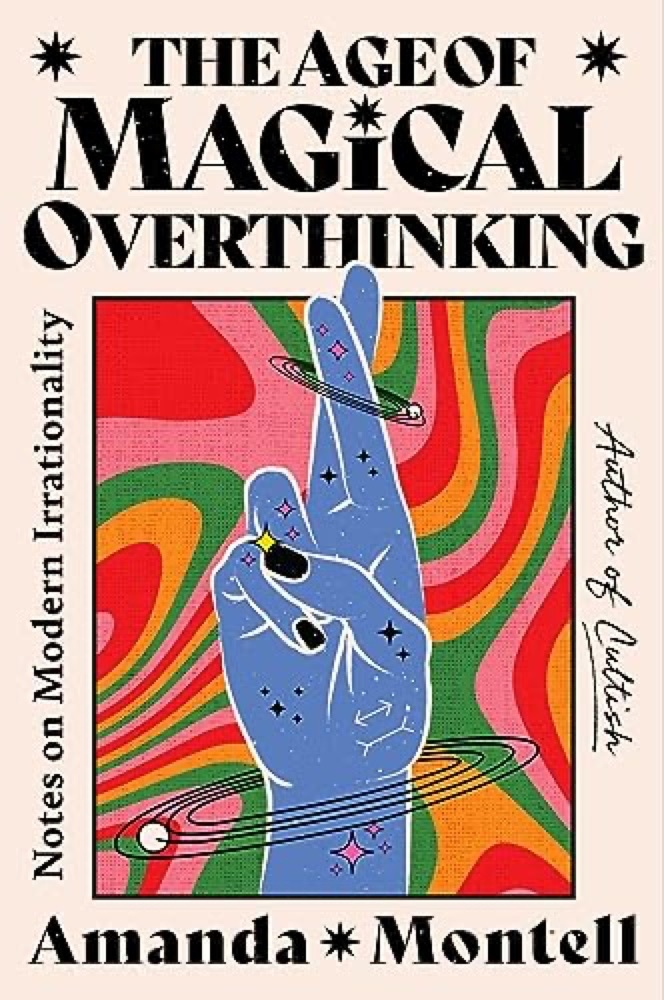 The Age of Magical Overthinking: Notes on Modern Irrationality
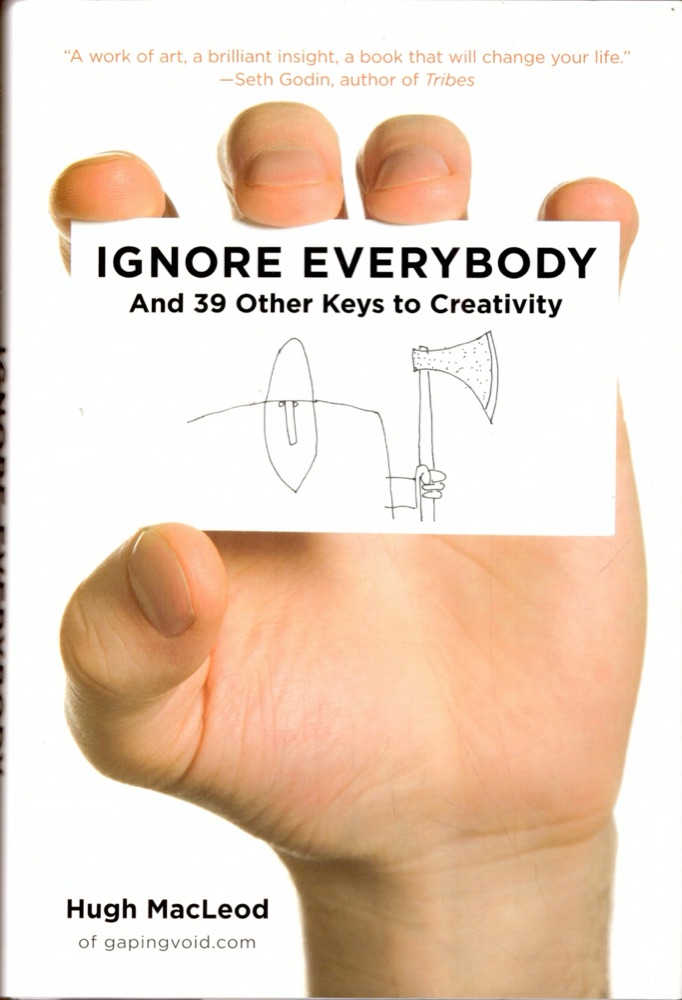 Ignore Everybody: and 39 Other Keys to Creativity
 Imagine: How Creativity Works
 Influence: The Psychology of Persuasion
 Fooled by Randomness: The Hidden Role of Chance in Life and in the Markets
 Where Good Ideas Come From: The Natural History of Innovation
 Revenge of the Tipping Point
 Trust Me, I'm Lying: Confessions of a Media Manipulator
 Same as Ever: A Guide to What Never Changes
 The Geography of Genius: A Search for the World's Most Creative Places from Ancient Athens to Silicon Valley
 How to Fly a Horse: The Secret History of Creation, Invention, and Discovery
 The Art of Creative Thinking
 A Whole New Mind: Why Right-Brainers Will Rule the Future
 Amusing Ourselves to Death: Public Discourse in the Age of Show Business
 Smartcuts: How Hackers, Innovators, and Icons Accelerate Success
 You Are Now Less Dumb: How to Conquer Mob Mentality, How to Buy Happiness, and All the Other Ways to Outsmart Yourself
 You Are Not So Smart
 Stumbling on Happiness
 Resonate: Present Visual Stories that Transform Audiences
 Show Your Work!: 10 Ways to Share Your Creativity and Get Discovered
 Creativity: Flow and the Psychology of Discovery and Invention
 The Element: How Finding Your Passion Changes Everything
 The Social Animal: The Hidden Sources of Love, Character, and Achievement
 Making Ideas Happen: Overcoming the Obstacles Between Vision and Reality
 The 22 Immutable Laws of Marketing: Violate Them at Your Own Risk
 To Sell is Human: The Surprising Truth About Moving Others
 Distrust That Particular Flavor
 Zero to One: Notes on Startups, or How to Build the Future
 Predictably Irrational: The Hidden Forces That Shape Our Decisions
 The World Is Flat: A Brief History of the Twenty-first Century
 Half Asleep in Frog Pajamas
 300 Arguments: Essays
 Think Like a Rocket Scientist: Simple Strategies You Can Use to Make Giant Leaps in Work and Life
 Please Understand Me II: Temperament, Character, Intelligence
 Barking Up the Wrong Tree: The Surprising Science Behind Why Everything You Know About Success Is (Mostly) Wrong
 Freakonomics: A Rogue Economist Explores the Hidden Side of Everything
 Both Flesh and Not: Essays
 Trump: The Art of the Deal
 Curious: The Desire to Know and Why Your Future Depends On It
 You Are Not a Gadget
 Antifragile: Things That Gain from Disorder
 TED Talks: The Official TED Guide to Public Speaking
 Devil House
 The Creative Habit: Learn It and Use It for Life
 Invent and Wander: The Collected Writings of Jeff Bezos
 Stolen Focus: Why You Can't Pay Attention— and How to Think Deeply Again