
 David and Goliath: Underdogs, Misfits, and the Art of Battling Giants
Quotes from the Book
Epidemics have rules. They have boundaries. They are subject to overstories—and we are the ones who create overstories. They change in size and shape when they reach a tipping point—and it is possible to know when and where those tipping points are. They are driven by a number of people, and those people can be identified. The tools necessary to control an epidemic are sitting on the table, right in front of us. We can let the unscrupulous take them. Or we can pick them up ourselves, and use them to build a better world.
5
Think about the psychology of that kind of change. “If you’re just below that tipping point—you’re at 20 percent—you have no idea how close you are,” Centola says. In one of the versions of his game, with twenty people, having four dissidents didn’t make the slightest difference. But when he added one more—bringing the outsiders up to the magic 25 percent mark—the consensus abruptly shifted. “You don’t know that [with] one or two more people, you could trigger that tipping point,” he said. If change happened gradually, you could see that you were getting closer and closer to your goal—and you wouldn’t be surprised when you reached it. But if nothing happens and then everything happens, you are in the strange position of being discouraged during the long stretch when nothing is happening and stunned at the point when it all shifts.
4
When a woman is all alone, she stands out as a woman, but she becomes invisible as a person.
3
If the world can be moved by just the slightest push, then the person who knows where and when to push has real power. So who are those people? What are their intentions? What techniques are they using? In the world of law enforcement, the word forensic refers to an investigation of the origins and scope of a criminal act: “reasons, culprits, and consequences.” Revenge of the Tipping Point is an attempt to do a forensic investigation of social epidemics.
3
The best solution to a monoculture epidemic is to break up the monoculture.
3
I always like to quote this line from. Of Scottish writer Andrew Fletcher. “If I can write the songs of a nation, I don't care who writes their laws.” We need to pay more attention to the songs we're singing.
2
Liberals, moderates and conservatives in most cases disagreed strongly on hot button issues only if they didn't watch a lot of television. But the more television people of all ideological persuasions watched, the more they started to agree. When a large group of people watched the same stories night after night, it brings them together. Here’s Gross again, “it's not the media pushing this button to get that effect. Its media is creating the cultural consciousness about how the world works.” The stories told on television shaped the kinds of things people thought about the conversations they had, the things they valued. The things they dismissed and that shared experience was so powerful and transformative that knowing how much television someone watched was a better predictor of how they saw current issues than knowing who they voted for in the last election.
2
The magic third turns up in all kinds of places. Take corporate boards, for example. They're among the most powerful institutions in the modern economy. Virtually every company of consequence has a group of typically around 9 experienced business people who provide guidance to the chief executive officer. Historically, boards have been all male, but slowly doors have opened to women and a body of research shows that having women on a board makes the board different. The research suggests that women on boards are more willing to ask difficult questions. They value collaboration more. They're better listeners. In other words, there's a woman effect. But how many women do you need on a board to get the woman effect? It isn't One…. It's just like Cantor predicted. When a woman is all alone, she stands out as a woman, but she becomes invisible as a person. Adding a second woman clearly helps, The study goes on, but it still wasn't enough. The magic seems to occur when three or more women serve on a board together. Three out of nine people. That magic third!
2
Moving from the position that a problem belongs to all of us to the position that a problem is being caused by a few of us is really difficult.
2
In medicine there is a term for the kind of illness that is caused by the intervention of doctors: iatrogenesis. You treat someone with a drug, and the side effects turn out to be worse than the disease. You do a minor operation, and the patient dies of complications. Iatrogenic illness is well-intentioned. No one is trying to harm the patient. But a doctor has no right to use the passive voice and speak of the patient who has been harmed.
2
In the end, nearly everyone was in agreement. Something dramatic happened when a once-insignificant set of outsiders reached between one-quarter and one-third of the population of whatever group they were joining.
2
But what you give up in a world of uniformity is resilience.
2
They had to figure out a way to characterize me in some special way because I was with them—and I was not meant to be with them.
2
If change happened gradually, you could see that you were getting closer and closer to your goal- and you wouldn't be surprised when you reached it. But if nothing happens and then everything happens, you are in the strange position of being discouraged during the long stretch when nothing is happening and stunned at the point when it all shifts.
1
I always like to quote this line from a Scottish writer, Andrew Fletcher,” Gross said. “‘If I can write the songs of a nation, I don’t care who writes their laws.’”7 We need to pay more attention to the songs we’re singing.
1
I think we can go one step further. I think we can call the Magic Third a universal law. (Or at least something very close to universal.)
1
Adding a second woman clearly helps,” the study goes on. But it still wasn’t enough: The magic seems to occur when three or more women serve on a board together. Three out of nine people. The Magic Third!
1
In Chapter 4, I talked about the strange dynamics of tipping points found in Damon Centola’s name game. Centola wanted to know how many “dissidents” it would take to disrupt a consensus reached by the majority. And his answer was, It doesn’t take a lot. Once 25 percent of the members of any group start pushing for a new name, the rest of the group quickly folds its cards and goes along.
1
If you read your contract closely, it says that the show is to be ninety minutes in length. It is to cost X. That’s the budget. Nowhere in that do we ever say that it has to be good. And if you are so robotic and driven that you feel the pressure to push yourself in that way to make it good, don’t come to us and say you’ve been treated unfairly, because you’re trying hard to make it good and we’re getting in your way. Because at no point did we ask for it to be good. That you’re neurotic is a bonus to us. Our job is to lie, cheat, and steal—and your job is to do the show.
1
That’s the revenge of the Tipping Point: The very same tools we use to build a better world can also be used against
1
Communities have their own stories, and those stories are contagious.
1
Why does place matter so much? The easiest explanation for small-area variation is that doctors are simply doing what patients want.
The chart showing usage of the term Holocaust showed that sometime early in 1978, that word goes from almost never having been used to being used all the time. When did the Holocaust miniseries air? April 16, 1978.
The game that Harvard is playing with rugby and that Georgetown is playing with tennis is
By labeling her as exceptional, as some kind of singular genius, her colleagues didn’t have to revisit their ideas about what women—and, in particular, black women—were capable of. They could keep their belief systems intact.
Actually, the word story isn’t quite right. A better word is overstory. An overstory is the upper layer of foliage in a forest, and the size and density and height of the overstory affect the behavior and development of every species far below on the forest floor.
Palo Alto is the heart of Silicon Valley
The overstory is made up of things way up in the air
the world can be moved by just the slightest push
I got a cat and named him Biggie Smalls.
Watch on YouTube
About Malcolm Gladwell
We have collected 176 quotes from 6 books by Malcolm Gladwell on BookQuoters.
More about the author →More by Malcolm Gladwell
David and Goliath: Underdogs, Misfits, and the Art of Battling Giants
 The Tipping Point: How Little Things Can Make a Big Difference
 Outliers: The Story of Success
 Blink: The Power of Thinking Without Thinking
About the book
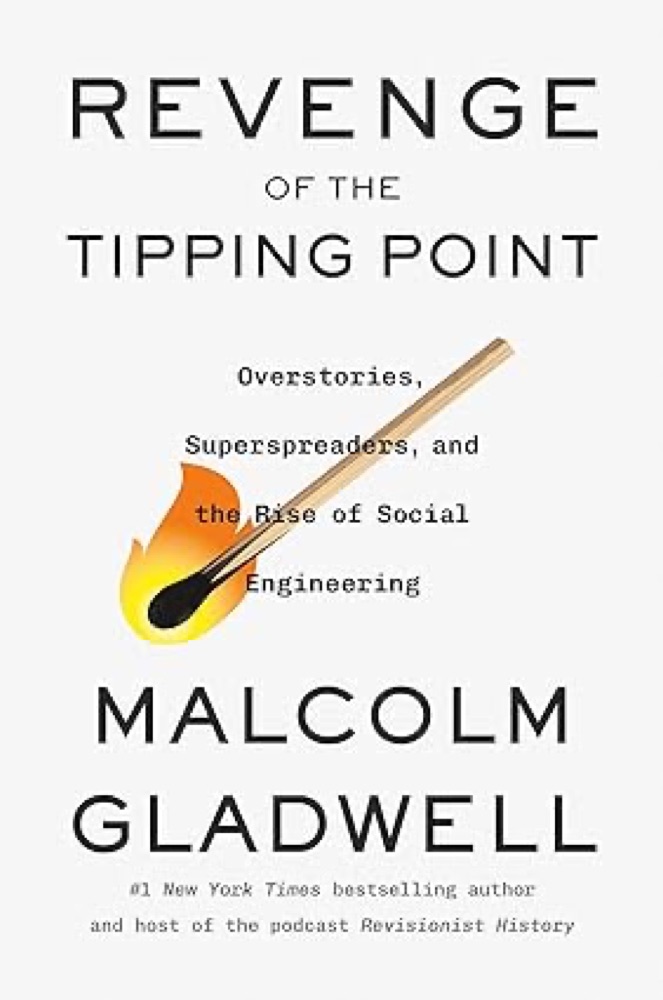
Twenty-five years after the publication of his groundbreaking first book, Malcolm Gladwell returns with a brand-new volume that reframes the lessons of The Tipping Point in a startling and revealing light.
Why is Miami…Miami? What does the heartbreaking fate of the cheetah tell us about the way we raise our children? Why do Ivy League schools care so much about sports? What is the Magic Third, and what does it mean for racial harmony? In this provocative new work, Malcolm Gladwell returns for the first time in twenty-five years to the subject of social epidemics and tipping points, this time with the aim of explaining the dark side of contagious phenomena.
Through a series of riveting stories, Gladwell traces the rise of a new and troubling form of social engineering. He takes us to the streets of Los Angeles to meet the world’s most successful bank robbers, rediscovers a forgotte
Book details
- First published
- 2024
- Author
- Malcolm Gladwell
- Genre
- Nonfiction
- Goodreads rating
- 4.02 (64k ratings)
Keep reading
The Tipping Point: How Little Things Can Make a Big Difference
 What the Dog Saw and Other Adventures
 My Life on the Road
 The World Is Flat: A Brief History of the Twenty-first Century
 The Black Swan: The Impact of the Highly Improbable
 The Shockwave Rider
 Revolution
 Fall; or, Dodge in Hell
 What's Our Problem?: A Self-Help Book for Societies
 Green Mars
 The Age of Magical Overthinking: Notes on Modern Irrationality
 Walden Two
 Loonshots: How to Nurture the Crazy Ideas That Win Wars, Cure Diseases, and Transform Industries
 Think Like a Freak
 The Nix
 Made to Stick: Why Some Ideas Survive and Others Die
 Red Mars
 The Art of Thinking Clearly
 Creation Lake
 Independent Study
 How Long 'til Black Future Month?
 The Truths We Hold: An American Journey
 Believe Me: A Memoir of Love, Death, and Jazz Chickens
 Skinny Legs and All
 The Future
 Persepolis Rising
 Influx
 All the Birds in the Sky
 Shortest Way Home: One Mayor's Challenge and a Model for America's Future
 Friday
 Humankind: A Hopeful History
 Table for Two
 Ancillary Justice
 Blackfish City
 The Lost World
 Gnomon
 Upheaval: Turning Points for Nations in Crisis
 Here for It; Or, How to Save Your Soul in America: Essays
 The Mandibles: A Family, 2029–2047
 The Bee Sting
 The Lives of Others
 The Ministry for the Future
 Chaos Monkeys: Obscene Fortune and Random Failure in Silicon Valley
 Doppelganger: A Trip into the Mirror World
 Disclosure
 The Person You Mean to Be: How Good People Fight Bias
 The Evolution of Everything: How New Ideas Emerge
 Alien Clay
 Genome
 The Undoing Project: A Friendship That Changed Our Minds
 Freakonomics: A Rogue Economist Explores the Hidden Side of Everything
 Crowds and Power
 The Most Human Human: What Talking with Computers Teaches Us About What It Means to Be Alive
 Becoming
 Prelude to Foundation
 You Can't Be Neutral on a Moving Train: A Personal History of Our Times
 The Blue Sweater: Bridging the Gap Between Rich and Poor in an Interconnected World
 Maelstrom
 The Biggest Secret: The Book That Will Change the World
 Tiamat's Wrath