
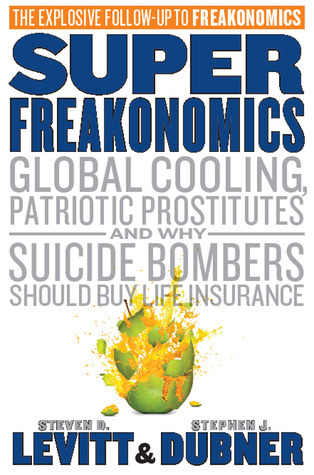
 SuperFreakonomics: Global Cooling, Patriotic Prostitutes And Why Suicide Bombers Should Buy Life Insurance
Quotes from the Book
Morality, it could be argued, represents the way that people would like the world to work, wheareas economics represents how it actually does work.
The conventional wisdom is often wrong.
Information is a beacon, a cudgel, an olive branch, a deterrent--all depending on who wields it and how.
As W.C. Fields once said: a thing worth having is a thing worth cheating for.
After all, your chances of winning a lottery and of affecting an election are pretty similar. From a financial perspective, playing the lottery is a bad investment. But it's fun and relatively cheap: for the price of a ticket, you buy the right to fantasize how you'd spend the winnings - much as you get to fantasize that your vote will have some impact on policy.
An incentive is a bullet, a key: an often tiny object with astonishing power to change a situation
Social scientists sometimes talk about the concept of "identity". It is the idea that you have a particular vision of the kind of person you are, and you feel awful when you do things that are out of line with that vision.
If you both own a gun and a swimming pool in your backyard, the swimming pool is about 100 times more likely to kill a child than the gun is.
When a woman does not want to have a child, she usually has good reason. She may be unmarried or in a bad marriage. She may consider herself too poor to raise a child. She may think her life is too unstable or unhappy, or she may think that her drinking or drug use will damage the baby’s health. She may believe that she is too young or hasn’t yet received enough education. She may want a child badly but in a few years, not now. For any of a hundred reasons, she may feel that she cannot provide a home environment that is conducive to raising a healthy and productive child.
A rogue economist explores the hidden side of everything.
Levitt admits to having the reading interests of a tweener girl, the Twilight series and Harry Potter in particular.
An expert must be BOLD if he hopes to alchemize his homespun theory into conventional wisdom.
But as incentives go, commissions are tricky. First of all, a 6 percent real-estate commission is typically split between the seller’s agent and the buyer’s. Each agent then kicks back roughly half of her take to the agency. Which means that only 1.5 percent of the purchase price goes directly into your agent’s pocket. So on the sale of your $300,000 house, her personal take of the $18,000 commission is $4,500. Still not bad, you say. But what if the house was actually worth more than $300,000? What if, with a little more effort and patience and a few more newspaper ads, she could have sold it for $310,000? After the commission, that puts an additional $9,400 in your pocket. But the agent’s additional share—her personal 1.5 percent of the extra $10,000—is a mere $150. If you earn $9,400 while she earns only $150, maybe your incentives aren’t aligned after all.
The swimming pool is almost 100 times more likely to kill a child than the gun is.
As we suggested near the beginning of this book, if morality represents an ideal world, then economics represents the actual world.
The ECLS data do show, for instance, that a child with a lot of books in his home tends to test higher than a child with no books.
But in both instances, the dissemination of the information diluted its power. As Supreme Court Justice Louis D. Brandeis once wrote, "Sunlight is said to be the best of disinfectants.
Since the science of economics is primarily a set of tools, as opposed to a subject matter, then no subject, however offbeat, need be beyond its reach.
It is well and good to opine or theorize about a subject, as humankind is wont to do, but when moral posturing is replaced by an honest assessment of the data, the result is often a new, surprising insight.
Turns out that a real-estate agent keeps her own home on the market an average of ten days longer and sells it for an extra 3-plus percent, or $10,000 on a $300,000 house.
Congress passed legislation requiring a five-year mandatory sentence for selling just five grams of crack; you would have to sell 500 grams of powder cocaine to get an equivalent sentence. This disparity has often been called racist, since it disproportionately imprisons blacks.
Experts depend on the fact that you don’t have the information they do. Or that you are so befuddled by the complexity of their operation that you wouldn’t know what to do with the information if you had it. Or that you are so in awe of their expertise that you wouldn’t dare challenge them.
And while it sounds bad to hear that Americans underpay their taxes by nearly one-fifth, the tax economist Joel Slemrod estimates that the U.S. is easily within the upper tier of worldwide compliance rates.
When moral posturing is replaced by an honest assessment of the data, the result is often a new, surprising insight.
There are three basic flavors of incentive: economic, social, and moral. Very often a single incentive scheme will include all three varieties. Think about the anti-smoking campaign of recent years. The addition of a $3-per-pack “sin tax” is a strong economic incentive against buying cigarettes. The banning of cigarettes in restaurants and bars is a powerful social incentive. And when the U.S. government asserts that terrorists raise money by selling black-market cigarettes, that acts as a rather jarring moral incentive.
But one need not oppose abortion on moral or religious grounds to feel shaken by the notion of a private sadness being converted into a public good.
It was Klan custom, for instance, to append a Kl to many words. (Thus would two Klansmen hold a Klonversation in the local Klavern.)
A woman's income appeal is a bell-shaped curve: men do not want to date low-earning women, but once a woman starts earning too much, they seem to be scared off.
The fear created by commercial experts may not quite rival the fear created by terrorists like the Ku Klux Klan, but the principle is the same.
For emotion is the enemy of rational argument.
18
Knowing what to measure and how to measure it makes a complicated world much less so.
17
Despite spending more time with themselves than with any other person, people often have surprisingly poor insight into their skills and abilities.
15
There are three basic flavours of incentive: economic, social and moral.
9
Roland G. Fryer Jr., while discussing his names research on a radio show, took a call from a black woman who was upset with the name just given to her baby niece. It was pronounced shuh-TEED but was in fact spelled “Shithead.”*
8
Did you know?
- The book originated from a 2003 New York Times Magazine profile of Steven Levitt written by Stephen Dubner.
- Steven Levitt won the John Bates Clark Medal in 2003, given to the leading American economist under age 40.
- One of the book's most controversial arguments links the legalization of abortion to a subsequent decline in crime.
- The book examines cheating by analyzing both schoolteachers and Japanese sumo wrestlers.
- It has been translated into dozens of languages and sold millions of copies worldwide.
- A follow-up book, SuperFreakonomics, was published in 2009.
About Steven D. Levitt
Steven D. Levitt (born 1967) is an American economist and a professor at the University of Chicago who won the 2003 John Bates Clark Medal, awarded to the most outstanding American economist under 40; his research applies economic analysis to subjects such as crime, corruption, and education. Stephen J. Dubner (born 1963) is an American journalist and author whose work has appeared in The New York Times and The New Yorker; he wrote a 2003 New York Times Magazine profile of Levitt that led to their collaboration on the Freakonomics books and later launched the Freakonomics Radio podcast.
More about the author →More by Steven D. Levitt
SuperFreakonomics: Global Cooling, Patriotic Prostitutes And Why Suicide Bombers Should Buy Life Insurance
 Think Like a Freak
About the book
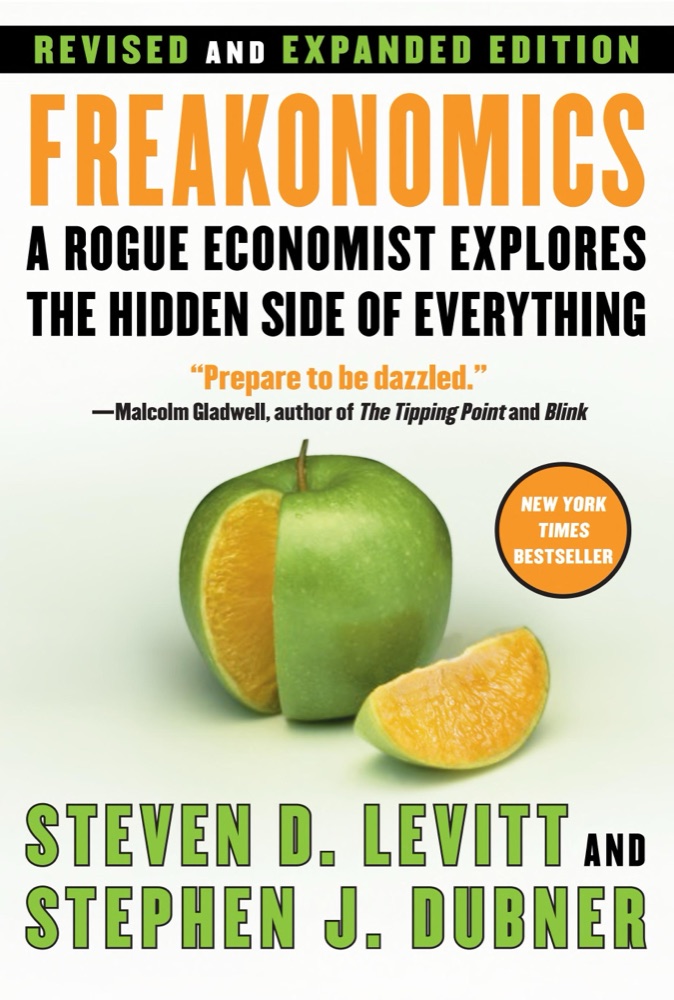
Freakonomics: A Rogue Economist Explores the Hidden Side of Everything is a nonfiction book by University of Chicago economist Steven D. Levitt and journalist Stephen J. Dubner, first published in 2005 by William Morrow. It grew out of a 2003 New York Times Magazine profile that Dubner wrote about Levitt's research. Rather than addressing traditional economic topics, the book applies the tools of economics, especially the analysis of incentives and large datasets, to unconventional everyday questions.
The book argues that economics is at its core the study of incentives, and it uses that lens to explore a range of surprising subjects: cheating among schoolteachers and sumo wrestlers, the inner economics of crack-dealing gangs, what real estate agents and the Ku Klux Klan have in common in their use of information, the influence of parenting on children's outcomes, the socioeconomic patterns behind baby names, and a controversial argument linking legalized abortion to a later drop in crime. A recurring theme is that conventional wisdom is often wrong and that data can reveal hidden causes behind ordinary phenomena.
Freakonomics became an enormous bestseller, reaching number two on the New York Times nonfiction list and selling millions of copies in dozens of languages, and it won a 2006 Book Sense Book of the Year Award. Its success spawned a follow-up book, SuperFreakonomics (2009), a 2010 anthology documentary film, a blog, and the popular Freakonomics Radio podcast launched by Dubner in 2010. The book also drew significant academic criticism, particularly over the statistical methods behind its abortion-and-crime claims.
Book details
- First published
- 2005
- Length
- 336 pages
- Reading time
- 6 hours
- Author
- Steven D. Levitt
- Genre
- Nonfiction
- Goodreads rating
- 4.01 (907k ratings)
Critical reception
- The book reached number two on the New York Times nonfiction bestseller list.
- It won a 2006 Book Sense Book of the Year Award for adult nonfiction.
- It faced substantial academic criticism over its statistical methodology, especially the claimed link between legalized abortion and reduced crime.
- Its commercial success led to a sequel, a documentary film, a blog, and the Freakonomics Radio podcast.
Movie & TV adaptations
- A 2010 anthology documentary film, Freakonomics, with segments directed by Seth Gordon, Morgan Spurlock, Alex Gibney, Eugene Jarecki, Rachel Grady, and Heidi Ewing.
If you liked this, read…
- 1SuperFreakonomicsThe direct sequel by the same authors, applying the same incentive-driven, data-first approach to a new set of unconventional questions.
- 2The Tipping PointMalcolm Gladwell's bestseller similarly uses social science and counterintuitive case studies to explain everyday phenomena for a general audience.
- 3Thinking, Fast and SlowDaniel Kahneman's popular account of behavioral economics and decision-making appeals to readers drawn to Freakonomics's data-driven look at human behavior.
Keep reading
Think Like a Freak
 The Black Swan: The Impact of the Highly Improbable
 Naked Economics: Undressing the Dismal Science
 Antifragile: Things That Gain from Disorder
 Predictably Irrational: The Hidden Forces That Shape Our Decisions
SuperFreakonomics: Global Cooling, Patriotic Prostitutes And Why Suicide Bombers Should Buy Life Insurance
Predictably Irrational: The Hidden Forces That Shape Our Decisions
SuperFreakonomics: Global Cooling, Patriotic Prostitutes And Why Suicide Bombers Should Buy Life Insurance
 Fooled by Randomness: The Hidden Role of Chance in Life and in the Markets
 The Art of Thinking Clearly
 What the Dog Saw and Other Adventures
 Poor Economics: A Radical Rethinking of the Way to Fight Global Poverty
 Small Is Beautiful: Economics as if People Mattered
 The Undoing Project: A Friendship That Changed Our Minds
 Barking Up the Wrong Tree: The Surprising Science Behind Why Everything You Know About Success Is (Mostly) Wrong
 The Signal and the Noise: Why So Many Predictions Fail—But Some Don't
 Weapons of Math Destruction: How Big Data Increases Inequality and Threatens Democracy
 The Mandibles: A Family, 2029–2047
 The World Is Flat: A Brief History of the Twenty-first Century
 The Age of Magical Overthinking: Notes on Modern Irrationality
 Revenge of the Tipping Point
 Influence: The Psychology of Persuasion
 Basic Economics: A Citizen's Guide to the Economy
 The Rational Optimist: How Prosperity Evolves
 David and Goliath: Underdogs, Misfits, and the Art of Battling Giants
 Talking to My Daughter About the Economy: or, How Capitalism Works—and How It Fails
 Superforecasting: The Art and Science of Prediction
 Friday
 Punished by Rewards: The Trouble with Gold Stars, Incentive Plans, A's, Praise and Other Bribes
 The Shockwave Rider
 The Blank Slate: The Modern Denial of Human Nature
 You Are Not So Smart
 Independent Study
 Human Action: A Treatise on Economics
 Who Owns the Future?
 Unscripted: Life, Liberty, and the Pursuit of Entrepreneurship
 Same as Ever: A Guide to What Never Changes
 Adapt: Why Success Always Starts with Failure
 Rationality: From AI to Zombies
 Alchemy: The Surprising Power of Ideas That Don't Make Sense
 The Evolution of Everything: How New Ideas Emerge
 Walden Two
 Mistakes Were Made (But Not by Me): Why We Justify Foolish Beliefs, Bad Decisions, and Hurtful Acts
 Coinman: An Untold Conspiracy
 Behold a Pale Horse
 Hackers & Painters: Big Ideas from the Computer Age
 State of Fear
 You Are Now Less Dumb: How to Conquer Mob Mentality, How to Buy Happiness, and All the Other Ways to Outsmart Yourself
 Algorithms to Live By: The Computer Science of Human Decisions
 Shop Class as Soulcraft: An Inquiry Into the Value of Work
 How to Lie with Statistics
 The Moon is a Harsh Mistress
 The Moral Landscape: How Science Can Determine Human Values
 The Social Animal: The Hidden Sources of Love, Character, and Achievement
 The Girl in the Spider's Web
 23 Things They Don't Tell You About Capitalism
 Economics in One Lesson
 The Dosadi Experiment
 The Drunkard's Walk: How Randomness Rules Our Lives
 Justice: What's the Right Thing to Do?
 A Hunter-Gatherer's Guide to the 21st Century: Evolution and the Challenges of Modern Life
 Hocus Pocus