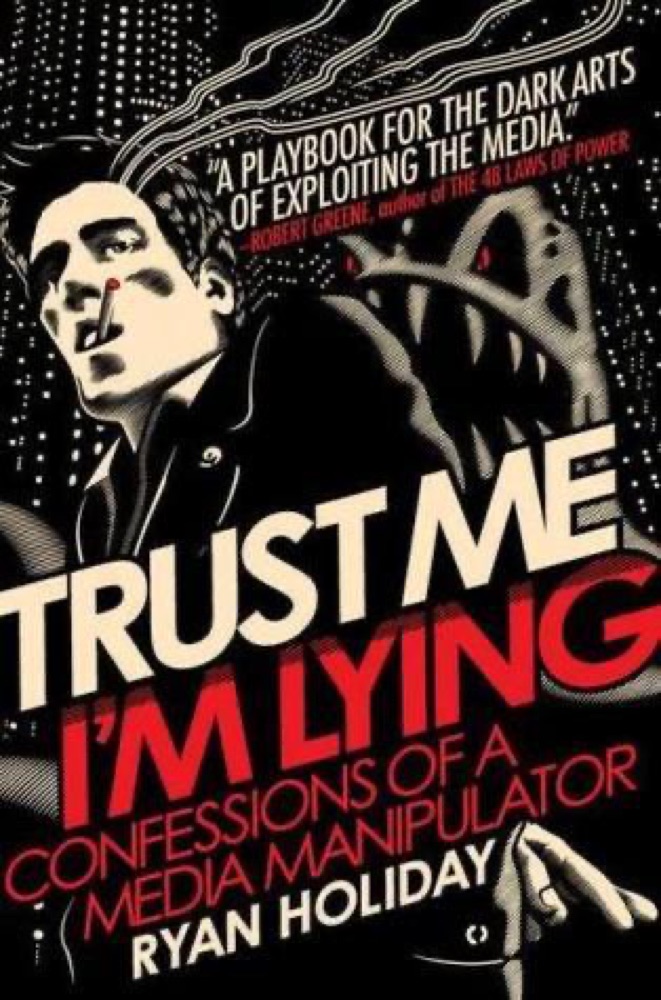

 Ego Is the Enemy
Quotes from the Book
When intelligent people read, they ask themselves a simple question: What do I plan to do with this information?
125
In an age of images and entertainment, in an age of instant emotional gratification, we neither seek nor want honesty or reality. Reality is complicated. Reality is boring. We are incapable or unwilling to handle its confusion.
21
You cannot have your news instantly and have it done well. You cannot have your news reduced to 140 characters or less without losing large parts of it. You cannot manipulate the news but not expect it to be manipulated against you. You cannot have your news for free; you can only obscure the costs. If as a culture we can learn this lesson, and if we can learn to love the hard work, we will save ourselves much trouble and collateral damage. We must remember: There is no easy way.
19
The work I do is not exactly respectable. But I want to explain how it works without any of the negatives associated with my infamous clients. I’ll show how I manipulated the media for a good cause. A friend of mine recently used some of my advice on trading up the chain for the benefit of the charity he runs. This friend needed to raise money to cover the costs of a community art project, and chose to do it through Kickstarter, the crowdsourced fund-raising platform. With just a few days’ work, he turned an obscure cause into a popular Internet meme and raised nearly ten thousand dollars to expand the charity internationally. Following my instructions, he made a YouTube video for the Kickstarter page showing off his charity’s work. Not a video of the charity’s best work, or even its most important work, but the work that exaggerated certain elements aimed at helping the video spread. (In this case, two or three examples in exotic locations that actually had the least amount of community benefit.) Next, he wrote a short article for a small local blog in Brooklyn and embedded the video. This site was chosen because its stories were often used or picked up by the New York section of the Huffington Post. As expected, the Huffington Post did bite, and ultimately featured the story as local news in both New York City and Los Angeles. Following my advice, he sent an e-mail from a fake address with these links to a reporter at CBS in Los Angeles, who then did a television piece on it—using mostly clips from my friend’s heavily edited video. In anticipation of all of this he’d been active on a channel of the social news site Reddit (where users vote on stories and topics they like) during the weeks leading up to his campaign launch in order to build up some connections on the site. When the CBS News piece came out and the video was up, he was ready to post it all on Reddit. It made the front page almost immediately. This score on Reddit (now bolstered by other press as well) put the story on the radar of what I call the major “cool stuff” blogs—sites like BoingBoing, Laughing Squid, FFFFOUND!, and others—since they get post ideas from Reddit. From this final burst of coverage, money began pouring in, as did volunteers, recognition, and new ideas. With no advertising budget, no publicist, and no experience, his little video did nearly a half million views, and funded his project for the next two years. It went from nothing to something. This may have all been for charity, but it still raises a critical question: What exactly happened? How was it so easy for him to manipulate the media, even for a good cause? He turned one exaggerated amateur video into a news story that was written about independently by dozens of outlets in dozens of markets and did millions of media impressions. It even registered nationally. He had created and then manipulated this attention entirely by himself.
13
The most powerful predictor of what spreads online is anger.
13
Conning the conmen is one of life’s most satisfying pleasures.
13
The reason the knives are so sharp online is because the pie is so small.
11
We’re a country governed by public opinion, and public opinion is largely governed by the press, so isn’t it critical to understand what governs the press?
10
Humiliation should not be suppressed. It should be monetized.
9
So today, as RSS buttons disappear from browsers and blogs, just know that this happened on purpose, so that readers could be deceived more easily.
8
it turns out that the more unbelievable headlines and articles readers are exposed to, the more it warps their compass—making the real seem fake and the fake seem real. The more extreme a headline, the longer participants spend processing it, and the more likely they are to believe it. The more times an unbelievable claim is seen, the more likely they are to believe it.
8
In 1948, long before the louder, faster, and busier world of Twitter and social media, Paul Lazarsfeld and Robert Merton wrote: The interested and informed citizen can congratulate himself on his lofty state of interest and information and neglect to see that he has abstained from decision and action. In short, he takes his secondary contact with the world of political reality, his reading and listening and thinking, as a vicarious performance…. He is concerned. He is informed. And he has all sorts of ideas as to what should be done. But, after he has gotten through his dinner and after he has listened to his favored radio programs and after he has read his second newspaper of the day, it is really time for bed.5 This is the exact reaction that web content is designed to produce. To keep you so caught up and consumed with the bubble that you don’t even realize you’re in one.
7
No marketer is ever going to push something with the stink of reasonableness, complexity, or mixed emotions.
7
Publicity does not come easily, profits do not come easily, and knowledge does not come easily.
7
The economics of the Internet created a twisted set of incentives that make traffic more important—and more profitable—than the truth.
6
Things must be negative but not too negative. Hopelessness, despair—these drive us to do nothing. Pity, empathy—those drive us to do something, like get up from our computers to act. But anger, fear, excitement, or laughter—these drive us to spread. They drive us to do something that makes us feel as if we are doing something, when in reality we are only contributing to what is probably a superficial and utterly meaningless conversation.
6
What is known can't jerk us around unwittingly. Before anything can be resolved, the implicit must be made into the explicit.
6
How can anyone maintain their sanity when everything you read, see, and hear is designed to make you stop whatever you're doing and consume because the world is supposedly ending?
5
Media was once about protecting a name; on the web it is about building one.
5
social media isn’t a set of tools to allow humans to communicate with humans. It is a set of embedding mechanisms to allow technologies to use humans to communicate with each other, in an orgy of self-organizing. . . . The Matrix had it wrong. You’re not the battery power in a global, human-enslaving AI, you are slightly more valuable. You are part of the switching circuitry.
4
What thrives online is not the writing that reflects anything close to the reality in which you and I live. Nor does it allow for the kind of change that will create the world we wish to live in.
4
Snark encourages the fakeness and stupidity it is supposedly trying to rail against.
4
Pageview journalism treats people by what they appear to want—from data that is unrepresentative to say the least—and gives them this and only this until they have forgotten that there could be anything else. It takes the audience at their worst and makes them worse.
4
As Chris Hedges, the philosopher and journalist, wrote, “In an age of images and entertainment, in an age of instant emotional gratification, we neither seek nor want honesty or reality. Reality is complicated. Reality is boring. We are incapable or unwilling to handle its confusion.
4
The link economy encourages bloggers to repeat what “other people are saying” and link to it instead of doing their own reporting and standing behind it. This changes the news from what has happened into what someone said the news is.
4
The reality is that while the Internet allows content to be written iteratively, the audience does not read or consume it iteratively. Each member usually sees what he or she sees a single time—a snapshot of the process—and makes his or her conclusions from that.
3
According to the story, “the most powerful predictor of virality is how much anger an article evokes” [emphasis mine]. I will say it again: The most powerful predictor of what spreads online is anger.
3
Snark functions as a device to punish human spontaneity, eccentricity, nonconformity, and simple error. Everyone is being snarked into line,
2
The more time kids spend online, studies show, the worse their grades are. According to Nielson, active social networkers are 26 percent more likely to give their opinion on politics and current events off-line, even though they are exactly the people whose opinions should matter the least.
2
THE FOOL WHO FEEDS THE MONSTER. I knew I had to find this century-old drawing, though I wasn’t sure why. As I rode the escalator through the glass canyon of the atrium and into the bowels of the central branch of the Los Angeles Public Library to search for it, it struck me that I wasn’t just looking for some rare old newspaper. I was looking for myself. I knew who that fool was. He was me. In addiction circles, those in recovery also use the image of the monster as a warning. They tell the story of a man who found a package on his porch. Inside was a little monster, but it was cute, like a puppy. He kept it and raised it. The more he fed it, the bigger it got and the more it needed to be fed. He ignored his worries as it grew bigger, more intimidating, demanding, and unpredictable, until one day, as he was playing with it, the monster attacked and nearly killed him. The realization that the situation was more than he could handle came too late—the man was no longer in control. The monster had a life of its own.
2
Watch on YouTube
About Ryan Holiday
We have collected 236 quotes from 8 books by Ryan Holiday on BookQuoters.
More about the author →
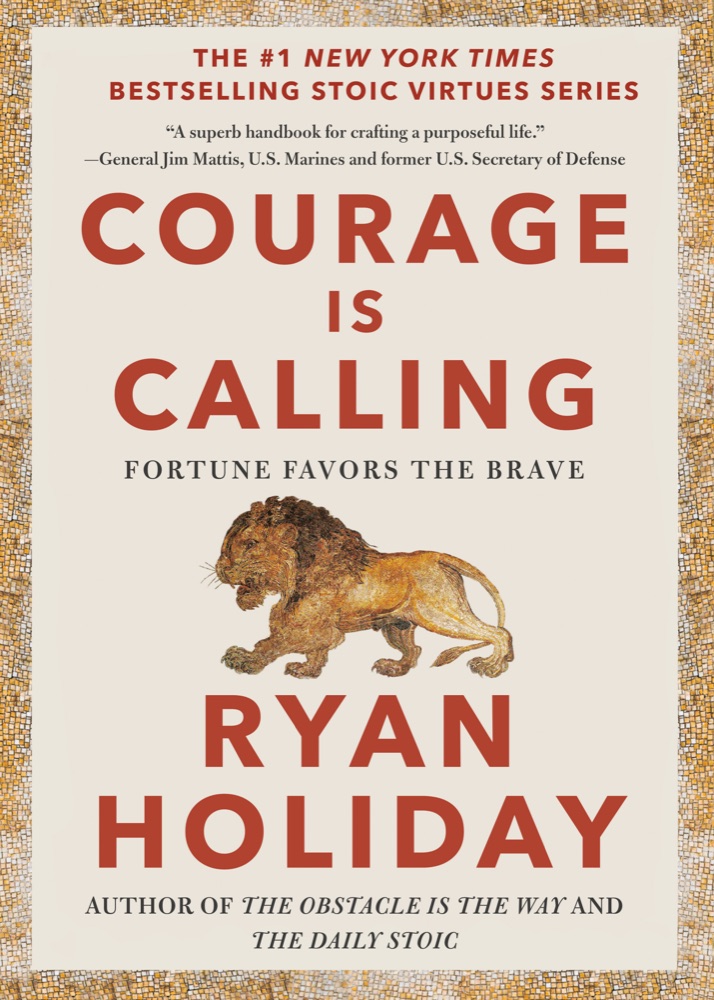

About the book
You've seen it all before. A malicious online rumor costs a company millions. A political sideshow derails the national news cycle and destroys a candidate. Some product or celebrity zooms from total obscurity to viral sensation. What you don't know is that someone is responsible for all this. Usually, someone like me.
I'm a media manipulator. In a world where blogs control and distort the news, my job is to control blogs--as much as any one person can. In today's culture...
1) Blogs like "Gawker," "Buzzfeed" and the "Huffington Post" drive the media agenda.
2) Bloggers are slaves to money, technology, and deadlines.
3) Manipulators wield these levers to shape everything you read, see and watch--online and off.
Why am I giving away these secrets? Because I'm tired of a world where blogs take indirect bribes, marketers help write the news, reckless journalists spread lie
Book details
- First published
- 2012
- Author
- Ryan Holiday
- Genre
- Nonfiction
- Goodreads rating
- 3.85 (12k ratings)
Keep reading
 The Influencing Machine: Brooke Gladstone on the Media
 Amusing Ourselves to Death: Public Discourse in the Age of Show Business
 You Are Not a Gadget
 Eating the Dinosaur
 The Age of Magical Overthinking: Notes on Modern Irrationality
 The Filter Bubble: What the Internet is Hiding From You
 You Are Not So Smart
 The Black Swan: The Impact of the Highly Improbable
 The Attention Merchants: The Epic Scramble to Get Inside Our Heads
 Chaos Monkeys: Obscene Fortune and Random Failure in Silicon Valley
 What's Our Problem?: A Self-Help Book for Societies
 You Are Now Less Dumb: How to Conquer Mob Mentality, How to Buy Happiness, and All the Other Ways to Outsmart Yourself
 I Hate the Internet
 Who Owns the Future?
 What the Dog Saw and Other Adventures
 Unscripted: Life, Liberty, and the Pursuit of Entrepreneurship
 Made to Stick: Why Some Ideas Survive and Others Die
 Airframe
 Trick Mirror: Reflections on Self-Delusion
 Hit Makers: The Science of Popularity in an Age of Distraction
 Think Like a Freak
 The Circle
 Dataclysm: Who We Are
 Artificial Wisdom
 The Art of Thinking Clearly
 Permanent Record
 Stop Reading the News: A Manifesto for a Happier, Calmer and Wiser Life
 21 Lessons for the 21st Century
 The View From Flyover Country: Essays by Sarah Kendzior
 Lexicon
 Gnomon
 Hatching Twitter: A True Story of Money, Power, Friendship, and Betrayal
 The Shockwave Rider
 Bleeding Edge
 The Witches Are Coming
 The Girl in the Spider's Web
 The World Is Flat: A Brief History of the Twenty-first Century
 Distrust That Particular Flavor
 Empire of Illusion: The End of Literacy and the Triumph of Spectacle
 How Do We Know We're Doing It Right: & Other Essays on Modern Life
 But What If We're Wrong? Thinking About the Present As If It Were the Past
 The Braindead Megaphone
 The Future
 An Absolutely Remarkable Thing
 Fooled by Randomness: The Hidden Role of Chance in Life and in the Markets
 World War Z: An Oral History of the Zombie War
 Sex, Drugs, and Cocoa Puffs: A Low Culture Manifesto
 The Imperfectionists
 Brave
Brave
 The Tipping Point: How Little Things Can Make a Big Difference
 Fall; or, Dodge in Hell
 Misbelief: What Makes Rational People Believe Irrational Things
 The Fry Chronicles
 Freakonomics: A Rogue Economist Explores the Hidden Side of Everything
 The Geek Feminist Revolution
 Influence: The Psychology of Persuasion
 The Elephant in the Brain: Hidden Motives in Everyday Life
 Same as Ever: A Guide to What Never Changes
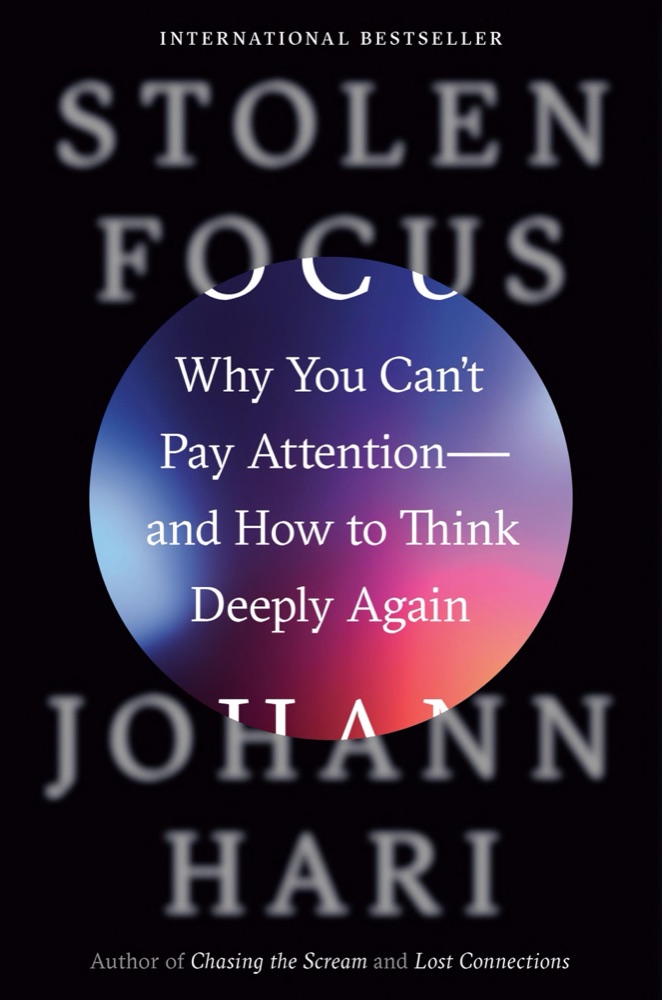 Stolen Focus: Why You Can't Pay Attention— and How to Think Deeply Again
 No Time To Spare: Thinking About What Matters