Quotes from the Book
The state is a fragile organization, and the statesman does not have the moral right to risk its survival on ethical restraint.
38
Facts are rarely self-explanatory; their significance, analysis, and interpretation—at least in the foreign policy world—depend on context and relevance.
25
To undertake a journey on a road never before traveled requires character and courage: character because the choice is not obvious; courage because the road will be lonely at first. And the statesman must then inspire his people to persist in the endeavor.
18
Because information is so accessible and communication instantaneous, there is a diminution of focus on its significance, or even on the definition of what is significant. This dynamic may encourage policymakers to wait for an issue to arise rather than anticipate it, and to regard moments of decision as a series of isolated events rather than part of a historical continuum. When this happens, manipulation of information replaces reflection as the principal policy tool.
13
The acquisition of knowledge from books provides an experience different from the Internet. Reading is relatively time-consuming; to ease the process, style is important. Because it is not possible to read all books on a given subject, much less the totality of all books, or to organize easily everything one has read, learning from books places a premium on conceptual thinking—the ability to recognize comparable data and events and project patterns into the future. And style propels the reader into a relationship with the author, or with the subject matter, by fusing substance and aesthetics. Traditionally, another way of acquiring knowledge has been through personal conversations. The discussion and exchange of ideas has for millennia provided an emotional and psychological dimension in addition to the factual content of the information exchanged. It supplies intangibles of conviction and personality. Now the culture of texting produces a curious reluctance to engage in face-to-face interaction, especially on a one-to-one basis.
12
A more immediate issue concerns North Korea, to which Bismarck’s nineteenth-century aphorism surely applies: “We live in a wondrous time, in which the strong is weak because of his scruples and the weak grows strong because of his audacity.
12
From all the great and indispensable achievements the Internet has brought to our era, its emphasis is on the actual more than the contingent, on the factual rather than the conceptual, on values shaped by consensus rather than by introspection. Knowledge of history and geography is not essential for whose who can evoke their data with the touch of a button. The mindset for walking lonely political paths may not be self-evident to those who seek confirmation by hundreds, sometimes thousands of friends on Facebook
11
Woe to the statesman whose arguments for entering a war are not as convincing at its end as they were at the beginning,” Bismarck had cautioned.
11
We live in a wondrous time, in which the strong is weak because of his scruples and the weak grows strong because of his audacity.
10
It is . . . a melancholy fact that the countries which are most humanitarian, which are most interested in internal improvement, tend to grow weaker compared with the other countries which possess a less altruistic civilization . .
9
A Harvard study has shown that in fifteen cases in history where a rising and an established power interacted, ten ended in war.
9
Americans hold that every problem has a solution; Chinese think that each solution is an admission ticket to a new set of problems.
8
The poet T. S. Eliot captured this in his “Choruses from ‘The Rock’”: Where is the Life we have lost in living? Where is the wisdom we have lost in knowledge? Where is the knowledge we have lost in information?
8
Islamic legal rulings stipulate that a treaty cannot be forever, since it must be immediately void should the Muslims become capable of fighting them.” What these treaties did not imply was a permanent system in which the Islamic state would interact on equal terms with sovereign non-Muslim states: “The communities of the dar al-harb were regarded as being in a ‘state of nature,’ for they lacked legal competence to enter into intercourse with Islam on the basis of equality and reciprocity because they failed to conform to its ethical and legal standards.” Because in this view the domestic principles of an Islamic state were divinely ordained, non-Muslim political entities were illegitimate; they could never be accepted by Muslim states as truly equal counterparts. A peaceful world order depended on the ability to forge and expand a unitary Islamic entity, not on an equilibrium of competing parts.
8
Any system of world order, to be sustainable, must be accepted as just—not only by leaders, but also by citizens. It must reflect two truths: order without freedom, even if sustained by momentary exaltation, eventually creates its own counterpoise; yet freedom cannot be secured or sustained without a framework of order to keep the peace. Order and freedom, sometimes described as opposite poles on the spectrum of experience, should instead be understood as interdependent. Can today’s leaders rise above the urgency of day-to-day events to achieve this balance?
8
New methods of accessing and communicating information unite regions as never before and project events globally—but in a manner that inhibits reflection, demanding of leaders that they register instantaneous reactions in a form expressible in slogans. Are we facing a period in which forces beyond the restraints of any order determine the future?
8
in international affairs a reputation for reliability is a more important asset than demonstrations of tactical cleverness.
7
In any of these evolutions, India will be a fulcrum of twenty-first-century order: an indispensable element, based on its geography, resources, and tradition of sophisticated leadership, in the strategic and ideological evolution of the regions and the concepts of order at whose intersection it stands.
7
The term “Asia” ascribes a deceptive coherence to a disparate region. Until the arrival of modern Western powers, no Asian language had a word for “Asia”; none of the peoples of what are now Asia’s nearly fifty sovereign states conceived of themselves as inhabiting a single “continent” or region requiring solidarity with all the others. As “the East,” it has never been clearly parallel to “the West.” There has been no common religion, not even one splintered into different branches as is Christianity in the West.
6
Three conclusions emerge from Richelieu’s career. First, the indispensable element of a successful foreign policy is a long-term strategic concept based on a careful analysis of all relevant factors. Second, the statesman must distill that vision by analyzing and shaping an array of ambiguous, often conflicting pressures into a coherent and purposeful direction. He (or she) must know where this strategy is leading and why. And, third, he must act at the outer edge of the possible, bridging the gap between his society’s experiences and its aspirations.
6
Two other issues are contributing to tension in Sino-American relations. China rejects the proposition that international order is fostered by the spread of liberal democracy and that the international community has an obligation to bring this about, and especially to achieve its perception of human rights by international action. The United States may be able to adjust the application of its views on human rights in relation to strategic priorities. But in light of its history and the convictions of its people, America can never abandon these principles altogether. On the Chinese side, the dominant elite view on this subject was expressed by Deng Xiaoping: Actually, national sovereignty is far more important than human rights, but the Group of Seven (or Eight) often infringe upon the sovereignty of poor, weak countries of the Third World. Their talk about human rights, freedom and democracy is designed only to safeguard the interests of the strong, rich countries, which take advantage of their strength to bully weak countries, and which pursue hegemony and practice power politics. No formal compromise is possible between these views; to keep the disagreement from spiraling into conflict is one of the principal obligations of the leaders of both sides.
6
postcolonial” countries. All have sought to overcome the legacy of colonial
6
Order should not have priority over freedom. But the affirmation of freedom should be elevated from a mood to a strategy.
6
United States would become the indispensable defender of the order Europe designed.
6
For the balance of power is never static; its components are in constant flux.
5
At least three viewpoints are identifiable in Arab attitudes: a small, dedicated, but not very vocal group accepting genuine coexistence with Israel and prepared to work for it; a much larger group seeking to destroy Israel by permanent confrontation; and those willing to negotiate with Israel but justifying negotiations, at least domestically, in part as a means to overcome the Jewish state in stages.
5
The cultural and political backgrounds of the two sides diverge in important aspects. The American approach to policy is pragmatic; China’s is conceptual. America has never had a powerful threatening neighbor; China has never been without a powerful adversary on its borders. Americans hold that every problem has a solution; Chinese think that each solution is an admission ticket to a new set of problems. Americans seek an outcome responding to immediate circumstances; Chinese concentrate on evolutionary change. Americans outline an agenda of practical “deliverable” items; Chinese set out general principles and analyze where they will lead. Chinese thinking is shaped in part by Communism but embraces a traditionally Chinese way of thought to an increasing extent; neither is intuitively familiar to Americans. China
5
This body of thought represents an almost total inversion of Westphalian world order. In the purist version of Islamism, the state cannot be the point of departure for an international system because states are secular, hence illegitimate; at best they may achieve a kind of provisional status en route to a religious entity on a larger scale. Noninterference in other countries’ domestic affairs cannot serve as a governing principle, because national loyalties represent deviations from the true faith and because jihadists have a duty to transform dar al-harb, the world of unbelievers. Purity, not stability, is the guiding principle of this conception of world order.
5
The religious scholar and Muslim Brotherhood ideologist Sayyid Qutb articulated perhaps the most learned and influential version of this view. In 1964, while imprisoned on charges of participating in a plot to assassinate Egyptian President Nasser, Qutb wrote Milestones, a declaration of war against the existing world order that became a foundational text of modern Islamism. In Qutb’s view, Islam was a universal system offering the only true form of freedom: freedom from governance by other men, man-made doctrines, or “low associations based on race and color, language and country, regional and national interests” (that is, all other modern forms of governance and loyalty and some of the building blocks of Westphalian order). Islam’s modern mission, in Qutb’s view, was to overthrow them all and replace them with what he took to be a literal, eventually global implementation of the Quran. The culmination of this process would be “the achievement of the freedom of man on earth—of all mankind throughout the earth.” This would complete the process begun by the initial wave of Islamic expansion in the seventh and eighth centuries, “which is then to be carried throughout the earth to the whole of mankind, as the object of this religion is all humanity and its sphere of action is the whole earth.” Like all utopian projects, this one would require extreme measures to implement. These Qutb assigned to an ideologically pure vanguard, who would reject the governments and societies prevailing in the region—all of which Qutb branded “unIslamic and illegal”—and seize the initiative in bringing about the new order.
5
Watch on YouTube
About Henry Kissinger
We have collected 82 quotes from 3 books by Henry Kissinger on BookQuoters.
More about the author →More by Henry Kissinger
About the book
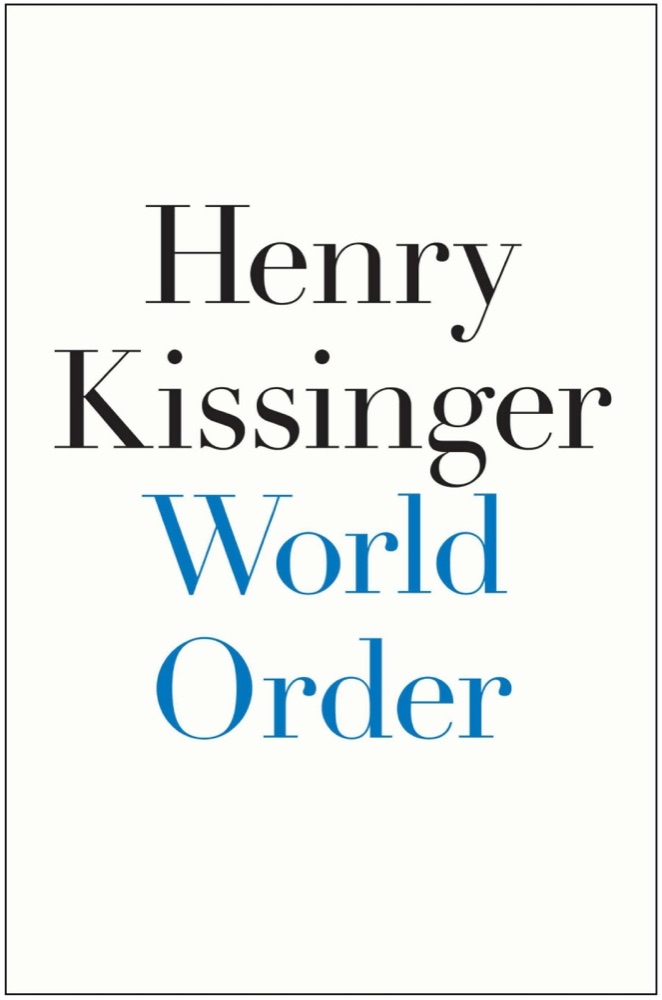
Henry Kissinger offers in World Order a deep meditation on the roots of international harmony and global disorder. Drawing on his experience as one of the foremost statesmen of the modern era—advising presidents, traveling the world, observing and shaping the central foreign policy events of recent decades—Kissinger now reveals his analysis of the ultimate challenge for the twenty-first century: how to build a shared international order in a world of divergent historical perspectives, violent conflict, proliferating technology, and ideological extremism.There has never been a true “world order,” Kissinger observes. For most of history, civilizations defined their own concepts of order. Each considered itself the center of the world and envisioned its distinct principles as universally relevant. China conceived of a global cultural hierarchy with the Emperor at its pinnacle. In Europe, Ro
Book details
- First published
- 2014
- Author
- Henry Kissinger
- Genre
- Nonfiction
- Goodreads rating
- 4.04 (14k ratings)
Keep reading
 The Next Decade: Where We've Been . . . and Where We're Going
 The Next 100 Years: A Forecast for the 21st Century
 Leadership : Six Studies in World Strategy
 The Revenge Of Geography: What the Map Tells Us About Coming Conflicts and the Battle Against Fate
 Upheaval: Turning Points for Nations in Crisis
 A World Without Islam
 Principles for Dealing with the Changing World Order: Why Nations Succeed and Fail
 The Lessons of History
 Flashpoints: The Emerging Crisis in Europe
 The Machiavellians: Defenders of Freedom
 Civilization: The West and the Rest
 The Discovery of India
 The Argumentative Indian: Writings on Indian History, Culture and Identity
 Reflections on the Revolution in France
 Imperial Ambitions: Conversations on the Post-9/11 World
 The Strange Death of Europe: Immigration, Identity, Islam
 Ill Fares the Land
 Seeing Like a State: How Certain Schemes to Improve the Human Condition Have Failed
 Rules for Radicals: A Pragmatic Primer for Realistic Radicals
 Conspirators' Hierarchy: The Story of the Committee of 300
 Understanding Power: The Indispensable Chomsky
 The Crisis of the Modern World
 The Essential Chomsky
 The World As It Is: Inside the Obama White House
 Modern Times: The World from the Twenties to the Nineties
 Closing the Ring
 Political Order and Political Decay: From the Industrial Revolution to the Globalization of Democracy
 Political Theology: Four Chapters on the Concept of Sovereignty
 From Dawn to Decadence: 500 Years of Western Cultural Life, 1500 to the Present
 Prisoners of Geography: Ten Maps That Tell You Everything You Need to Know About Global Politics
 The Muqaddimah: An Introduction to History
 Twilight of Democracy: The Seductive Lure of Authoritarianism
 A History of the World in 100 Objects
 A People's History of the United States
 Fascism: A Warning
 These Truths: A History of the United States
 Capital and Ideology
 Democracy in America
 A Conflict of Visions: Ideological Origins of Political Struggles
 The Evolution of Everything: How New Ideas Emerge
 Selections from the Prison Notebooks
 On Tyranny: Twenty Lessons from the Twentieth Century
 The Nutmeg's Curse: Parables for a Planet in Crisis
 The Origins of Totalitarianism
 Small Is Beautiful: Economics as if People Mattered
 Collapse: How Societies Choose to Fail or Succeed
 You Can't Be Neutral on a Moving Train: A Personal History of Our Times
 How Should We Then Live? The Rise and Decline of Western Thought and Culture
 The End of History and the Last Man
 On Revolution
 Walden Two
 In the Light of What We Know
 The Message
 The Federalist Papers
 Human Action: A Treatise on Economics
 Arguably: Selected Essays
 The Road to Serfdom
 Recognizing the Stranger: On Palestine and Narrative
 The Better Angels of Our Nature: Why Violence Has Declined