
 Eichmann in Jerusalem: A Report on the Banality of Evil
Quotes from the Book
Revolutions are the only political events which confront us directly and inevitably with the problem of beginning.
30
When an old truth ceases to be applicable, it does not become any truer by being stood on its head.
19
Neither Rousseau nor Robespierre was capable of dreaming of a goodness beyond virtue, just as they were unable to imagine that radical evil would ‘partake nothing of the sordid or sensual’ (Melville), that there could be wickedness beyond vice.
5
We noted before that the passion of compassion was singularly absent from the minds and hearts of the men who made the American Revolution.
4
To sound off with a cheerful ‘give me liberty or give me death’ sort of argument in the face of the unprecedented and inconceivable potential of destruction in nuclear warfare is not even hollow; it is downright ridiculous.
4
We have become so used to thinking of domestic politics in terms of party politics that we are inclined to forget that the conflict between [the party system and the council system] has always been a conflict between parliament, the source and seat of power of the party system, and the people, who have surrendered their power to their representatives.
3
For goodness that is beyond virtue, and hence beyond temptation, ignorant of the argumentative reasoning by which man fends off temptations and, by this very process, comes to know the ways, of wickedness, is also incapable of learning the arts of persuading and arguing.
2
he gains as much power by the system of mutual promises as he loses by his consent to a monopoly of power in the ruler
1
The greatest revolutionary innovation, Madison’s discovery of the federal principle for the foundation of large republics,
1
Totalitarianism’s essence, she asserts, is the total domination of human beings by terror. It is not only the scale of the crimes that is novel; it is their very character. At their heart is the attempted extirpation of all human “spontaneity,” which is to say human freedom. Nothing less than radical surgery upon “human nature” has been attempted. To this end, the essential means is the concentration camp system, perfected in different forms by Stalin and Hitler. It acts by tearing down the dignity of human beings, layer by layer, first nullifying the “judicial person,” then destroying the “moral person” (by forcing the inmates to make choices between criminal alternatives), and finally tearing down “individuality,” the seat of spontaneity, leaving, in place of recognizable human beings, “ghastly marionettes with human face.
When regimes lose the Mayflower-Compact-like cooperation of their people, their power evaporates, and, although they may stave off defeat with violence for a while, it cannot save them.
Watch on YouTube
About Hannah Arendt
We have collected 100 quotes from 4 books by Hannah Arendt on BookQuoters.
More about the author →More by Hannah Arendt
Eichmann in Jerusalem: A Report on the Banality of Evil
 The Origins of Totalitarianism
 The Human Condition
About the book
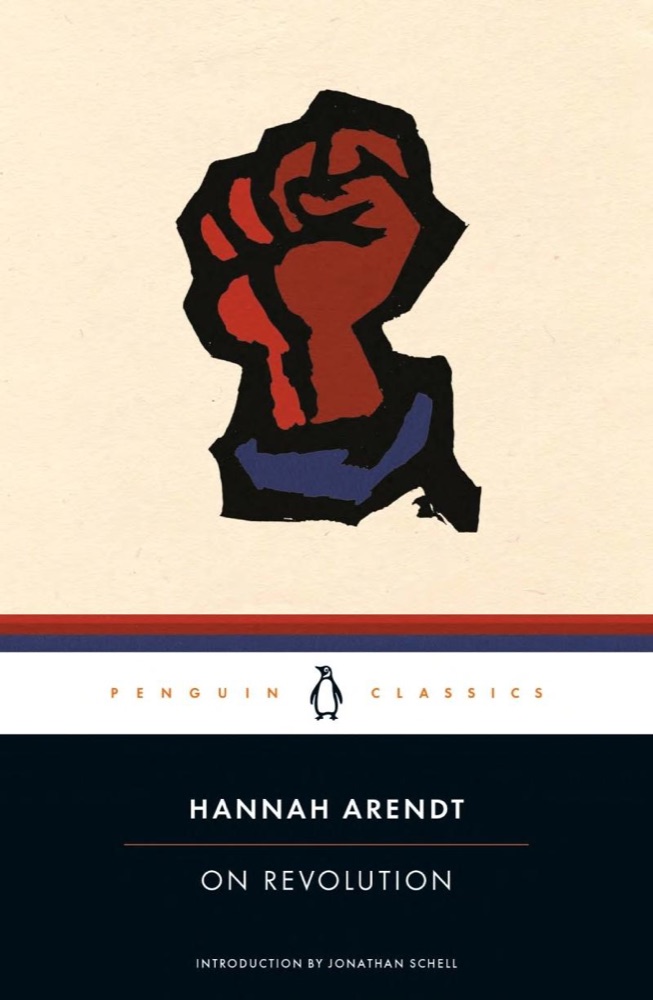
A unique and fascinating look at violent political change by one of the most profound thinkers of the twentieth century and the author of Eichmann in Jerusalem and The Origins of Totalitarianism
Hannah Arendt’s penetrating observations on the modern world, based on a profound knowledge of the past, have been fundamental to our understanding of our political landscape. On Revolution is her classic exploration of a phenomenon that has reshaped the globe. From the eighteenth-century rebellions in America and France to the explosive changes of the twentieth century, Arendt traces the changing face of revolution and its relationship to war while underscoring the crucial role such events will play in the future. Illuminating and prescient, this timeless work will fascinate anyone who seeks to decipher the forces that shape our tumultuous age.
Book details
- First published
- 1956
- Author
- Hannah Arendt
- Genre
- Philosophy
- Goodreads rating
- 3.99 (3k ratings)
Keep reading
 Reflections on the Revolution in France
 The Machiavellians: Defenders of Freedom
The Origins of Totalitarianism
The Machiavellians: Defenders of Freedom
The Origins of Totalitarianism
 The Old Regime and the French Revolution
 The March of Folly: From Troy to Vietnam
 Political Theology: Four Chapters on the Concept of Sovereignty
 Rules for Radicals: A Pragmatic Primer for Realistic Radicals
 Ill Fares the Land
 You Can't Be Neutral on a Moving Train: A Personal History of Our Times
 The First Salute : View of the American Revolution
 Democracy in America
 Arguably: Selected Essays
 The Lessons of History
 These Truths: A History of the United States
 The Rebel: An Essay on Man in Revolt
 Modern Times: The World from the Twenties to the Nineties
 The Revolution: A Manifesto
 Darkness at Noon
 It Can't Happen Here
 The Age of Revolution, 1789–1848
 The Road to Serfdom
 The Spirit of the Laws
 Ameritopia: The Unmaking of America
 History of the Russian Revolution
 The Closing of the American Mind
 The Federalist Papers
 From Dawn to Decadence: 500 Years of Western Cultural Life, 1500 to the Present
 Twilight of Democracy: The Seductive Lure of Authoritarianism
 The Subjection of Women
 Resistance, Rebellion and Death: Essays
 Conspirators' Hierarchy: The Story of the Committee of 300
 De la Démocratie en Amérique, tome II
 The Discovery of India
 The Eighteenth Brumaire of Louis Bonaparte
 On Tyranny: Twenty Lessons from the Twentieth Century
 The Chomsky-Foucault Debate: On Human Nature
 World Order
 The Next Decade: Where We've Been . . . and Where We're Going
 A People's History of the United States
 Founding Brothers: The Revolutionary Generation
 Liberalism: The Classical Tradition
 Civil Disobedience
 First As Tragedy, Then As Farce
 The Last Lion: Winston Spencer Churchill: Alone, 1932-40
 The Republic
 Liberty Defined: 50 Essential Issues That Affect Our Freedom
 The Proud Tower: A Portrait of the World Before the War, 1890-1914
 On Freedom
 The Discourses
 Behold a Pale Horse
 The Wretched of the Earth
 The Education of Henry Adams
 The Secret Agent
 Ninety-Three
 The Accursed Share: An Essay on General Economy, Volume I: Consumption
 Where Do We Go from Here: Chaos or Community?
 Anti-Intellectualism in American Life
 Walden Two
 Common Sense
 Civil Disobedience and Other Essays