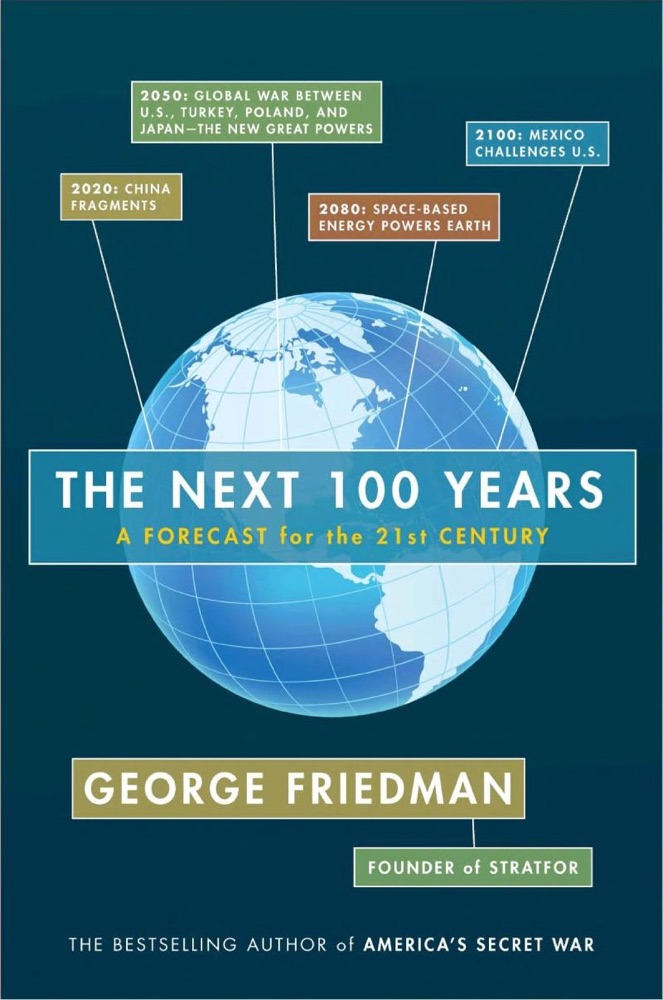
 The Next 100 Years: A Forecast for the 21st Century
Quotes from the Book
The great presidents never forget the principle of the republic and seek to preserve and enhance them – in the long run– without undermining the needs of the moment. Bad presidents simply do what is expedient, heedless of principles. But the worst presidents are those who adhere to the principles regardless of what the fortunes of the moment demand.
5
A century is about events. A decade is about people.
5
President Obama dropped the term 'war on terror', and rightly so. Terrorism is not an enemy but a type of warfare that may or may not be adopted by an enemy. Imagine if, after Pearl Harbor, an attack that relied on aircraft carriers, President Roosevelt had declared a global war on naval aviation. By focusing on terrorism instead of al Qaeda or radical Islam, Bush elevated a specific kind of assault to a position that shaped American global strategy, which left the United States strategically off-balance. Obama may have clarified the nomenclature, but he left in place a significant portion of the imbalance, which is an obsession with the threat of terrorist attacks. As we consider presidential options in the coming decade, it appears imperative that we clear up just how much of a threat terrorism actually presents and what that threat means for U.S. policy.
5
The reality is that the American people have no desire for an empire. This is not to say that they don't want the benefits, both economic and strategic. It simply means that they don't want to pay the price. Economically, Americans want the growth potential of open markets but not the pains. Politically, they want to have an enormous influence, but not the resentment of the world. Military, they want to be protected from dangers but not to bear the burdens of long-term strategy.
3
Long-term solutions are more attractive and cause much less controversy than short-term solutions, which will affect people who are still alive and voting.
2
Building a naval power takes generations, not so much to develop the necessary technology as to pass along the accumulated experience that creates good admirals.
2
While you and I are allowed the luxury of our pain, president isn't. A president must take into account how his citizens feel and he must manage them and lead them, but he must not succumb to personal feelings. His job is to maintain a ruthless sense of proportion while keeping the coldness of his calculation to himself.
2
Presidents and other politicians manage the appearance of things, largely by manipulating the air and hope.
2
The kind of president we need has little to do with ideology and more to do with a willingness to wield power to moral ends.
2
The pursuit of universal rights requires more than speeches. It requires power.
1
Success will require the studied lack of sophistication of a Ronald Reagan and the casual dishonesty of an FDR. The president must appear to be not very bright yet be able to lie convincingly.
1
The great presidents never forget the principles of the republic and seek to preserve and enhance them--in the long run--without undermining the needs of the moment. Bad presidents simply do what is expedient, heedless of principles. But the worst presidents are those who adhere to principles regardless of what the fortunes of the moment demand. [...] In preventing the unintended empire from destroying the republic, the critical factor will not be the balance of power among the branches of government, but rather a president who is committed to that constitutional balance, yet willing to wield power in his own right. In orderr to do this, the president must grasp the insufficiency of both the idealist and the realist positions. The idealists, whether of the neoconservative or the liberal flavor, don't understand that it is necessary to master the nature of power in order to act according to moral principles. The realists don't understand the futility of power without a moral core.
1
Terrorism derives from weakness, focusing on the psyche in order to make the terrorist appear more powerful than he is. The terrorist’s goal is to be treated as a significant threat when in fact he isn’t one.
When there is a surplus of money chasing assets such as homes, stocks, or bonds, prices rise and interest rates fall. Eventually prices reach irrational levels, and then they collapse. Money becomes scarce, and inefficient businesses are forced to shut down. Efficient businesses survive, and the cycle starts again. This has been repeated over and over since modern capitalism arose.
The founders made the president commander in chief for a reason: they had read Machiavelli carefully and they knew that, as he wrote, “there is no avoiding war; it can only be postponed to the advantage of others.
While America’s imperial power might degrade, power of this magnitude does not collapse quickly except through war. German, Japanese, French, and British power declined not because of debt but because of wars
my literary agent, for his support and encouragement
the most efficient way to use military power is to disrupt emerging powers before they can become even marginally threatening.
Machiavelli wrote, “The main foundations of every state, new states as well as ancient or composite ones, are good laws and good arms. You cannot have good laws without good arms, and where there are good arms, good laws inevitably follow.” This is a better definition of realism than the realists have given us.
At the height of the British Empire, Lord Palmerston said, “It is a narrow policy to suppose that this country or that is to be marked out as the eternal ally or the perpetual enemy of England. We have no eternal allies, and we have no perpetual enemies. Our interests are eternal and perpetual, and those interests it is our duty to follow.
Terrorism is an act of violence whose primary purpose is to create fear and, through that, a political result.
Maintaining the balance of power should be as fundamental to American foreign policy as the Bill of Rights is to domestic policy.
the American people must mature. We are an adolescent lot, expecting solutions to insoluble problems and perfection in our leaders.
But wishes don’t make policy. Policy is made by reality, and the reality of what has been created, whether intentionally or not, can’t be abandoned without breathtakingly severe consequences.
Ideals without power are simply words—they can come alive only when reinforced by the capacity to act. Reality is understanding how to wield power, but by itself it doesn’t guide you toward the ends to which your power should be put. Realism devoid of an understanding of the ends of power is frequently another word for thugishness, which is ultimately unrealistic. Similarly, idealism is frequently another word for self-righteousness, a disease that can be corrected only by a profound understanding of power in its complete sense, while realism uncoupled from principle is frequently incompetence masquerading as tough-mindedness. Realism and idealism are not alternatives but necessary complements. Neither can serve as a principle for foreign policy by itself.
Presidents may run for office on ideological platforms and promised policies, but their presidency is actually defined by the encounter between fortune and virtue, between the improbable and the unexpected—the thing that neither their ideology nor their proposals prepared them for—and their response. The president’s job is to anticipate what will happen, minimize the unpredictability, then respond to the unexpected with cunning and power.
Wars are times of intense technological transformation, because societies invest – sometimes with extensive borrowing – when and where matters of life and death are at stake.
If the cost of naming the enemy is diplomatically or politically unacceptable, then the war is not likely to go well.
Their job as leader was not to solve the problem – the president really has little control over the economy – but to convince the public not only that he has a plan but that he is altogether confident in the plan's success and that only a cynic or someone in different to the public's well-being would dare to question him on the details.
Idealism is frequently another word for self-righteousness, a disease that can only be corrected by a profound understanding power in its complete sense.
Watch on YouTube
About George Friedman
We have collected 79 quotes from 3 books by George Friedman on BookQuoters.
More about the author →More by George Friedman
The Next 100 Years: A Forecast for the 21st Century
 Flashpoints: The Emerging Crisis in Europe
About the book
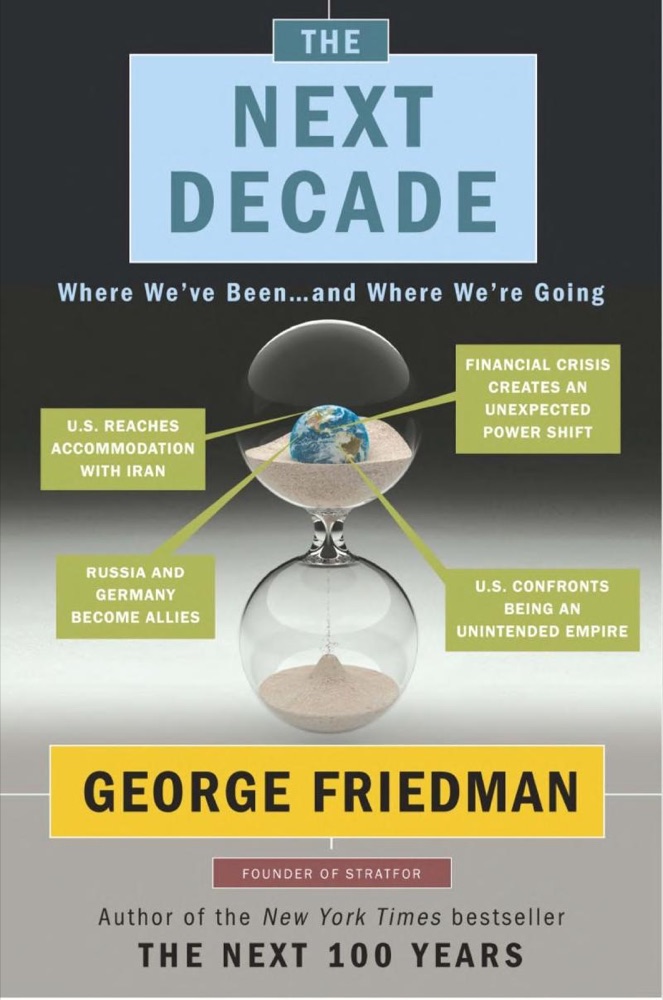
The author of the acclaimed New York Times bestseller The Next 100 Years now focuses his geopolitical forecasting acumen on the next decade and the imminent events and challenges that will test America and the world, specifically addressing the skills that will be required by the decade’s leaders.
The next ten years will be a time of massive transition. The wars in the Islamic world will be subsiding, and terrorism will become something we learn to live with. China will be encountering its crisis. We will be moving from a time when financial crises dominate the world to a time when labor shortages will begin to dominate. The new century will be taking shape in the next decade.
In The Next Decade , George Friedman offers readers a provocative and endlessly fascinating prognosis for the immediate future. Using Machiavelli’s The Prince as a model, Friedman focuses on the world’s leaders
Book details
- First published
- 2011
- Author
- George Friedman
- Genre
- Nonfiction
- Goodreads rating
- 3.84 (2k ratings)
Keep reading
 World Order
 Imperial Ambitions: Conversations on the Post-9/11 World
 Principles for Dealing with the Changing World Order: Why Nations Succeed and Fail
The Next 100 Years: A Forecast for the 21st Century
Principles for Dealing with the Changing World Order: Why Nations Succeed and Fail
The Next 100 Years: A Forecast for the 21st Century
 Reflections on the Revolution in France
 On Tyranny: Twenty Lessons from the Twentieth Century
 The World As It Is: Inside the Obama White House
 Upheaval: Turning Points for Nations in Crisis
 This Kind of War: A Study in Unpreparedness
 Behold a Pale Horse
 Leadership : Six Studies in World Strategy
 Empire
 The Soul of America: The Battle for Our Better Angels
 Understanding Power: The Indispensable Chomsky
 Conspirators' Hierarchy: The Story of the Committee of 300
 Fascism: A Warning
 One Nation: What We Can All Do to Save America's Future
 The Untold History of The United States
 Distraction
 Rules for Radicals: A Pragmatic Primer for Realistic Radicals
 The Audacity of Hope: Thoughts on Reclaiming the American Dream
 The Shock Doctrine: The Rise of Disaster Capitalism
 Executive Orders
 The Invisible Bridge: The Fall of Nixon and the Rise of Reagan
 Democracy in America
 Power Systems: Conversations on Global Democratic Uprisings and the New Challenges to U.S. Empire
 The Machiavellians: Defenders of Freedom
 Liberty Defined: 50 Essential Issues That Affect Our Freedom
 The Federalist Papers
 The Autobiography of Eleanor Roosevelt
 Becoming Madam Secretary
 Ill Fares the Land
 The Small and the Mighty: Twelve Unsung Americans Who Changed the Course of History, from the Founding to the Civil Rights Movement
 America Alone: The End of the World As We Know It
 Trumpocracy: The Corruption of the American Republic
 A World Without Islam
 It Can't Happen Here
 Dead Fall
 Shortest Way Home: One Mayor's Challenge and a Model for America's Future
 Independent Study
 The Lessons of History
 Walden Two
 Closing the Ring
 Glenn Beck's Common Sense: The Case Against an Out-of-Control Government, Inspired by Thomas Paine
 The World Is Flat: A Brief History of the Twenty-first Century
 You Can't Be Neutral on a Moving Train: A Personal History of Our Times
 The American Spirit: Who We Are and What We Stand For
 Confidence Men: Wall Street, Washington, and the Education of a President
 Profiles in Courage
 The Revolution: A Manifesto
 A People's History of the United States
 The Truths We Hold: An American Journey
 The Evolution of Everything: How New Ideas Emerge
 Quotations from Chairman Mao Tsetung
 God Emperor of Dune
Flashpoints: The Emerging Crisis in Europe
God Emperor of Dune
Flashpoints: The Emerging Crisis in Europe
 The Technological Republic: Hard Power, Soft Belief, and the Future of the West
 Promises to Keep: On Life and Politics
 Death of the Liberal Class