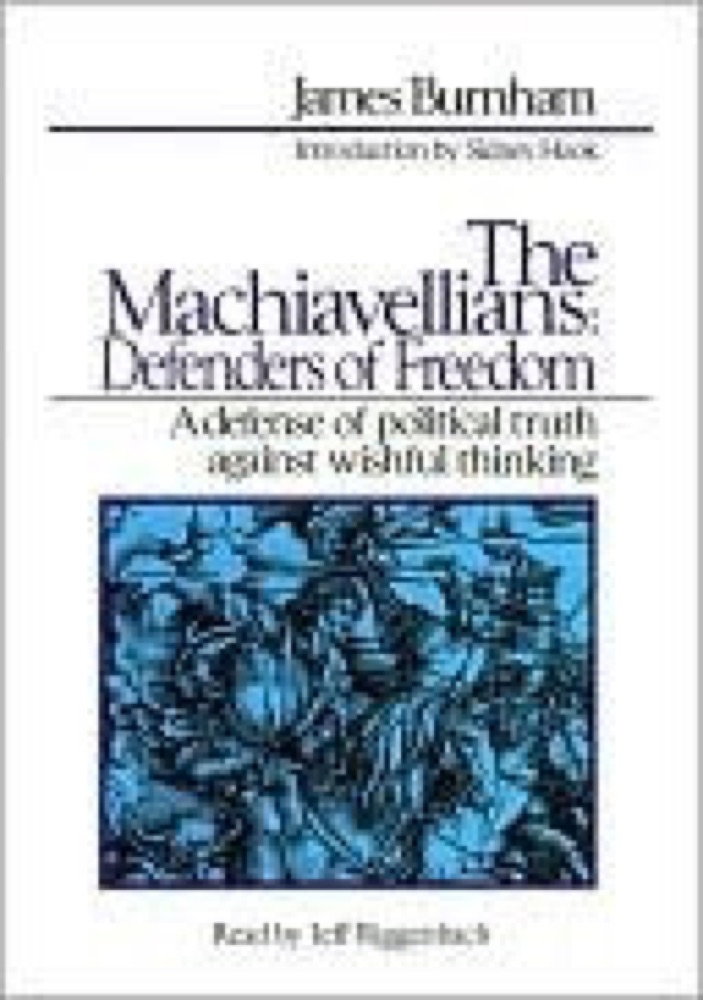
 The Machiavellians: Defenders of Freedom
Quotes from the Book
The exception is more interesting than the rule. The rule proves nothing; the exception proves everything. In the exception the power of real life breaks through the crust of a mechanism that has become torpid by repetition.
94
All significant concepts of the modern theory of the state are secularized theological concepts not only because of their historical development - in which they were transferred from theology to the theory of the state, whereby, for example, the omnipotent god became the omnipotent lawgiver - but also because of their systematic structure, the recognition of which is necessary for a sociological consideration of these concepts. The exception in jurisprudence is analogous to the miracle in theology. Only by being aware of this analogy can we appreciate the manner in which the philosophical ideas of the state developed in the last centuries.
40
Today nothing is more modern than the onslaught against the political. American financiers, industrial technicians, Marxist socialists, and anarchic-syndicalist revolutionaries unite in demanding that the biased rule of politics over unbiased economic management be done away with. There must no longer be political problems, only organizational-technical and economic-sociological tasks. The kind of economic-technical thinking that prevails today is no longer capable of perceiving a political idea. The modern state seems to have actually become what Max Weber envisioned: a huge industrial plant.
7
his sovereign slumbers in normal times but suddenly awakens when a normal situation threatens to become an exception.13 The core of this authority is its exclusive possession of the right of, or its monopoly of, political decision making. Thus Schmitt’s definition: “Sovereign is he who decides on the exception.
1
Engels in the years 1842—1844 is of the greatest significance: “The essence of the state, as that of religion, is mankind’s fear of itself.
The sovereign, who in the deistic view of the world, even if conceived as residing outside the world, had remained the engineer of the great machine, has been radically pushed aside. The machine now runs by itself.
That the works created by several masters are not as perfect as those created by one. “One sole architect” must construct a house and a town; the best constitutions are those that are the work of a sole wise legislator, they are “devised by only one”;
Arguing in Legalität und Legitimität that every constitution embodies principles that are sacrosanct, principles that may include liberalism, private property, and religious toleration, Schmitt opposed the view of those who interpreted the constitution in a “value-free” and “legalistic” fashion.21 He acknowledged that such an interpretation might be appropriate in countries where political parties accept the legitimacy of the constitution and hence adhere to what are commonly known as the rules of the game, as in England, for example. There, as Lord Balfour noted in his introduction to Walter Bagehot’s The English Constitution, “[the] whole political machinery presupposes a people so fundamentally at one that they can safely afford to bicker; and so sure of their own moderation that they are not dangerously disturbed by the never-ending din of political conflict.” Because such conditions did not exist in Germany, Schmitt argued, a value-neutral and legalistic interpretation of the constitution facilitated its subversion. Having once gained power, a militant party would not hesitate to exercise sovereignty in order to transform itself into the state.
any decision about whether something is unpolitical is always a political decision,
It is not a claim that law is not centrally important to human affairs, but rather that in the end human affairs rest upon humans and cannot ever be independent of them.
The enemy,” Schmitt notes, “is hostis (enemy) not inimicus (disliked) in the broader sense; polémios (belonging to war) not exthrós (hateful).
Todos los conceptos centrales de la moderna teoría del Estado son concepto teológicos secularizados. Lo cual es cierto no sólo por razón de su evolución histórica, en cuanto fueron transferidos de la teología a la teoría del Estado, convirtiéndose, por ejemplo, el Dios omnipotente en el legislador todopoderoso, sino también por razón de su estructura sistemática, cuyo conocimiento es imprescindible para la consideración sociológica de sus conceptos. El Estado de excepción tiene en la jurisprudencia análoga significación que el milagro en la teología. [...] Ambas disciplinas tienen un "duplex principium": la "ratio" (de ahí la teología natural y la jurisprudencia natural) y la "scriptura", es decir, un libro con revelaciones y reglas positivas.
Political ideas are generally recognized only when groups can be identified that have a plausible economic interest in turning them to their advantage.
There must no longer be political problems, only organizational-technical and economic-sociological tasks. The kind of economic-technical thinking that prevails today is no longer capable of perceiving a political idea.
Although the liberal bourgeoisie wanted a god, its god could not become active; it wanted a monarch, but he had to be powerless; it demanded freedom and equality but limited voting rights to the propertied classes in order to ensure the influence of education and property on legislation, as if education and property entitled that class to repress the poor and uneducated; it abolished the aristocracy of blood and family but permitted the impudent rule of the moneyed aristocracy, the most ignorant and the most ordinary form of an aristocracy; it wanted neither the sovereignty of the king nor that of the people. What did it actually want?
A class that shifts all political activity onto the plane of conversation in the press and in parliament is no match for social conflict.
the bloody decisive battle that has flared up today between Catholicism and atheist socialism. According to Donoso Cortés, it was characteristic of bourgeois liberalism not to decide in this battle but instead to begin a discussion. He straightforwardly defined the bourgeoisie as a “discussing class,” una clasa discutidora.
Humanity reels blindly through a labyrinth that we call history, whose entrance, exit, and shape nobody knows;2 humanity is a boat aimlessly tossed about on the sea and manned by a mutinous, vulgar, forcibly recruited crew that howls and dances until God’s rage pushes the rebellious rabble into the sea so that quiet can prevail once more.
Marxist socialism considers the question of the nature of man incidental and superfluous because it believes that changes in economic and social conditions change man.
Every political idea in one way or another takes a position on the “nature” of man and presupposes that he is either “by nature good” or “by nature evil.
All the anarchist theories from Babeuf to Bakunin, Kropotkin, and Otto Gross revolve around the one axiom: “The people are good, but the magistrate is corruptible.
In America this manifested itself in the reasonable and pragmatic belief that the voice of the people is the voice of God—a belief that is at the foundation of Jefferson’s victory of 1801.
The world architect is simultaneously the creator and the legislator, which means the legitimizing authority.
That religious, philosophical, artistic, and literary changes are closely linked with political and social conditions was already a widespread dogma in western Europe, especially in France, in the 1820s. In the Marxist philosophy of history this interdependence is radicalized to an economic dependence; it is given a systematic basis by seeking a point of ascription also for political and social changes and by finding it in the economic sphere. This materialist explanation makes a separate consideration of ideology impossible, because everywhere it sees only “reflexes,” “reflections,” and “disguises” of economic relations. Consequently, it looks with suspicion at psychological explanations and interpretations, at least in their vulgar form. Precisely because of its massive rationalism, this philosophy can easily turn into an irrationalist conception of history, since it conceives all thought as being a function and an emanation of vital processes
Democracy is the expression of a political relativism and a scientific orientation that are liberated from miracles and dogmas and based on human understanding and critical doubt.
The legal prescription, as the norm of decision, only designates how decisions should be made, not who should decide.
That the legal idea cannot translate itself independently is evident from the fact that it says nothing about who should apply it.
Watch on YouTube
About Carl Schmitt
We have collected 27 quotes from 1 book by Carl Schmitt on BookQuoters.
More about the author →About the book
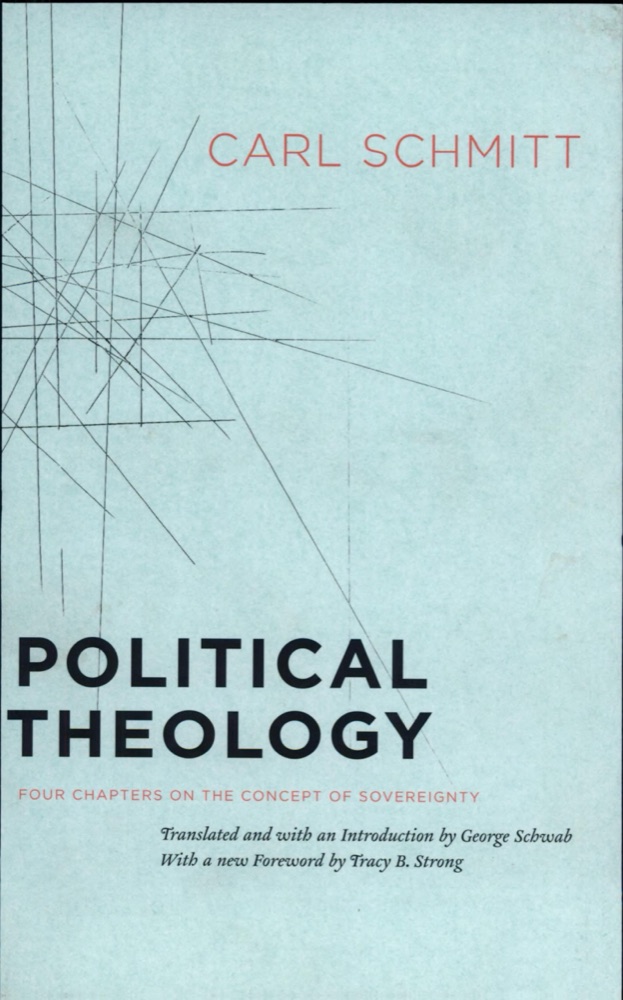
Written in the intense political and intellectual tumult of the early years of the Weimar Republic, Political Theology develops the distinctive theory of sovereignty that made Carl Schmitt one of the most significant and controversial political theorists of the twentieth century.
Focusing on the relationships among political leadership, the norms of the legal order, and the state of political emergency, Schmitt argues in Political Theology that legal order ultimately rests upon the decisions of the sovereign. According to Schmitt, only the sovereign can meet the needs of an "exceptional" time and transcend legal order so that order can then be reestablished. Convinced that the state is governed by the ever-present possibility of conflict, Schmitt theorizes that the state exists only to maintain its integrity in order to ensure order and stability. Suggesting that all concepts of modern
Book details
- First published
- 1922
- Author
- Carl Schmitt
- Genre
- Philosophy
- Goodreads rating
- 3.92 (2k ratings)
Keep reading
The Machiavellians: Defenders of Freedom
 The Constitution of Liberty
 The Spirit of the Laws
 Elements of the Philosophy of Right
 Anarchy, State, and Utopia
 A Theory of Justice
 Chomsky On Anarchism
 Reflections on the Revolution in France
 Selections from the Prison Notebooks
 Ameritopia: The Unmaking of America
 The Open Society and Its Enemies - Volume One: The Spell of Plato
 Capitalism: The Unknown Ideal
 The Origins of Totalitarianism
 Liberalism: The Classical Tradition
 A Conflict of Visions: Ideological Origins of Political Struggles
 Theological-Political Treatise
 The Road to Serfdom
 Politics
 The 5000 Year Leap: A Miracle That Changed the World
 The Chomsky-Foucault Debate: On Human Nature
 Political Order and Political Decay: From the Industrial Revolution to the Globalization of Democracy
 The Old Regime and the French Revolution
 The Federalist Papers
 Socialism: Utopian and Scientific
 Conspirators' Hierarchy: The Story of the Committee of 300
 On Revolution
 Rights of Man
 Second Treatise of Government
 Rules for Radicals: A Pragmatic Primer for Realistic Radicals
 First As Tragedy, Then As Farce
 On Liberty
 Twilight of Democracy: The Seductive Lure of Authoritarianism
 The Iron Heel
 A People's History of the United States
 A Theology of Liberation
 The Fatal Conceit: The Errors of Socialism
 Capitalism and Freedom
 One-Dimensional Man: Studies in the Ideology of Advanced Industrial Society
 Seeing Like a State: How Certain Schemes to Improve the Human Condition Have Failed
 Human Action: A Treatise on Economics
 On the Republic / On the Laws
 The Undiscovered Self
 From Dawn to Decadence: 500 Years of Western Cultural Life, 1500 to the Present
 Capitalism, Socialism and Democracy
 Democracy in America
 Socialism: An Economic and Sociological Analysis
 The Accursed Share: An Essay on General Economy, Volume I: Consumption
 The Social Contract
 The Muqaddimah: An Introduction to History
 World Order
 Ill Fares the Land
 Why Marx Was Right
 Modern Times: The World from the Twenties to the Nineties
 Civil Disobedience
 The Law
 The Evolution of Everything: How New Ideas Emerge
 The Reactionary Mind: Conservatism from Edmund Burke to Sarah Palin
 After Virtue
 Common Sense
 The Age of Revolution, 1789–1848