
 The Ascent of Money: A Financial History of the World
Quotes from the Book
No civilization, no matter how mighty it may appear to itself, is indestructible.
16
It was an idea that made the crucial difference between British and Iberian America – an idea about the way people should govern themselves. Some people make the mistake of calling that idea ‘democracy’ and imagining that any country can adopt it merely by holding elections. In reality, democracy was the capstone of an edifice that had as its foundation the rule of law – to be precise, the sanctity of individual freedom and the security of private property rights, ensured by representative, constitutional government.
14
What makes a civilization real to its inhabitants, in the end, is not just the splendid edifices at it centre, nor even the smooth functioning of the institutions they house. At its core, a civilization is the texts that are taught in its schools, learned by its students and recollected in times of tribulation.
13
The dead outnumber the living fourteen to one, and we ignore the accumulated experience of such a huge majority of mankind at our peril
13
The real social contract, (Edmund Burke) argued, was not Rousseau's social contract between the noble savage and the General Will, but a "partnership" between the present generation and future generations.
11
The success of a civilization is measured not just in its aesthetic achievements but also, and surely more importantly, in the duration and quality of life of its citizens.
9
Between 1980 and 2000 the number of patents registered in Israel was 7652 compared with 367 for all the Arab countries combined. In 2008 alone is really inventors applied to register 9591 new patents. The equivalent figure for Iran was 50 and for all majority Muslim countries in the world with 5657.
8
Was there something distinctive about American civil society that gave democracy a better chance than in France, as Tocqueville argued? Was the already centralized French state more likely to produce a Napoleon than the decentralized United States? We cannot be sure. But it is not unreasonable to ask how long the US constitution would have lasted if the United States had suffered the same military and economic strains that swept away the French constitution of 1791
7
To my mind, a civilization is much more than just the contents of a few first-rate art galleries. It is a highly complex human organization. Its paintings, statues and buildings may well be its most eye-catching achievements, but they are unintelligible without some understanding of the economic, social and political institutions which devised them, paid for them, executed them – and preserved them for our gaze.
6
The result is one of the greatest paradoxes of modern history: that an economic system designed to offer infinite choice to the individual has ended up homogenizing humanity.
6
Conceptio culpa Nasci pena Labor vita Necesse mori ‘Conception is sin, birth is pain, life is toil, death is inevitable.
5
The Japanese had no idea what elements of Western culture and institutions where the crucial ones, so they ended up copying everything, from western clothes and hair styles to the European practice of colonizing foreign people. Unfortunately, they took up empire-building at precisely the moment when the cost of imperialism began to exceed the benefits.
5
The rise of the West is, quite simply, the pre-eminent historical phenomenon of the second half of the second millennium after Christ. It is the story at the very heart of modern history. It is perhaps the most challenging riddle historians have to solve. And we should solve it not merely to satisfy our curiosity. For it is only by identifying the true causes of Western ascendancy that we can hope to estimate with any degree of accuracy the imminence of our decline and fall.
4
There is in fact no such thing as the future, singular; only futures, plural. There are multiple interpretations of history, to be sure, none definitive – but there is only one past. And although the past is over, for two reasons it is indispensable to our understanding of what we experience today and what lies ahead of us tomorrow and thereafter.
4
After 1968 the restored communist regime required all Czech rock musicians to sit a written exam in Marxism Leninism
4
We should not delude ourselves into thinking that our historical narratives, as commonly constructed, are anything more than retrofits.
3
Historians are not scientists. They cannot (and should not even trying to) establish universal laws of social or political "physics" with reliable predictive powers. Why? Because there is no possibility of repeating the single, multi-millennium experiment that constant to the past. The sample size of human history is one.
3
No serious writer would claim that the reign of Western civilization was unblemished. Yet there are those who would insist that there was nothing whatever good about it. This position is absurd.
3
Christianity, the King remarked sardonically, was ‘stuffed with miracles, contradictions and absurdities, was spawned in the fevered imaginations of the Orientals and then spread to our Europe, where some fanatics espoused it, some intriguers pretended to be convinced by it and some imbeciles actually believed it’.
2
The English were luckier in their drugs, too: long habituated to alcohol, they were roused from inebriation in the seventeenth century by American tobacco, Arabic coffee and Chinese tea. They got the stimulation of the coffee house, part café, part stock exchange, part chat-room;47 the Chinese ended up with the lethargy of the opium den, their pipes filled by none other than the British East India Company.
2
interaction of these few civilizations with one another, as much as with their own environments, has been among the most important drivers of historical change.10 The striking thing about these interactions is that authentic civilizations seem to remain true unto themselves for very long periods, despite outside influences. As Fernand Braudel put it: ‘Civilization is in fact the longest story of all . . . A civilization . . . can persist through a series of economies or societies.
2
A civilization is the single largest unit of human organization, higher though more amorphous than even an empire. Civilizations are partly a practical response by human populations to their environments – the challenges of feeding, watering, sheltering and defending themselves – but they are also cultural in character; often, though not always, religious; often, though not always, communities of language. 5 They are few, but not far between. Carroll Quigley counted two dozen in the last ten millennia.
2
The biggest threat to Western civilization is posed not by other civilizations, but by our own pusillanimity — and by the historical ignorance that feeds it.
2
One difficulty is that we cannot always reconstruct the past thoughts of these non-Western peoples, for not all of them existed in civilizations with the means of recording and preserving thought. In the end, history is primarily the study of civilizations, because without written records the historian is thrown back on spearheads and pot fragments, from which much less can be inferred. The
2
For roughly thirty years, young people at Western schools and universities have been given the idea of a liberal education, without the substance of historical knowledge. They have been taught isolated ‘modules’, not narratives, much less chronologies. They have been trained in the formulaic analysis of document excerpts, not in the key skill of reading widely and fast. They have been encouraged to feel empathy with imagined Roman centurions or Holocaust victims, not to write essays about why and how their predicaments arose.
2
In marked contrast, Ottoman scientific progress was non-existent in this same period. The best explanation for this divergence was the unlimited sovereignty of religion in the Muslim world. Towards the end of the eleventh century, influential Islamic clerics began to argue that the study of Greek philosophy was incompatible with the teachings of the Koran.
2
The bacteriologist, often risking his life to find cures for lethal afflictions, was another kind of imperial hero, as brave in his way as the soldier-explorer.
2
Not the last time in Western history, the revolutionaries armed themselves with a new religion to steel themselves for greater outrageous.
2
Institutions or products of culture. But they formalize a set of norms.
2
Watch on YouTube
About Niall Ferguson
We have collected 57 quotes from 2 books by Niall Ferguson on BookQuoters.
More about the author →More by Niall Ferguson
The Ascent of Money: A Financial History of the World
About the book
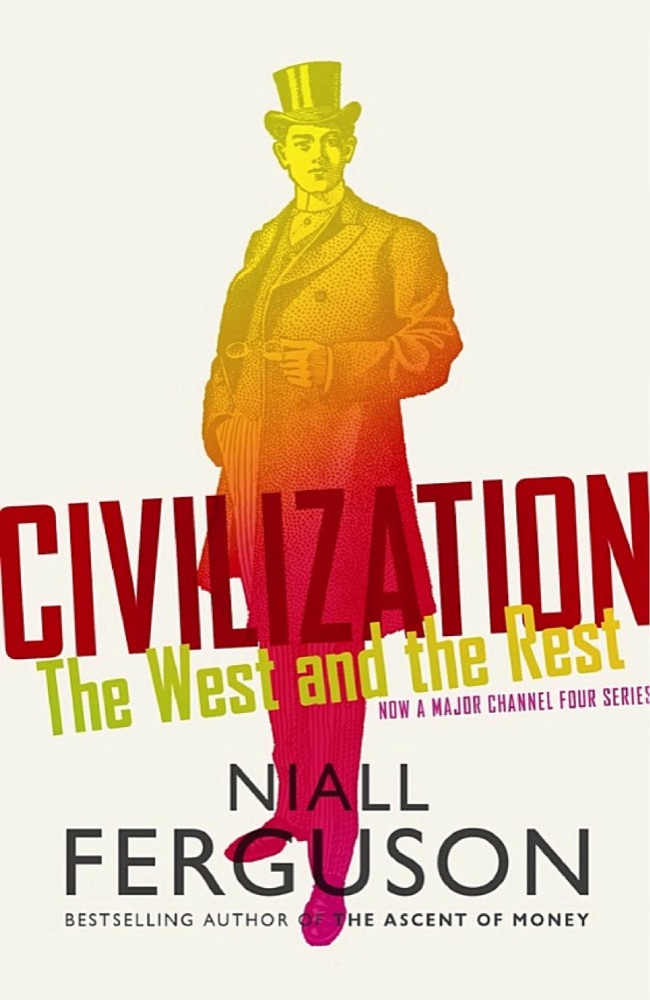
Western civilization’s rise to global dominance is the single most important historical phenomenon of the past five centuries
How did the West overtake its Eastern rivals? And has the zenith of Western power now passed? Acclaimed historian Niall Ferguson argues that beginning in the fifteenth century, the West developed six powerful new concepts, or “killer applications”—competition, science, the rule of law, modern medicine, consumerism, and the work ethic—that the Rest lacked, allowing it to surge past all other competitors.
Yet now, Ferguson shows how the Rest have downloaded the killer apps the West once monopolized, while the West has literally lost faith in itself. Chronicling the rise and fall of empires alongside clashes (and fusions) of civilizations, Civilization: The West and the Rest recasts world history with force and wit. Boldly argued and teeming with memorable c
Book details
- First published
- 2011
- Author
- Niall Ferguson
- Genre
- History
- Goodreads rating
- 3.86 (10k ratings)
Keep reading
 A History of the World in 100 Objects
 The Lessons of History
 The Dawn of Everything: A New History of Humanity
 From Dawn to Decadence: 500 Years of Western Cultural Life, 1500 to the Present
 Guns, Germs, and Steel: The Fates of Human Societies
 A Short History of Progress
 Sapiens: A Brief History of Humankind
 Europe: A History
 Homo Deus: A History of Tomorrow
 Collapse: How Societies Choose to Fail or Succeed
 The Social Conquest of Earth
 How Should We Then Live? The Rise and Decline of Western Thought and Culture
 The New Penguin History of The World
 The Next 100 Years: A Forecast for the 21st Century
 The Wizard and the Prophet: Two Remarkable Scientists and Their Dueling Visions to Shape Tomorrow's World
 Upheaval: Turning Points for Nations in Crisis
 The Evolution of Everything: How New Ideas Emerge
 Enlightenment Now: The Case for Reason, Science, Humanism, and Progress
 Our Oriental Heritage
 The Strange Death of Europe: Immigration, Identity, Islam
 1491: New Revelations of the Americas Before Columbus
 Flashpoints: The Emerging Crisis in Europe
 Last and First Men
 World Order
 The Better Angels of Our Nature: Why Violence Has Declined
 What Is History?
 A Distant Mirror: The Calamitous 14th Century
 Modern Times: The World from the Twenties to the Nineties
 Culture and Imperialism
 The World Is Flat: A Brief History of the Twenty-first Century
 Brave New World Revisited
 The Muqaddimah: An Introduction to History
 The War on the West: An Instant NYT Bestselling History of the Modern World
 The Fatal Conceit: The Errors of Socialism
 These Truths: A History of the United States
 A People's History of the United States
 Civilized to Death: What Was Lost on the Way to Modernity
 Billions & Billions: Thoughts on Life and Death at the Brink of the Millennium
 The Discovery of India
 The Crisis of the Modern World
 The Story of B: An Adventure of the Mind and Spirit
 Seeing Like a State: How Certain Schemes to Improve the Human Condition Have Failed
 Straw Dogs: Thoughts on Humans and Other Animals
 Human Action: A Treatise on Economics
 Walden Two
 Conspirators' Hierarchy: The Story of the Committee of 300
 The Rational Optimist: How Prosperity Evolves
 Orientalism
 Principles for Dealing with the Changing World Order: Why Nations Succeed and Fail
 The Nutmeg's Curse: Parables for a Planet in Crisis
 Understanding Power: The Indispensable Chomsky
 America Alone: The End of the World As We Know It
 Too Like the Lightning
 Endgame, Vol. 1: The Problem of Civilization
 Destiny Disrupted: A History of the World Through Islamic Eyes
 Humankind: A Hopeful History
 The Ascent of Man
 The End of History and the Last Man
 The Wretched of the Earth
 Magicians of the Gods: The Forgotten Wisdom of Earth's Lost Civilization