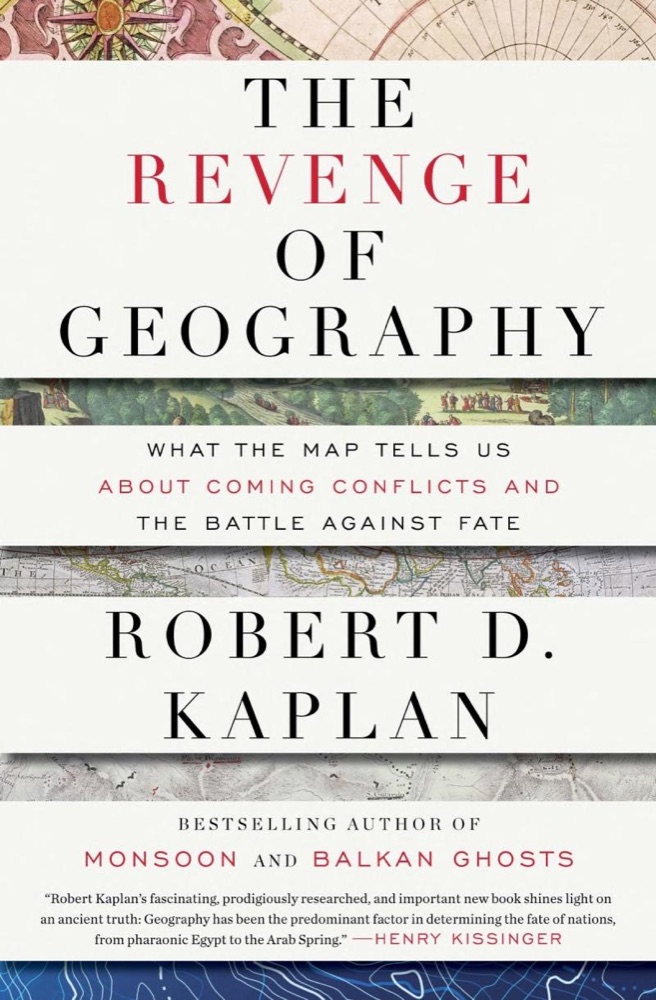
 The Revenge Of Geography: What the Map Tells Us About Coming Conflicts and the Battle Against Fate
Quotes from the Book
Sometimes you will hear leaders say, “I’m the only person who can hold this nation together.” If that’s true then that leader has truly failed to build their nation.’ That
39
What is now the EU was set up so that France and Germany could hug each other so tightly in a loving embrace that neither would be able to get an arm free with which to punch the other.
29
There are fifty American states, but they add up to one nation in a way the twenty-eight sovereign states of the European Union never can. Most of the EU states have a national identity far stronger, more defined, than any American state. It is easy to find a French person who is French first, European second, or one who pays little allegiance to the idea of Europe, but an American identifies with their Union in a way few Europeans do theirs. This is explained by the geography, and the history of the unification of the United States.
29
Why do you think your values would work in a culture you don’t understand?
24
All great nations spend peacetime preparing for the day war breaks out.
18
THE MIDDLE OF WHAT? EAST OF WHERE? THE REGION’S VERY name is based on a European view of the world, and it is a European view of the region that shaped it. The Europeans used ink to draw lines on maps: they were lines that did not exist in reality and created some of the most artificial borders the world has seen. An attempt is now being made to redraw them in blood.
17
Equally important, anyone stupid enough to contemplate invading America would soon reflect on the fact that it contains hundreds of millions of guns, which are available to a population that takes its life, liberty, and pursuit of happiness very seriously.
15
Look again at the standard Mercator map and you see that Greenland appears to be the same size as Africa, and yet Africa is actually fourteen times the size of Greenland! You could fit the USA, Greenland, India, China, Spain, France, Germany and the UK into Africa and still have room for most of Eastern Europe. We know Africa is a massive land mass, but the maps rarely tell us how massive.
12
The countries of northern Europe have been richer than those of the south for several centuries. The north industrialised earlier than the south and so has been more economically successful.
11
Analysts often write about the need for certain cultures not to lose face, or ever be seen to back down, but this is not just a problem in the Arab or East Asian cultures—it is a human problem expressed in different ways.
11
India and Pakistan can agree on one thing: neither wants the other one around.
8
Technology may seem to overcome the distances between us in both mental and physical space, but it is easy to forget that the land where we live, work and raise our children is hugely important, and that the choices of those who lead the seven billion inhabitants of this planet will to some degree always be shaped by the rivers, mountains, deserts, lakes and seas that constrain us all – as they always have.
8
It is a riddle wrapped in a mystery inside an enigma,” but few go on to complete the sentence, which ends “but perhaps there is a key. That key is Russian national interest.
8
When we are reaching for the stars, the challenges ahead are such that we will perhaps have to come together to meet them: to travel the universe not as Russians, Americans, or Chinese but as representatives of humanity. But so far, although we have broken free from the shackles of gravity, we are still improsoned in our own minds, confined by our suspicion of the "other," and thus our primal competition for resources. There is a long way to go.
7
The routine expression of hatred for others is so common in the Arab world that it barely draws comment other than from the region’s often Western-educated liberal minority who have limited access to the platform of mass media.
7
Very little trade has moved between China and India over the centuries, and that is unlikely to change soon. Of course the border is really the Tibetan–Indian border – and that is precisely why China has always wanted to control it. This is the geopolitics of fear. If China did not control Tibet, it would always be possible that India might attempt to do so. This would give India the commanding heights of the Tibetan Plateau and a base from which to push into the Chinese heartland, as well as control of the Tibetan sources of three of China’s great rivers, the Yellow, Yangtze and Mekong, which is why Tibet is known as ‘China’s Water Tower’. China, a country with approximately the same volume of water usage as the USA, but with a population five times as large, will clearly not allow that. It matters not whether India wants to cut off China’s river supply, only that it would have the power to do so. For centuries China has tried to ensure that it could never happen.
6
As we’ve seen, the Chinese are everywhere, they mean business and they are now every bit as involved across the continent as the Europeans and Americans. About a third of China’s oil imports come from Africa, which – along with the precious metals to be found in many African countries – means they have arrived, and will stay. European and American oil companies and big multinationals are still far more heavily involved in Africa, but China is quickly catching up.
6
In 1867 Alaska was bought from Russia. At the time it was known as ‘Seward’s folly’ after the Secretary of State, William Seward, who agreed the deal. He paid $7.2 million, or 2 cents an acre. The press accused him of purchasing snow, but minds were changed with the discovery of major gold deposits in 1896. Decades later huge reserves of oil were also found.
5
In Russia we see the influence of the Arctic, and how its freezing climate limits Russia’s ability to be a truly global power. In China we see the limitations of power without a global navy, and now the speed at which China is seeking to change this is becoming apparent.
5
The word ‘arctic’ comes from the Greek artikos, which means ‘near the bear’, and is a reference to the Ursa Major constellation whose last two stars point towards the North Star. The Arctic Ocean is 5.4 million square miles; this might make it the world’s smallest ocean but it is still almost as big as Russia, and one and a half times the size of the USA.
5
Why would the Russians want Moldova? Because as the Carpathian Mountains curve round south-west to become the Transylvanian Alps, to the south-east is a plain leading down to the Black Sea. That plain can also be thought of as a flat corridor into Russia; and, just as the Russians would prefer to control the North European Plain at its narrow point in Poland, so they would like to control the plain by the Black Sea – also known as Moldova – in the region formerly known as Bessarabia.
4
In NATO terms, Turkey is a key country because it controls the entrance to and exit from the Black Sea through the narrow gap of the Bosporus Strait. If it closes the Strait, which is less than a mile across at its narrowest point, the Russian Black Sea Fleet cannot break out into the Mediterranean and then the Atlantic. Even getting through the Bosporus only takes you into the Sea of Marmara; you still have to navigate through the Dardanelles Straits to get to the Aegean Sea en route to the Mediterranean.
4
This lack of a warm-water port with direct access to the oceans has always been Russia’s Achilles heel, as strategically important to it as the North European Plain. Russia is at a geographical disadvantage, saved from being a much weaker power only because of its oil and gas. No wonder, in his will of 1725, that Peter the Great advised his descendants to ‘approach as near as possible to Constantinople and India. Whoever governs there will be the true sovereign of the world. Consequently, excite continual wars, not only in Turkey, but in Persia . . . Penetrate as far as the Persian Gulf, advance as far as India.
3
When writers seek to get to the heart of the bear they often use Winston Churchill’s famous observation of Russia, made in 1939: ‘It is a riddle wrapped in a mystery inside an enigma’, but few go on to complete the sentence, which ends, ‘but perhaps there is a key. That key is Russian national interest.’ Seven years later he used that key to unlock his version of the answer to the riddle, asserting, ‘I am convinced that there is nothing they admire so much as strength, and there is nothing for which they have less respect than for weakness, especially military weakness.
3
North Korea is a stain on the world’s conscience, and yet few people know the full scale of the horrors taking place there.
3
Various Arabian tribes had helped the British against the Ottomans during the First World War, but there were two in particular which London promised to reward at the war’s end. Unfortunately both were promised the same thing – control of the Arabian Peninsula. Given that the Saud and Hashemite tribes frequently fought each other, this was a little awkward. So London dusted down the maps, drew some lines and said the head of the Saud family could rule over one region, and the head of the Hashemites could rule the other, although each would ‘need’ a British diplomat to keep an eye on things. The Saudi leader eventually landed on a name for his territory, calling it after himself, hence we know the area as Saudi Arabia – the rough equivalent would be calling the UK ‘Windsorland’.
3
For example, in Liberia it is seeking iron ore, in the DRC and Zambia it’s mining copper and, also in the DRC, cobalt. It has already helped to develop the Kenyan port of Mombasa and is now embarking on more huge projects just as Kenya’s oil assets are beginning to become commercially viable.
3
China chose the same strategy as Russia: attack as defence, leading to power. As we shall see, there were natural barriers which – if the Han could reach them and establish control – would protect them. It was a struggle over millennia, only fully realised with the annexation of Tibet in 1951.
3
Russia is not an Asian power for many reasons. Although 75 per cent of its territory is in Asia, only 22 per cent of its population lives there. Siberia may be Russia’s ‘treasure chest’, containing the majority of the mineral wealth, oil, and gas, but it is a harsh land, freezing for months on end, with vast forests (taiga), poor soil for farming and large stretches of swampland. Only two railway networks run west to east – the Trans-Siberian and the Baikal–Amur Mainline. There are few transport routes leading north to south and so no easy way for Russia to project power southward into modern Mongolia or China: it lacks the manpower and supply lines to do so.
3
All the sovereignty issues [in the Arctic region] stem from the same desires and fears -- the desire to safeguard routes for military and comercial shipping, the desire to own the natural riches of the region, and the fear that others may gain where you lose.
3
Did you know?
- The book is structured around ten maps, one for each region Marshall examines.
- It reached number one on the Sunday Times bestseller list and was a New York Times bestseller.
- It is the first book in Marshall's "Politics of Place" series, followed by The Power of Geography (2021).
- An illustrated children's edition was later adapted from the book.
- Marshall draws on roughly three decades of experience as a foreign-affairs and diplomatic correspondent.
- The US edition was published by Scribner under the subtitle "Ten Maps That Explain Everything About the World."
About Tim Marshall
Tim Marshall is a British author and journalist who spent around thirty years in news, including as foreign affairs editor and diplomatic editor at Sky News, reporting from conflicts in the Balkans, Afghanistan, Iraq and elsewhere. He is best known for his popular books on geopolitics, beginning with Prisoners of Geography.
More about the author →About the book
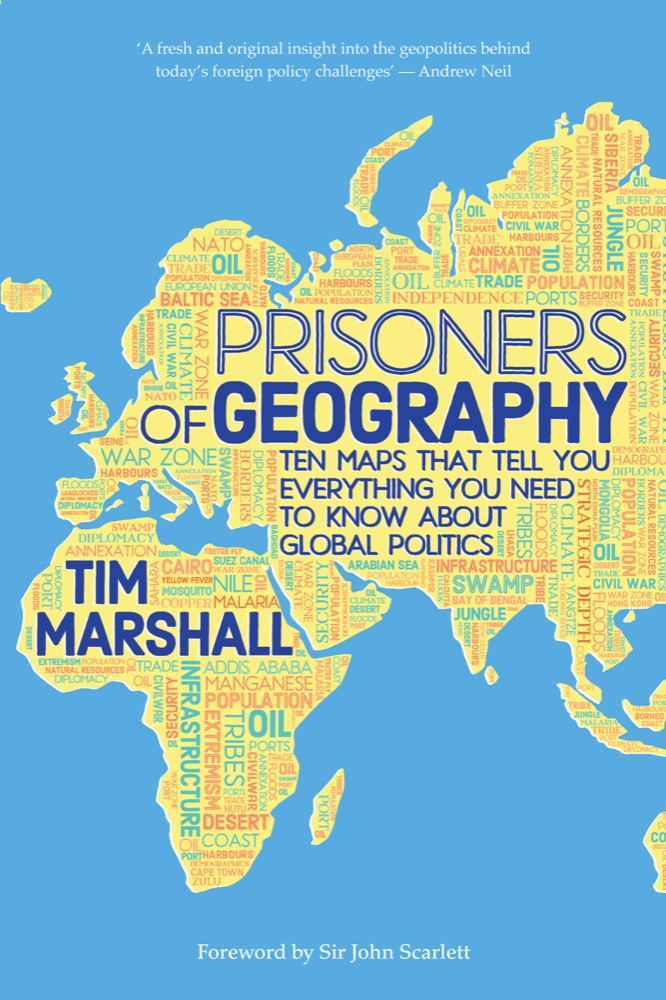
"Prisoners of Geography" is a work of popular geopolitics by British journalist Tim Marshall that argues physical geography—mountains, rivers, seas, deserts and access to ports—has shaped, and continues to constrain, the choices available to nations and their leaders. Organized around ten maps, the book devotes a chapter each to Russia, China, the United States, Western Europe, Africa, the Middle East, India and Pakistan, Korea and Japan, Latin America, and the Arctic, using each region's terrain to explain its history, alliances and conflicts.
Marshall's central theme is that geography is a persistent, underappreciated factor in world affairs even in an age of air power, the internet and globalization. He returns repeatedly to ideas such as Russia's vulnerability on the flat North European Plain and its search for a warm-water port, China's relationship with Tibet and the South China Sea, and America's good fortune in its navigable rivers and ocean barriers. The book is written for a general audience, drawing on Marshall's decades reporting from conflict zones rather than on academic geographic theory.
Published in 2015, the book became a major commercial success, reaching number one on the Sunday Times bestseller list and appearing on the New York Times bestseller list. It launched Marshall's "Politics of Place" series and was followed by "The Power of Geography" (2021). While praised for making geopolitics accessible, it has also drawn criticism from some academic geographers who see it as leaning on an older, deterministic style of regional geography.
Book details
- First published
- 2015
- Length
- 256 pages
- Series
- Politics of Place #1
- Reading time
- 5 hours
- Author
- Tim Marshall
- Genre
- Nonfiction
- Goodreads rating
- 4.19 (122k ratings)
Critical reception
- Reached number one on the UK Sunday Times bestseller list and appeared on the New York Times bestseller list.
- Widely praised as an accessible introduction to geopolitics for general readers.
- Some academic geographers criticized it for relying on a deterministic, older style of regional geography.
Series & reading order
- 1 Prisoners of Geography
- 2 The Power of Geography
If you liked this, read…
- 1The Revenge of GeographyRobert D. Kaplan's argument that geography drives international politics.
- 2Why Nations FailAnother accessible big-picture explanation of why some countries thrive and others struggle.
- 3Guns, Germs, and SteelJared Diamond's classic on how environment and geography shaped the fate of societies.
Keep reading
The Revenge Of Geography: What the Map Tells Us About Coming Conflicts and the Battle Against Fate
 Flashpoints: The Emerging Crisis in Europe
 The Next 100 Years: A Forecast for the 21st Century
 Imperium
 Upheaval: Turning Points for Nations in Crisis
 Europe: A History
 World Order
 Blowout
 Postwar: A History of Europe Since 1945
 A Short History of Russia: Tracing Russia's Path Through History, from Its Wars and Conquests, Royal Dynasties, Revolutions into the Modern Era Under Putin―a Concise Exploration of a Complex Nation
 The Strange Death of Europe: Immigration, Identity, Islam
 Principles for Dealing with the Changing World Order: Why Nations Succeed and Fail
 The World Is Flat: A Brief History of the Twenty-first Century
 Imperial Ambitions: Conversations on the Post-9/11 World
 The Quest: Energy, Security, and the Remaking of the Modern World
 Border: A Journey to the Edge of Europe
 A History of the World in 100 Objects
 Understanding Power: The Indispensable Chomsky
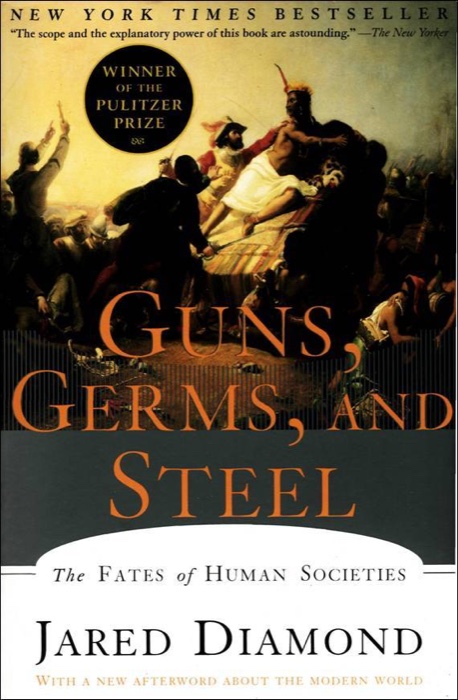 Guns, Germs, and Steel: The Fates of Human Societies
 A Russian Journal
 Moscow Rules
 Dead Fall
 River of Smoke
 The Next Decade: Where We've Been . . . and Where We're Going
 America Alone: The End of the World As We Know It
 Collapse: How Societies Choose to Fail or Succeed
 The Wretched of the Earth
 Civilization: The West and the Rest
 The Nutmeg's Curse: Parables for a Planet in Crisis
 A World Without Islam
 Power Systems: Conversations on Global Democratic Uprisings and the New Challenges to U.S. Empire
 Closing the Ring
 Boomerang: Travels in the New Third World
 Ripple
 The Wizard and the Prophet: Two Remarkable Scientists and Their Dueling Visions to Shape Tomorrow's World
 The Shadow of the Sun
 Capitalism: A Ghost Story
 The World As It Is: Inside the Obama White House
 Modern Times: The World from the Twenties to the Nineties
 Antarctica
 Patriot: A Memoir
 Billions & Billions: Thoughts on Life and Death at the Brink of the Millennium
 A Short History of Progress
 The Jakarta Method: Washington's Anticommunist Crusade and the Mass Murder Program that Shaped Our World
 1491: New Revelations of the Americas Before Columbus
 Maphead: Charting the Wide, Weird World of Geography Wonks
 Conspirators' Hierarchy: The Story of the Committee of 300
 Red Notice: A True Story of High Finance, Murder, and One Man's Fight for Justice
 The Evolution of Everything: How New Ideas Emerge
 The Message
 Arctic Dreams
 A People's History of the United States
 Start-up Nation: The Story of Israel's Economic Miracle
 Quotations from Chairman Mao Tsetung
 The Inconvenient Indian: A Curious Account of Native People in North America
 The Cold War: A World History
 Persepolis Rising
 Sandworms of Dune
 The Winds of War