
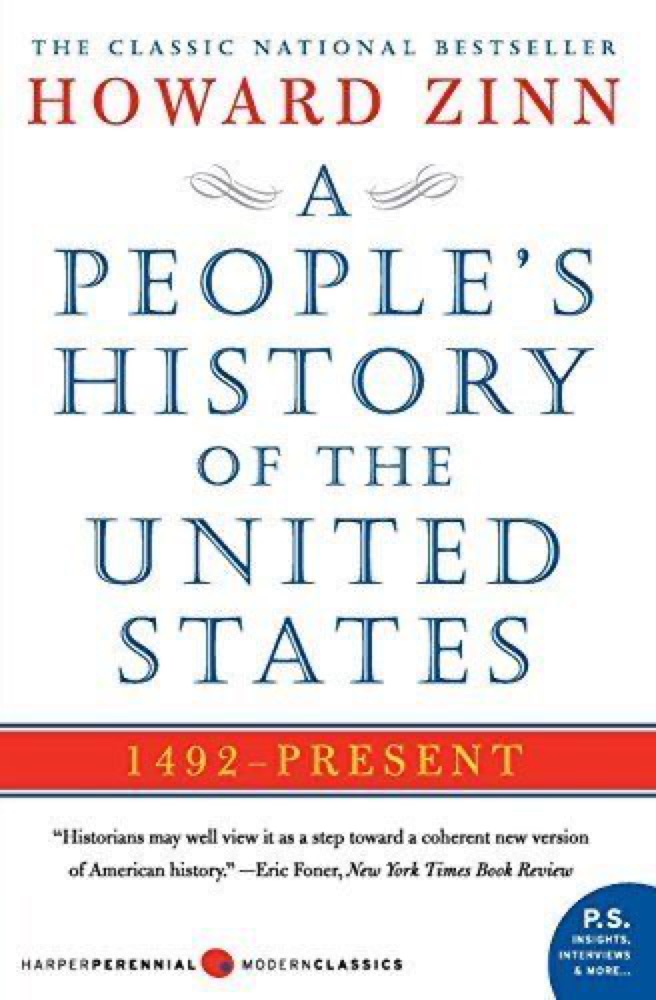
 A People's History of the United States
Quotes from the Book
I am convinced that imprisonment is a way of pretending to solve the problem of crime. It does nothing for the victims of crime, but perpetuates the idea of retribution, thus maintaining the endless cycle of violence in our culture. It is a cruel and useless substitute for the elimination of those conditions--poverty, unemployment, homelessness, desperation, racism, greed--which are at the root of most punished crime. The crimes of the rich and powerful go mostly unpunished. It must surely be a tribute to the resilience of the human spirit that even a small number of those men and women in the hell of the prison system survive it and hold on to their humanity.
204
The power of a bold idea uttered publicly in defiance of dominant opinion cannot be easily measured. Those special people who speak out in such a way as to shake up not only the self-assurance of their enemies, but the complacency of their friends, are precious catalysts for change.
118
You can't be neutral on a moving train.
114
I was astonished, bewildered. This was America, a country where, whatever its faults, people could speak, write, assemble, demonstrate without fear. It was in the Constitution, the Bill of Rights. We were a democracy... But I knew it wasn't a dream; there was a painful lump on the side of my head... The state and its police were not neutral referees in a society of contending interests. They were on the side of the rich and powerful. Free speech? Try it and the police will be there with their horses, their clubs, their guns, to stop you. From that moment on, I was no longer a liberal, a believer in the self-correcting character of American democracy. I was a radical, believing that something fundamental was wrong in this country--not just the existence of poverty amidst great wealth, not just the horrible treatment of black people, but something rotten at the root. The situation required not just a new president or new laws, but an uprooting of the old order, the introduction of a new kind of society--cooperative, peaceful, egalitarian.
108
Civil disobedience, as I put it to the audience, was not the problem, despite the warnings of some that it threatened social stability, that it led to anarchy. The greatest danger, I argued, was civil obedience, the submission of individual conscience to governmental authority. Such obedience led to the horrors we saw in totalitarian states, and in liberal states it led to the public's acceptance of war whenever the so-called democratic government decided on it... In such a world, the rule of law maintains things as they are. Therefore, to begin the process of change, to stop a war, to establish justice, it may be necessary to break the law, to commit acts of civil disobedience, as Southern black did, as antiwar protesters did.
103
I've always resented the smug statements of politicians, media commentators, corporate executives who talked of how, in America, if you worked hard you would become rich. The meaning of that was if you were poor it was because you hadn't worked hard enough. I knew this was a lie, about my father and millions of others, men and women who worked harder than anyone, harder than financiers and politicians, harder than anybody if you accept that when you work at an unpleasant job that makes it very hard work indeed.
87
But human beings are not machines, and however powerful the pressure to conform, they sometimes are so moved by what they see as injustice that they dare to declare their independence. In that historical possibility lies hope.
82
Pessimism becomes a self-fulfilling prophecy; it reproduces itself by crippling our willingness to act.
69
Human beings, whatever their backgrounds, are more open than we think, that their behavior cannot be confidently predicted from their past, that we are all creatures vulnerable to new thoughts, new attitudes. And while such vulnerability creates all sorts of possibilities, both good and bad, its very existence is exciting. It means that no human being should be written off, no change in thinking deemed impossible.
59
The future is an infinite succession of presents, and to live now as we think human beings should live, in defiance of all that is bad around us, is itself a marvelous victory.
54
That chain of relationships made me think of how connections are made--you read a book, you meet a person, you have a single experience, and your life is changed in some way. No act, therefore, however small, should be dismissed or ignored.
40
Politics is pointless if it does nothing to enhance the beauty of our lives.
38
But by this time I was acutely conscious of the gap between law and justice. I knew that the letter of the law was not as important as who held the power in any real-life situation.
34
There is a power that can be created out of pent-up indignation, courage, and the inspiration of a common cause, and that if enough people put their minds and bodies into that cause, they can win. It is a phenomenon recorded again and against in the history of popular movements against injustice all over the world.
33
History can come in handy. If you were born yesterday, with no knowledge of the past, you might easily accept whatever the government tells you. But knowing a bit of history--while it would not absolutely prove the government was lying in a given instance--might make you skeptical, lead you to ask questions, make it more likely that you would find out the truth.
30
Education becomes most rich and alive when it confronts the reality of moral conflict in the world.
25
Perhaps the most important thing I learned was about democracy, that democracy is not our government, our constitution, our legal structure. Too often they are enemies of democracy.
23
The willingness to undertake such action cannot be based on certainties, but on those possibilities glimpsed in a reading of history different from the customary painful recounting of human cruelties. In such a reading we can find not only war but resistance to war, not only injustice but rebellion against injustice, not only selfishness but self-sacrifice, not only silence in the fact of tyranny but defiance, not only callousness but compassion. Human beings show a broad spectrum of qualities, but it is the worst of these that are usually emphasized, and the result, too often, is to dishearten us, diminish our spirit. And yet, historically, that spirit refuses to surrender.
20
I had always insisted that a good education was a synthesis of book learning and involvement in social action, that each enriched the other. I wanted my students to know that the accumulation of knowledge, while fascinating in itself, is not sufficient as long as so many people in the world have no opportunity to experience that fascination.
19
The courtroom is one instance of the fact that while our society may be liberal and democratic in some large and vague sense, its moving parts, its smaller chambers--its classrooms, its workplaces, its corporate boardrooms, its jails, its military barracks--are flagrantly undemocratic, dominated by one commanding person or a tiny elite of power.
19
I see this as the central issue of our time: how to find a substitute for war in human ingenuity, imagination, courage, sacrifice, patience... War is not inevitable, however persistent it is, however long a history it has in human affairs. It does not come out of some instinctive human need. It is manufactured by political leaders, who then must make a tremendous effort--by enticement, by propaganda, by coercion--to mobilize a normally reluctant population to go to war.
18
I didn't want to spent a lot of close time with someone who believed that fun is a bourgeois indulgence.
14
Police, I learned over the years, are like soldiers, normally good-natured people, but part of a culture of obedience to orders and capable of brutal acts against anyone designated as “the enemy”—in this case, the antiwar movement.
13
Being fired has some of the advantages of dying without its supreme disadvantages. People say extra-nice things about you, and you get to hear them.
13
You can’t be neutral on a moving train,” I would tell them. Some were baffled by the metaphor, especially if they took it literally and tried to dissect its meaning. Others immediately saw what I meant: that events are already moving in certain deadly directions, and to be neutral means to accept that.
12
... the atmosphere of war brutalizes everyone involved, begets a fanaticism in which the original moral factor is buried at the bottom of a heap of atrocities committed by all sides.
9
A jury is always a more orthodox body than any defendant brought before it; for blacks it is usually a whiter group, for poor people, a more prosperous group... Another lesson about the justice system: the way the judge charges the jury inevitably pushes them one way or the other, limits their independent judgment.
8
Missing from such histories are the countless small actions of unknown people that led up to those great moments. When we understand this, we can see that the tiniest acts of protest in which we engage may become the invisible roots of social change.
7
From that moment on, I was no longer a liberal, a believer in the self-correcting character of American democracy. I was a radical, believing that something fundamental was wrong in this country—not just the existence of poverty amidst great wealth, not just the horrible treatment of black people, but something rotten at the root. The situation required not just a new president or new laws, but an uprooting of the old order, the introduction of a new kind of society—cooperative, peaceful, egalitarian.
6
I’ve always resented the smug statements of politicians, media commentators, corporate executives who talked of how, in America, if you worked hard you would become rich. The meaning of that was if you were poor it was because you hadn’t worked hard enough. I knew this was a lie, about my father and millions of others, men and women who worked harder than anyone, harder than financiers and politicians, harder than anybody if you accept that when you work at an unpleasant job that makes it very hard work indeed.
6
Watch on YouTube
About Howard Zinn
We have collected 62 quotes from 2 books by Howard Zinn on BookQuoters.
More about the author →More by Howard Zinn
A People's History of the United States
About the book
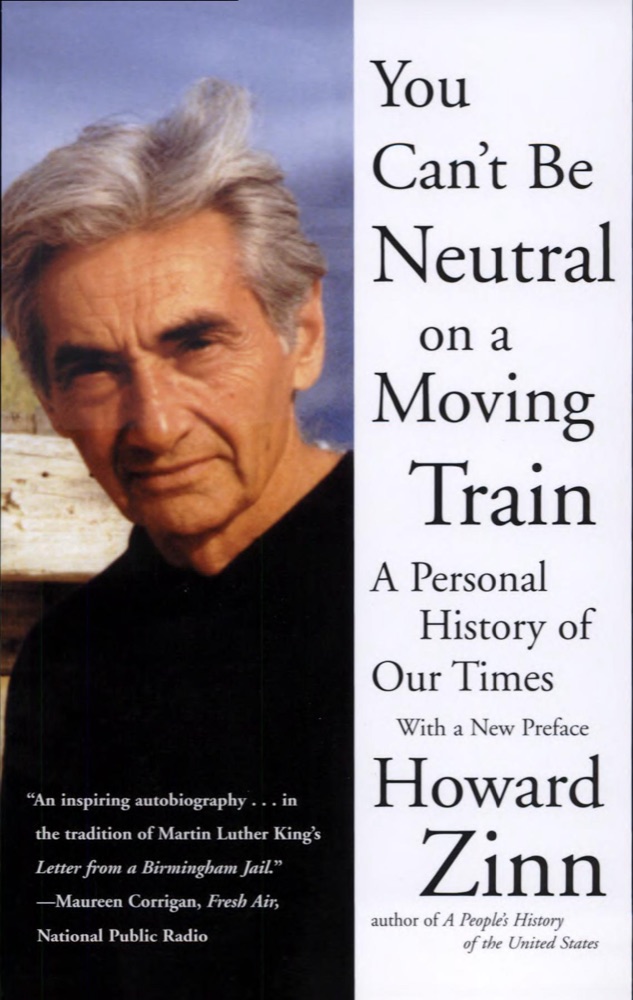
Howard Zinn, author of A People's History of the United States, tells his personal stories about more than thirty years of fighting for social change, from teaching at Spelman College to recent protests against war. A former bombardier in WWII, Zinn emerged in the civil rights movement as a powerful voice for justice. Although he's a fierce critic, he gives us reason to hope that by learning from history and engaging politically, we can make a difference in the world.
Book details
- First published
- 1994
- Author
- Howard Zinn
- Genre
- History
- Goodreads rating
- 4.34 (4k ratings)
Keep reading
 Across That Bridge: A Vision for Change and the Future of America
A People's History of the United States
Across That Bridge: A Vision for Change and the Future of America
A People's History of the United States
 The Autobiography of Martin Luther King, Jr.
 Assata: An Autobiography
 The Small and the Mighty: Twelve Unsung Americans Who Changed the Course of History, from the Founding to the Civil Rights Movement
 The Audacity of Hope: Thoughts on Reclaiming the American Dream
 Between the World and Me
 Why We Can't Wait
 No Name in the Street
 Rules for Radicals: A Pragmatic Primer for Realistic Radicals
 A Promised Land
 United: Thoughts on Finding Common Ground and Advancing the Common Good
 The Message
 The Autobiography of Eleanor Roosevelt
 The Truths We Hold: An American Journey
 Where Do We Go from Here: Chaos or Community?
 Long Walk to Freedom
 Nobody Knows My Name
 Revolution
 Humankind: A Hopeful History
 Independent Study
 On Freedom
 The Chomsky-Foucault Debate: On Human Nature
 My Life on the Road
 Walden Two
 The Source of Self-Regard: Selected Essays, Speeches, and Meditations
 Resistance, Rebellion and Death: Essays
 One Nation: What We Can All Do to Save America's Future
 The American Spirit: Who We Are and What We Stand For
 Ill Fares the Land
 The View From Flyover Country: Essays by Sarah Kendzior
 On the Other Side of Freedom: The Case for Hope
 Civil Disobedience
 One Day, Everyone Will Have Always Been Against This
 Arguably: Selected Essays
 On Tyranny: Twenty Lessons from the Twentieth Century
 Promises to Keep: On Life and Politics
 Democracy in America
 Opinions: A Decade of Arguments, Criticism, and Minding Other People’s Business
 Behold a Pale Horse
 Green Mars
 Civil Disobedience and Other Essays
 The Soul of America: The Battle for Our Better Angels
 Hope in the Dark: The Untold History of People Power
 Doing Justice: A Prosecutor's Thoughts on Crime, Punishment, and the Rule of Law
 Shortest Way Home: One Mayor's Challenge and a Model for America's Future
 What Unites Us: Reflections on Patriotism
 Children of Dune
 World War Z: An Oral History of the Zombie War
 Understanding Power: The Indispensable Chomsky
 The Fire Next Time
 The Sympathizer
 Free: A Child and a Country at the End of History
 The Fall of Babel
 Letters to a Young Contrarian
 My Beloved World
 The Road to Serfdom
 Pedagogy of the Oppressed
 Things I've Been Silent About
 The Shockwave Rider