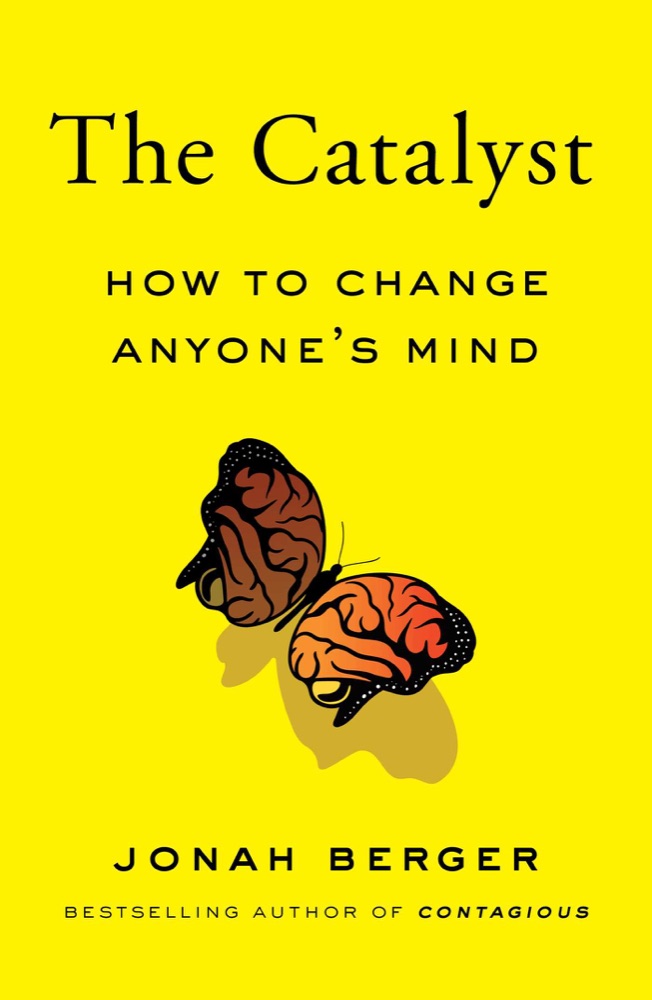

 Influence Is Your Superpower: The Science of Winning Hearts, Sparking Change, and Making Good Things Happen
Quotes from the Book
Trying to change company culture or to get a team to go along with a tough reorganization? Rather than taking a predetermined plan and pushing it on people, catalysts do the opposite. They start by asking questions. Visiting with stakeholders, getting their perspectives, and engaging them in the planning process.
5
People search for, interpret, and favor information in a way that confirms or supports their existing beliefs.
3
People have a need for freedom and autonomy. To feel that their lives and actions are within their personal control. That, rather than driven by randomness, or subject to the whims of others, they get to choose. Consequently, people are loath to give up agency. In fact, choice is so important that people prefer it even when it makes them worse off. Even when having choice makes them less happy.
2
Because rather than asking what might convince someone to change, catalysts start with a more basic question: Why hasn’t that person changed already? What is blocking them?
2
Few people attain great lives, in large part because it is just so easy to settle for a good life.
2
The question, then, is how to reduce uncertainty by lowering the barrier to trial. Four key ways to do that are to (1) harness freemium, (2) reduce up-front costs, (3) drive discovery, and (4) make it reversible.
1
To avoid this issue, rather than inhabiting someone else’s shoes, deep canvassing encourages voters to find a parallel situation from their own experience. Not imagining what it’s like to be someone else, but a time the voter felt similarly.
1
Business author Jim Collins once said that “good is the enemy of great… We don’t have great schools, principally because we have good schools. We don’t have great government, principally because we have good government. Few people attain great lives, in large part because it is just so easy to settle for a good life.
1
Push them too hard and they’ll snap. Tell them what to do and they’re unlikely to listen.
1
Try to convince people to do something, and they spend a lot of time counterarguing. Thinking about all the various reasons why it’s a bad idea or why something else would be better. Why they don’t want to do what was suggested. But give people multiple options, and suddenly things shift. Rather than thinking about what is wrong with whatever was suggested, they think about which one is better. Rather than poking holes in whatever was raised, they think about which of the options is best for them. And because they’ve been participating, they’re much more likely to go along with one of them in the end.
Letting potential hires choose which dimension is more important makes them feel like they have more of an active role in the process—and hopefully satisfies their need to negotiate. By letting candidates choose between two options the boss is equally happy with, potential hires feel like they have more autonomy without making the boss any worse off. It’s providing a menu: a limited set of options from which people can choose.
One way to spot barriers is to think about the past and present rather than the future. As we’ve discussed, instead of asking what would encourage change, ask why things haven’t changed already. Why hasn’t the desired shift already occurred. What’s preventing it? What existing factors have prevented it from happening by now?
Label Emotions Changing minds is often as much about emotion as information. Facts and figures are fine, but if you don’t understand the underlying emotional issues, it’s hard to get people to move. Emotional labeling helps identify the issues and feelings that are driving someone’s behavior. Statements like “You sound angry” or “You seem frustrated” help show that you’re listening and trying to understand. Even if the emotion is misidentified, the response provides background that helps identify the root issue.
Reflect What You Heard Mirroring involves repeating the last few words of what someone said to show you’re listening and engaged. Particularly if someone is feeling emotional, it encourages them to keep talking and gives them the opportunity to vent. If someone says, “I’m so annoyed that our supplier is always a day or two late,” for example, one could respond, “They’re always a day or two late?” Mirroring builds liking and affiliation while keeping the conversation flowing. Rather than repeating exactly what was said, paraphrasing involves restating someone’s meaning using your own words. This shows not only that you’re listening but that you truly understand what was being conveyed.
Harness Effective Pauses Pauses harness the power of silence. Silence can be uncomfortable, so people tend to fill in conversational space. Hostage negotiators use pauses to get subjects to speak up and provide additional information, particularly when they think asking a question might derail things. Rather than asking a follow-up question, they’ll be quiet and let the suspect fill in the dead air. Pauses also help focus attention. Pausing just before or after saying something important breeds anticipation and encourages listeners to focus on what the communicator is saying. President Obama was famous for this. His campaign slogan “Yes, we can” was often delivered with a pause in between, as in “Yes… we can.” In his 2008 election night speech, his most stirring sentence contained ten of these pauses: “If there is anyone out there… who still doubts… that America is a place… where all things are possible,… who still wonders… if the dream of our Founders… is alive in our time,… who still questions… the power of our democracy,… tonight… is your answer.” Strategically pausing helps make points and hold attention.
Ask Open-ended Questions Questions get discussion going and build trust. Looking at a range of situations, from getting-to-know-you conversations to speed dating, people who ask more questions are liked more.2 Questions also help collect useful information so people can better understand their conversation partners. But not all questions are equally good. Why questions (“Why didn’t you take out the trash?”), for example, can make people defensive or feel like they are being interrogated. Yes-no questions, or those that encourage one-word answers (“Do you have a gun?”), are also less effective because they fail to advance the conversation. Open-ended questions (“Can you tell me more about that?” or “Wow, how did that happen?”) not only show people you’re listening but generate details and information that can be helpful later.
Use Minimal Encouragers One way to show someone you are listening is to demonstrate through your body language and verbal responses that you are focused on what is being said. This can include nodding your head, leaning forward, or watching the person’s eyes, as well as phrases like “Yes,” “Uh-huh,” and “Okay, I see.” While such assent words or phrases may seem inconsequential, they’re actually the glue that holds conversation together. When presenters don’t get any response or feedback from their audience, they not only enjoy it less, they do a worse job overall.
Jacek Nowak was struggling to get buy-in from senior management. He was working in an industry, banking, that is known for being reticent to change. And he was trying to get them to do something about customer experience that was in some senses the antithesis of what they were used to. But by lowering the barrier to trial and driving discovery, he helped management experience the value of what he was suggesting and ultimately adopt his suggestions. Chuck Wolfe was competing against one of the largest industries in the world, whose budget dwarfed his by more than a thousandfold. And getting teens to quit smoking was something that dozens of organizations had been trying to do for decades, without much success. But by laying out the truth rather than telling teens what to do, he was able to turn the tide. By letting them be active participants rather than passive bystanders, Chuck made them feel like they were in control. He reduced reactance and got teens to convince themselves. Nick Swinmurn needed a way to help a small start-up get off the ground. Shoesite.com was running out of money and they needed to change consumer behavior—fast. But rather than trying to convince people or spending funds they didn’t have on splashy ads, they removed the roadblocks. They used free shipping (and returns) to let potential customers experience the offering firsthand. By lowering the barrier to trial, Zappos reduced risk, alleviated uncertainty, and built a billion-dollar business. And along the way, helped usher in the world of online shopping we’re all so familiar with today.
FIND CORROBORATING EVIDENCE Are you dealing with a pebble or a boulder? How expensive, risky, time-consuming, or controversial is the change you’re asking people to make? How can you provide more proof? Like interventionists, by making sure people hear from multiple sources saying similar things? What similar but independent sources can you call on to help provide more evidence? How can you concentrate them close in time? Making sure people hear from multiple others in a short period? For larger-scale change, should you use a fire hose or a sprinkler? Concentrate scarce resources or spread them out?
ALLEVIATE UNCERTAINTY How can you reduce uncertainty and get people to un-pause? Can you lower the barrier to trial? Like Dropbox, can you leverage freemium? Like Zappos, how can you reduce the up-front costs, using test drives, renting, sampling, or other approaches to make it easier for people to experience something themselves? Rather than waiting for people to come to you, can you drive discovery? Like the Acura experience, by encouraging people who didn’t know they might be interested to check it out? Can you reduce friction on the back end by making things reversible? Like Street Tails Animal Rescue did with a two-week trial period, or as others do with lenient return policies?
SHRINK DISTANCE How can you avoid the confirmation bias by staying out of the region of rejection? Can you start by asking for less? Like the doctor who got the trucker to drink less soda, chunking the change and then asking for more? Who falls in the movable middle and how can you use them to help convince others? What would be a good unsticking point and how can you use it to switch the field? Like deep canvassing, by finding a dimension on which there is already common ground to bring people closer?
EASE ENDOWMENT What is the status quo and what aspects make it attractive? Are there hidden costs of sticking with it that people might not realize? Like financial advisor Gloria Barrett, how can you surface the costs of inaction? Like Cortés, or Sam Michaels in IT, how can you burn the ships to make it clear that going back isn’t a feasible option? Like Dominic Cummings and Brexit, can you frame new things as regaining a loss?
REDUCE REACTANCE How can you allow for agency? Like the truth campaign, encouraging people to chart their path to your destination? Can you provide a menu? Like asking kids whether they want their broccoli or chicken first, can you use guided choices? Like Smoking Kid, is there a gap between attitudes and behavior, and if so, how can you highlight it? Rather than going straight for influence, have you started with understanding? Have you found the root? Like Greg Vecchi, built trust and use that to drive change?
CORROBORATING EVIDENCE Some things need more proof. Catalysts find corroborating evidence, using multiple sources to help overcome the translation problem.
REACTANCE When pushed, people push back. So rather than telling people what to do, or trying to persuade, catalysts allow for agency and encourage people to convince themselves. ENDOWMENT People are attached to the status quo. To ease endowment, catalysts surface the costs of inaction and help people realize that doing nothing isn’t as costless as it seems. DISTANCE Too far from their backyard, people tend to disregard. Perspectives that are too far away fall in the region of rejection and get discounted, so catalysts shrink distance, asking for less and switching the field. UNCERTAINTY Seeds of doubt slow the winds of change. To get people to un-pause, catalysts alleviate uncertainty. Easier to try means more likely to buy.
Take two people, one who got two invitations in quick succession and one who received them a month or two apart. The person who received the two invitations one right after the other was over 50 percent more likely to join the site.
But beyond how many invitations people received, when they received those invitations also mattered. The closer the different invitations were in time, the bigger their collective impact.
In cases where people are not aware that something exists, however, or don’t think it’s a good fit for them, driving discovery helps. Like Acura or Kiwi Crate, bringing things directly to people or using social ties to encourage trial.
But if something like free shipping or returns helps overcome that inertia and leads someone to order a particular pair, the impact of inertia shifts. Now the question isn’t whether it is worth the effort to get new shoes but whether it is worth the effort to get rid of the pair that was just ordered.
Watch on YouTube
About Jonah Berger
We have collected 29 quotes from 1 book by Jonah Berger on BookQuoters.
More about the author →About the book
From the author of New York Times bestsellers Contagious and Invisible Influence comes a revolutionary approach to changing anyone’s mind.
Everyone has something they want to change. Marketers want to change their customers’ minds and leaders want to change organizations. Start-ups want to change industries and nonprofits want to change the world. But change is hard. Often, we persuade and pressure and push, but nothing moves. Could there be a better way?
This book takes a different approach. Successful change agents know it’s not about pushing harder, or providing more information, it’s about being a catalyst. Catalysts remove roadblocks and reduce the barriers to change. Instead of asking, “How could I change someone’s mind?” they ask a different question: “Why haven’t they changed already? What’s stopping them?”
The Catalyst identifies the key barriers to change and how to mi
Book details
- First published
- 2020
- Author
- Jonah Berger
- Genre
- Nonfiction
- Goodreads rating
- 3.92 (4k ratings)
Keep reading
Influence Is Your Superpower: The Science of Winning Hearts, Sparking Change, and Making Good Things Happen
 Getting More: How to Negotiate to Achieve Your Goals in the Real World
 Smarter Faster Better: The Secrets of Being Productive in Life and Business
 The Art of Thinking Clearly
 To Sell is Human: The Surprising Truth About Moving Others
 Made to Stick: Why Some Ideas Survive and Others Die
 The Tipping Point: How Little Things Can Make a Big Difference
 Amp It Up: Leading for Hypergrowth by Raising Expectations, Increasing Urgency, and Elevating Intensity
 Crucial Conversations: Tools for Talking When Stakes are High
 Think Like a Freak
 Influencer: The Power to Change Anything
 Tribes: We Need You to Lead Us
 If I Understood You, Would I Have This Look on My Face?: My Adventures in the Art and Science of Relating and Communicating
 Think Again: The Power of Knowing What You Don't Know
 The Elephant in the Brain: Hidden Motives in Everyday Life
 Be Your Future Self Now: The Science of Intentional Transformation
 The Mom Test: How to talk to customers & learn if your business is a good idea when everyone is lying to you
 Principles: Life and Work
 Think Like a Rocket Scientist: Simple Strategies You Can Use to Make Giant Leaps in Work and Life
 Managing Humans: Biting and Humorous Tales of a Software Engineering Manager
 Supercommunicators: How to Unlock the Secret Language of Connection
 Black Box Thinking: Why Some People Never Learn from Their Mistakes - But Some Do
 Radical Candor: Be a Kickass Boss Without Losing Your Humanity
 QBQ! The Question Behind the Question: Practicing Personal Accountability in Work and in Life
 Resonate: Present Visual Stories that Transform Audiences
 Originals: How Non-Conformists Move the World
 Wait, What?: And Life's Other Essential Questions
 Never Split the Difference: Negotiating As If Your Life Depended On It
 Lean Analytics: Use Data to Build a Better Startup Faster
 The 7 Habits of Highly Effective People: Personal Workbook
 Revenge of the Tipping Point
 Smartcuts: How Hackers, Innovators, and Icons Accelerate Success
 High Conflict: Why We Get Trapped and How We Get Out
 Invent and Wander: The Collected Writings of Jeff Bezos
 Difficult Conversations: How to Discuss What Matters Most
 TED Talks: The Official TED Guide to Public Speaking
 Start with Why: How Great Leaders Inspire Everyone to Take Action
 Pour Your Heart Into It: How Starbucks Built a Company One Cup at a Time
 Founders at Work: Stories of Startups' Early Days
 Excellent Advice for Living: Wisdom I Wish I'd Known Earlier
 Predictably Irrational: The Hidden Forces That Shape Our Decisions
 Necessary Endings: The Employees, Businesses, and Relationships That All of Us Have to Give Up in Order to Move Forward
 The Black Swan: The Impact of the Highly Improbable
 Rework
 The Undoing Project: A Friendship That Changed Our Minds
 Right Kind of Wrong: The Science of Failing Well
 Thank You for Arguing: What Aristotle, Lincoln, and Homer Simpson Can Teach Us About the Art of Persuasion
 Tribe Of Mentors: Transformative Wisdom From Icons and Innovators to Help You Navigate Life's Challenges
 Antifragile: Things That Gain from Disorder
 Barking Up the Wrong Tree: The Surprising Science Behind Why Everything You Know About Success Is (Mostly) Wrong
 You Are Not So Smart
 The Power of a Positive No: How to Say No and Still Get to Yes
 Creativity, Inc.: Overcoming the Unseen Forces That Stand in the Way of True Inspiration
 Superforecasting: The Art and Science of Prediction
 The Last Lecture
 The Win Without Pitching Manifesto
 The Art of Choosing
 The Art of the Start: The Time-Tested, Battle-Hardened Guide for Anyone Starting Anything