
 How to Win Friends & Influence People
Quotes from the Book
A person’s life persuades better than his word,” said one of Aristotle’s contemporaries.
5
A bully wants you to cower or blush or run away in embarrassment. If you want to reverse the power, try pretending deep affection with just a little bit of pity.
4
When you want to change someone’s mood, tell a story.
4
Don’t push back. Keep asking questions. Insist on drilling down to definitions (“Define Star Trek”), details, and sources. And see if you can outlast your bullying opponent. If you can—if he walks away exasperated—then, despite all I’ve written about previously…you win.
3
THE UNANNOUNCED EMOTION: Don’t advertise a mood. Invoke it
3
Rhetoric is the art of influence, friendship, and eloquence, of ready wit and irrefutable logic. And it harnesses the most powerful of social forces, argument.
2
The basic difference between an argument and a fight: an argument, done skillfully, gets people to want to do what you want. You fight to win; you argue to achieve agreement.
1
When someone tries to derail an argument with an insult, your response depends on who the audience is. If the two of you are alone, say something like, “This isn’t recess. I’m out of here,” and walk away. You’re not about to persuade the jerk. But if there are bystanders, ridicule the insult. “So Bob’s answer to the problem of noise in this town is that I’m a jerk. Was that helpful to you all?” You turn sophistry into genuine banter.
1
I resist stoically. No cat is going to boss me around this morning.
1
Reframing entails refusing to accept the opponent’s definition of what the issue is about, and then substituting your own. You define the issue in your terms.
1
If life were free of contingencies, then we could live by a few rules written in stone that would apply to all our decisions. Every baby would come with an operating manual, the same guide that worked for her older brother. Every rule of thumb would apply to every situation. The early bird would always catch the worm, everything would be cheaper by the dozen, and the world would come in two colors: black and white. But alas, it doesn’t. Sometimes, under some circumstances (say, jumping out of an airplane for the first time), it’s a very bad idea to look before you leap. Sometimes the enemy of your enemy makes a terrible friend. Girl
1
Extremists usually describe the middle course as extreme.
1
For persuasive purposes, the opinion of your audience is as good as what it knows, and what it thinks is true counts the same as the truth.
1
Persuasion Alert Self-deprecating humor is an acceptable way to brag. Mentioning a moment of boneheadedness at my former company beats the far more obnoxious “I was a high-level manager at a publishing company that had twenty-three million customers the year I left.” The term du jour for this device: humblebrag. So I’m a lousy prognosticator of bestsellers. In retrospect, however, I can explain why the title was not such a bad idea after all. “South Beach” conjures an image of people—you—in bathing attire. It says vacation, one of the chief reasons people go on a diet. The Rodale editors stimulated an emotion by making readers picture a desirable and highly personal goal: you, in a bathing suit, looking great. So
1
CONCESSION: Concede your opponent’s point in order to win what you want.
1
John F. Kennedy deployed a chiasmus during his inaugural address—“Ask not what your country can do for you, ask what you can do for your country”—and thousands joined the Peace Corps.
1
It’s a form of amplification, an essential rhetorical tactic that turns up the volume as you speak. In a presentation, you can amplify by layering your points: “Not only do we have this, but we also
1
Así, cuando te enfrentes a un hombre enfadado, muéstrate serio y preocupado; no le grites «¡Venga, amargado!» Cuando una niña parece triste, la empatía implica parecer triste también; no significa decirle alegremente: «¡Anímate!»
Goals. What does the persuader want to get out of the argument? Is she trying to change the audience’s mood or mind, or does she want it to do something? Is she fixing blame, bringing a tribe together with values speech, or talking about a decision? Ethos, pathos, logos. Which appeal does she emphasize—character, emotion, or logic? Kairos. Is her timing right? Is she using the right medium?
While the rest of the world fights, we’ll argue. And argument gets you what you want more than fighting does.
Seduction is manipulation, manipulation is half of argument, and therefore many of us shy from it. But seduction offers more than just consensual sex. It can bring you consensus. Even Aristotle, that logical old soul, believed in the curative powers of seduction. Logic alone will rarely get people to do anything. They have to desire the act. You may not like seduction’s manipulative aspects; still, it beats fighting, which is what we usually mistake for an argument.
Keep it focused on choices that solve a problem to your audience’s (and your) advantage.
A bullying occasion should not be about the bully. That’s just what the bully wants. It’s about the audience. And a bully can give you the chance to enhance your ethos to that audience.
In the middle of her act, a young man shouted for her to expose her breasts. (Um, he didn’t say it exactly that way.) Now, Schumer had some choices. She could have simply had security throw the man right out. She could have yelled at him and given the audience a lecture on sexism. Instead, she got super friendly. Interrupting her routine, she shaded her eyes while the spotlight found the heckler. Looking as if she wanted to get to know him, Schumer asked the man what he did for a living. Sales, he said. “Sales?” Schumer repeated. “How’s that working out for you? ’Cause we’re not buying it.” Not the greatest joke in the world, but its spontaneity got her a laugh. More important, Schumer gained control of the occasion, seizing the power back from the heckler. Her goal was to entertain the audience, not to express any pain. When the idiot continued to harass her, Schumer still didn’t have him ejected. First she asked the audience to vote. This got a big cheer. As security escorted the man out, Schumer said, “I already miss him!
Audience targeting. When you’re under attack, search out your persuadable audience. Aim your response at that audience, even if you’re speaking to the bully.
The ancients listed definition as the tool to fall back on when the facts are against you, or when you lack a good grasp of them. If you want, you can harness definition to win an argument without using any facts at all. Facts and definitions are part of a larger overall strategy called stance. It was originally designed for defense, but it works offensively as well. Before you begin to argue, or when you find yourself under attack, take your stance: If facts work in your favor, use them. If they don’t (or you don’t know them), then… Redefine the terms instead. If that won’t work, accept your opponent’s facts and terms but… Argue that your opponent’s argument is less important than it seems. And if even that isn’t to your advantage… Claim the discussion is irrelevant.
if the two of you are alone, walk away. If you have an audience, consider throwing the fallacy back at your opponent. “I see. Purple is a fruit. So, since your skin is tan, that makes you a pair of khakis.
When being bullied or heckled, refuse to show the emotion the bully wants. Gain the audience’s sympathy by trying to look calm and above it all.
You’ll mold the minds of men and women to your will, and make any group yield to the dominion of your voice. Even more important, you’ll get them to want to yield, to commit to your plan, and to consider the result a consensus.
The argument which is made by a man’s life is of more weight than that which is furnished by words. —ISOCRATES
Watch on YouTube
About Jay Heinrichs
We have collected 30 quotes from 1 book by Jay Heinrichs on BookQuoters.
More about the author →About the book
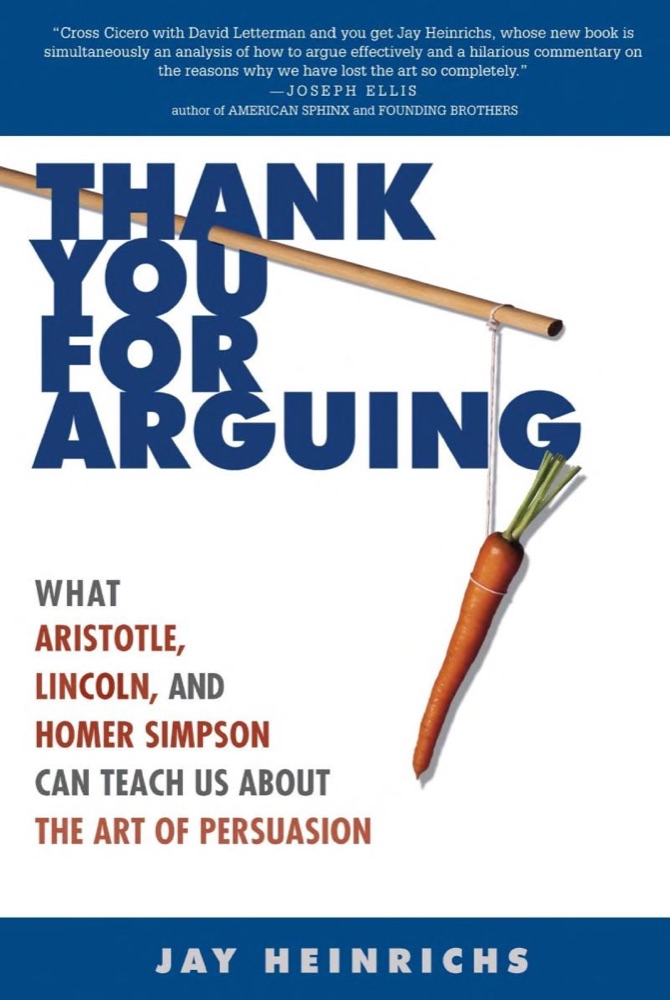
Thank You for Arguing is your master class in the art of persuasion, taught by professors ranging from Bart Simpson to Winston Churchill.
The time-tested secrets this book discloses include Cicero’s three-step strategy for moving an audience to action—as well as Honest Abe’s Shameless Trick of lowering an audience’s expectations by pretending to be unpolished. But it’s also replete with contemporary techniques such as politicians’ use of “code” language to appeal to specific groups and an eye-opening assortment of popular-culture dodges—including The Yoda Technique, The Belushi Paradigm, and The Eddie Haskell Ploy.
Whether you’re an inveterate lover of language books or just want to win a lot more anger-free arguments on the page, at the podium, or over a beer, Thank You for Arguing is for you. Written by one of today’s most popular language mavens, it’s warm, witty, erudite, an
Book details
- First published
- 2007
- Author
- Jay Heinrichs
- Genre
- Nonfiction
- Goodreads rating
- 3.56 (7k ratings)
Keep reading
How to Win Friends & Influence People
 Crucial Conversations: Tools for Talking When Stakes are High
 Words That Work: It's Not What You Say, It's What People Hear
 The Art of Thinking Clearly
 If I Understood You, Would I Have This Look on My Face?: My Adventures in the Art and Science of Relating and Communicating
 The Art of Public Speaking
 The Power of a Positive No: How to Say No and Still Get to Yes
 Letters to a Young Contrarian
 The Gift of Fear: Survival Signals That Protect Us from Violence
 Skin in the Game: The Hidden Asymmetries in Daily Life
 The 48 Laws of Power
 Influence: The Psychology of Persuasion
 Influence Is Your Superpower: The Science of Winning Hearts, Sparking Change, and Making Good Things Happen
 Rationality: From AI to Zombies
 Difficult Conversations: How to Discuss What Matters Most
 Getting More: How to Negotiate to Achieve Your Goals in the Real World
 Made to Stick: Why Some Ideas Survive and Others Die
 My Own Words
 The Rhetoric & The Poetics of Aristotle
 Tactics: A Game Plan for Discussing Your Christian Convictions
 Resonate: Present Visual Stories that Transform Audiences
 Excellent Advice for Living: Wisdom I Wish I'd Known Earlier
 Never Split the Difference: Negotiating As If Your Life Depended On It
 Consider This: Moments in My Writing Life After Which Everything Was Different
 The Coddling of the American Mind: How Good Intentions and Bad Ideas Are Setting up a Generation for Failure
 Think Like a Freak
 The Elephant in the Brain: Hidden Motives in Everyday Life
 TED Talks: The Official TED Guide to Public Speaking
 The Influencing Machine: Brooke Gladstone on the Media
 Tools of Titans: The Tactics, Routines, and Habits of Billionaires, Icons, and World-Class Performers
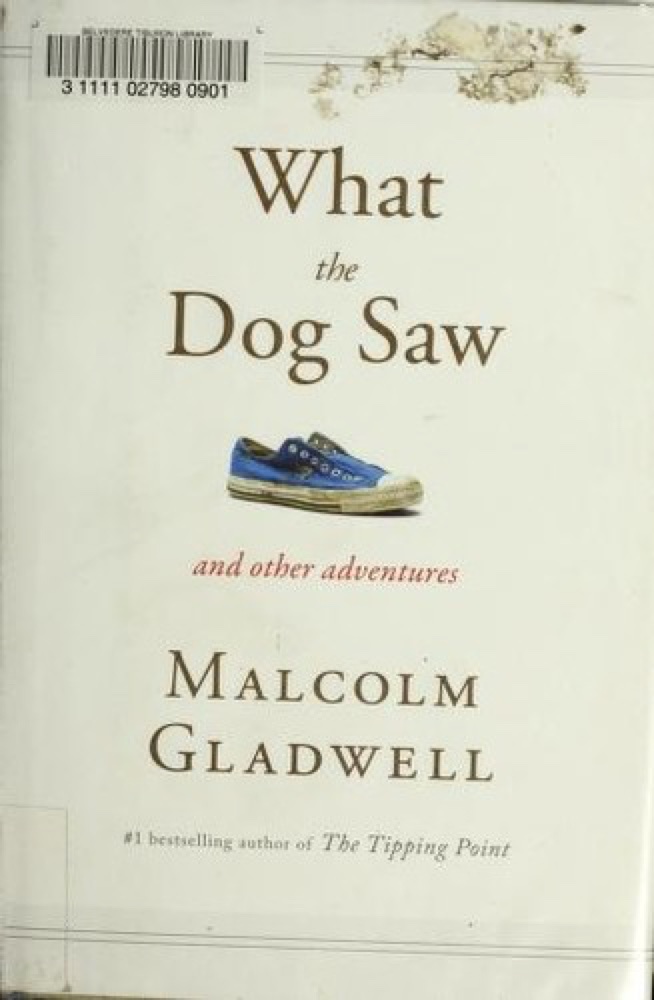 What the Dog Saw and Other Adventures
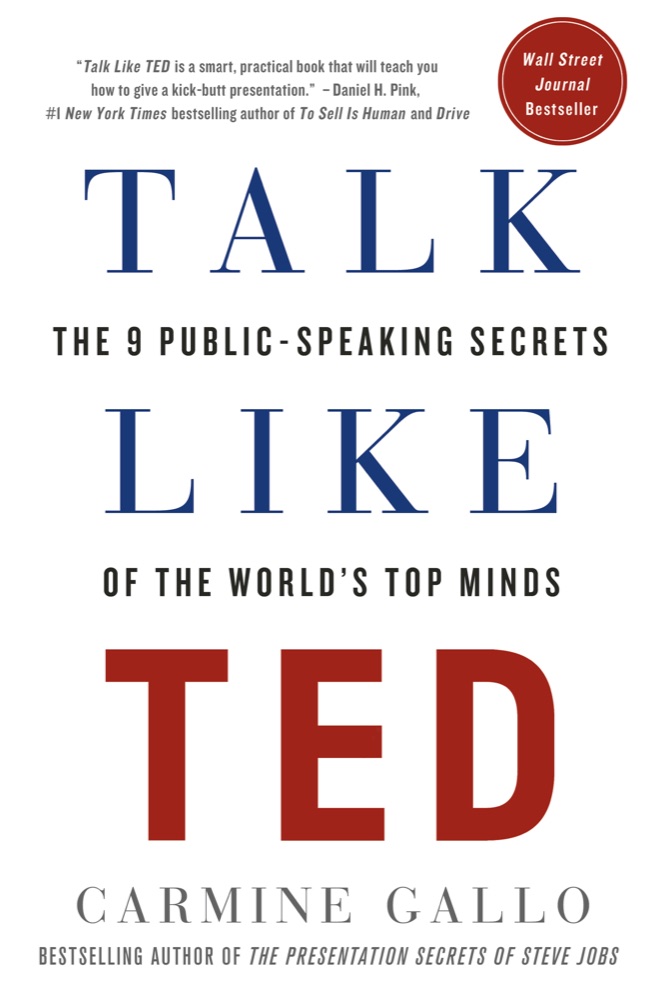 Talk Like TED: The 9 Public-Speaking Secrets of the World's Top Minds
 Bossypants
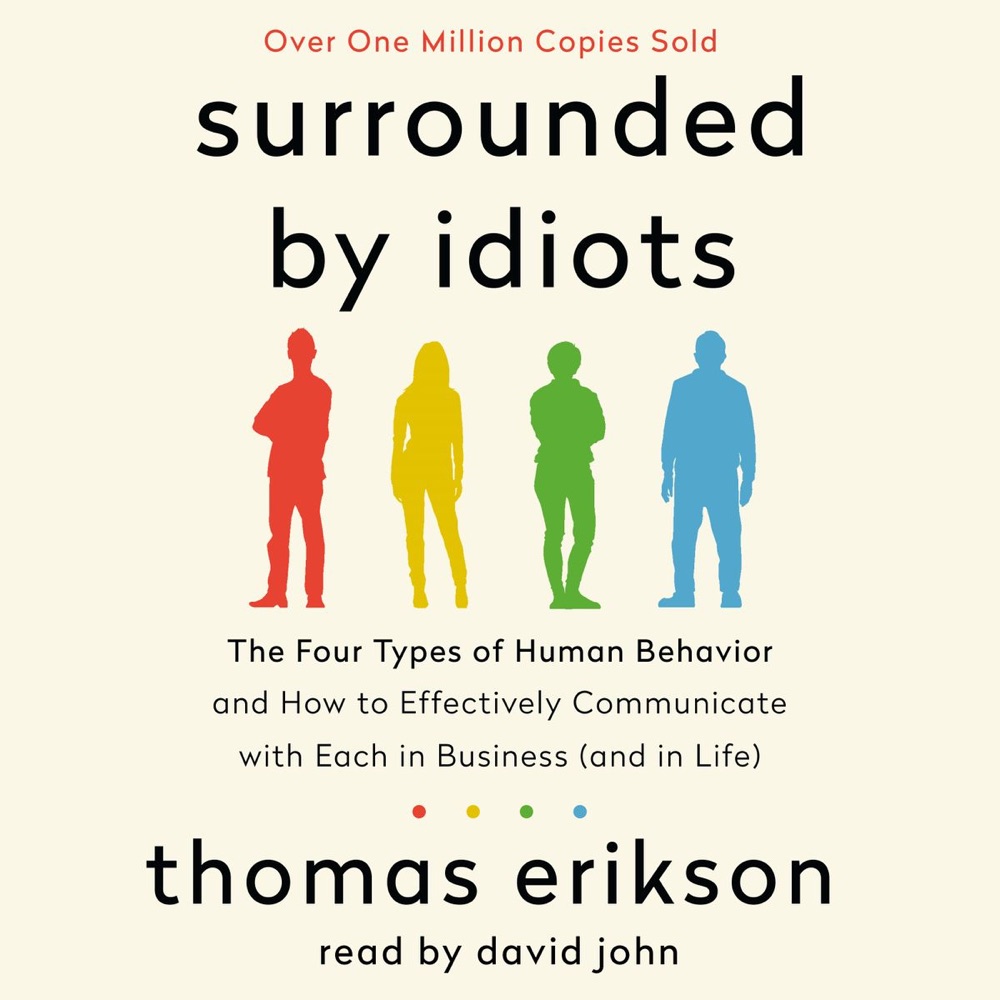 Surrounded by Idiots
 The Last Lecture
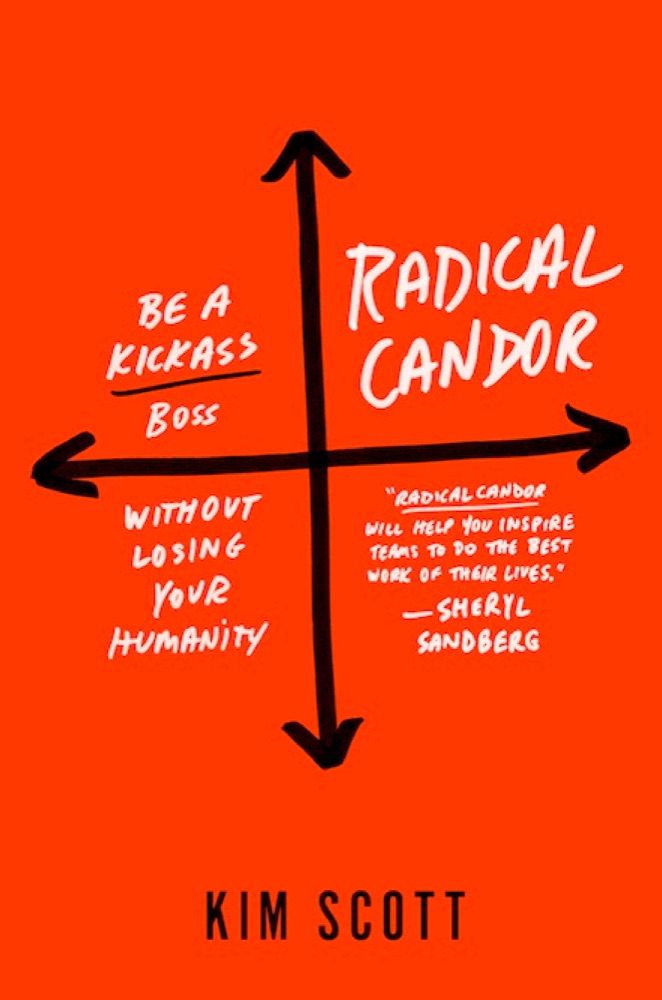 Radical Candor: Be a Kickass Boss Without Losing Your Humanity
 Children of Dune
 The Art of Seduction
 The Fran Lebowitz Reader
 The Art of Always Being Right
 If This Isn't Nice, What Is?: Advice for the Young
 Lexicon
 Hitch-22: A Memoir
 The Art of Living: The Classical Manual on Virtue, Happiness and Effectiveness
 High Conflict: Why We Get Trapped and How We Get Out
 Rules for Radicals: A Pragmatic Primer for Realistic Radicals
 Supercommunicators: How to Unlock the Secret Language of Connection
 Dangerous
 To Sell is Human: The Surprising Truth About Moving Others
 The Witches Are Coming
 Gorgias
 Impro: Improvisation and the Theatre
 David and Goliath: Underdogs, Misfits, and the Art of Battling Giants
 Dare to Lead
 The Black Swan: The Impact of the Highly Improbable
 You Are Not So Smart
 Imager
 How to Be a Bawse: A Guide to Conquering Life
 Look Closer