
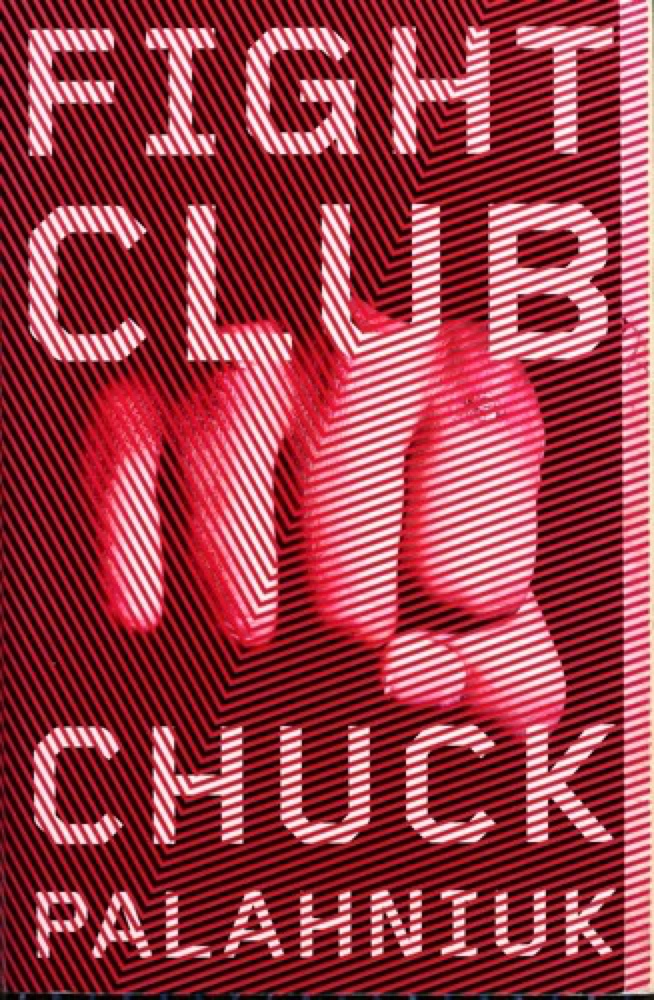
 Fight Club
Quotes from the Book
Getting inside a character might seem like a vacation from being you . But face it , you’re never not you . No matter what world you create you’re always dealing with your own shit . Same shit , different mask . You’ve chosen to explore a certain character because something about it resonates with you . Don’t pretend for a moment that writing as a different person is evading reality . If anything it allows you a greater freedom to explore parts of yourself you wouldn’t dare consciously examine .
10
You have to talk, otherwise your head turns into a cemetery.
8
What if all of our anger and fear is unwarranted? What if world events are unfolding in perfect order to deliver us to a distant joy we can't conceive of at this time?
8
do not write to be liked. Write to be remembered.
5
Ideally, you should be combining gesture, action, and expression with your dialogue.
5
Little voice gives us the facts. Big voice gives us the meaning—or at least a character’s subjective interpretation of the events.
5
If you were my student, I’d tell you to shift as needed between the three POVs. Not constantly, but as appropriate to control authority, intimacy, and pace.
5
This book is, in a way, a scrapbook of my writing life. From shopping the cathedral flea market in Barcelona with David Sedaris to having drinks at Cognac with Nora Ephron just months before she died. To the years of sporadic correspondence I had with Thom Jones and Ira Levin. I’ve stalked my share of mentors, asking for advice. Therefore, if you came back another day and asked me to teach you, I’d tell you that becoming an author involves more than talent and skill. I’ve known fantastic writers who never finished a project. And writers who launched incredible ideas, then never fully executed them. And I’ve seen writers who sold a single book and became so disillusioned by the process that they never wrote another. I’d paraphrase the writer Joy Williams, who says that writers must be smart enough to hatch a brilliant idea—but dull enough to research it, keyboard it, edit and re-edit it, market the manuscript, revise it, revise it, re-revise it, review the copy edit, proofread the typeset galleys, slog through the interviews and write the essays to promote it, and finally to show up in a dozen cities and autograph copies for thousands or tens of thousands of people… And then I’d tell you, “Now get off my porch.” But if you came back to me a third time, I’d say, “Kid…” I’d say, “Don’t say I didn’t warn you.
5
Take full advantage of the complete freedom books provide. To not take advantage of that freedom is to waste the one chief strength of the medium.
5
Think of a good joke. “Yesterday I walked into a bar. You know how it goes. You walk into a bar, and you expect a bartender, maybe some video poker. A man needs his distractions. No guy wants to get off work and go into some bar and see a penguin mixing drinks…” In conversation we switch between first-, second-, and third-person points of view. The constant shift controls the intimacy and authority of our story; for instance, “I walked” has the authority of first person. Second person addresses the listeners and enlists them: “You walk.” And the shift to third person controls the pace, “No guy wants,” by moving from the specific “I” to the general “guy.
4
So never dictate meaning to your reader. If need be, misdirect him. But always allow him to realize the truth before you state it outright. Trust your readers’ intelligence and intuition, and they will return the favor.
3
No matter what world you create you’re always dealing with your own shit. Same shit, different mask.
3
The problem with loving so many people is that you lose so many.
3
Use attribution to control the delivery of dialogue, creating the sort of dramatic pause an actor would insert. Otherwise, the reader will race through a line without realizing how it ought to be weighted.
3
To shut yourself off from these stories is to accept the banal version of reality that’s always used to frame advertisements for miracle wrinkle creams and miracle diet pills . It’s as if we’ve denied the real magic of life so that we can sell each other the sham magic of consumer products . Another example of the shop replacing the church .
3
My guess is that people haven’t a clue how to get along . They need a structure , rules , and roles to play .
3
Three parts description . Two parts instruction . One part onomatopoeia . Mix to taste .
3
In our world of fake news…this world in which the internet has eroded the credibility of all information…people want to know the context of a story just as much as they want to hear the story itself. Context and source are more important now than they’ve ever been.
2
What if all our anger and fear is unwarranted? What if world events are unfolding in perfect order to deliver us to a distant joy we can't conceive of at this time? Please consider that the next ending will be the happy one.
2
Establish your authority,” Tom Spanbauer used to tell us, “and you can do anything.
2
Don’t shy away from inventing rituals in your story. Invent rules and prayers. Give people roles to play and lines to recite. Include some form of communion and confession, a way for people to tell their stories and find connection with others.
2
Writers write because they weren’t invited to a party.
2
Everyone should use three types of communication. Three parts description. Two parts instruction. One part onomatopoeia. Mix to taste.
2
Using all three forms of communication creates a natural, conversational style. Description combined with occasional instruction, and punctuated with sound effects or exclamations: It’s how people talk.
2
Think of a story as a stream of information. At best it’s an ever-changing series of rhythms. Now think of yourself, the writer, as a DJ mixing tracks.
2
And another thing,” he cautioned me, “don’t use a lot of commas. People hate sentences with lots of commas. Keep your sentences short. Readers like short sentences.
2
If you’re dedicated to becoming an author, nothing I can say here will stop you. But if you’re not, nothing I can say will make you one.
2
I love knowing a lot of people, but the downside is that means going to a lot of funerals.
2
So long as my checks cleared, I’d no interest in figuring down to the penny how poor I always was. For the same reason, I’ve put off writing a book on writing. I didn’t want to be faced with how little I could offer on the subject. How stupid I remained after all this time and practice.
2
Watch on YouTube
About Chuck Palahniuk
We have collected 433 quotes from 17 books by Chuck Palahniuk on BookQuoters.
More about the author →

About the book
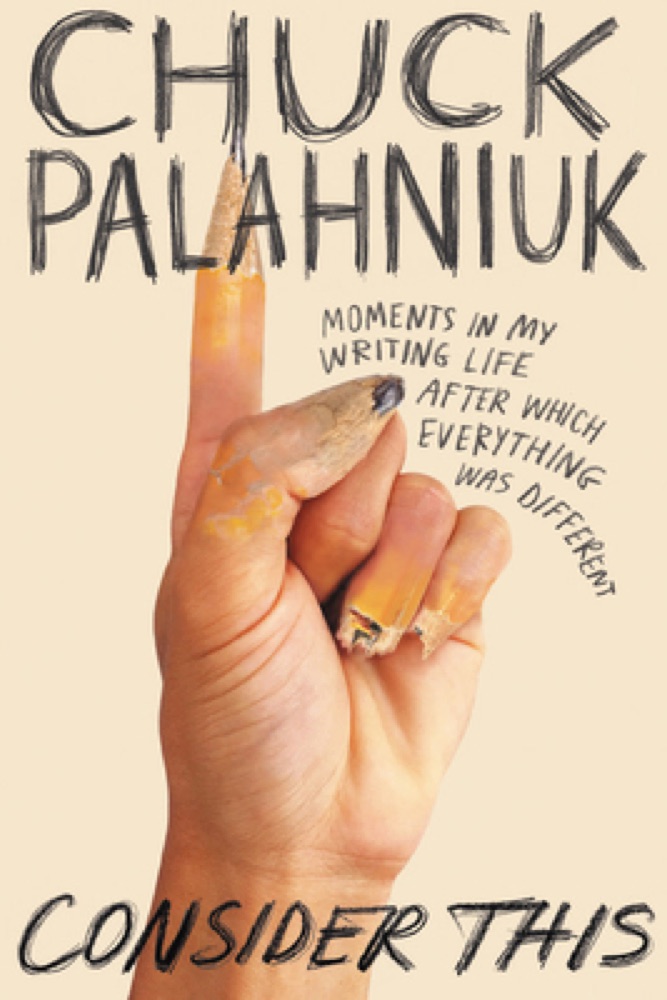
Renowned, bestselling novelist Chuck Palahniuk takes us behind the scenes of the writing life, with postcards from decades on the road and incredible examination of the power of fiction and the art of storytelling.In this spellbinding blend of memoir and insight, bestselling author Chuck Palahniuk shares stories and generous advice on what makes writing powerful and what makes for powerful writing.With advice grounded in years of careful study and a keenly observed life, Palahniuk combines practical advice and concrete examples from beloved classics, his own books, and a"kitchen-table MFA" culled from an evolving circle of beloved authors and artists, with anecdotes, postcards from the road, and much more.Clear-eyed, sensitive, illuminating, and knowledgeable, Consider This is Palahniuk's love letter to stories and storytellers, booksellers and books themselves. Consider it a classic in
Book details
- First published
- 2020
- Author
- Chuck Palahniuk
- Genre
- Nonfiction
- Goodreads rating
- 4.37 (6k ratings)
The buzz
- Kirkus ReviewsReview in Kirkus Reviewsprofessional review (via Book Marks)
- Publishers WeeklyReview in Publishers Weeklyprofessional review (via Book Marks)
- New York Journal of BooksReview in New York Journal of Booksprofessional review (via Book Marks)
- LibraryjournalReview in Libraryjournalprofessional review (via Book Marks)
- Toronto StarReview in Toronto Starprofessional review (via Book Marks)
- Star TribuneReview in Star Tribuneprofessional review (via Book Marks)
Keep reading
 The Triggering Town: Lectures and Essays on Poetry and Writing
 The Getaway Car: A Practical Memoir About Writing and Life
 How to Write an Autobiographical Novel
 Storyworthy: Engage, Teach, Persuade, and Change Your Life through the Power of Storytelling
 Stein on Writing
 On Writing: A Memoir of the Craft
 Dæmon Voices
 Bird by Bird
 The View from the Cheap Seats: Selected Nonfiction
 On Writing Well: The Classic Guide to Writing Nonfiction
 Everyone on This Train Is a Suspect
 Reality Hunger: A Manifesto
 The Writing Life
 Wonderbook: The Illustrated Guide to Creating Imaginative Fiction
 Here for It; Or, How to Save Your Soul in America: Essays
 Writing Down the Bones: Freeing the Writer Within
 Letters to a Young Writer: Some Practical and Philosophical Advice
 Becoming a Writer
 A Million Miles in a Thousand Years: What I Learned While Editing My Life
 How Not to Write a Novel: 200 Classic Mistakes and How to Avoid Them—A Misstep-by-Misstep Guide
 If You Want to Write: A Book about Art, Independence and Spirit
 Wired for Story: The Writer's Guide to Using Brain Science to Hook Readers from the Very First Sentence
 The Book of Form and Emptiness
 Writing Tools: 50 Essential Strategies for Every Writer
 Poison for Breakfast
 The Braindead Megaphone
 Dear Mr. M
 Negotiating with the Dead: A Writer on Writing
 On Writing
 Story: Substance, Structure, Style, and the Principles of Screenwriting
 On Writing
 The Art of Fiction: Notes on Craft for Young Writers
 Zen in the Art of Writing
 These Precious Days: Essays
 The Storied Life of A.J. Fikry
 Novelist as a Vocation
 The Wave in the Mind: Talks and Essays on the Writer, the Reader and the Imagination
 Stories: All-New Tales
 The Elements of Style
 Body Work: The Radical Power of Personal Narrative
 A Slip of the Keyboard: Collected Non-Fiction
 The Rent Collector
 The Book of Dreams
 If This Isn't Nice, What Is?: Advice for the Young
 Burning Questions: Essays and Occasional Pieces, 2004 to 2021
 Reading Like a Writer: A Guide for People Who Love Books and for Those Who Want to Write Them
 Walking on Water: Reading, Writing, and Revolution
 Blueberries: Essays Concerning Understanding
 The Anthologist
 Death in the Afternoon
 Ignore Everybody: and 39 Other Keys to Creativity
 No One Writes Back
 Still Writing: The Perils and Pleasures of a Creative Life
 The Name of This Book Is Secret
 The Unlikely Escape of Uriah Heep
 How to Read Literature Like a Professor
 Show Your Work!: 10 Ways to Share Your Creativity and Get Discovered
 Asymmetry
 Several Short Sentences About Writing
 Mystery and Manners: Occasional Prose