
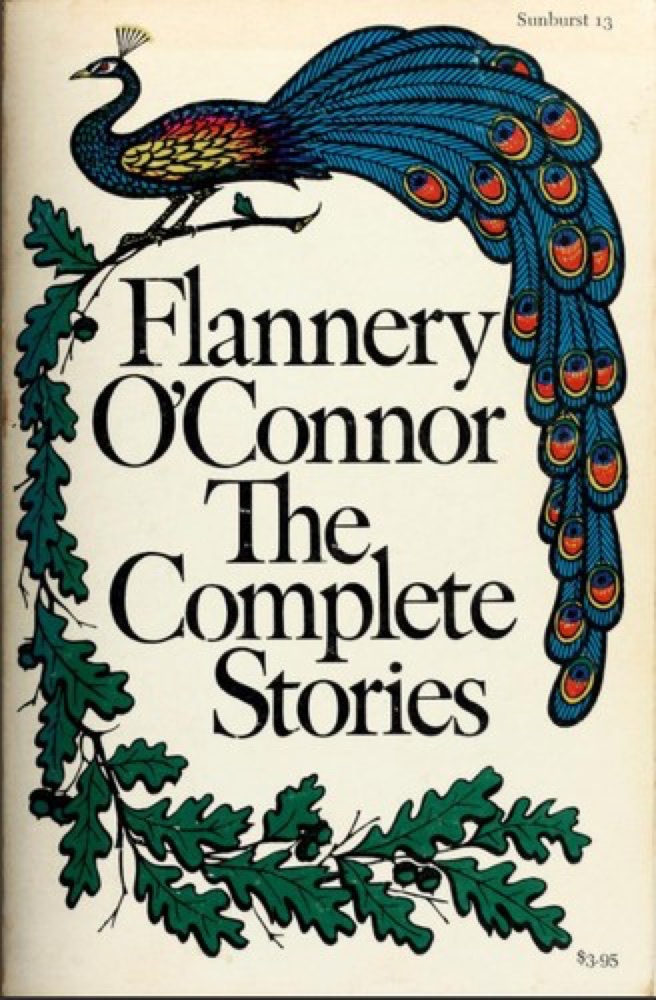
 The Complete Stories
Quotes from the Book
Anybody who has survived his childhood has enough information about life to last him the rest of his days.
765
Art never responds to the wish to make it democratic; it is not for everybody; it is only for those who are willing to undergo the effort needed to understand it.
714
Writing a novel is a terrible experience, during which the hair often falls out and the teeth decay. I'm always irritated by people who imply that writing fiction is an escape from reality. It is a plunge into reality and it's very shocking to the system.
626
There is something in us, as storytellers and as listeners to stories, that demands the redemptive act, that demands that what falls at least be offered the chance to be restored. The reader of today looks for this motion, and rightly so, but what he has forgotten is the cost of it. His sense of evil is diluted or lacking altogether, and so he has forgotten the price of restoration. When he reads a novel, he wants either his sense tormented or his spirits raised. He wants to be transported, instantly, either to mock damnation or a mock innocence.
317
Anything that comes out of the South is going to be called grotesque by the northern reader, unless it is grotesque, in which case it is going to be called realistic.
193
Whenever I'm asked why Southern writers particularly have a penchant for writing about freaks, I say it is because we are still able to recognize one. To be able to recognize a freak, you have to have some conception of the whole man, and in the South the general conception of man is still, in the main, theological. That is a large statement, and it is dangerous to make it, for almost anything you say about Southern belief can be denied in the next breath with equal propriety. But approaching the subject from the standpoint of the writer, I think it is safe to say that while the South is hardly Christ-centered, it is most certainly Christ-haunted. The Southerner, who isn't convinced of it, is very much afraid that he may have been formed in the image and likeness of God. Ghosts can be very fierce and instructive. They cast strange shadows, particularly in our literature. In any case, it is when the freak can be sensed as a figure for our essential displacement that he attains some depth in literature.
116
To know oneself is, above all, to know what one lacks. It is to measure oneself against Truth, and not the other way around. The first product of self-knowledge is humility . . .
109
Your beliefs will be the light by which you see, but they will not be what you see and they will not be a substitute for seeing.
96
Our age not only does not have a very sharp eye for the almost imperceptible intrusions of grace, it no longer has much feeling for the nature of the violences which precede and follow them.
82
There is no excuse for anyone to write fiction for public consumption unless he has been called to do so by the presence of a gift. It is the nature of fiction not to be good for much unless it is good in itself.
78
I have found, in short, from reading my own writing, that my subject in fiction is the action of grace in territory largely held by the devil. I have also found that what I write is read by an audience which puts little stock either in grace or the devil. You discover your audience at the same time and in the same way that you discover your subject, but it is an added blow.
50
When there is a tendency to compartmentalize the spiritual and make it resident in a certain type of life only, the spiritual is apt gradually to be lost.
48
When you can assume that your audience holds the same beliefs you do, you can relax and use more normal means of talking to it; when you have to assume that it does not, then you have to make your vision apparent by shock -- to the hard of hearing you shout, and for the almost-blind you draw large and startling figures.
45
Those who have no absolute values cannot let the relative remain merely relative; they are always raising it to the level of the absolute.
33
If other ages felt less, they saw more, even though they saw with the blind, prophetical, unsentimental eye of acceptance, which is to say, of faith. In the absence of this faith now, we govern by tenderness. It is a tenderness which, long cut off from the person of Christ, is wrapped in theory. When tenderness is detached from the source of tenderness, its logical outcome is terror. It ends in forced-labor camps and in the fumes of the gas chamber.
32
St. Cyril of Jerusalem, in instructing catechumens, wrote: “The dragon sits by the side of the road, watching those who pass. Beware lest he devour you. We go to the Father of Souls, but it is necessary to pass by the dragon.” No matter what form the dragon may take, it is of this mysterious passage past him, or into his jaws, that stories of any depth will always be concerned to tell, and this being the case, it requires considerable courage at any time, in any country, not to turn away from the storyteller.
30
The type of mind that can understand good fiction is not necessarily the educated mind, but it is at all times the kind of mind that is willing to have its sense of mystery deepened by contact with reality, and its sense of reality deepened by contact with mystery.
27
We are now living in an age which doubts both fact and value. It is the life of this age that we wish to see and judge.
23
In most good stories it is the character's personalty that creates the action of the story.
22
Unless we are willing to accept our artists as they are, the answer to the question, "Who speaks for America today?" will have to be: the advertising agencies. They are entirely capable of showing us our unparalleled prosperity and our almost classless society, and no one has ever accused them of not being affirmative. Where the artist is still trusted, he will not be looked to for assurance. Those who believe that art proceeds from a healthy, and not from a diseased, faculty of the mind will take what he shows them as a revelation, not of what we ought to be but of what we are at a given time and under given circumstances; that is , as a limited revelation but revelation nevertheless.
20
We Catholics are very much given to the Instant Answer. Fiction doesn't have any. It leaves us, like Job, with a renewed sense of mystery. St. Gregory wrote that every time the sacred text describes a fact, it reveals a mystery. That is what the fiction writer, on his lesser level, hopes to do.
12
Fiction operates through the senses, and I think one reason that people find it so difficult to write stories is that they forget how much time and patience is required to convince through the senses. No reader who doesn't actually experience, who isn't made to feel, the story is going to believe anything the fiction writer merely tells him. The first and most obvious characteristic of fiction is that it deals with reality through what can be seen, heard, smelt, tasted, and touched.
11
Poorly written novels -- no matter how pious and edifying the behavior of the characters -- are not good in themselves and are therefore not really edifying.
11
Drama usually bases itself on the bedrock of original sin, whether the writer thinks in theological terms or not. Then, too, any character in a serious novel is supposed to carry a burden of meaning larger than himself. The novelist doesn’t write about people in a vacuum; he writes about people in a world where something is obviously lacking, where there is the general mystery of incompleteness and the particular tragedy of our own times to be demonstrated, and the novelist tries to give you, within the form of the book, a total experience of human nature at any time. For this reason, the greatest dramas naturally involve the salvation or loss of the soul. Where there is no belief in the soul, there is very little drama. The Christian novelist is distinguished from his pagan colleagues by recognizing sin as sin. According to his heritage, he sees it not as a sickness or an accident of the environment, but as a responsible choice of offense against God which involves his eternal future. Either one is serious about salvation or one is not. And it is well to realize that the maximum amount of seriousness admits the maximum amount of comedy. Only if we are secure in our beliefs can we see the comical side of the universe. One reason a great deal of our contemporary fictions is humorless is because so many of these writers are relativists and have to be continually justifying the actions of their characters on a sliding scale of values.
11
The meaning of fiction is not abstract meaning but experienced meaning.
10
For nearly two centuries the popular spirit of each succeeding generation has tended more and more to the view that the mysteries of life will eventually fall before the mind of man. Many modern novelists have been more concerned with the processes of consciousness than with the objective world outside the mind. In twentieth-century fiction it increasingly happens that a meaningless, absurd world impinges upon the sacred consciousness of author or character; author and character seldom now go out to explore and penetrate a world in which the sacred is reflected.
9
I still suspect that most people start out with some kind of ability to tell a story but that it gets lost along the way. Of course, the ability to create life with words is essentially a gift. If you have it in the first place, you can develop it; if you don't have it, you might as well forget it. But I have found that people who don't have it are frequently the ones hell-bent on writing stories. I'm sure anyway that they are the ones who write the books and the magazine articles on how-to-write-short-stories. I have a friend who is taking a correspondence course in this subject, and she has passed a few of the chapter headings on to me—such as, "The Story Formula for Writers," "How to Create Characters," "Let's Plot!" This form of corruption is costing her twenty-seven dollars.
9
The first product of self-knowledge is humility.
9
I think the writer is initially set going by literature more than by life. When there are many writers all employing the same idiom, all looking out on more or less the same social scene, the individual writer will have to be more than ever careful that he isn't just doing badly what has already been done to completion. The presence alone of Faulkner in our midst makes a great difference in what the writer can and cannot permit himself to do. Nobody wants his mule and wagon stalled on the same track the Dixie Limited is roaring down.
8
I don't know which is worse—to have a bad teacher or no teacher at all. In any case, I believe the teacher's work should be largely negative. He can't put the gift into you, but if he finds it there, he can try to keep it from going in an obviously wrong direction. We can learn how not to write, but this is a discipline that does not simply concern writing itself but concerns the whole intellectual life. A mind cleared of false emotion and false sentiment and egocentricity is going to have at least those roadblocks removed from its path. If you don't think cheaply, then there at least won't be the quality of cheapness in your writing, even though you may not be able to write well. The teacher can try to weed out what is positively bad, and this should be the aim of the whole college. Any discipline can help your writing: logic, mathematics, theology, and of course and particularly drawing. Anything that helps you to see, anything that makes you look. The writer should never be ashamed of staring. There is nothing that doesn't require his attention.
8
Watch on YouTube
About Flannery O'Connor
We have collected 195 quotes from 8 books by Flannery O'Connor on BookQuoters.
More about the author →More by Flannery O'Connor
The Complete Stories
 Wise Blood
 Everything That Rises Must Converge: Stories
 A Good Man is Hard to Find and Other Stories
About the book
Alternate Cover Edition can be found here and .
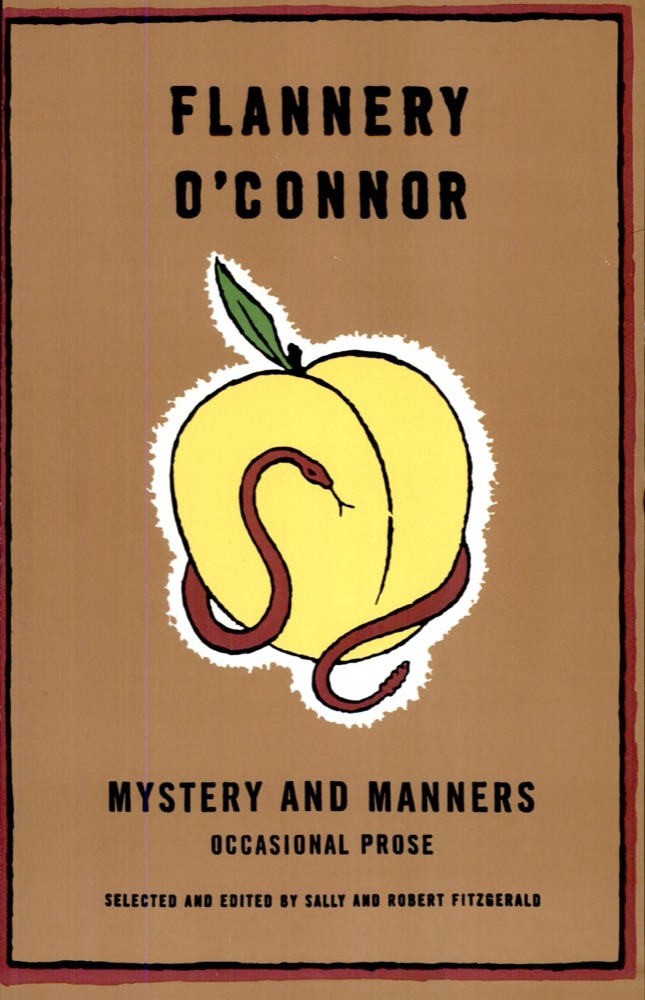
At her death in 1964, O'Connor left behind a body of unpublished essays and lectures as well as a number of critical articles that had appeared in scattered publications during her too-short lifetime. The keen writings comprising Mystery and Manners, selected and edited by O'Connor's lifelong friends Sally and Robert Fitzgerald, are characterized by the directness and simplicity of the author's style, a fine-tuned wit, understated perspicacity, and profound faith.The book opens with "The King of the Birds," her famous account of raising peacocks at her home in Milledgeville, Georgia. Also included are: three essays on regional writing, including "The Fiction Writer and His Country" and "Some Aspects of the Grotesque in Southern Fiction"; two pieces on teaching literature, including "Total Effect and the 8th Grade"; and four articles con
Book details
- First published
- 1969
- Author
- Flannery O'Connor
- Genre
- Nonfiction
- Goodreads rating
- 4.27 (4k ratings)
Keep reading
 Dæmon Voices
 Aspects of the Novel
 The Art of Fiction: Notes on Craft for Young Writers
 Death in the Afternoon
 The Language of the Night: Essays on Writing, Science Fiction, and Fantasy
 How to Read Literature
 Negotiating with the Dead: A Writer on Writing
 When I Was a Child I Read Books
 How to Read Literature Like a Professor
 The View from the Cheap Seats: Selected Nonfiction
 Nothing to Be Frightened Of
 On Becoming a Novelist
 The Wave in the Mind: Talks and Essays on the Writer, the Reader and the Imagination
 Stein on Writing
 Flaubert's Parrot
 How Fiction Works
 The Writing Life
 Both Flesh and Not: Essays
 How Proust Can Change Your Life
 Becoming a Writer
 Human, All Too Human
 The Common Reader
 Illuminations: Essays and Reflections
 Experience
 Novelist as a Vocation
 The Fall of Babel
 The Varieties of Religious Experience
 The Mind of the Maker: Dorothy L. Sayers' Witty Classic on the Trinity, Christianity, and Human Creativity
 The Thirteenth Tale
 The Abundance
 The Unlikely Escape of Uriah Heep
 The World's Last Night: And Other Essays
 Reality Hunger: A Manifesto
 The Habit of Being: Letters of Flannery O'Connor
 The Triggering Town: Lectures and Essays on Poetry and Writing
 Reading Lolita in Tehran: A Memoir in Books
 The Source of Self-Regard: Selected Essays, Speeches, and Meditations
 Too Like the Lightning
 A Circle of Quiet
 Six Characters in Search of an Author
 The Art of the Novel
 Big Sur and the Oranges of Hieronymus Bosch
 A Slip of the Keyboard: Collected Non-Fiction
 Stories: All-New Tales
 The Everlasting Man
 The Essays of Ralph Waldo Emerson
 How to Write an Autobiographical Novel
 Heretics
 In Other Worlds: SF and the Human Imagination
 Dear Mr. M
 The Hero's Journey: Joseph Campbell on His Life & Work
 Myths to Live By
 Monday or Tuesday
 Tales from Earthsea
 Consider This: Moments in My Writing Life After Which Everything Was Different
 Eating the Dinosaur
 The Summer Without Men
 Burning Questions: Essays and Occasional Pieces, 2004 to 2021
 Elizabeth Costello