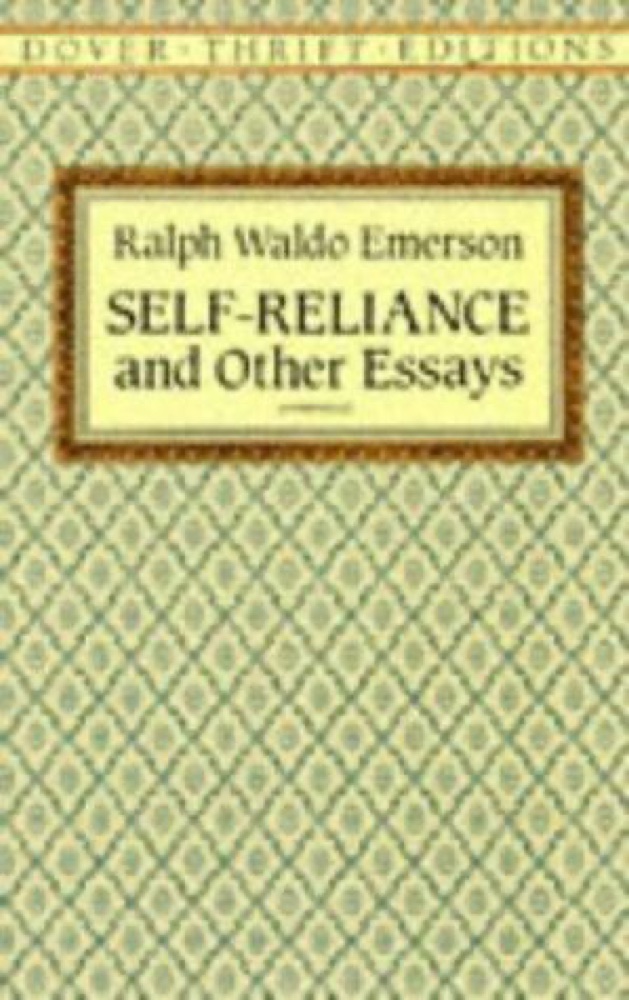
 Self-Reliance and Other Essays
Quotes from the Book
Though we travel the world over to find the beautiful, we must carry it with us, or we find it not.
1.2k
I hate quotations. Tell me what you know.
480
At times the whole world seems to be in conspiracy to importune you with emphatic trifles. Friend, client, child, sickness, fear, want, charity, all knock at once at thy closet door and say,—'Come out unto us.' But keep thy state; come not into their confusion. The power men possess to annoy me I give them by a weak curiosity. No man can come near me but through my act.
100
Doubt not, O poet, but persist. Say 'It is in me, and shall out.' Stand there, balked and dumb, stuttering and stammering, hissed and hooted, stand and strive, until at last rage draw out of thee that dream-power which every night shows thee is thine own; a power transcending all limit and privacy, and by virtue of which a man is the conductor of the whole river of electricity.
46
When we are young, we spend much time and pains in filling our note-books with all definitions of Religion, Love, Poetry, Politics, Art, in the hope that, in the course of a few years, we shall have condensed into our encyclopaedia the net value of all the theories at which the world has yet arrived. But year after year our tables get no completeness, and at last we discover that our curve is a parabola, whose arcs will never meet.
33
We are immensed in beauty, but our eyes have no clear vision.
32
God offers to every mind a choice between repose and truth. take which you please--you can never have both. [Essay on Intellect]
24
It is not metres, but a metre-making argument that makes a poem,—a thought so passionate and alive that like the spirit of a plant or an animal it has an architecture of its own, and adorns nature with a new thing. The thought and the form are equal in the order of time, but in the order of genesis the thought is prior to the form.
18
If we are related, we shall meet. It was a tradition of the ancient world, that no metamorphosis could hide a god from a god; and there is a Greek verse which runs, "The Gods are to each other not unknown." Friends also follow the laws of divine necessity; they gravitate to each other, and cannot otherwise.
17
We, as we read, must become Greeks, Romans, Turks, priest and king, martyr and executioner; must fasten these images to some reality in our secret experience, or we shall learn nothing rightly.
15
The life of truth is cold.
14
I unsettle all things.
12
Every revolution was first a thought in one man's mind, and when the same thought occurs to another man, it is the key to that era.
11
the mystic must be steadily told,—All that you say is just as true without the tedious use of that symbol as with it. Let us have a little algebra, instead of this trite rhetoric,—universal signs, instead of these village symbols,—and we shall both be gainers. The history of hierarchies seems to show that all religious error consisted in making the symbol too stark and solid, and was at last nothing but an excess of the organ of language.
9
Life goes headlong. We chase some flying scheme, or we are hunted by some fear or command behind us. But if suddenly we encounter a friend, we pause; our heat and hurry look foolish enough; now pause, now possession, is required, and the power to swell the moment from the resources of the heart. The moment is all, in all noble relations.
8
Why covet a knowledge of new facts? Day and night, house and garden, a few books, a few actions, serve us as well as would all trades and all spectacles. We are far from having exhausted the significance of the few symbols we use. We can come to use them yet with a terrible simplicity.
8
I have no expectation that any man will read history aright who thinks that what was done in a remote age, by men whose names have resounded far, has any deeper sense than what he is doing today.
6
They measure their esteem of each other by what each has, and not by what each is. But a cultivated man becomes ashamed of his property, out of new respect for his nature.
4
Our life is March weather, savage and serene in one hour.
4
There are many eyes that can detect and honor the prudent and household virtues; there are many that can discern Genius on his starry track, though the mob is incapable; but when that love which is all-suffering, all-abstaining, all-aspiring, which has vowed to itself, that it will be a wretch and also a fool in this world, sooner than soil its white hands by any compliances, comes into our streets and houses, --only the pure and aspiring can know its face, and the only compliment they can pay it, is to own it.
4
Life is a train of moods like a string of beads, and as we pass through them they prove to be many-colored lenses which paint the world their own hue, and each shows only what lies in its focus. From the mountain you see the mountain. We animate what we can, and we see only what we animate. Nature and books belong to the eyes
3
The young man reveres men of genius, because, to speak truly, they are more himself than he is.
3
A fever, a mutilation, a cruel disappointment, a loss of wealth, a loss of friends, seems at the moment unpaid loss, and unpayable. But the sure years reveal the deep remedial force that underlies all facts. The death of a dear friend, wife, brother, lover, which seemed nothing but privation, somewhat later assumes the aspect of a guide or genius; for it commonly operates revolutions in our way of life, terminates an epoch of infancy or of youth which was waiting to be closed, breaks up a wonted occupation, or a household, or style of living, and allows the formation of new ones more friendly to the growth of character.
3
Does not… the ear of Handel predict the witchcraft of harmonic sound?
3
Let us learn the revelation of all nature and thought, that the Highest dwells within us, that the sources of nature are in our own minds. As there is no screen or ceiling between our heads and the infinite heavens, so there is no bar or wall in the soul where we, the effect, cease, and God, the cause, begins. I am constrained every moment to acknowledge a higher origin for events than the will I call mine. There is a deep power in which we exist and whose beatitude is accessible to us. Every moment when the individual feels invaded by it is memorable. It comes to the lowly and simple; it comes to whosoever will put off what is foreign and proud; it comes as insight; it comes as serenity and grandeur. The soul's health consists in the fullness of its reception. For ever and ever the influx of this better and more universal self is new and unsearchable. Within us is the soul of the whole, the wise silence, the universal beauty, to which every part and particle is equally related; the eternal One. When it breaks through our intellect, it is genius; when it breathes through our will, it is virtue; when it flows through our affections, it is love.
2
Every man is an impossibility until he is born; every thing impossible until we see a success.
2
Every man alone is sincere. At the entrance of a second person, hypocrisy begins.
2
The end of friendship is a commerce the most strict and homely that can be joined; more strict than any of which we have experience. It is for aid and comfort through all the relations and passages of life and death. It is fit for serene days, and graceful gifts, and country rambles, but also for rough roads and hard fare, shipwreck, poverty, and persecution. It keeps company with the sallies of the wit and the trances of religion. We are to dignify to each other the daily needs and offices of man's life, and embellish it by courage, wisdom and unity.
2
I do not wish to treat friendships daintily, but with roughest courage. When they are real, they are not glass threads or frost-work, but the solidest thing we know.
2
Watch on YouTube
About Ralph Waldo Emerson
We have collected 139 quotes from 7 books by Ralph Waldo Emerson on BookQuoters.
More about the author →More by Ralph Waldo Emerson
Self-Reliance and Other Essays
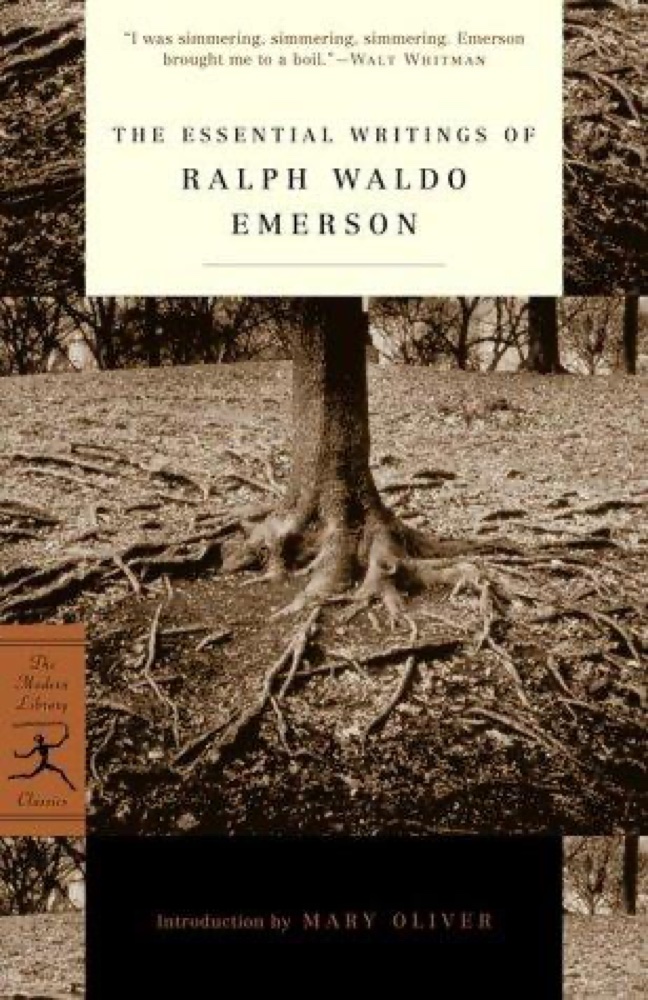 The Essential Writings of Ralph Waldo Emerson
 Nature and Selected Essays
 Essays and Poems
About the book
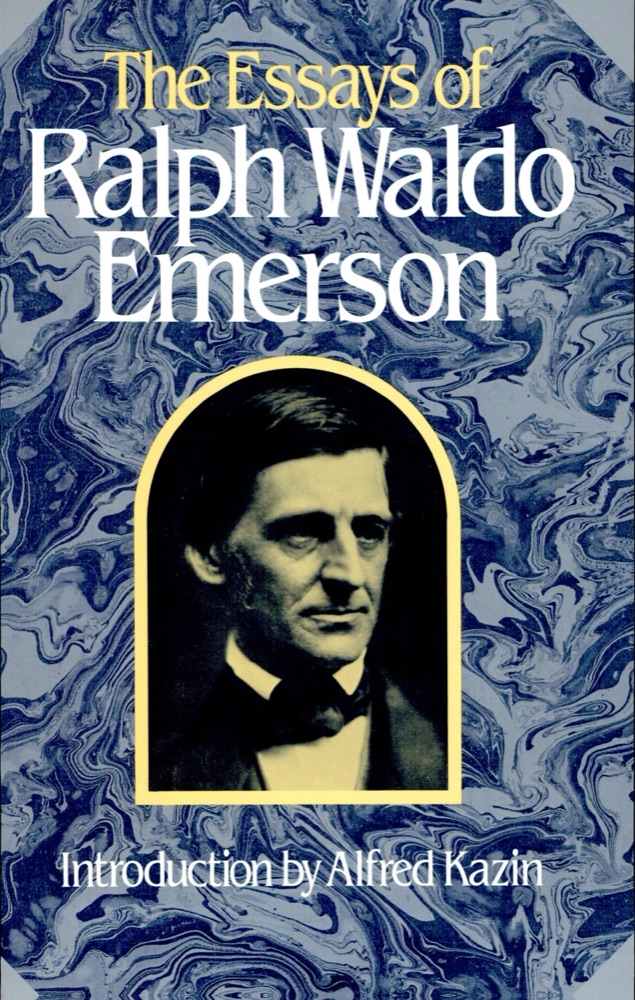
Ralph Waldo Emerson, Alfred Kazin observes in his Introduction, “was a great writer who turned the essay into a form all his own.” His celebrated essays―the twelve published in First Series (1841) and eight in Second Series (1844)―are here presented for the first time in an authoritative one-volume edition, which incorporates all the changes and corrections Emerson made after their initial publication.
The text is reproduced from the second and third volumes of The Collected Works of Ralph Waldo Emerson , a critical edition which draws on the vast body of Emerson scholarship of the last half century. Alfred R. Ferguson was founding editor of the edition, followed by Joseph Slater (until 1996).
Book details
- First published
- 1844
- Author
- Ralph Waldo Emerson
- Genre
- Philosophy
- Goodreads rating
- 4.22 (3k ratings)
Keep reading
The Essential Writings of Ralph Waldo Emerson
 Daniel Deronda
 The Common Reader
 Self-Reliance: An Excerpt from Collected Essays, First Series
 Basic Writings of Nietzsche
Nature and Selected Essays
Basic Writings of Nietzsche
Nature and Selected Essays
 The Will to Power
 Complete Works of Oscar Wilde
 The Intellectual Life: Its Spirit, Conditions, Methods
 Selected Poems
 The Gay Science
 Walden and other writings
 The Wisdom of Life
 The Abundance
 Heretics
 The World as Will and Representation, Vol 1
 Phaedrus
 A Treatise of Human Nature
 In the Light of What We Know
 Pensées
 The Glass Bead Game
 The Myth of Sisyphus and Other Essays
 The Ides of March
 The Story of My Experiments With Truth
 Monday or Tuesday
 The Varieties of Religious Experience
 Maldoror and the Complete Works
 Wilhelm Meister's Apprenticeship
 In Search of Lost Time
 The Magic Mountain
 An Essay Concerning Human Understanding
 Walden & Civil Disobedience
 You Can't Go Home Again
 Ben-Hur: A Tale of the Christ
 Narcissus and Goldmund
 The Everlasting Man
 Henry David Thoreau: A Week, Walden, The Maine Woods, Cape Cod
 The Myth of Sisyphus
 Selected Non-Fictions
 The Seven Storey Mountain
 Surprised by Joy: The Shape of My Early Life
 Persian Letters
 Big Sur and the Oranges of Hieronymus Bosch
 Orthodoxy
 The Complete Essays
 The Home and the World
 The Discovery of India
 The Recognitions
 Philosophical Dictionary
 Emile or On Education
 Fragments
 The Spinoza Problem
 Man and Superman
 One Man's Meat
 Death in Venice and Other Tales
 The Greek Way
 The Republic
 Six Characters in Search of an Author
 Labyrinths: Selected Stories and Other Writings
 She
She