
 The Complete Stories
Quotes from the Book
I don't deserve any credit for turning the other cheek as my tongue is always in it.
1.1k
All human nature vigorously resists grace because grace changes us and the change is painful.
571
I can, with one eye squinted, take it all as a blessing.
297
Total non-retention has kept my education from being a burden to me.
240
I think there is no suffering greater than what is caused by the doubts of those who want to believe. I know what torment this is, but I can only see it, in myself anyway, as the process by which faith is deepened. A faith that just accepts is a child's faith and all right for children, but eventually you have to grow religiously as every other way, though some never do. What people don't realize is how much religion costs. They think faith is a big electric blanket, when of course it is the cross. It is much harder to believe than not to believe. If you feel you can't believe, you must at least do this: keep an open mind. Keep it open toward faith, keep wanting it, keep asking for it, and leave the rest to God.
208
I love a lot of people, understand none of them...
157
Your criticism sounds to me as if you have read too many critical books and are too smart in an artificial, destructive, and very limited way.
143
I come from a family where the only emotion respectable to show is irritation. In some this tendency produces hives, in others literature, in me both.
123
Children know by instinct that hell is an absence of love, and they can pick out theirs without missing.
78
...the only thing that makes the Church endurable is that it is somehow the body of Christ and that on this we are fed. It seems to be a fact that you have to suffer as much from the Church as for it but if you believe in the divinity of Christ, you have to cherish the world at the same time that you struggle to endure it.
71
Faith comes and goes. It rises and falls like the tides of an invisible ocean. If it is presumptuous to think that faith will stay with you forever, it is just as presumptuous to think that unbelief will.
59
Satisfy your demand for reason but always remember that charity is beyond reason, and God can be known through charity.
57
Not-writing is a good deal worse than writing.
46
What people don’t realize is how much religion costs. They think faith is a big electric blanket, when of course it is the cross.
44
The serious writer has always taken the flaw in human nature for his starting point, usually the flaw in an otherwise admirable character. Drama usually bases itself on the bedrock of original sin, whether the writer thinks in theological terms or not. Then, too, any character in a serious novel is supposed to carry a burden of meaning larger than himself. The novelist doesn't write about people in a vacuum; he writes about people in a world where something is obviously lacking, where there is the general mystery of incompleteness and the particular tragedy of our own times to be demonstrated, and the novelist tries to give you, within the form of the book, the total experience of human nature at any time. For this reason, the greatest dramas naturally involve the salvation or loss of the soul. Where there is no belief in the soul, there is very little drama.
43
The mind serves best when it's anchored in the Word of God. There is no danger then of becoming an intellectual without integrity...
38
Doctors always think anybody doing something they aren't is a quack; also they think all patients are idiots.
35
I don't think literature would be possible in a determined world. We might go through the motions but the heart would be out of it. Nobody could then 'smile darkly and ignore the howls.' Even if there were no Church to teach me this, writing two novels would do it. I think the more you write, the less inclined you will be to rely on theories like determinism. Mystery isn't something that is gradually evaporating. It grows along with knowledge.
31
For me it is the virgin birth, the Incarnation, the resurrection which are the true laws of the flesh and the physical. Death, decay, destruction are the suspension of these laws. I am always astonished at the emphasis the Church puts on the body. It is not the soul she says that will rise but the body, glorified.
29
When you leave a man alone with his Bible and the Holy Ghost inspires him, he's going to be a Catholic one way or another, even though he knows nothing about the visible church. His kind of Christianity may not be socially desirable, but will be real in the sight of God.
28
Lord, I believe; help my unbelief'... is the most natural and most human and most agonizing prayer in the gospels, and I think it is the foundation prayer of faith.
27
A working knowledge of the devil can be very well had from resisting him.
27
I have what passes for an education in this day and time, but I am not deceived by it.
25
Let me make no bones about it: I write from the standpoint of Christian orthodoxy. Nothing is more repulsive to me than the idea of myself setting up a little universe of my own choosing and propounding a little immoralistic message. I write with a solid belief in all the Christian dogmas.
25
One of the awful things about writing when you are a Christian is that for you the ultimate reality is the Incarnation, the present reality is the Incarnation, and nobody believes in the Incarnation; that is, nobody in your audience. My audience are the people who think God is dead. At least these are the people I am conscious of writing for.
23
I couldn't make any judgment on the Summa, except to say this: I read it for about twenty minutes every night before I go to bed. If my mother were to come in during this process and say, 'Turn off that light. It's late,' I with a lifted finger and broad bland beatific expression, would reply, 'On the contrary, I answer that the light, being eternal and limitless, cannot be turned off. Shut your eyes,' or some such thing.
21
I do not like the raw sound of the human voice in unison unless it is under the discipline of music.
21
...I have to write to discover what I am doing. Like the old lady, I don't know so well what I think until I see what I say; then I have to say it again.
21
I distrust pious phrases, especially when they issue from my mouth. I try militantly never to be affected by the pious language of the faithful but it is always coming out when you least expect it. In contrast to the pious language of the faithful, the liturgy is beautifully flat.
19
Watch on YouTube
About Flannery O'Connor
We have collected 195 quotes from 8 books by Flannery O'Connor on BookQuoters.
More about the author →More by Flannery O'Connor
The Complete Stories
 Wise Blood
 Everything That Rises Must Converge: Stories
 A Good Man is Hard to Find and Other Stories
About the book
Winner of the National Book Critics Circle Special Award
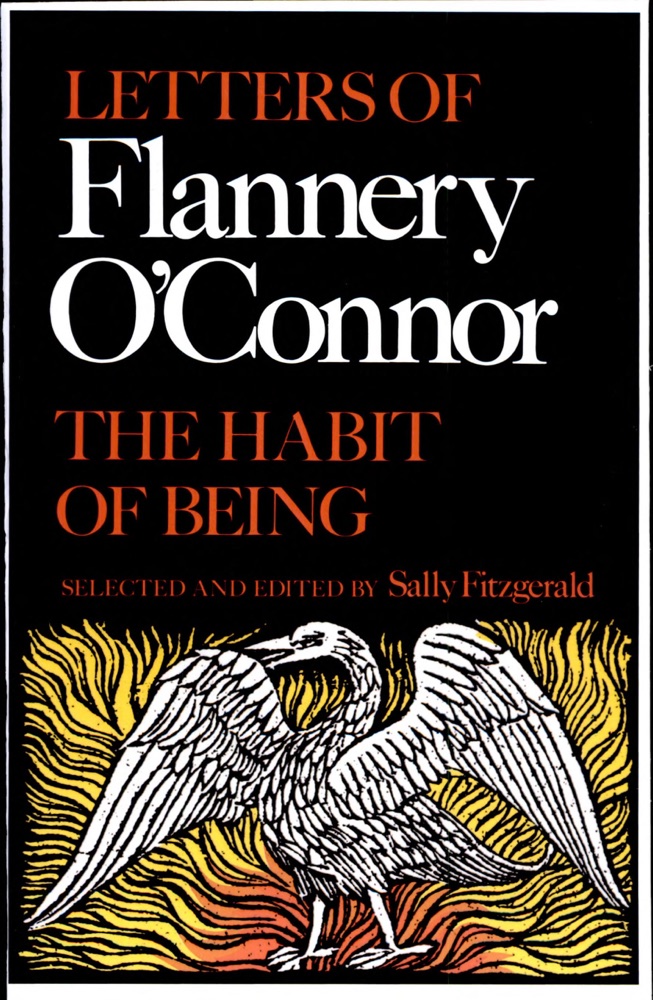
"I have come to think that the true likeness of Flannery O'Connor will be painted by herself, a self-portrait in words, to be found in her letters . . . There she stands, a phoenix risen from her own words: calm, slow, funny, courteous, both modest and very sure of herself, intense, sharply penetrating, devout but never pietistic, downright, occasionally fierce, and honest in a way that restores honor to the word."—Sally Fitzgerald, from the Introduction
Book details
- First published
- 1979
- Author
- Flannery O'Connor
- Genre
- Nonfiction
- Goodreads rating
- 4.47 (2k ratings)
Keep reading
 Children of God
 Dust Tracks on a Road
 Gilead
 The Story of My Experiments With Truth
 The Shape of Mercy
 The Secret Scripture
 The Year of Living Biblically: One Man's Humble Quest to Follow the Bible as Literally as Possible
 Surprised by Joy: The Shape of My Early Life
 When I Was a Child I Read Books
 The Devil's Advocate
 All My Knotted-Up Life: A Memoir
 Plan B: Further Thoughts on Faith
 Reflections on the Psalms
 The Seven Storey Mountain
 Blue Like Jazz: Nonreligious Thoughts on Christian Spirituality
 The Cloister Walk
 The World's Last Night: And Other Essays
 A Circle of Quiet
 The Bondage of the Will
 Leaving Church: A Memoir of Faith
 Amazing Grace: A Vocabulary of Faith
 Hallelujah Anyway: Rediscovering Mercy
 The Fall
 The Varieties of Religious Experience
 The Golden Notebook
 Christy
 Infinite Jest
 Daniel Deronda
 The Spiral Staircase: My Climb Out of Darkness
 Stranger in a Strange Land
 Blessed Are the Misfits: Great News for Believers who are Introverts, Spiritual Strugglers, or Just Feel Like They're Missing Something
 Why I Am Not a Christian and Other Essays on Religion and Related Subjects
 Traveling Mercies: Some Thoughts on Faith
 Surrender: 40 Songs, One Story
 Breaking the Spell: Religion as a Natural Phenomenon
 The Poisonwood Bible
 Story of a Soul: The Autobiography of St. Therese of Lisieux
 Mystery and Manners: Occasional Prose
 The Rebel Angels
 Letter to My Daughter
 No Time To Spare: Thinking About What Matters
 Lectures to My Students
 A Severe Mercy: A Story of Faith, Tragedy and Triumph
 Father Joe: The Man Who Saved My Soul
 The Angel's Game
 The Fountainhead
 Lit
Lit
 Marcelo in the Real World
 Island
 Still: Notes on a Mid-Faith Crisis
 The Bible Jesus Read
 Twilight of the Idols
 The Manticore
 The Burning Girls
 Letters from the Earth: Uncensored Writings
 Mortality
 Everyone Burns
 Notes From The Tilt-A-Whirl: Wide-Eyed Wonder in God's Spoken World
 The Story of My Life
 The Gay Science