
 Tropic of Capricorn
Quotes from the Book
If we are always arriving and departing, it is also true that we are eternally anchored. One's destination is never a place but rather a new way of looking at things.
223
Whoever uses the spirit that is in him creatively is an artist. To make living itself an art, that is the goal.
157
Surely every one realizes, at some point along the way, that he is capable of living a far better life than the one he has chosen.
117
Certainly paradise, whatever, wherever it be, contains flaws. (Paradisical flaws, if you like.) If it did not, it would be incapable of drawing the hearts of men or angels.
62
Out yonder they may curse, revile, and torture one another, defile all the human instincts, make a shambles of creation (if it were in their power), but here, no, here, it is unthinkable, here there is abiding peace, the peace of God, and the serene security created by a handful of good neighbors living at one with the creature world.
28
She discovered what others know only too well in a cynical way, that people prefer to believe in and worship a god who is remote rather than live out the godlike nature which is their inherent being.
13
And no one sets about saving the world unless he has first experienced the miracle of personal salvation.
10
If it be knowledge or wisdom one is seeking, then one had better go direct to the source. And the source is not the scholar or philosopher, not the master, saint, or teacher, but life itself - direct experience of life. The same is true for art. Here, too, we an dispense with "the masters.
10
Sweet or bitter, I am now convinced that all experience is enriching and rewarding. Above all, instructive.
9
The ideal community, in a sense, would be the loose, fluid aggregation of individuals who elected to be alone and detached in order to be at one with themselves and all that lives and breathes. It would be a God-filled community, even if none of its members believe in (a) God. It would be a paradise, even though the word had long disappeared from our vocabulary.
6
. . . They had skies of pure azure and walls of fog moving in and out of the canyons with invisible feet, hills in winter of emerald green and in summer mountain upon mountain of pure gold. They had even more, for there was ever the unfathomable silence of the forest, the blazing immensity of the Pacific, days drenched with sun and nights spangled with stars. . .
5
This is the lone-American type I admire, the kind I believe in, can get along with, and whom I vote for even though he’s never nominated for office. The democratic man our poets sang of but who, alas, is being rapidly exterminated, along with the buffalo, the moose and the elk, the great bear, the eagle, the condor, the mountain lion. The sort of American that never starts a war, never raises a feud, never draws the color line, never tries to lord it over his fellow-man, never yearns for higher education, never holds a grudge against his neighbor, never treats an artist shabbily and never turns a beggar away. Often untutored and unlettered, he sometimes has more of the poet and the musician in him, philosopher too, than those who are acclaimed as such. His whole way of life is aesthetic. What marks him as different, sometimes ridiculous, is his serenity and originality. That he aspires to be none other than himself, is this not the essence of wisdom?
4
Better keep the young on lemons and lavender until they've reached the age of discretion.
3
Big Sur? Why it's just like every other place! . . . a profound truth, since a place is only what you make it, what you bring to it.
3
If you do not know where you are going, any road will take you there.”*
3
Between laughs I could hear my mother’s words ringing in my ears. “Why don't you write something that will sell?
3
There is one other thing to know … when you have expressed yourself to the fullest, then and only then will it dawn upon you that everything has already been expressed, not in words alone but in deed, and that all you need really do is say Amen!
3
No, we are never alone. But one has to live apart to know it for the truth.
3
Only when we are truly alone does the fullness and richness of life reveal itself to us. In simplifying our lives, everything acquires a significance hitherto unknown. When we are one with ourselves the most insignificant blade of grass assumes its proper place in the universe
1
A writer often has two great surprises in store for him: the first is the lack of proper response to his efforts; the second is the overwhelming nature of the response when it does come. One is just as bad as the other.
1
You will then be ready to undergo initiation: an ordeal imposed by the Brotherhood of Fools and Simpletons. Three questions will be put to you. Just three. The first: 'How would you order the world if you were given the powers of the creator?' the second: 'What is it you desire that you do not already possess?' The third: 'Say something that will truly astonish us!' If you answer these satisfactorily you are then to return to your birthplace, sit quietly with hands folded, and meditate on the needs of all God's creatures. . . . When you know what it is they need . . . you are to report back to the Brotherhood and dissolve the order.
1
This is the California that men dreamed of years ago, this is the Pacific that Balboa looked out on from the Peak of Darien, this is the face of the earth as the creator intended it to look.
1
If it was a mistake not to finish school (it wasn't!), it was an even worse mistake to go to work. ("Work! The word was so painful he couldn't bring himself to pronounce it," says a character in one of Cossery's books.) Until I was almost eighteen I had know freedom, a relative freedom, which is more than most people ever get to know. (It included "freedom of speech," which has hung over into my writing.) Then, like an idiot, I entered the lists. Overnight, as it were, the bit was put in my mouth, I was saddled, and the cruel rowels were dug into my tender flanks. It didn't take long to realize what a shithouse I had let myself into. Every new job I took was a step further in the direction of "murder, death and blight." I think of them still as prisons, whorehouses, lunatic asylums: the Atlas Portland Cement Co., the Federal Reserve Bank, the Bureau of Economic Research, the Charles Williams Mail Order House, the Western Union Telegraph Co., etc. To think that I wasted ten years of my life serving these anonymous lords and masters! That look of rapture in Pookie's eyes, that look of supreme admiration which I reserved for such as Eddie Carney, Lester Reardon, Johnny Paul: it was gone, lost, buried. It returned only when, much later, I reached the point where I was completely cut off, thoroughly destitute, utterly abandoned. When I became the nameless one, wandering as a mendicant through the streets of my own home town. Then I began to see again, to look with eyes of wonder, eyes of love, into the eyes of my fellow-man.
1
Naturally, from my standpoint, the first and most important thing was to see that the poor devil ate more regularly, and more abundantly. I hadn't the means to guarantee him three meals a day, but I could and did throw a meal into him now and then. Sometimes I invited him out to lunch or dinner; more often I invited him to my quarters where I would cook as bountiful and delicious a meal as possible. Half-starved as he was most of the time, it was small wonder that by the end of the meal he was usually drunk. Drunk not with wine, thought he drank copiously, but with food, food which his impoverished organism was unable to assimilate in such quantities. The ironic thing was—and how well I understood it!—that by the time he had walked home he was hungry all over again. Poor Moricand! How very, very familiar to me was this ludicrous aspect of his tribulations! Walking on an empty stomach, walking on a full stomach, walking to digest a meal, walking in search of a meal, walking because it is the only recreation one's pocketbook permits, as Balzac discovered when he came to Paris. Walking to lay the ghost. Walking instead of weeping. Walking in the vain and desperate hope of meeting a friendly face. Walking, walking, walking. . . . But why go into it? Let's dismiss it with the label—"ambulatory paranoia.
Up all the wrong alleys, down all the wrong streets—yet how right I was!—until I came to the end of my tether.
What I say is, if we are going to meet one another with a view or an awareness of our diversity and divergences we will never acquire enough knowledge to deal with one another smoothly and effectively. To get anywhere with another individual one has to cut through to the rock-bottom man, to that common human substratum which exists in all of us. This is not a difficult procedure and certainly doesn't demand of one that he be a psychologist or a mind reader. One doesn't have to know a thing about astrological types, the complexity of their reactions to this or that. There is one simple, direct way to deal with all types, and that is truthfully and honestly.
Watch on YouTube
About Henry Miller
We have collected 167 quotes from 7 books by Henry Miller on BookQuoters.
More about the author →More by Henry Miller
All books by Henry Miller →

About the book
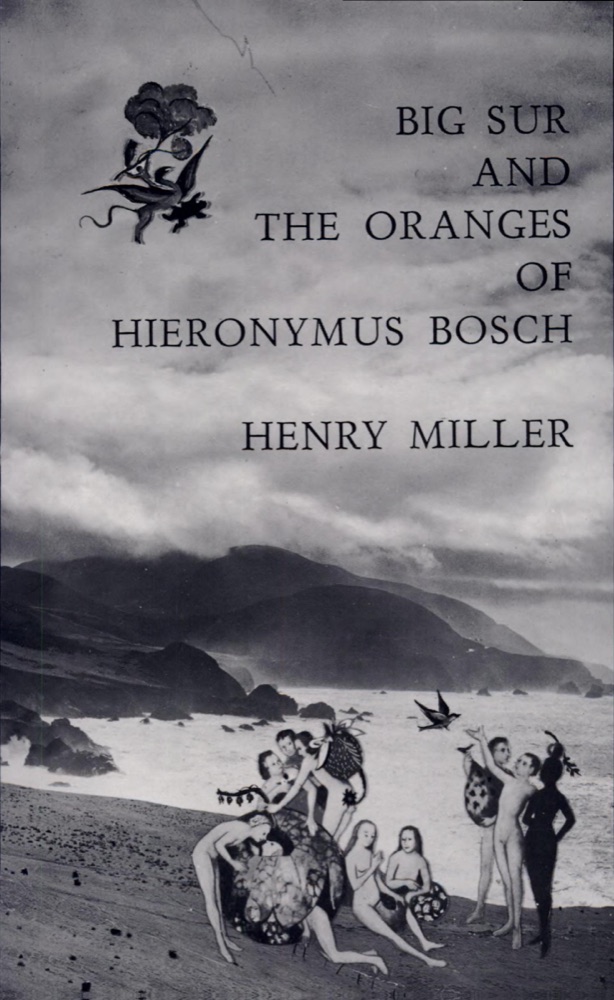
Whence Henry Miller's title for this, one of his most appealing books; first published in 1957, it tells the story of Miller's life on the Big Sur, a section of California coast where he lived for fifteen years.
Big Sur is the portrait of a place one of the most colorful in the U.S. and of the extraordinary people Miller knew there: writers (and writers who didn't write), mystics seeking truth in meditation (and the not-so-saintly looking for sex-cults or celebrity), sophisticated children and adult innocents; geniuses, cranks and the unclassifiable.
Henry Miller writes with a buoyancy and brimming energy that are infectious. He has a fine touch for comedy. But this is also a serious book the testament of a free spirit who has broken through the restraints and cliches of modern life to find within himself his own kind of paradise.
Book details
- First published
- 1957
- Author
- Henry Miller
- Genre
- Fiction
- Goodreads rating
- 4.02 (3k ratings)
Keep reading
 The Gay Science
 Jayber Crow
 You Can't Go Home Again
 The Seven Storey Mountain
 The Island of the Day Before
 Walden & Civil Disobedience
 Dust Tracks on a Road
 The Fall
 Demian
 Walden and other writings
 The Essays of Ralph Waldo Emerson
 The Lincoln Highway
 Surprised by Joy: The Shape of My Early Life
 Island
 The Abundance
 A Circle of Quiet
 The Magic Mountain
 A Sudden Light
 Daniel Deronda
 Hippie
 Light Years
 Walden
 The Story of My Experiments With Truth
 Sexing the Cherry
 The Sea Keeper's Daughters
 The Etched City
 This Is Happiness
 My Friends
 Asymmetry
 Henderson the Rain King
 The Wolf Gift
 The Schopenhauer Cure
 Perelandra
 Sometimes a Great Notion
 West with the Night
 Villa Incognito
 Slouching Towards Bethlehem
 Sacred Journey of the Peaceful Warrior
 The Everlasting Man
 The Fall of Babel
 In Search of Lost Time
 The Home and the World
 Narcissus and Goldmund
 Beautiful Ruins
 East of Eden
 Twilight of the Idols
 The World-Ending Fire: The Essential Wendell Berry
 Flights
 Small Wonder
 Always Coming Home
 Foucault's Pendulum
 A Joseph Campbell Companion: Reflections on the Art of Living
 Breakfast with Buddha
 The Lathe of Heaven
 The Intellectual Life: Its Spirit, Conditions, Methods
 Odd Apocalypse
 The Secret Scripture
 Skinny Legs and All
 Humboldt's Gift