 When Things Fall Apart: Heart Advice for Difficult Times
Quotes from the Book
No … big … deal.” He wasn’t saying “bad,” and he wasn’t saying “good.” He was saying that these things happen and they can transform your life, but at the same time don’t make too big a deal of them, because that leads to arrogance and pride, or a sense of specialness. On the other hand, making too big a deal about your difficulties takes you in the other direction; it takes you into poverty, self-denigration, and a low opinion of yourself.
4
The principle of nowness is very important to any effort to establish an enlightened society. You may wonder what the best approach is to helping society and how you can know that what you are doing is authentic and good. The only answer is nowness. The way to relax, or rest the mind in nowness, is through the practice of meditation. In meditation you take an unbiased approach. You let things be as they are, without judgment, and in that way you yourself learn to be. —CHÖGYAM TRUNGPA RINPOCHE
3
The sage Shantideva, in the Bodhicaryavatara, in talking about the subject of suffering, offered a famous analogy for how we try to alleviate our suffering. He’s said that if you walk on the earth and it’s hurting your feet, you might want to cover all the earth with hides of leather, so that you’d never have to suffer from the pain of the ground. But where could such an amount of leather be found? Rather, you could simply wrap a bit of leather around your feet, and then it’s as if the whole world is covered with leather and you’re always protected.
2
The natural quality of mind is clear, awake, alert, and knowing. Free from fixation. By training in being present, we come to know the nature of our mind. So the more you train in being present - being right here - the more you begin to feel like your mind is sharpening up. The mind that can come back to the present is clearer and more refreshed, and it can better weather all the ambiguities, pains, and paradoxes of life.
2
This is a standard meditation instruction that you can embody in the entirety of your life: do not act out and do not repress. See what happens if you don’t do either of those things.
2
The towns and countryside that the traveler sees through a train window do not slow down the train, nor does the train affect them. Neither disturbs the other. This is how you should see the thoughts that pass through your mind when you meditate. —DILGO KHYENTSE RINPOCHE
1
In meditation, you are moving closer and closer to yourself, and you begin to understand yourself so much more clearly. You begin to see clearly without a conceptual analysis, because with regular practice, you see what you do over and over and over and over again. You see that you replay the same tapes over and over and over in your mind. The name of the partner might be different, the employer might be different, but the themes are somewhat repetitious. Meditation helps us to clearly see ourselves and the habitual patterns that limit our life.
1
I was reading a transcript of a talk by Ponlop Rinpoche, and he said, “In the process of uncovering buddha nature, in the process of uncovering our open, unfixated quality of our mind, we have to be willing to get our hands dirty.” In other words, he was saying that we need to be willing to work with our disturbing emotions, the ones that feel entirely dark.
1
In other words, you could endlessly try to have suffering cease by dealing with outer circumstances—and that’s usually what all of us do. It is the usual approach; you just try to solve the outer problem again and again and again. But the Buddha said something quite revolutionary, which most of us don’t really buy: if you work with your mind, you will alleviate all the suffering that seems to come from the outside. When something is bothering you—a person is bugging you, a situation is irritating you, or physical pain is troubling you—you must work with your mind, and that is done through meditation. Working with our minds is the only means through which we’ll actually begin to feel happy and contented with the world that we live in.
1
Meditation works very directly with beginning to see what we’re doing and beginning to realize that we have a choice in any moment to either return to the present or to escalate our suffering by letting our stories and thoughts take over.
In meditation, you learn how to get out of your own way long enough for there to be room for your own wisdom to manifest, and this happens because you’re not repressing this wisdom any longer.
In fact, the only thing that keeps us from being alive and delighted—or alive and interested with some sense of appetite for our life—is that we have no encouragement to sit still. When we feel tense, when we feel pain, when we feel shaky, we have no encouragement to relax and soften our stomach and our shoulders and our mind and our heart. Anytime you want to make something out of your life, let go. Let go more. Soften. This is how your life becomes workable. This is how your life becomes wonderful.
With meditation practice, slowly over time we find that we are more and more able to stay present in everything we do. We can even do it when we’re having a conversation: we stay mindful and present to the person speaking to us, rather than wandering off to what we need to add to our shopping list. After a while, you don’t even think about an object of meditation. There’s just the continual coming back, and a more and more continuous sense of presence. And when that happens, you know that it’s happened. Usually it happens in little blips and blurps, but it’s quite dramatic when you realize that you’ve never been present in your whole life before, and suddenly there’s this simple experience of being fully here. It can happen out of the blue one day when you’re meditating, or it can happen when you’re washing a dish. The sense that you are just being present is so simple and so gorgeously alive. It is a big breakthrough.
That which is threatening to ego is liberating to the heart.
We turn our emotions into frozen objects and invest them with truth, and as a result they have so much power over us.
Distraction is married to discontent
So the intelligent way of working with emotions is to try to relate with their basic substance. The basic “isness” quality of the emotions, the fundamental nature of the emotions, is just energy. And if one is able to relate with the energy, then the energies have no conflict with you. They become a natural process.
We can't control what's going to happen but we can grow in awareness of what is happening.
Meditation is just gently coming back again and again to what's right here.
When we multitask and split up our mind into a million directions, we are actually creating our own suffering, because these habits strengthen strong emotional reactivity and discursive thought.
When you hold a fixed idea of yourself, you have to leave out all the parts that you find boring, embarrassing, difficult, or sad. You leave out the emotions you don’t want to feel. And then when you do that, when you leave out all those parts, when those parts are not acceptable, then it eats away at you underneath. These unacknowledged parts are like a hum in the background that’s eating away at you, and you have to find an escape to get away from that.
But the Buddhist teachings are not only about removing the symptoms of suffering, they’re about actually removing the cause, or the root, of suffering.
este dogma por el que sientes que el mundo se va a hundir si no actúa como tú quieres es una manera de agresión, aunque la creencia se considere digna o humanitaria
Watch on YouTube
About Pema Chödrön
We have collected 206 quotes from 8 books by Pema Chödrön on BookQuoters.
More about the author →More by Pema Chödrön
When Things Fall Apart: Heart Advice for Difficult Times
 The Pocket Pema Chodron
 Living Beautifully with Uncertainty and Change
 The Places That Scare You: A Guide to Fearlessness in Difficult Times
About the book
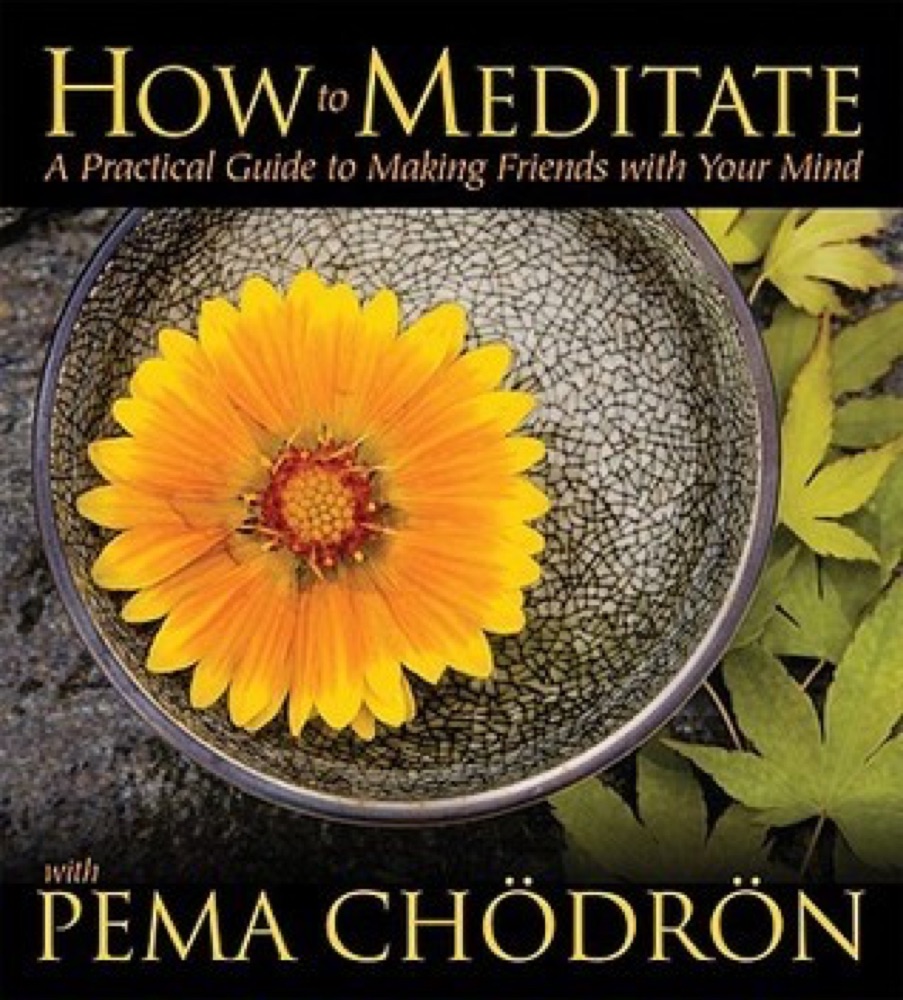
When it comes to meditation, Pema Chödrön is widely regarded as one of the world's foremost teachers. Yet she's never offered an introductory course on audio--until now.
On How to Meditate with Pema Chödrön, the American-born Tibetan Buddhist nun and bestselling author presents her first complete spoken-word course for those new to meditation.
Through traditional insights and her personal guidance, offered in 12 sitting sessions, Pema Chödrön will help you honestly meet and compassionately relate with your mind as you explore:
The basics of mindfulness awareness practice, from proper posture to learning to settle to breathing and relaxation- Gentleness, patience, and humor--three ingredients for a well-balanced practice- Shamatha (or calm abiding), the art of stabilizing the mind to remain present with whatever arises- Thoughts and emotions as "sheer delight"--instead of obstacl
Book details
- First published
- 2007
- Author
- Pema Chödrön
- Genre
- Nonfiction
- Goodreads rating
- 4.19 (5k ratings)
Keep reading
 Mindfulness in Plain English
 Full Catastrophe Living: Using the Wisdom of Your Body and Mind to Face Stress, Pain, and Illness
 Real Happiness: A 28-Day Program to Realize the Power of Meditation
Living Beautifully with Uncertainty and Change
Real Happiness: A 28-Day Program to Realize the Power of Meditation
Living Beautifully with Uncertainty and Change
 The Joy of Living: Unlocking the Secret and Science of Happiness
 Meditation for Beginners
 Meditation for Fidgety Skeptics: A 10% Happier How-To Book
 The Wisdom of No Escape: How to Love Yourself and Your World
The Pocket Pema Chodron
The Wisdom of No Escape: How to Love Yourself and Your World
The Pocket Pema Chodron
 The Mind Illuminated: A Complete Meditation Guide Integrating Buddhist Wisdom and Brain Science
 Wherever You Go, There You Are: Mindfulness Meditation in Everyday Life
 Peace Is Every Breath: A Practice for Our Busy Lives
 Everyday Zen: Love & Work
 The Wise Heart: A Guide to the Universal Teachings of Buddhist Psychology
 Advice Not Given: A Guide to Getting Over Yourself
 How to Sit
 The Miracle of Mindfulness: An Introduction to the Practice of Meditation
 Buddha's Brain: The Practical Neuroscience of Happiness, Love, and Wisdom
 True Refuge: Finding Peace and Freedom in Your Own Awakened Heart
 Nothing Special: A Zen Buddhist Guide to Awakening Through Daily Life's Feelings, Relationships, and Work
 The Tibetan Book of Living and Dying
 Living Untethered: Beyond the Human Predicament
 Meditation
 Going to Pieces without Falling Apart: A Buddhist Perspective on Wholeness
 Practicing the Power of Now: Essential Teachings, Meditations, and Exercises from the Power of Now
 The Yoga Sutras of Pantanjali
 Waking Up: A Guide to Spirituality Without Religion
 The Dalai Lama's Cat and the Power of Meow
 Against the Stream: A Buddhist Manual for Spiritual Revolutionaries
 Awakening the Buddha Within
 The Book of Secrets: Unlocking the Hidden Dimensions of Your Life
 The Buddha Walks into a Bar . . .: A Guide to Life for a New Generation
 The Power of Now: A Guide to Spiritual Enlightenment
 Radical Acceptance: Embracing Your Life With the Heart of a Buddha
 The Book of Secrets
 Breaking the Habit of Being Yourself: How to Lose Your Mind and Create a New One
 In Love with the World: A Monk's Journey Through the Bardos of Living and Dying
 You Can Heal Your Life
 How to See Yourself As You Really Are
 Buddhism Plain & Simple: The Practice of Being Aware, Right Now, Every Day
 Letting Go of the Person You Used to Be: Lessons on Change, Loss, and Spiritual Transformation
 Stillness Is the Key
 The Things You Can See Only When You Slow Down: How to Be Calm in a Busy World
 The Untethered Soul: The Journey Beyond Yourself
 Happiness: A Guide to Developing Life's Most Important Skill
 Why Buddhism Is True: The Science and Philosophy of Meditation and Enlightenment
 Letting Go: The Pathway To Surrender
 Stillness Speaks
 Cutting Through Spiritual Materialism
 Meditation: Insights and Inspirations
 Eastern Body, Western Mind: Psychology and the Chakra System as a Path to the Self
 The Seven Spiritual Laws of Success: A Practical Guide to the Fulfillment of Your Dreams
 Becoming Supernatural: How Common People are Doing the Uncommon
 Buddhist Boot Camp
 Thoughts Without A Thinker: Psychotherapy From A Buddhist Perspective
 Meditations from the Mat: Daily Reflections on the Path of Yoga
 Lovingkindness: The Revolutionary Art of Happiness