
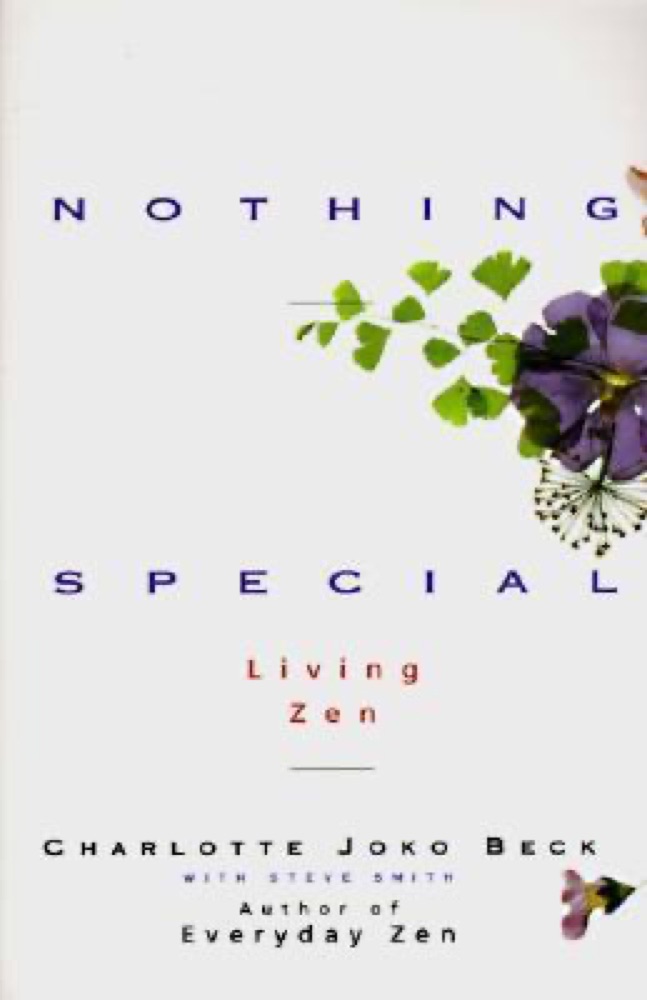
 Nothing Special: A Zen Buddhist Guide to Awakening Through Daily Life's Feelings, Relationships, and Work
Quotes from the Book
We tend to run our whole life trying to avoid all that hurts or displeases us, noticing the objects, people, or situations that we think will give us pain or pleasure, avoiding one and pursuing the other.
20
Enlightenment is not something you achieve. It is the absence of something. All your life you have been going forward after something, pursuing some goal. Enlightenment is dropping all that.
19
My dog doesn’t worry about the meaning of life.
18
If we can accept things just the way they are, we’re not going to be greatly upset by anything.
17
The best way to let go is to notice the thoughts as they come up and to acknowledge them.
13
When we’re lost in thought, when we’re dreaming, what have we lost? We’ve lost reality. Our life has escaped us.
12
If we cease looking, searching, what are we left with? We’re left with what’s been right there at the center all the time. Underneath all that searching there is distress. There is unease. The minute that we realize that, we see that the point isn’t the search, but rather the distress and unease which motivate the search. That’s the magic moment—when we realize that searching outside of ourselves is not the way.
12
We have a fictional “I” that we try to love and protect. We spend most of our life playing this futile game. “What will happen? How will it go? Will I get something out of it?” I, I, I—it’s a mind game of illusion, and we are lost in it.
12
But sitting is not something that we do for a year or two with the idea of mastering it. Sitting is something we do for a lifetime. There is no end to the opening up that is possible for a human being. Eventually we see that we are the limitless, boundless ground of the universe. Our job for the rest of our life is to open up into that immensity and to express it. Having more and more contact with this reality always brings compassion for others and changes our daily life. We live differently, work differently, relate to people differently. Zen is a lifelong study. It isn’t just sitting on a cushion for thirty or forty minutes a day. Our whole life becomes practice, twenty-four hours a day.
8
We all have to practice, and we have to practice with all of our might for the rest of our lives.
8
We have all spent many years building up a conditioned view of life. There is “me” and there is this “thing” out there that is either hurting me or pleasing me. We tend to run our whole life trying to avoid all that hurts or displeases us, noticing the objects, people, or situations that we think will give us pain or pleasure, avoiding one and pursuing the other. Without exception, we all do this. We remain separate from our life, looking at it, analyzing it, judging it, seeking to answer the questions, “What am I going to get out of it? Is it going to give me pleasure or comfort or should I run away from it?” We do this from morning until night. We have to see through the mirage that there is an “I” separate from “that.” Our practice is to close the gap. Only in that instant when we and the object become one can we see what our life is.
6
Human beings are basically good, kind, and compassionate, but it takes hard digging to uncover that buried jewel.
6
We enter a discipline like Zen practice so that we can learn to live in a sane way.
6
Our only freedom is in knowing, from years of observation and experiencing, that all personally centered thoughts and emotions (and the actions born of them) are empty. They are empty; but if they are not seen as empty they can be harmful. When we realize this we can abandon them. When we do, very naturally we enter the space of wonder. This space of wonder—entering into heaven—opens when we are no longer caught up in ourselves: when no longer “It is I,” but “It is Thou.” I am all things when there is no barrier. This is the life of compassion, and none of us lives such a life all the time. In the eye-gazing practice, in which we meditate while facing another person, when we can put aside our personal emotions and thoughts and truly look into another’s eyes, we see the space of no-self. We see the wonder, and we see that this person is ourselves. This is marvelously healing, particularly for people in relationships who aren’t getting along. We see for a second what another person is: they are no-self, as we are no-self, and we are both the wonder.
6
Renunciation Suzuki Roshi said, “Renunciation is not giving up the things of this world, but accepting that they go away.” Everything is impermanent; sooner or later everything goes away. Renunciation is a state of nonattachment, acceptance of this going away. Impermanence is, in fact, just another name for perfection. Leaves fall; debris and garbage accumulate; out of the debris come flowers, greenery, things that we think are lovely. Destruction is necessary. A good forest fire is necessary. The way we interfere with forest fires may not be a good thing. Without destruction, there could be no new life; and the wonder of life, the constant change, could not be. We must live and die. And this process is perfection itself.
6
Essentially, this extra structure covering our life has no reality. It has come to be there because of the misuse of our minds. It’s not a question of getting rid of it, since it has no reality; but it is a question of seeing its nature. And as we see its nature, instead of it being so thick and dark, the covering becomes more transparent: we see through it. Enlightenment (bringing in more light) is what happens in practice. Actually we’re not getting rid of a structure, we’re seeing through it as the dream it is, and as we realize its true nature its whole function in our life weakens; and at the same time we can see more accurately what is going on in our daily life. It’s as if we have to go full circle. Our life is always all right. There’s nothing
5
Dōgen Zenji said, “To look for the Buddha dharma outside of yourself is like putting a devil on top of yourself.” Master Rinzai said, “Place no head above your own.” That is, to look outside of ourselves for true peace and satisfaction is hopeless.
4
But if other people are irritable, we may divorce their behavior from their experiencing. We can’t feel their experience; and so we judge their behavior. If we think, “She shouldn’t be so arrogant,” we only see her behavior and judge it, because we have no awareness of what is true for her
3
The minute we have even a passing thought of judging another person, the red light of practice should go on.
2
There’s nothing wrong with conceptualization per se; but when we take our opinions about any event to be some kind of absolute truth and fail to see that they are opinions, then we suffer. That’s false suffering.
2
Shakespeare’s Polonius said, “To thine own self be true, and it must follow, as the night the day, thou canst not then be false to any man.
2
There are two kinds of thoughts. There is nothing wrong with thinking in the sense of what I call “technical thinking.” We have to think in order to walk from here to the corner or to bake a cake or to solve a physics problem. That use of the mind is fine. It isn’t real or unreal; it is just what it is. But opinions, judgments, memories, dreaming about the future—ninety percent of the thoughts spinning around in our heads have no essential reality. And we go from birth to death, unless we wake up, wasting most of our life with them.
2
One way to evaluate our practice is to see whether life is more and more OK with us. And of course it’s fine when we can’t say that, but still it is our practice. When something’s OK with us we accept everything we are with it; we accept our protest, our struggle, our confusion, the fact that we’re not getting anywhere according to our view of things. And we are willing for all those things to continue: the struggle, the pain, the confusion. In a way that is the training of sesshin. As we sit through it an understanding slowly increases: “Yes, I’m going through this and I don’t like it—wish I could run out—and somehow, it’s OK.” That increases. For example: you may enjoy life with your partner, and think, “Wow, this is the one for me!” Suddenly he or she leaves you; the sharp suffering and the experience of that suffering is the OKness. As we sit in zazen, we’re digging our way into this koan, this paradox which supports our life. More and more we know that whatever happens, and however much we hate it, however much we have to struggle with it—in some way it’s OK. Am I making practice sound difficult? But practice is difficult. And strangely enough, those who practice like this are the people who hugely enjoy life, like Zorba the Greek. Expecting nothing from life, they can enjoy it. When events happen that most people would call disastrous, they may struggle and fight and fuss, but still they enjoy—it’s OK.
2
Work is just taking care of what needs to be done right now, but very few of us work that way.
1
So there are two kinds of suffering. One is when we feel we’re being pressed down; as though suffering is coming at us from without, as though we’re receiving something that’s making us suffer. The other kind of suffering is being under, just bearing it, just being it.
1
Practice is not a trimming on your life. Practice is the foundation. If that’s not there nothing else will be there.
1
We’re like the earnest fish that spent its lifetime swimming from teacher to teacher. The fish wanted to know what the ocean was. And some teachers told him, “Well, you have to try very hard to be a good fish. This is a tremendous area that you’re investigating. And you have to meditate for long hours, and you have to punish yourself and you have to really really try to be a good fish.” But the fish at last came to one teacher and asked, “What’s the great ocean? What’s the great ocean?” And the teacher simply laughed.
1
Sitting is essentially a simplified space. Our daily life is in constant movement: lots of things going on, lots of people talking, lots of events taking place. In the middle of that, it’s very difficult to sense what we are in our life. When we simplify the situation, when we take away the externals and remove ourselves from the ringing phone, the television, the people who visit us, the dog who needs a walk, we get a chance—which is absolutely the most valuable thing there is—to face ourselves.
1
Who is there?” asks God. “It is I.” “Go away,” God says… Later… “Who is there?” asks God. “It is Thou.” “Enter,” replies God.
1
If you are new to practice it's important to realize that simply to sit on that cushion for fifteen minutes is a victory. Just to sit with that much composure, just to be there, is fine.
About Charlotte Joko Beck
We have collected 59 quotes from 2 books by Charlotte Joko Beck on BookQuoters.
More about the author →More by Charlotte Joko Beck
Nothing Special: A Zen Buddhist Guide to Awakening Through Daily Life's Feelings, Relationships, and Work
About the book
A Zen guide to the problems of daily living, love, relationships, work, fear and suffering. Combining earthly wisdom with spiritual enlightenment, it describes how to live each moment to the full and shows the relevance of Zen to every aspect of life.
Book details
- First published
- 1989
- Author
- Charlotte Joko Beck
- Genre
- Nonfiction
- Goodreads rating
- 4.16 (6k ratings)
Keep reading
Nothing Special: A Zen Buddhist Guide to Awakening Through Daily Life's Feelings, Relationships, and Work
 Buddhism Plain & Simple: The Practice of Being Aware, Right Now, Every Day
 The Wisdom of No Escape: How to Love Yourself and Your World
 Living Beautifully with Uncertainty and Change
 The Pocket Pema Chodron
 The Wise Heart: A Guide to the Universal Teachings of Buddhist Psychology
 The Tibetan Book of Living and Dying
 Waking Up: A Guide to Spirituality Without Religion
 The Heart of the Buddha's Teaching: Transforming Suffering into Peace, Joy, and Liberation
 The Miracle of Mindfulness: An Introduction to the Practice of Meditation
 The Joy of Living: Unlocking the Secret and Science of Happiness
 Zen and the Art of Saving the Planet
 Full Catastrophe Living: Using the Wisdom of Your Body and Mind to Face Stress, Pain, and Illness
 The Book of Secrets: Unlocking the Hidden Dimensions of Your Life
 Meditation for Beginners
 Awakening the Buddha Within
 Advice Not Given: A Guide to Getting Over Yourself
 The Power of Now: A Guide to Spiritual Enlightenment
 Against the Stream: A Buddhist Manual for Spiritual Revolutionaries
 365 Tao: A Study of Taoist Wisdom for Daily Life
 Mindfulness in Plain English
 How to Practice: The Way to a Meaningful Life
 Buddha's Brain: The Practical Neuroscience of Happiness, Love, and Wisdom
 The Buddha Walks into a Bar . . .: A Guide to Life for a New Generation
 The Things You Can See Only When You Slow Down: How to Be Calm in a Busy World
 Total Freedom: The Essential Krishnamurti
 The Yoga Sutras of Pantanjali
 How to See Yourself As You Really Are
 Living Untethered: Beyond the Human Predicament
 Cutting Through Spiritual Materialism
 Wherever You Go, There You Are: Mindfulness Meditation in Everyday Life
 Striking Thoughts: Bruce Lee's Wisdom for Daily Living
 True Refuge: Finding Peace and Freedom in Your Own Awakened Heart
 In Love with the World: A Monk's Journey Through the Bardos of Living and Dying
 Loving What Is: Four Questions That Can Change Your Life
 The Book of Awakening: Having the Life You Want by Being Present to the Life You Have
 Hardcore Zen: Punk Rock, Monster Movies and the Truth about Reality
 The Book of Wisdom
 Change Your Thoughts - Change Your Life: Living the Wisdom of the Tao
 Happiness: A Guide to Developing Life's Most Important Skill
 Meditation
 Real Happiness: A 28-Day Program to Realize the Power of Meditation
 Letting Go of the Person You Used to Be: Lessons on Change, Loss, and Spiritual Transformation
 The Dalai Lama's Cat and the Power of Meow
 How to Stop Worrying and Start Living
 Stillness Is the Key
 Practicing the Power of Now: Essential Teachings, Meditations, and Exercises from the Power of Now
 Not Always So: Practicing the True Spirit of Zen – The Final Teachings of Shunryu Suzuki to Empower Your Freedom
 Kitchen Table Wisdom: Stories that Heal
 The Wisdom of Insecurity: A Message for an Age of Anxiety
 The Book of Secrets
 Be Water, My Friend: The Teachings of Bruce Lee
 Buddhist Boot Camp
 Zen and the Art of Motorcycle Maintenance
 The Book: On the Taboo Against Knowing Who You Are
 Going to Pieces without Falling Apart: A Buddhist Perspective on Wholeness
 A Return to Love: Reflections on the Principles of "A Course in Miracles"