
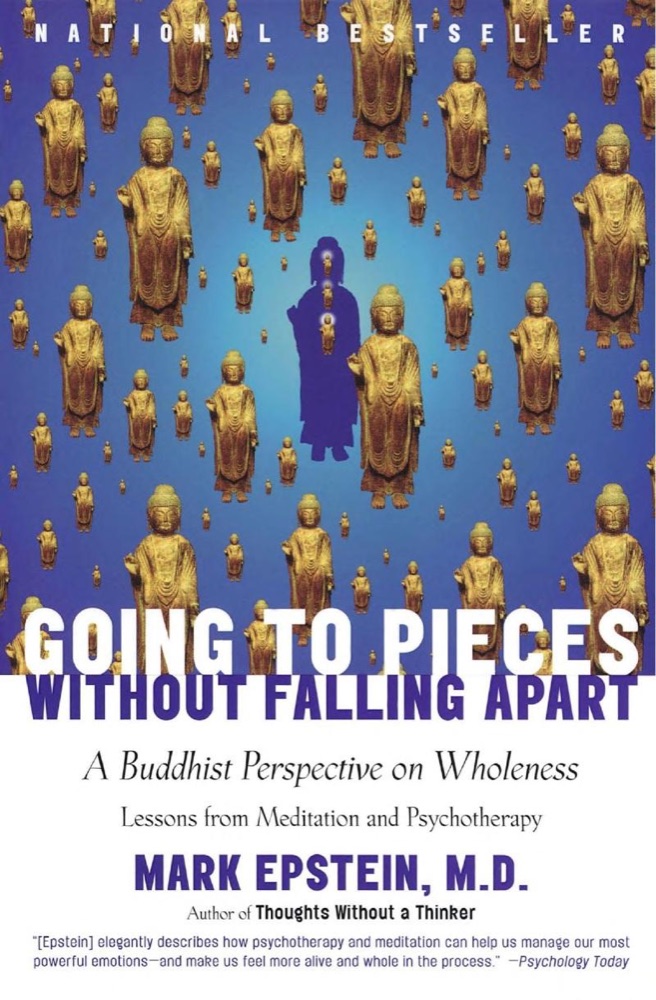
 Going to Pieces without Falling Apart: A Buddhist Perspective on Wholeness
Quotes from the Book
Making one’s life into a meditation is different from using meditation to escape from life.
4
Mourning has no timetable. Grief is not the same for everyone. And it does not necessarily go away. The healthiest way to deal with it is to lean into it, rather than try to keep it at bay. In the attempt to fit in, to be normal, we end up feeling estranged.
4
After the ecstasy, it is said, comes the laundry.
4
The ego needs all the help it can get. We can all benefit from getting over ourselves.
2
So often, within the privacy of our inner worlds, we take the difficult thing and make it worse. Our own subliminal hate speech coats our experience and gives an added layer of meaning to things that are already difficult enough.
2
There is much self-esteem to be gained from learning how and when to surrender.
1
Even in therapy, people are stubbornly lost in their thoughts and imprisoned within the stories they repeat to themselves. They try to use therapy the way many people try to use meditation: powering through to get to an imagined place of cure. Right Mindfulness, like a successful psychotherapy, slows people down. It pokes holes in the facades we unwittingly hide behind. When we stand outside and listen, we have a chance to eavesdrop on the ego's endlessly obsessive self-preoccupation. With the senses aroused in a new way--if people are willing-- they can step outside of themselves as well.
1
Buddhism is all about releasing oneself from the unnecessary constraints of the ego. Every aspect of the Eightfold path is a counterweight to selfish preoccupation. But the Buddhist reprieve is accomplished not by leapfrogging over the ego's needs or demands, but by zeroing in on them: acknowledging and accepting them while learning to hold them with a lighter, more questioning, and more forgiving touch.
1
Trauma is not just the result of major disasters. It does not happen to only some people. An undercurrent of it runs through ordinary life, shot through as it is with the poignancy of impermanence.
1
One of the things I have always appreciated about the Buddhism I have known is the way it has urged me to circumvent my own expectations about what an “enlightened” response might be in any given situation.
1
Many people, in both the East and the West, believe that shutting down the ego, and the thinking mind, is the ultimate purpose of meditation. The Dalai Lama, rather forcefully, always argues that this is a grave misunderstanding. Ego is at once our biggest obstacle and our greatest hope. We can be at its mercy or we can learn to mold it according to certain guiding principles. Intelligence is a key ally in this shaping process, something to be harnessed in the service of one’s progress.
1
being right is not the point in this profession. Being useful is.
1
The most important events in our lives, from falling in love to giving birth to facing death, all require the ego to let go.
Pride, it is often said, is the last fetter to enlightenment. If one can believe the ancient Buddhist psychologists, many other difficult emotions--anger, jealousy, and envy among them--are easier to work with than pride. Even among very accomplished spiritual people, it has long been acknowledged, the tendency to compare self and other remains. If Buddhism can teach us anything useful, it is to loosen the attachments we have to our own indignation. ...letting go even when you know you are right...
Therapy is a compelling tool of Right Effort. A skilled therapist can tell when patients are acting out an emotion rather than acknowledging it, or when they are numbing themselves to escape from something that feels overwhelming. Right Effort seeks to create a context in which learned habits of indulging or denying feelings can be divested. These habits are the equivalents of striking the lute too tightly or too loosely. Too tight is like the rigidity of people chronically clamping down on their feelings. Too loose is like giving feelings free rein, assuming that because we feel them they are "true" and must be taken seriously. Right Effort is an attempt to find balance in the midst of all this. From a therapeutic point of view, it means trusting that an inherent wisdom can emerge when we avoid the two extremes. This wisdom, or clear comprehension, is the emotional equivalent of a therapist's evenly suspended attention. Buddha believed this emotional equilibrium was possible for everyone. Feelings are confusing but they also make sense. A therapist's job is to help bring this equilibrium into awareness. There is a wonderful sound when it dawns.
In Buddhism, there are said to be four "divine" states of mind: kindness, compassion, sympathetic joy, and equanimity. The "divine" properties are present to various degrees in all people, but they emerge in accentuated form in meditation, almost as a by-product, as people learn to relate to their egos in a new way. It is here that we can apply the analogy to athletes finding "the flow" when they learn to get out of their own way. When self-centered preoccupations quiet down, these more "selfless" feelings come to the fore. Ancient texts compare kindness, compassion, sympathetic joy, and equanimity to the feelings a mother has for four sons: "a child, an invalid, one in the flush of youth, and one busy with his own affairs." Kindness is what a mother naturally feels for her young child, compassion is what she feels when her child is ill, sympathetic joy arises when she sees him thriving in the glory of his youth, and equanimity is what she knows when her child is grown and taking care of him- or herself.
While it is true that we spend much of our time needlessly dwelling in thoughts of the past or the future, the ability to stay focused in the present moment, by itself, does not guarantee any kind of personal transformation. Being in the moment is pleasant enough, but it is just a jumping-off place. Right Mindfulness opens up interesting opportunities for honest self-reflection, but there is no built-in guarantee that these openings will be used productively. The self does not give up its grip easily--all of the same defense mechanisms that Freud outlined are still operative even when mindfulness is strong. It is possible to overvalue mindfulness, to remain attached to its form rathe than working directly with what it reveals.
[Concentration] is "Right" when it demonstrates the feasibility of training the mind, when it supports the investigation of impermanence, when it erodes selfish preoccupation, and when it reveals the benefits of surrender.
Right Mindfulness, and the self-scrutiny it engenders, builds a mental muscle. It is a muscle of nonjudgmental self-observation, but it can become much more than that. It is also a precursor of insight. The form such insight takes is different for everyone, but the flavor is similar. Mindfulness makes use of all of those throwaway thoughts that harken back to our childhoods, the ones we adopted to cope with the pressures of growing up. In asking us to pay attention to their repetitive nature, mindfulness also encourages us to recognize their childish quality. ... stopped in our tracks and made aware of how unnecessary such self-protective responses could be. Given the freedom to act differently, we both made a similar choice. Mindfulness showed us how.
We are already equipped to meet whatever befalls us. Life's challenges are challenging, but there is room for faith, for confidence, even for optimism.
What I try to convey to my patients is that they can meet the challenges life throws at them by changing the way they relate to them. The goal is to meet the challenges with equanimity, not to make them go away. When Suzuki Roshi said not to be bothered by the waves' fluctuations, he meant it. And one thing we can say for sure. Life gives us endless opportunity to practice. Mostly we fail. Who can say they are not bothered by anything, really? But when we make the effort, the results can be astonishing. In an insecure world, we can become our own refuge. Our eon do not have to have the last word.
The ego's instinctive favoring of itself is eroded by a sense of the infinite
impermanence is the inescapable flavor of worldly life.
But when we are able to see the extent of our own fears and desires, there is something in us, recognized by both Buddha and Freud, which is able to break free.
Buddhism and Western psychotherapy have much in common. They each recognize that the key to overcoming suffering is the conscious acknowledgment of the ego’s nefarious ways. Without such consciousness, we remain pushed around by impulses and held in check by unrecognized defenses. But when we are able to see the extent of our own fears and desires, there is something in us, recognized by both Buddha and Freud, which is able to break free. Taking responsibility for what is going on inside of us gives hope.
More than the relaxation it evoked, this feeling in the dining hall hinted at who I might be if I wasn’t who I thought I was.
Watch on YouTube
About Mark Epstein
We have collected 85 quotes from 3 books by Mark Epstein on BookQuoters.
More about the author →More by Mark Epstein
Going to Pieces without Falling Apart: A Buddhist Perspective on Wholeness
 Thoughts Without A Thinker: Psychotherapy From A Buddhist Perspective
About the book
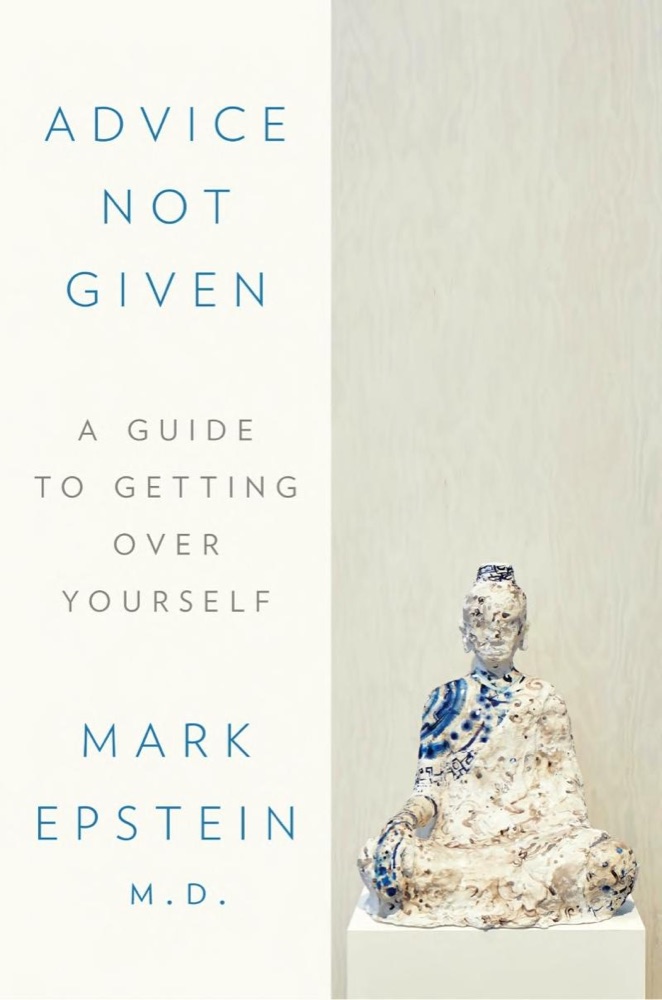
"Most people will never find a great psychiatrist or a great Buddhist teacher, but Mark Epstein is both, and the wisdom he imparts in Advice Not Given is an act of generosity and compassion. The book is a tonic for the ailments of our time."--Ann Patchett, New York Times bestselling author of Commonwealth
Our ego, and its accompanying sense of nagging self-doubt as we work to be bigger, better, smarter, and more in control, is one affliction we all share. And while our ego claims to have our best interests at heart, in its never-ending pursuit of attention and power, it sabotages the very goals it sets to achieve. In Advice Not Given, renowned psychiatrist and author Dr. Mark Epstein reveals how Buddhism and Western psychotherapy, two traditions that developed in entirely different times and places and, until recently, had nothing to do with each other, both identify the ego as the l
Book details
- First published
- 2018
- Author
- Mark Epstein
- Genre
- Nonfiction
- Goodreads rating
- 3.81 (3k ratings)
Keep reading
Going to Pieces without Falling Apart: A Buddhist Perspective on Wholeness
Thoughts Without A Thinker: Psychotherapy From A Buddhist Perspective
 The Wise Heart: A Guide to the Universal Teachings of Buddhist Psychology
 Living Beautifully with Uncertainty and Change
 The Joy of Living: Unlocking the Secret and Science of Happiness
 The Wisdom of No Escape: How to Love Yourself and Your World
 Letting Go: The Pathway To Surrender
 Full Catastrophe Living: Using the Wisdom of Your Body and Mind to Face Stress, Pain, and Illness
 The Places That Scare You: A Guide to Fearlessness in Difficult Times
 In Love with the World: A Monk's Journey Through the Bardos of Living and Dying
 Everyday Zen: Love & Work
 True Refuge: Finding Peace and Freedom in Your Own Awakened Heart
 How to See Yourself As You Really Are
 Letting Go of the Person You Used to Be: Lessons on Change, Loss, and Spiritual Transformation
 The Buddha Walks into a Bar . . .: A Guide to Life for a New Generation
 Mindfulness in Plain English
 Buddha's Brain: The Practical Neuroscience of Happiness, Love, and Wisdom
 Waking Up: A Guide to Spirituality Without Religion
 Cutting Through Spiritual Materialism
 Against the Stream: A Buddhist Manual for Spiritual Revolutionaries
 Finding Meaning in the Second Half of Life: How to Finally, Really Grow Up
 Maybe You Should Talk to Someone: A Therapist, Her Therapist, and Our Lives Revealed
 The Tibetan Book of Living and Dying
 Awakening the Buddha Within
 Kitchen Table Wisdom: Stories that Heal
 The Dalai Lama's Cat and the Power of Meow
 Reconciliation: Healing the Inner Child
 Meditation for Beginners
 Real Happiness: A 28-Day Program to Realize the Power of Meditation
 Buddhist Boot Camp
 Stillness Is the Key
 Happiness: A Guide to Developing Life's Most Important Skill
 Radical Acceptance: Embracing Your Life With the Heart of a Buddha
 You Can Heal Your Life
 How to Be an Adult in Relationships: The Five Keys to Mindful Loving
 The Things You Can See Only When You Slow Down: How to Be Calm in a Busy World
 A New Earth: Awakening to Your Life's Purpose
 Self-Compassion: The Proven Power of Being Kind to Yourself
 Zen and the Art of Saving the Planet
 The Art of Communicating
 Six Pillars of Self-Esteem
 The Art of Being
 Why Buddhism Is True: The Science and Philosophy of Meditation and Enlightenment
 The Antidote: Happiness for People Who Can't Stand Positive Thinking
 The Book of Awakening: Having the Life You Want by Being Present to the Life You Have
 The School of Life: An Emotional Education
 Buddhism Plain & Simple: The Practice of Being Aware, Right Now, Every Day
 The Untethered Soul: The Journey Beyond Yourself
 Orbiting the Giant Hairball: A Corporate Fool's Guide to Surviving with Grace
 Eastern Body, Western Mind: Psychology and the Chakra System as a Path to the Self
 Wherever You Go, There You Are: Mindfulness Meditation in Everyday Life
 Meditation for Fidgety Skeptics: A 10% Happier How-To Book
 No Self, No Problem: How Neuropsychology Is Catching Up to Buddhism
 Nothing Special: A Zen Buddhist Guide to Awakening Through Daily Life's Feelings, Relationships, and Work
 Living Untethered: Beyond the Human Predicament