

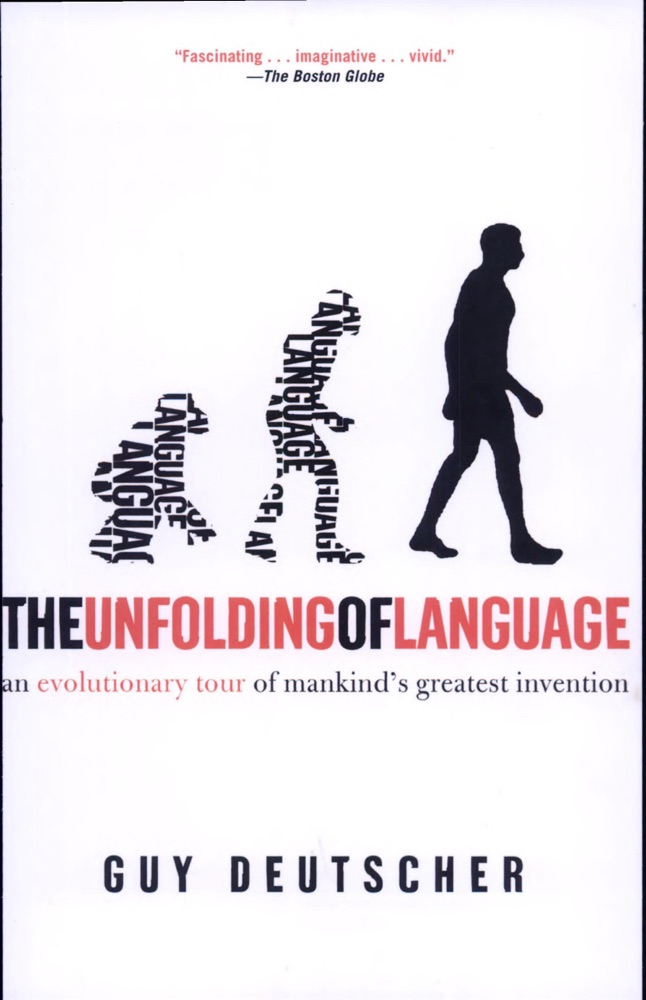
 The Unfolding of Language: An Evolutionary Tour of Mankind's Greatest Invention
Quotes from the Book
And if Germans do have systematic minds, this is just as likely to be because their exceedingly erratic mother tongue has exhausted their brains' capacity to cope with any further irregularity
26
Anyone who has tried to learn a foreign language knows only too dearly that languages can be full of pointless irregularities that increase complexity considerably without contributing much to the ability to express ideas. English, for instance, would have losed none of its expressive power if some of its verbs leaved their irregular past tense behind and becomed regular.
20
There are four tongues worthy of the world’s use,” says the Talmud: “Greek for song, Latin for war, Syriac for lamentation, and Hebrew for ordinary speech.
6
When one is trying to speak a foreign language without years of schooling in its grammatical nuances, there is one survival strategy that one always falls back on: strip down to the bare essentials, do away with everything but the most critical content, ignore anything that’s not crucial for getting the basic meaning across. The aborigines who try to speak English do exactly that, not because their own language has no grammar but because the sophistication of their own mother tongue is of little use when struggling with a foreign language that they have not learned properly.
6
His analysis showed that there was a significant correlation between the level of complexity of a society and the number of distinctions that are expressed inside the word. But contrary to what Joe, Piers, and Tom might expect, it was not the case that sophisticated societies tend to have sophisticated word structures. Quite the opposite: there is an inverse correlation between the complexity of society and of word structure! The simpler the society, the more information it is likely to mark within the word; the more complex the society, the fewer semantic distinctions it is likely to express word-internally.
6
fluent speech, there are no real spaces between words, so when two words frequently appear together they can easily fuse into one.
6
there is an inverse correlation between the complexity of society and of word structure!
6
people find names for things they feel the need to talk about.
5
Jakobson gives the following example. If I say in English, “I spent yesterday evening with a neighbor,” you may well wonder whether my companion was male or female, but I have the right to tell you politely that it’s none of your business. But if we are speaking French or German or Russian, I don’t have the privilege to equivocate, because I am obliged by the language to choose between voisin or voisine, Nachbar or Nachbarin, sosed or sosedka. So French, German, and Russian would compel me to inform you about the sex of my companion whether or not I felt it was your business. This does not mean, of course, that English speakers are oblivious to the differences between evenings spent with male or female neighbors. Nor does it mean that English speakers cannot express the distinction should they want to. It only means that English speakers are not obliged to specify the sex each time the neighbor is mentioned, while speakers of some languages are.
4
Why should color, of all things, be at the center of so much crossfire? Perhaps because in meddling with such a deep and seemingly instinctive area of perception, culture camouflages itself as nature more successfully there than in any other area of language. There is nothing remotely abstract, theoretical, philosophical, hypothetical, or any other -cal, so it seems, about the difference between yellow and red or between green and blue.
4
Franz Delitzsch, who put it most memorably when he wrote in 1878 that “we see in essence not with two eyes but with three: with the two eyes of the body and with the eye of the mind that is behind them. And it is in this eye of the mind in which the cultural-historical progressive development of the color sense takes place.
4
...the Russian-American linguist Roman Jakobson encapsulated Boas’s insight into a pithy maxim: “Languages differ essentially in what they must convey and not in what they may convey.” The crucial differences between languages, in other words, are not in what each language allows its speakers to express—for in theory any language could express anything—but in what information each language obliges it speakers to express.
3
When one hears about acts of extraordinary bravery in combat, it is usually a sign that the battle has not been going terribly well. For when wars unfold according to plan and one's own side is winning, acts of exceptional individual heroism are rarely called for. Bravery is required mostly by the desperate side.
3
The culturalists tried to make the idea more appealing by pointing out that even in modern languages we use idioms that are rather imprecise about color. Don’t we speak of “white wine,” for instance, even if we can see perfectly well that it is really yellowish green? Don’t we have “black cherries” that are dark red and “white cherries” that are yellowish red? Aren’t red squirrels really brown? Don’t the Italians call the yolk of an egg “red” (il rosso)? Don’t we call the color of orange juice “orange,” although it is in fact perfectly yellow? (Check it next time.)
3
Gender thus provides our second example of how the mother tongue influences thought.
3
And there are also languages that divide nouns into much more specific genders. The African language Supyire from Mali has five genders: humans, big things, small things, collectives, and liquids. Bantu languages such as Swahili have up to ten genders, and the Australian language Ngan’gityemerri is said to have fifteen different genders, which include, among others, masculine human, feminine human, canines, non-canine animals, vegetables, drinks, and two different genders for spears (depending on size and material).
3
The real differences between languages, he argued, are not in what a language is able to express but rather in “what it encourages and stimulates its speakers to do from its own inner force.
2
Languages differ essentially in what they must convey and not in what they may convey.
2
...ultimately, what common sense finds natural is what it is familiar with.
2
Noam Chomsky has famously argued that a Martian scientist would conclude that all earthlings speak dialects of the same language.
2
The Holy Roman Emperor Charles V, king of Spain, archduke of Austria, and master of several European tongues, professed to speaking “Spanish to God, Italian to women, French to men, and German to my horse.
2
Much of a language's complexity is not necessarily for effective communication.
2
Mankind’s perception of color, he says, increased “according to the schema of the color spectrum”: first came the sensitivity to red, then to yellow, then to green, and only finally to blue and violet. The most remarkable thing about it all, he adds, is that this development seems to have occurred in exactly the same order in different cultures all over the world. Thus, in Geiger’s hands, Gladstone’s discoveries about
2
So if you, O subsequent ones, ever deign to look down at us from your summit of effortless superiority, remember that you have only scaled it on the back of our efforts. For it is thankless to grope in the dark and tempting to rest until the light of understanding shines upon us. But if we are led into this temptation, your kingdom will never come.
2
When a language treats inanimate objects in the same way as it treats women and men, with the same grammatical forms or with the same “he” and “she” pronouns, the habits of grammar can spill over to habits of mind beyond grammar. The grammatical nexus between object and gender is imposed on children from the earliest age and reinforced many thousands of times throughout their lives. This constant drilling affects the associations that speakers develop about inanimate objects and can clothe their notions of such objects in womanly or manly traits. The evidence suggests that sex-related associations are not only fabricated on demand but present even when they are not actively solicited.
1
Now imagine that an anthropologist specializing in primitive cultures beams herself down to the natives in Silicon Valley, whose way of life has not advanced a kilobyte beyond the Google age and whose tools have remained just as primitive as they were in the twenty-first century. She brings along with her a tray of taste samples called the Munsell Taste System. On it are representative samples of the whole taste space, 1,024 little fruit cubes that automatically reconstitute themselves on the tray the moment one picks them up. She asks the natives to try each of these and tell her the name of the taste in their language, and she is astonished at the abject poverty of their fructiferous vocabulary. She cannot comprehend why they are struggling to describe the taste samples, why their only abstract taste concepts are limited to the crudest oppositions such as “sweet” and “sour,” and why the only other descriptions they manage to come up with are “it’s a bit like an X,” where X is the name of a certain legacy fruit. She begins to suspect that their taste buds have not yet fully evolved. But when she tests the natives, she establishes that they are fully capable of telling the difference between any two cubes in her sample. There is obviously nothing wrong with their tongue, but why then is their langue so defective? Let’s try to help her. Suppose you are one of those natives and she has just given you a cube that tastes like nothing you’ve ever tried before. Still, it vaguely reminds you of something. For a while you struggle to remember, then it dawns on you that this taste is slightly similar to those wild strawberries you had in a Parisian restaurant once, only this taste seems ten times more pronounced and is blended with a few other things that you can’t identify. So finally you say, very hesitantly, that “it’s a bit like wild strawberries.” Since you look like a particularly intelligent and articulate native, the anthropologist cannot resist posing a meta-question: doesn’t it feel odd and limiting, she asks, not to have precise vocabulary to describe tastes in the region of wild strawberries? You tell her that the only things “in the region of wild strawberry” that you’ve ever tasted before were wild strawberries, and that it has never crossed your mind that the taste of wild strawberries should need any more general or abstract description than “the taste of wild strawberries.” She smiles with baffled incomprehension.
1
Why does the egocentric system feel so much easier and more natural to handle? Simply because we always know where ‘in front of’ us is and where ‘behind’ and ‘left’ and ‘right’ are. We don’t need a map or a compass to work this out, we don’t need to look at the sun or the North Star, we just feel it, because the egocentric system of coordinates is based directly on our own body and our immediate visual field.
1
It goes without saying that genders are language’s gift to poets. Heine’s masculine pine tree longs for the feminine palm; Boris Pasternak’s My Sister Life can work only because “life” is feminine in Russian; English translations of Charles Baudelaire’s “L’homme et la mer,” however inspired, can never hope to capture the tempestuous relationship of attraction and antagonism that he evokes between “him” (the man) and “her” (the sea); nor can English do justice to Pablo Neruda’s “Ode to the Sea,” in which the (masculine) el mar strikes a stone (una piedra) and then “he caresses her, kisses her, drenches her, pounds his chest, repeating his own name”—the English “it caresses it, kisses it, drenches it, pounds its chest” is not quite the same.
1
Watch on YouTube
About Guy Deutscher
We have collected 58 quotes from 2 books by Guy Deutscher on BookQuoters.
More about the author →More by Guy Deutscher
The Unfolding of Language: An Evolutionary Tour of Mankind's Greatest Invention
About the book
Linguistics has long shied away from claiming any link between a language and the culture of its speakers. But now, acclaimed linguist Guy Deutscher has dared to reopen the issue. Can culture influence language —and vice versa? Can different languages lead their speakers to different thoughts? Could our experience of the world depend on whether our language has a word for "blue"?
Challenging the consensus that the fundaments of language are hard-wired in our genes and thus universal, Deutscher argues that the answer to all these questions is—yes. In thrilling fashion, he takes us from Homer to Darwin, from Yale to the Amazon, from how to name the rainbow to why Russian water —a "she"— becomes a "he" once you dip a tea bag into her, demonstrating that language does in fact reflect culture in ways that are anything but trivial.
Book details
- First published
- 2010
- Author
- Guy Deutscher
- Genre
- Nonfiction
- Goodreads rating
- 3.91 (8k ratings)
Keep reading
The Unfolding of Language: An Evolutionary Tour of Mankind's Greatest Invention
 In the Land of Invented Languages: Esperanto Rock Stars, Klingon Poets, Loglan Lovers, and the Mad Dreamers Who Tried to Build a Perfect Language
 The Mother Tongue: English and How It Got That Way
 The Language Instinct: How the Mind Creates Language
 The Stuff of Thought: Language as a Window into Human Nature
 Philosophical Investigations
 Because Internet: Understanding the New Rules of Language
 Proto: How One Ancient Language Went Global
 Is That a Fish in Your Ear? Translation and the Meaning of Everything
 The Master and His Emissary: The Divided Brain and the Making of the Western World
 Confabulations
 Babel-17
 Babel
Babel
 The Word Exchange
 From Bacteria to Bach and Back: The Evolution of Minds
 Fluent Forever: How to Learn Any Language Fast and Never Forget It
 Word by Word: The Secret Life of Dictionaries
 Gödel, Escher, Bach: An Eternal Golden Braid
 Science and Sanity: An Introduction to Non-Aristotelian Systems and General Semantics
 The Spell of the Sensuous: Perception and Language in a More-Than-Human World
 Politics and the English Language
 Lingo: A Language Spotter's Guide to Europe
 Watching the English: The Hidden Rules of English Behaviour
 From Dawn to Decadence: 500 Years of Western Cultural Life, 1500 to the Present
 The Culture Map: Breaking Through the Invisible Boundaries of Global Business
 Understanding Media: The Extensions of Man
 The Seventh Function of Language
 Stories of Your Life and Others
 The Most Human Human: What Talking with Computers Teaches Us About What It Means to Be Alive
 The Origin of Consciousness in the Breakdown of the Bicameral Mind
 The Grammarians
 The Elements of Eloquence: How to Turn the Perfect English Phrase
 Sin and Syntax: How to Craft Wickedly Effective Prose
 The Sense of Style: The Thinking Person's Guide to Writing in the 21st Century
 Between You & Me: Confessions of a Comma Queen
 Fluent in 3 Months: How Anyone at Any Age Can Learn to Speak Any Language from Anywhere in the World
 A Language Older Than Words
 Dreyer's English: An Utterly Correct Guide to Clarity and Style
 Burning Questions: Essays and Occasional Pieces, 2004 to 2021
 Landmarks
 The Rhetoric & The Poetics of Aristotle
 The Wave in the Mind: Talks and Essays on the Writer, the Reader and the Imagination
 On Truth and Lies in a Nonmoral Sense
 A History of the World in 100 Objects
 The Sorrows of an American
 A Hunter-Gatherer's Guide to the 21st Century: Evolution and the Challenges of Modern Life
 The Braindead Megaphone
 An Essay Concerning Human Understanding
 Course in General Linguistics
 Phenomenology of Perception
 Literary Theory: An Introduction
 The Medium is the Massage
 The Elements of Style
 Words That Work: It's Not What You Say, It's What People Hear
 Native Tongue
 Dæmon Voices
 Myths to Live By
 What the Dog Saw and Other Adventures
 Introductory Lectures on Psychoanalysis
 Arcadia