

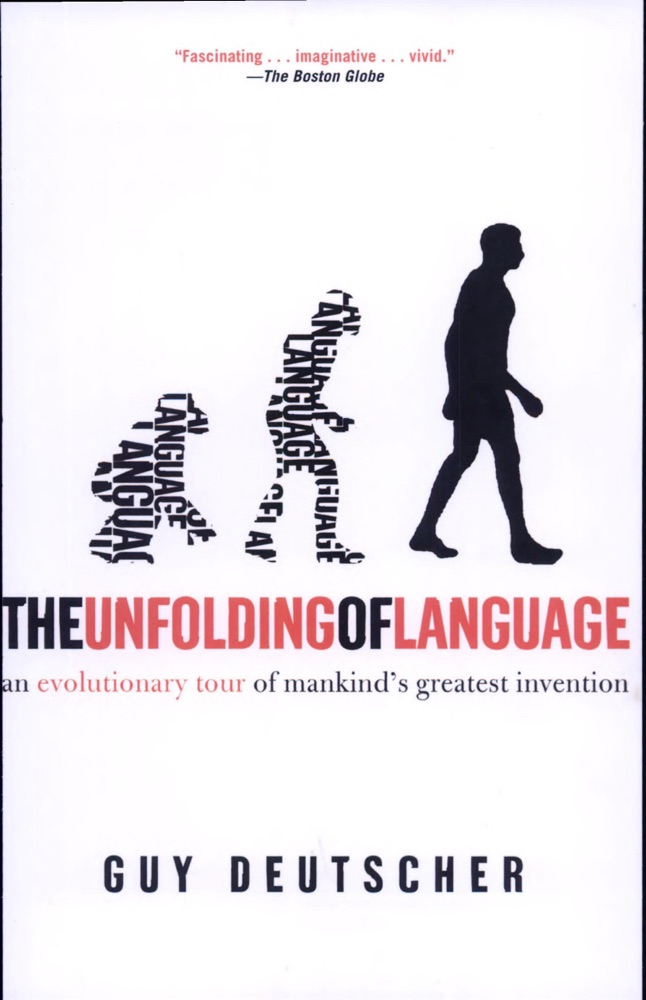
 The Unfolding of Language: An Evolutionary Tour of Mankind's Greatest Invention
Quotes from the Book
The job of the linguist, like that of the biologist or the botanist, is not to tell us how nature should behave, or what its creations should look like, but to describe those creations in all their messy glory and try to figure out what they can teach us about life, the world, and, especially in the case of linguistics, the workings of the human mind.
30
What kind of a world do we live in that has room for dog yoga but not for Esperanto?
18
Before you judge me as some kind of 'anything goes' language heathen, let me just say that I'm not against usage standards. I don't violate them when I want to sound like an educated person, for the same reason I don't wear a bikini to a funeral when I want to look like a respectful person. There are social conventions for the way we do lots of things, and it is to everyone's benefit to be familiar with them. But logic ain't got nothin' to do with it.
16
The variety of shape, pattern, and color found in the languages of the world is a testament to the wonder of nature, to the breathtaking array of possibilities that can emerge, tangled and wild, from the fertile human endowments of brain and larynx, intelligence and social skills.
6
How many Lojbanists does it take to change a broken light-bulb?” goes the old Lojban joke. “Two: one to decide what to change it into and one to decide what kind of bulb emits broken light.
5
At one stage in the history of English, the past tenses of verbs were marked by a regular vowel change process; instead of “help/helped,” we had “help/holp.” Over time, -ed became the preferred way to mark the past tense, and eventually the past tense of most verbs was formed by adding -ed. But the old pattern was preserved in verbs like “eat/ate,” “give/gave,” “take/ took,” “get/got”—verbs that are used very often, and so are more entrenched as a linguistic habit (the very frequently used “was/ were” is a holdover from an even older pattern). They became irregular because the world changed around them.
3
If the word "clear" is imprecise, it is mercifully so. And not necessarily to the detriment of meaning. "It is clear that..." carries with it a bit of transparent glass, the bright ring of a bell, a sunny day, a candid conversation, an uncluttered table.
As revolutions broke out and tensions increased, language inventors found not only a new strategy for building the structures of their languages but a new reason for building them in the first place.
Esperanto is a ‘linguistic handshake,’ a neutral ground where people of different nations can communicate as equals.” Nice idea, but people don’t speak languages for abstract reasons. The Irish feel a strong emotional attachment to the once-persecuted language of their heritage, but despite mandatory school instruction, they don’t speak Irish.
Sometimes we do find the words to express an idea, and only then realize what a stupid idea it is. This experience would suggest that our thoughts are not as clean and beautiful as we would like to believe.
Seventeenth-century philosophers and scientists were complaining that language obscured thinking, that words got in the way of understanding things. They believed that concepts were clear and universal, but language was ambiguous and unsystematic.
The way people think about language is influenced by the times they live in, and it is possible to show how changing times led, in a general way, to changes in the types of languages that inventors came up with. There are trends, or eras, in language invention that reflect the preoccupations of the surrounding culture, and so, in a way, the history of invented languages is a story about the way we think about languages.
He suggested that people test the language by writing to a friend in a foreign land, enclosing a small leaflet with the translations of a few roots and affixes, and leaving it up to the recipient to make sense of it.
All this fighting stems from the illusion that people choose to learn a language for rational reasons, that they are looking for the language that has the most useful features, the best agenda. But no one is out there comparison shopping for an artificial language. They find what they like, and there's no accounting for taste.
Watch on YouTube
About Arika Okrent
We have collected 14 quotes from 1 book by Arika Okrent on BookQuoters.
More about the author →About the book
Just about everyone has heard of Esperanto, which was nothing less than one man's attempt to bring about world peace by means of linguistic solidarity. And every Star Trek fan knows about Klingon, which was nothing more than a television show's attempt to create a tough-sounding language befitting a warrior race with ridged foreheads. But few people have heard of Babm, Blissymbolics, and the nearly nine hundred other invented languages that represent the hard work, high hopes, and full-blown delusions of so many misguided souls over the centuries.
In In the Land of Invented Languages, author Arika Okrent tells the fascinating and highly entertaining history of man's enduring quest to build a better language. Peopled with charming eccentrics and exasperating megalomaniacs, the land of invented languages is a place where you can recite the Lord's Prayer in John Wilkins's Philosophical
Book details
- First published
- 2009
- Author
- Arika Okrent
- Genre
- Nonfiction
- Goodreads rating
- 4.10 (3k ratings)
Keep reading
The Unfolding of Language: An Evolutionary Tour of Mankind's Greatest Invention
 Through the Language Glass: Why the World Looks Different in Other Languages
 The Mother Tongue: English and How It Got That Way
 Because Internet: Understanding the New Rules of Language
 The Language Instinct: How the Mind Creates Language
 The Stuff of Thought: Language as a Window into Human Nature
 Philosophical Investigations
 Proto: How One Ancient Language Went Global
 Babel-17
 Word by Word: The Secret Life of Dictionaries
 Is That a Fish in Your Ear? Translation and the Meaning of Everything
 Confabulations
 The Word Exchange
 Babel
Babel
 Lingo: A Language Spotter's Guide to Europe
 The Elements of Eloquence: How to Turn the Perfect English Phrase
 Gödel, Escher, Bach: An Eternal Golden Braid
 Between You & Me: Confessions of a Comma Queen
 From Bacteria to Bach and Back: The Evolution of Minds
 Politics and the English Language
 Burning Questions: Essays and Occasional Pieces, 2004 to 2021
 The Master and His Emissary: The Divided Brain and the Making of the Western World
 Science and Sanity: An Introduction to Non-Aristotelian Systems and General Semantics
 Stories of Your Life and Others
 Fluent in 3 Months: How Anyone at Any Age Can Learn to Speak Any Language from Anywhere in the World
 Fluent Forever: How to Learn Any Language Fast and Never Forget It
 The Grammarians
 Sin and Syntax: How to Craft Wickedly Effective Prose
 A Language Older Than Words
 Dreyer's English: An Utterly Correct Guide to Clarity and Style
 The Wave in the Mind: Talks and Essays on the Writer, the Reader and the Imagination
 The Spell of the Sensuous: Perception and Language in a More-Than-Human World
 Watching the English: The Hidden Rules of English Behaviour
 What Do You Care What Other People Think?
 The Etymologicon: A Circular Stroll through the Hidden Connections of the English Language
 The Most Human Human: What Talking with Computers Teaches Us About What It Means to Be Alive
 The Medium is the Massage
 The Sense of Style: The Thinking Person's Guide to Writing in the 21st Century
 Always Coming Home
 From Dawn to Decadence: 500 Years of Western Cultural Life, 1500 to the Present
 The Futurological Congress: From the Memoirs of Ijon Tichy
 Arcadia
 Understanding Media: The Extensions of Man
 The Information: A History, a Theory, a Flood
 The Origin of Consciousness in the Breakdown of the Bicameral Mind
 Made in America: An Informal History of the English Language in the United States
 The Meaning of It All: Thoughts of a Citizen-Scientist
 The Mountain in the Sea
 The Professor and the Madman: A Tale of Murder, Insanity and the Making of the Oxford English Dictionary
 Love in English
 The Culture Map: Breaking Through the Invisible Boundaries of Global Business
 The Seventh Function of Language
 Skinny Legs and All
 The Telling
 Generation A
 The Dictionary of Lost Words
 Please Understand Me II: Temperament, Character, Intelligence
 The Braindead Megaphone
 Incidental Inventions
 Course in General Linguistics