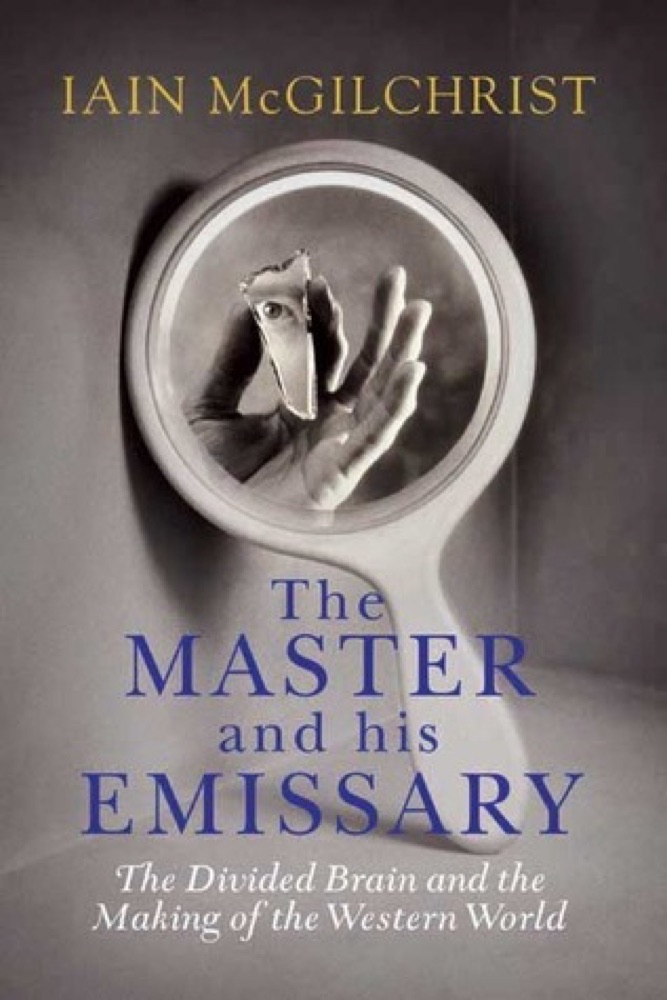
 The Master and His Emissary: The Divided Brain and the Making of the Western World
Quotes from the Book
The body is our general medium for having a world.
161
The perception of other people and the intersubjective world is problematic only for adults. The child lives in a world which he unhesitatingly believes accessible to all around him. He has no awares of himself or of others as private subjectives, nor does he suspect that all of us, himself included, are limited to one certain point of view of the world. That is why he subjects neither his thoughts, in which he believes as they present themselves, to any sort of criticism. He has no knowledge of points of view. For him men are empty heads turned towards one single, self-evident world where everything takes place, even dreams, which are, he thinks, in his room, and even thinking, since it is not distinct from words.
61
Language transcends us and yet we speak.
57
Our view of man will remain superficial so long as we fail to go back to that origin [of silence], so long as we fail to find, beneath the chatter of words, the primordial silence, and as long as we do not describe the action which breaks this silence. the spoken word is a gesture, and its meaning, a world.
55
Because we are in the world, we are condemned to meaning, and we cannot do or say anything without its acquiring a name in history.
47
We must therefore rediscover, after the natural world, the social world, not as an object or sum of objects, but as a permanent field or dimension of existence.
42
Nothing determines me from outside, not because nothing acts upon me, but, on the contrary, because I am from the start outside myself and open to the world.
34
The phenomenological world is not the bringing to explicit expression of a pre-existing being, but the laying down of being. Philosophy is not the reflection of a pre-existing truth, but, like art, the act of bringing truth into being.
30
The full meaning of a language is never translatable into another. We may speak several languages but one of them always remains the one in which we live. In order completely to assimilate a language it would be necessary to make the world which it expresses one's own and one never does belong to two worlds at once.
27
(T)he philosopher is a perpetual beginner. This means that he accepts nothing as established from what men or scientists believe they know. This also means that philosophy itself is an ever-renewed experiment of its own beginning , that it consists entirely in describing this beginning, and finally, that radical reflection is conscious of its own dependence on an unreflected life that is its initial, constant, and final situation.
25
All thought of something is at the same time self-consciousness [...] At the root of all our experiences and all our reflections, we find [...] a being which immediately recognises itself, [...] and which knows its own existence, not by observation and as a given fact, nor by inference from any idea of itself, but through direct contact with that existence. Self-consciousness is the very being of mind in action.
23
True reflection presents me to myself not as idle and inaccessible subjectivity, but as identical with my presence in the world and to others, as I am now realizing it: I am all that I see, I am an intersubjective field, not despite my body and historical situation, but, on the contrary, by being this body and this situation, and though them, all the rest.
21
Being established in my life, buttressed by my thinking nature, fastened down in this transcendental field which was opened for me by my first perception, and in which all absence is merely the obverse of a presence, all silence a modality of the being of sound, I enjoy a sort of ubiquity and theoretical eternity, I feel destined to move in a flow of endless life, neither the beginning nor the end of which I can experience in thought, since it is my living self who think of them, and since thus my life always precedes and survives itself.
17
It is no more natural and no less conventional to shout in anger or to kiss in love than to call a table 'a table'. Feelings and passional conduct are invented like words. Even those which like paternity seem to be part and parcel of the human make-up are in reality institutions. It is impossible to superimpose on man a lower layer of behavior which one chooses to call 'natural' followed by a manufactured cultural or spiritual world. Everything is both manufactured and natural in man as it were in the sense that there is not a word, not a form of behavior which does not owe something to purely biological being and which at the same time does not elude the simplicity of animal life and cause forms of vital behavior to deviate from their pre-ordained direction through a sort of leakage and through a genius for ambiguity which might serve to define man.
15
It is the essence of certainty to be established only with reservations.
14
Everything that I know about the world, even through science, I know from a perspective that is my own or from an experience of the world without which scientific symbols would be meaningless. The entire universe of science is constructed upon the lived world, and if we wish to think science rigorously, to appreciate precisely its sense and its scope, we must first awaken that experience of the world of which science is the second-order expression. Science neither has, nor ever will have the same ontological sense as the perceived world for the simple reason that science is a determination or an explanation of that world. ... Scientific perspectives … always imply, without mentioning it, that other perspective - the perspective of consciousness - by which a world first arranges itself around me and begins to exist for me. To return to the things themselves is to return to this world prior to knowledge, this world of which knowledge always speaks, and this world with regard to which every scientific determination is abstract, signitive, and dependent, just like geography with regard to the landscape where we first learned what a forest, a meadow, or a river is.
9
The world is inseparable from the subject, but from a subject which is nothing but a project of the world, and the subject is inseparable from the world, but from a world which the subject itself projects.
9
There is nothing to be seen beyond our horizons, but other landscapes and still other horizons, and nothing inside the thing but other smaller things.
8
I discover vision, not as a "thinking about seeing," to use Descartes expression, but as a gaze at grips with a visible world, and that is why for me there can be another's gaze.
8
I am a psychological and historical structure. Along with existence, I received a way of existing, or a style. All of my actions and thoughts are related to this structure, and even a philosopher’s thought is merely a way of making explicit his hold upon the world, which is all he is. And Yet, I am free, not in spite of or beneath these motivations, but rather by their means. For that meaningful life, that particular signification of nature and history that I am, does not restrict my access to the world; it is rather my means of communication with it
6
Nothing is more difficult than to know precisely what we see.
5
the real is coherent and probable because it is real, and not real because it is coherent...
5
Speech is not a means in the service of an external end. It contains its own rule of usage, ethics, and view of the world, as a gesture sometimes bears the whole truth about a man.
5
The thing can never be separated from someone who perceives it; nor can it ever actually be in itself because its articulations are the very ones of our existence, and because it is posited at the end of a gaze or at the conclusion of a sensory exploration that invests it with humanity. To taking up or the achievement by us of an alien intention or inversely the accomplishment beyond our perceptual powers and as a coupling of our body wit the things.
5
To see the object is to plunge into it.
4
Ambiguity is essential to human existence, and everything we live or think always has several senses.
3
If I wanted to express perceptual experience with precision, I would have to say that one perceives in me, and not that I perceive. Every sensation includes a seed of dream or depersonalization, as we experience through this sort of stupor into which it puts us when we truly live at the level of sensation.
3
It is because we are through and through compounded of relationships with the world that for us the only way to become aware of the fact is to suspend the resultant activity, to refuse it our complicity (to look at it ohne mitzumachen, as Husserl often says), or yet again, to put it 'out of play'. Not because we reject the certainties of common sense and a natural attitude to things - they are, on the contrary, the constant theme of philosophy - but because, being the presupposed basis of any thought, they are taken for granted, and go unnoticed, and because in order to arouse them and bring them to view, we have to suspend for a moment our recognition of them. The best formulation of the reduction is probably that given by Eugen Fink, Husserl's assistant, when he spoke of 'wonder' in the face of the world.
3
The destruction of sight, wherever the injuries be sustained, follows the same law: all colors are affected in the first place,and lose their saturation. Then the spectrum is simplified, being reduced to four and soon to two colors; finally a grey monochrome stage is reached, although the pathological color is never identifiable with any normal one. Thus in central as in peripheral lesions ‘the loss of nervous substance results not only in a deficiency of certain qualities, but in the change to a less differentiated and more primitive structure’.
3
The wonderful thing about language is that it promotes its own oblivion.
2
Watch on YouTube
About Maurice Merleau-Ponty
We have collected 30 quotes from 1 book by Maurice Merleau-Ponty on BookQuoters.
More about the author →About the book
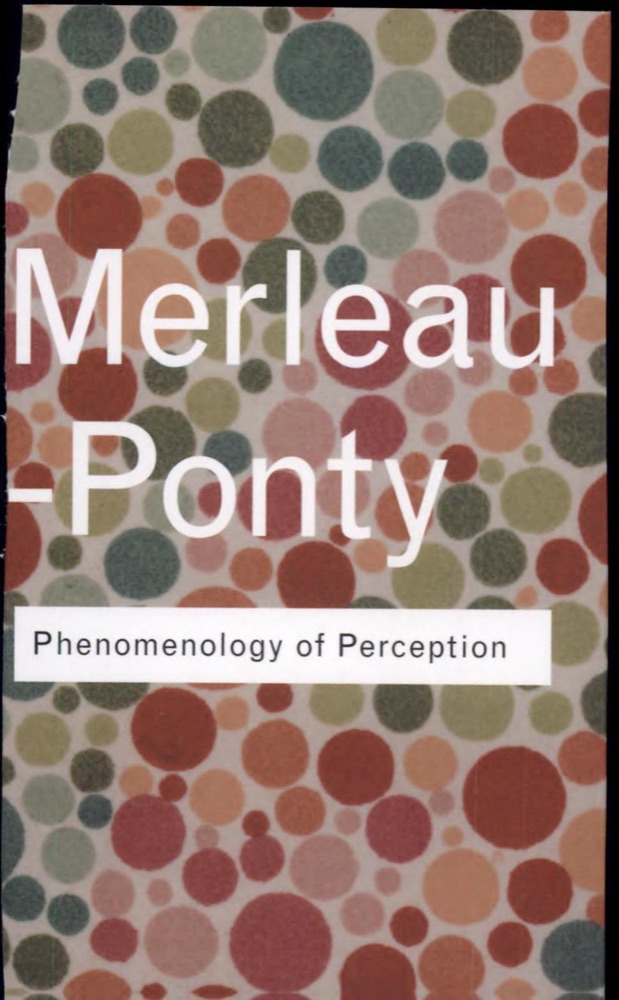
Together with Sartre, Merleau-Ponty was the foremost French philosopher of the post-war period and Phenomenology of Perception, first published in 1945, is his masterpiece. What makes this work so important is that it returned the body to the forefront of philosophy for the first time since Plato.
Book details
- First published
- 1945
- Author
- Maurice Merleau-Ponty
- Genre
- Philosophy
- Goodreads rating
- 4.18 (7k ratings)
Keep reading
The Master and His Emissary: The Divided Brain and the Making of the Western World
 The Doors of Perception & Heaven and Hell
 The Origin of Consciousness in the Breakdown of the Bicameral Mind
 The Book: On the Taboo Against Knowing Who You Are
 At the Existentialist Café
 Being and Time
 Phenomenology of Spirit
 Truth and Method
 Irrational Man: A Study in Existential Philosophy
 The World as Will and Representation, Vol 1
 Philosophical Investigations
 The Big Picture: On the Origins of Life, Meaning, and the Universe Itself
 The Case Against Reality: Why Evolution Hid the Truth from Our Eyes
 Modern Man in Search of a Soul
 On Truth and Lies in a Nonmoral Sense
 Myths to Live By
 Basic Writings
 Buddhism Plain & Simple: The Practice of Being Aware, Right Now, Every Day
 An Enquiry Concerning Human Understanding
 Understanding Media: The Extensions of Man
 The Doors of Perception
 Think: A Compelling Introduction to Philosophy
 The Medium is the Massage
 The Problems of Philosophy
 The Essential Writings of Ralph Waldo Emerson
 The Wisdom of Insecurity: A Message for an Age of Anxiety
 The Human Condition
 The Stuff of Thought: Language as a Window into Human Nature
 The Perennial Philosophy
 Immortality
 Memories, Dreams, Reflections
 The Way of Zen
 Critique of Pure Reason
 The Myth of Sisyphus
 An Essay Concerning Human Understanding
 Maps of Meaning: The Architecture of Belief
 The Spell of the Sensuous: Perception and Language in a More-Than-Human World
 The Myth of Sisyphus and Other Essays
 Tractatus Logico-Philosophicus
 In Love with the World: A Monk's Journey Through the Bardos of Living and Dying
 Stories of Your Life and Others
 A Treatise of Human Nature
 The Invention of Solitude
 Science and Sanity: An Introduction to Non-Aristotelian Systems and General Semantics
 Pensées
 What Does It All Mean? A Very Short Introduction to Philosophy
 Helgoland: Making Sense of the Quantum Revolution
 Man and His Symbols
 The Ethics of Ambiguity
 Total Freedom: The Essential Krishnamurti
 Metaphysics
 Seth Speaks: The Eternal Validity of the Soul
 Finite and Infinite Games: A Vision of Life as Play and Possibility
 Twilight of the Idols/The Anti-Christ
 Freedom from the Known
 The Varieties of Religious Experience
 Autumn
 The Common Reader
 Time Regained
 Sculpting in Time