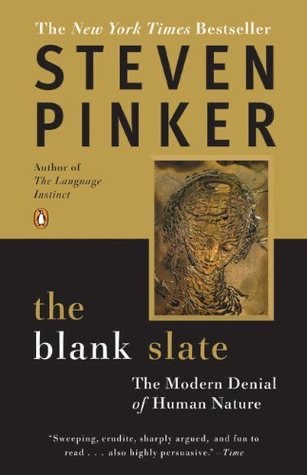
 The Blank Slate: The Modern Denial of Human Nature
Quotes from the Book
Seek authorities who are willing to both show you how they arrived at their conclusions and admit when they have made mistakes.
7
The differences between the sexes are found in babies, and across cultures, too -so this is not some weird WEIRD phenomenom. Given a choice, neonate girls spend more time looking at faces, while neonate boys spend more time looking at things.
6
We work side by side, and some of us imagine that because we are equal under the law, we are also the same. We are and should be equal under the law. But we are not the same - despite what some activists and politicians, journalists and academics would have us believe.
4
Humans are antifragile; exposure to discomfort and uncertainty -physical, emotional and intellectual- is necessary.
3
Gestation and lactation are anatomically, physiologically mandated features of being a female mammal.
3
Pretending that we are identical, rather than ensuring that we are equal under the law, is a fool's game.
3
When we say that men are taller than women, the words -on average- are implied. Pointing to the existence of your friend Rhonda, who really is quite tall, does not negate the statistical truth that, on average, men are still taller than women.
3
Men will never ovulate, gestate, lactate, menstruate, or go through menopause. Women who identify as men might, but that thing is different.
3
It is important to know what the group thinks, but that is not the same as believing or reinforcing what the group thinks. In a time of rapid change in particular, then, it is important to be willing to be the lone voice. Be the person who never conforms to patently wrong statements in order to fit in with the crowd. Be Asch-Negative.
3
Either way, modernity is doing something to us at a deeply fundamental level, and the fact that we don’t understand it is alarming.
3
Those who advocate for a raw diet suggest that it is the healthiest, "most natural" way to eat. Cooking, they say, is a modern bastardization of the human diet. This is simply wrong.
2
Like all social, long-lived organisms with long childhoods and overlap between our generations, we need to learn how to be adults. That is different, however, from needing to be taught.
2
Chesterton wrote this of a “fence or gate erected across a road”: The more modern type of reformer goes gaily up to it and says, “I don’t see the use of this; let us clear it away.” To which the more intelligent type of reformer will do well to answer: “If you don’t see the use of it, I certainly won’t let you clear it away. Go away and think. Then, when you can come back and tell me that you do see the use of it, I may allow you to destroy it.
2
The best, most all-encompassing way to describe our world is hyper-novel. As we will show throughout the book, humans are extraordinarily well adapted to, and equipped for, change. But the rate of change itself is so rapid now that our brains, bodies, and social systems are perpetually out of sync. For millions of years we lived among friends and extended family, but today many people don’t even know their neighbors’ names. Some of the most fundamental truths—like the fact of two sexes—are increasingly dismissed as lies. The cognitive dissonance spawned by trying to live in a society that is changing faster than we can accommodate is turning us into people who cannot fend for ourselves. Simply put, it’s killing us.
2
Dogs are in many ways a human construct. We have co-evolved with them for so long that they are now attuned to human behavior, language, and emotion.
1
While actually intersex individuals are real and incredibly rare, and actually transgendered people are also real and very rare, much of modern "gender ideology" is dangerous and contagious, and many of the interventions (hormonal, surgical) are not reversible.
1
We should also not expect that men and women will make identical choices, or be driven to excel at identical things, or even, perhaps, be motivated by the same goals. To ignore our differences and demand uniformity is a different kind of sexism. Differences between the sexes are a reality, and while they can be cause for concern, they are also very often a strength, and we ignore them at our peril.
1
Our differences are fascinating, but our similarities make us human.
1
humans deserve a night sky, a sky full of possibilities—sometimes of clouds, often the moon, occasionally planets, nearly always stars and the Milky Way in which we live.
1
they are, as a country, starving? It’s yet another paradox, which is, we argue, a kind of treasure map. When you see a paradox, keep digging.
1
Keep an eye out for other things that we moderns might be trying to rid ourselves of without sufficiently understanding their function—not only Chesterton’s organs, but his gods and his breast milk, his cuisine and his play.
1
It is likely that our highly geometric homes and playgrounds, which make up so much of what we see during early childhood, calibrate our eyes such that we suffer from such illusions far more than do those in the rest of the world.
1
The more you move, therefore, within whatever your particular limits are, the more integrated, whole, and accurate your perception of the world is likely to be.
In families of white-collar workers, if children engage in physical activity only when parents ferry them to specially sanctioned places and times for formal sport, the illusion is created that real physical work is always an option, never a necessity. While that may serve your class aspirations (and it may currently reflect the reality of your life), it does not serve your child.
Group membership never disappears, but an organism will try to pass as something it’s not, if enough of its traits transform. We are nucleate, heterotrophic, vertebral, brainy, bony fish. We are fish.
Asking if a particular trait is due to nature or nurture implies a false dichotomy between nature, genes, and evolution on the one side and between nurture and environment on the other. In fact, all of it is evolutionary.
Does your pet love you? Of course your pet loves you. (Qualifier: your pet can love you if it’s a mammal or one of a few clades of birds, like a parrot. If your pet is a gecko or a python or a goldfish, your pet is probably incapable of love.) Love develops for every evolutionary pairing that requires devotion. We love our pets, and our pets love us. Dogs, in particular, are love generators who hang out with you and help you know that you’re not alone. Dog is love, unmoored.
When we sit down to eat a meal together, especially when we are breaking bread that we have ourselves made, we gain far more than calories.
The concept of scientism was introduced by 20th-century economist Friedrich Hayek.4 He observed that, too often, the methods and language of science are imitated by institutions and systems not engaged in science, such that the resulting efforts are generally not scientific at all.
Watch on YouTube
About Heather E. Heying
We have collected 29 quotes from 1 book by Heather E. Heying on BookQuoters.
More about the author →About the book
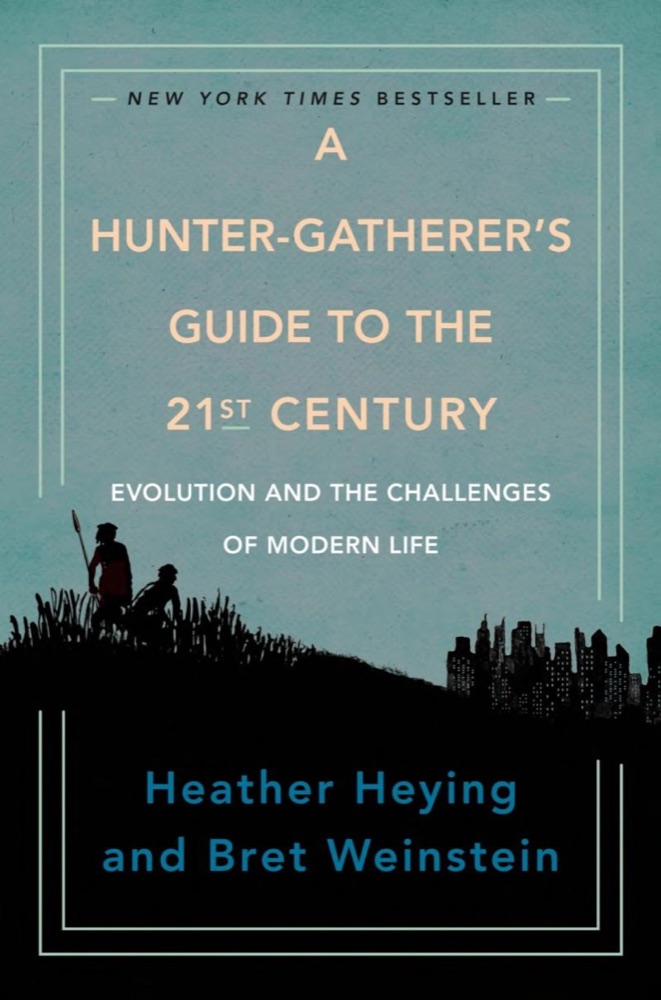
A bold, provocative history of our species finds the roots of civilization’s success and failure in our evolutionary biology.
We are living through the most prosperous age in all of human history, yet people are more listless, divided and miserable than ever. Wealth and comfort are unparalleled, and yet our political landscape grows ever more toxic, and rates of suicide, loneliness, and chronic illness continue to skyrocket. How do we explain the gap between these two truths? What's more, what can we do to close it?
For evolutionary biologists Heather Heying and Bret Weinstein, the cause of our woes is the modern world is out of sync with our ancient brains and bodies. We evolved to live in clans, but today most people don't even know their neighbors’ names. Traditional gender roles once served a necessary evolutionary purpose, but today we dismiss them as regressive. The cognitive
Book details
- First published
- 2021
- Author
- Heather E. Heying
- Genre
- Nonfiction
- Goodreads rating
- 3.75 (6k ratings)
Keep reading
The Blank Slate: The Modern Denial of Human Nature
 Sapiens: A Brief History of Humankind
 Shadows of Forgotten Ancestors
 The Social Conquest of Earth
 The Lost World
 Dragons of Eden: Speculations on the Evolution of Human Intelligence
 How the Mind Works
 The Red Queen: Sex and the Evolution of Human Nature
 Undeniable: Evolution and the Science of Creation
 Humankind: A Hopeful History
 The Moral Animal: Why We Are the Way We Are - The New Science of Evolutionary Psychology
 The Social Animal: The Hidden Sources of Love, Character, and Achievement
 Animal: The Autobiography of a Female Body
 Homo Deus: A History of Tomorrow
 A Language Older Than Words
 Our Inner Ape: A Leading Primatologist Explains Why We are Who We Are
 Some We Love, Some We Hate, Some We Eat: Why It's So Hard to Think Straight About Animals
 Endgame, Vol. 1: The Problem of Civilization
 Starry Messenger: Cosmic Perspectives on Civilization
 Natural Causes: An Epidemic of Wellness, the Certainty of Dying, and Killing Ourselves to Live Longer
 The Gene: An Intimate History
 The Blind Watchmaker: Why the Evidence of Evolution Reveals a Universe Without Design
 Enlightenment Now: The Case for Reason, Science, Humanism, and Progress
 21 Lessons for the 21st Century
 My Life on the Road
 The Culture of Make Believe
 On Human Nature
 Genome
 Psych: The Story of the Human Mind
 Echopraxia
 The Elephant in the Brain: Hidden Motives in Everyday Life
 Civilized to Death: What Was Lost on the Way to Modernity
 Why We Get Sick: The New Science of Darwinian Medicine
 Woman: An Intimate Geography
 The Rational Optimist: How Prosperity Evolves
 Straw Dogs: Thoughts on Humans and Other Animals
 Antifragile: Things That Gain from Disorder
 The Shockwave Rider
 Sex at Dawn: The Prehistoric Origins of Modern Sexuality
 Good Reasons for Bad Feelings: Insights from the Frontier of Evolutionary Psychiatry
 The Black Swan: The Impact of the Highly Improbable
 Why Fish Don’t Exist: A Story of Loss, Love, and the Hidden Order of Life
 12 Rules for Life: An Antidote to Chaos
 What's Our Problem?: A Self-Help Book for Societies
 The Mountain in the Sea
 A Devil's Chaplain: Reflections on Hope, Lies, Science, and Love
 The Age of Magical Overthinking: Notes on Modern Irrationality
 Walden Two
 The Moral Landscape: How Science Can Determine Human Values
 What's Wrong with the World
 The Tell-Tale Brain: A Neuroscientist's Quest for What Makes Us Human
 The Mother of All Questions
 The Truth Will Set You Free, But First It Will Piss You Off!: Thoughts on Life, Love, and Rebellion
 Religion Explained: The Evolutionary Origins of Religious Thought
 Creation Lake
 The Story of More: How We Got to Climate Change and Where to Go from Here
 The Laws of Human Nature
 Genesis
 Billions & Billions: Thoughts on Life and Death at the Brink of the Millennium
 The Mating Mind: How Sexual Choice Shaped the Evolution of Human Nature