
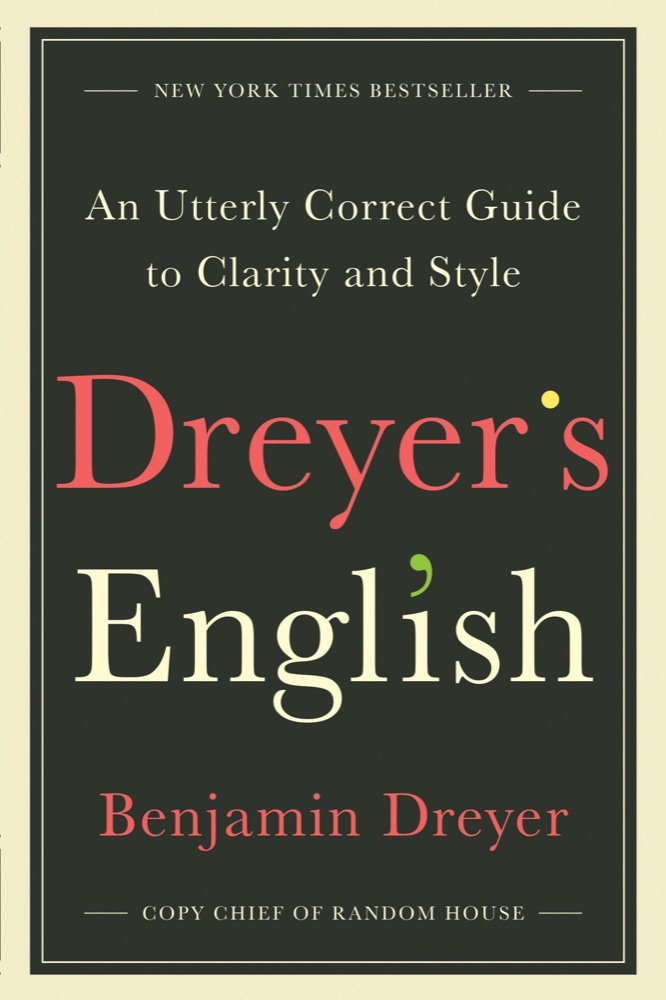
 Dreyer's English: An Utterly Correct Guide to Clarity and Style
Quotes from the Book
Fiddlesticks” is Scarlett O’Hara’s way of saying “Fuck this shit.
26
Whom" may indeed be on the way out, but so is Venice, and we still like to go there.
11
Why, if there is alphabet soup, do we not have punctuation cereal?
7
First we get the rocks out, Alice. Then we get the pebbles out. Then we get the sand out, and the writer’s voice rises. No harm done.
6
The English language is full of words that are just waiting to be misspelled, and the world is full of sticklers, ready to pounce.
6
But good writers have a reason for doing things the way they do them, and if you tinker with their work, taking it upon yourself to neutralize a slightly eccentric usage or zap a comma or sharpen the emphasis of something that the writer was deliberately keeping obscure, you are not helping. In my experience, the really great writers enjoy the editorial process. They weigh queries, and they accept or reject them for good reasons. They are not defensive. The whole point of having things read before publication is to test their effect on a general reader. You want to make sure when you go out there that the tag on the back of your collar isn’t poking up—unless, of course, you are deliberately wearing your clothes inside out.
6
Muphry’s Law: “If you write anything criticising editing or proofreading, there will be a fault of some kind in what you have written.
5
Sing in me, o Muse, of that small minority of men who are secure enough in their masculinity to use the feminine third-person singular!
4
Nobody knows everything—one of the pleasures of language is that there is always something new to learn—and everybody makes mistakes.
4
I can’t help but think that the way we punctuate now is the right way—that we are living in a punctuation renaissance.
2
Those extra letters dangling at the ends of words are the genitalia of grammar.
2
who” stands in for “he, she, they, I, we”; “whom” stands in for “him, her, them, me, us.
2
Spelling is the clothing of words, their outward visible sign, and even those who favour sweatpants in everyday life like to make a bella figura, as the Italians say – a good impression – in their prose.
2
You had to be willing to admit that you were capable of missing something or you would not catch what you missed.
1
I always wanted to write a book, but it looked really hard: how did you get all the lines to come out even on the right-hand side of the page?
1
Punctuation is a deeply conservative club. It hardly ever admits a new member.
1
Because English has so many words of foreign origin, and words that look the same but mean something different depending on their context, and words that are in flux, opening and closing like flowers in time-lapse photography, the human element is especially important if we are to stay on top of the computers, which, in their determination to do our job for us, make decisions so subversive that even professional wordsmiths are taken by surprise.
1
The seven words George Carlin said you couldn’t say on TV or radio (“fuck,” “piss,” “shit,” “cunt,” “motherfucker,” “cocksucker,” and “tits”).
1
You cannot legislate language. Prohibition never worked, right? Not for booze and not for sex and not for words.
1
I would never disable spell-check. That would be hubris. Autocorrect I could do without.
1
In my experience, the really great writers enjoy the editorial process.
1
The image of the copy editor is of someone who favours a rigid consistency, a mean person who enjoys pointing out other people’s errors, a lowly person who is just starting on her career in publishing and is eager to make an impression, or, at worst, a bitter, thwarted person who wanted to be a writer and instead got stuck dotting the i’s and crossing the t’s and otherwise advancing the careers of other writers.
1
The better the writer, the more complicated the dangler.
1
So many things in language can never be known or settled or explained, except by custom.
1
Some women bristle, in certain contexts, at being called female: it seems to focus exclusively on the reproductive system, and makes you feel like a chicken, all thighs and breasts.
1
Back in the twentieth century, we thought that robots would have taken over by this time, and, in a way, they have. But robots as a race have proved disappointing. Instead of getting to boss around underlings made of steel and plastic with circuitry and blinking lights and tank treads, like Rosie the maid on The Jetsons, we humans have outfitted ourselves with robotic external organs. Our iPods dictate what we listen to next, gadgets in our cars tell us which way to go, and smartphones finish our sentences for us. We have become our own robots.
1
I once asked Eleanor Gould how to make the plural possessive of McDonald’s, and she very sensibly told me to leave it alone. “You have to stop somewhere,” she said. We stopped at McDonald’ses’.
A colon is sometimes preferable to a semicolon if the thrust of the sentence is forward: you are amplifying something, providing a definition or a list or an illustration. The semicolon sets up a different relationship; whatever follows relates in a more subtle way to what came before. A dash can perform either of these services, but it is looser, less formal.
Teall feels that the words that lose the hyphen and become solid tend to be figurative (cowcatcher), while the ones that retain the hyphen are literal (bronco-buster). The same logic seems to be behind The New Yorker’s decision about “hard-boiled” and “hardboiled.
The received wisdom about compounds is that they start out as two words, acquire a transitional hyphen, and then lose the hyphen, becoming one word. “Today” used to be hyphenated. “Ringtone” was two words for about a nanosecond before solidifying, skipping the hyphen stage completely.
Watch on YouTube
About Mary Norris
We have collected 30 quotes from 1 book by Mary Norris on BookQuoters.
More about the author →About the book
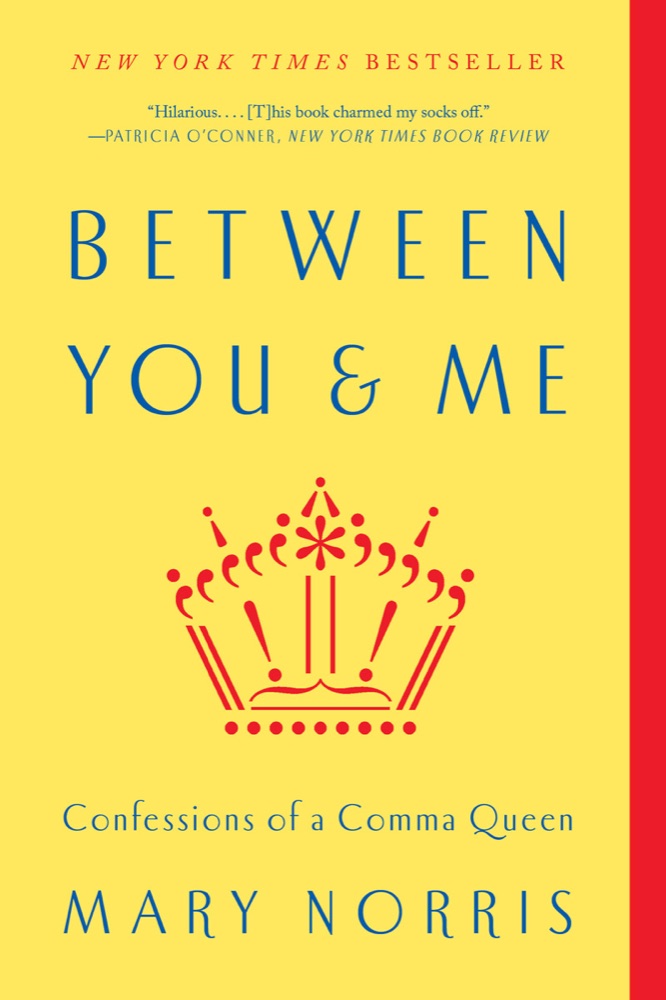
Mary Norris has spent more than three decades in The New Yorker's copy department, maintaining its celebrated high standards. Now she brings her vast experience, good cheer, and finely sharpened pencils to help the rest of us in a boisterous language book as full of life as it is of practical advice.
Between You & Me features Norris's laugh-out-loud descriptions of some of the most common and vexing problems in spelling, punctuation, and usage—comma faults, danglers, "who" vs. "whom," "that" vs. "which," compound words, gender-neutral language—and her clear explanations of how to handle them. Down-to-earth and always open-minded, she draws on examples from Charles Dickens, Emily Dickinson, Henry James, and the Lord's Prayer, as well as from The Honeymooners, The Simpsons, David Foster Wallace, and Gillian Flynn. She takes us to see a copy of Noah Webster's groundbreaking Blue-Back Spe
Book details
- First published
- 2015
- Author
- Mary Norris
- Genre
- Nonfiction
- Goodreads rating
- 3.61 (7k ratings)
Keep reading
Dreyer's English: An Utterly Correct Guide to Clarity and Style
 Eats, Shoots & Leaves: The Zero Tolerance Approach to Punctuation
 Sin and Syntax: How to Craft Wickedly Effective Prose
 Word by Word: The Secret Life of Dictionaries
 The Elements of Style
 Writing Tools: 50 Essential Strategies for Every Writer
 The Elements of Eloquence: How to Turn the Perfect English Phrase
 Because Internet: Understanding the New Rules of Language
 The Sense of Style: The Thinking Person's Guide to Writing in the 21st Century
 The Mother Tongue: English and How It Got That Way
 How Not to Write a Novel: 200 Classic Mistakes and How to Avoid Them—A Misstep-by-Misstep Guide
 Babel-17
 The Liar's Dictionary
 The Language Instinct: How the Mind Creates Language
 The Unfolding of Language: An Evolutionary Tour of Mankind's Greatest Invention
 On Writing Well: The Classic Guide to Writing Nonfiction
 Politics and the English Language
 The Dictionary of Lost Words
 Everyone on This Train Is a Suspect
 The Grammarians
 Consider This: Moments in My Writing Life After Which Everything Was Different
 The Etymologicon: A Circular Stroll through the Hidden Connections of the English Language
 The Word Exchange
 The Anthologist
 Several Short Sentences About Writing
 Incidental Inventions
 On Writing: A Memoir of the Craft
 The Names
 Dataclysm: Who We Are
 The Weight of Words
 Through the Language Glass: Why the World Looks Different in Other Languages
 The Well of Lost Plots
 The Professor and the Madman: A Tale of Murder, Insanity and the Making of the Oxford English Dictionary
 The Imperfectionists
 Stein on Writing
 Reading Like a Writer: A Guide for People Who Love Books and for Those Who Want to Write Them
 Everything's Eventual
 The Most Human Human: What Talking with Computers Teaches Us About What It Means to Be Alive
 Lexicon
 Finders Keepers
 Burning Questions: Essays and Occasional Pieces, 2004 to 2021
 Philosophical Investigations
 Love in English
 Dear Mr. M
 The Know-It-All
 In the Land of Invented Languages: Esperanto Rock Stars, Klingon Poets, Loglan Lovers, and the Mad Dreamers Who Tried to Build a Perfect Language
 Book of Lives: A Memoir of Sorts
 Ghostwritten
 The Writing Class
 There but for the
 Flaubert's Parrot
 The Triggering Town: Lectures and Essays on Poetry and Writing
 The Ghost
 Speedboat
 Ella Minnow Pea: A Novel in Letters
 Erasure
 A Slip of the Keyboard: Collected Non-Fiction
 The Wave in the Mind: Talks and Essays on the Writer, the Reader and the Imagination
 One of Our Thursdays Is Missing
 Me Talk Pretty One Day