
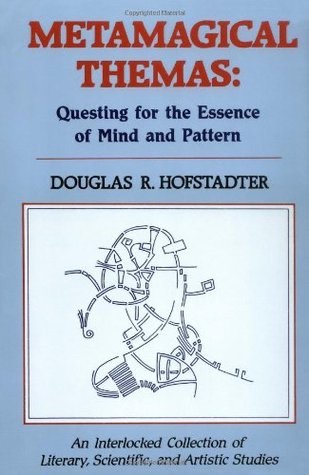
 Metamagical Themas: Questing for the Essence of Mind and Pattern
Quotes from the Book
Meaning lies as much in the mind of the reader as in the Haiku.
How gullible are you? Is your gullibility located in some "gullibility center" in your brain? Could a neurosurgeon reach in and perform some delicate operation to lower your gullibility, otherwise leaving you alone? If you believe this, you are pretty gullible, and should perhaps consider such an operation.
Sometimes it seems as though each new step towards AI, rather than producing something which everyone agrees is real intelligence, merely reveals what real intelligence is not.
The paraphrase of Gödel's Theorem says that for any record player, there are records which it cannot play because they will cause its indirect self-destruction.
What is an "I", and why are such things found (at least so far) only in association with, as poet Russell Edson once wonderfully phrased it, "teetering bulbs of dread and dream" -- that is, only in association with certain kinds of gooey lumps encased in hard protective shells mounted atop mobile pedestals that roam the world on pairs of slightly fuzzy, jointed stilts?
People enjoy inventing slogans which violate basic arithmetic but which illustrate “deeper” truths, such as “1 and 1 make 1” (for lovers), or “1 plus 1 plus 1 equals 1” (the Trinity). You can easily pick holes in those slogans, showing why, for instance, using the plus-sign is inappropriate in both cases. But such cases proliferate. Two raindrops running down a window-pane merge; does one plus one make one? A cloud breaks up into two clouds -more evidence of the same? It is not at all easy to draw a sharp line between cases where what is happening could be called “addition”, and where some other word is wanted. If you think about the question, you will probably come up with some criterion involving separation of the objects in space, and making sure each one is clearly distinguishable from all the others. But then how could one count ideas? Or the number of gases comprising the atmosphere? Somewhere, if you try to look it up, you can probably fin a statement such as, “There are 17 languages in India, and 462 dialects.” There is something strange about the precise statements like that, when the concepts “language” and “dialect” are themselves fuzzy.
This idea that there is generality in the specific is of far-reaching importance.
[...] provability is a weaker notion than truth
I wish my wish would not be granted!
I can't help but recall, at this point, a horribly elitist but very droll remark by one of my favorite writers, the American "critic of the seven arts", James Huneker, in his scintillating biography of Frédéric Chopin, on the subject of Chopin's étude Op. 25, No. 11 in A minor, which for me, and for Huneker, is one of the most stirring and most sublime pieces of music ever written: “Small-souled men, no matter how agile their fingers, should avoid it.” "Small-souled men"?! Whew! Does that phrase ever run against the grain of American democracy! And yet, leaving aside its offensive, archaic sexism (a crime I, too, commit in GEB, to my great regret), I would suggest that it is only because we all tacitly do believe in something like Hueneker's' shocking distinction that most of us are willing to eat animals of one sort or another, to smash flies, swat mosquitos, fight bacteria with antibiotics, and so forth. We generally concur that "men" such as a cow, a turkey, a frog, and a fish all possess some spark of consciousness, some kind of primitive "soul" but by God, it's a good deal smaller than ours is — and that, no more and no less, is why we "men" feel that we have the perfect right to extinguish the dim lights in the heads of these fractionally-souled beasts and to gobble down their once warm and wiggling, now chilled and stilled protoplasm with limitless gusto, and not feel a trace of guilt while doing so.
It now becomes clear that consistency is not a property of a formal system per se, but depends on the interpretation which is proposed for it. By the same token, inconsistency is not an intrinsic property of any formal system.
What does it matter if two brains are isomorphic, or quasi-isomorphic, or not isomorphic at all? The answer is that we have an intuitive sense that, although other people differ from us in important ways, they are still 'the same' as we are in some deep and important ways. It would be instructive to be able to pinpoint what this invariant core of human intelligence is, and then to be able to describe the kinds of 'embellishments' which can be added to it, making each one of us a unique embodiment of this abstract and mysterious quality called 'intelligence.
Since, as is well know, God helps those who help themselves, presumably the Devil helps all those, and only those, who don't help themselves. Does the Devil help himself?
Perhaps the greatest contradiction in our lives, the hardest to handle, is the knowledge 'There was a time when I was not alive, and there will come a time when I am not alive.' On one level, when you 'step out of yourself' and see yourself as 'just another human being', it makes complete sense. But on another level, perhaps a deeper level, personal nonexistence makes no sense at all. All that we know is embedded inside our minds, and for all that to be absent from the universe is not comprehensible. This is a basic undeniable problem of life...
Why is some music so much deeper and more beautiful than other music? It is because form, in music, is expressive–expressive to some strange subconscious regions of our minds. The sounds of music do not refer to serfs or city-states, but they do trigger clouds of emotion in our innermost selves; in that sense musical meaning IS dependent on intangible links from symbols to things in the world–those 'things', in this case, being secret software structures in our minds.
A computer program can modify itself but it cannot violate its own instructions — it can at best change some parts of itself by *obeying* its own instructions.
Just as science is permeated with 'conceptual revolution' on all levels at all times, so the thinking of individuals is shot through and through with creative and new acts. Computer programs today do not yet seem to produce many small creations. Most of what they do is quite 'mechanical' still. That just testifies to the fact that they are not close to simulating the way we think–but they are getting closer. Perhaps what differentiates highly creative ideas from ordinary ones is some combined sense of beauty, simplicity, and harmony.
If words were nuts and bolts, people could make any bolt fit into any nut: they'd just squish the one into the other, as in some surrealistic painting where everything goes soft. Language, in human hands, becomes almost like a fluid, despite the coarse grain of its components.
It is extremely interesting, then, to think about the meaning of the word ‘form’ as it applies to constructions of arbitrarily complex shapes. For instance, what is it that we respond to when we look at a painting and feel its beauty? Is if the ‘form’ of the lines and dots on our retina? Evidently it must be, for that is how it gets passed along to the analyzing mechanisms in our heads–but the complexity of the processing makes us feel that we are not merely looking at a two-dimensional surface; we are responding to some sort of inner meaning inside the picture, a multidimensional aspect trapped somehow inside those two dimensions. It is the word ‘meaning’ which is important here. Our minds contain interpreters which accept two-dimensional patterns and then ‘pull’ from them high-dimensional notions which are so complex that we cannot consciously describe them. The same can be said about how we respond to music, incidentally.
Consistent or inconsistent, no one is exempt from the mystery of the self. Probably we are all inconsistent. Te world is just too complicated for a person to be able to afford the luxury of reconciling all of his beliefs with each other. Tension and confusion are important in a world where many decisions must be made quickly. Miguel de Unamuno once said, 'If a person never contradicts himself, it must be that he says nothing.' I would say that we all are in the same boast as the Zen master who, after contradicting himself several times in a row, said to the confused Doko, 'I cannot understand myself.
Consistent or inconsistent, no one is exempt from the mystery of the self. Probably we are all inconsistent. The world is just too complicated for a person to be able to afford the luxury of reconciling all of his beliefs with each other. Tension and confusion are important in a world where many decisions must be made quickly. Miguel de Unamuno once said, 'If a person never contradicts himself, it must be that he says nothing.' I would say that we all are in the same boast as the Zen master who, after contradicting himself several times in a row, said to the confused Doko, 'I cannot understand myself.'.
It is an inherent property of intelligence that it can jump out of the task which it is performing, and survey what it has done; it is always looking for, and often finding, patterns. Now I said that an intelligence canjump out of its task, but that does not mean that it always will. However, a little prompt- ing will often suffice. For example, a human being who is reading a book may grow sleepy. Instead of continuing to read until the book is finished, he is just as likely to put the book aside and turn off the light. He has stepped "out of the system" and yet it seems the most natural thing in the world to us. Or, suppose person A is watching television when person B comes in the room, and shows evident displeasure with the situation. Person A may think he understands the problem, and try to remedy it by exiting the present system (that television program), and flipping the chan- nel knob, looking for a better show. Person B may have a more radical concept of what it is to "exit the system"-namely to turn the television off! Of course, there are cases where only a rare individual will have the vision to perceive a system which governs many peoples' lives, a system which had never before even been recognized as a system; then such people often devote their lives to convincing other people that the system really is there, and that it ought to be exited from!
Watch on YouTube
About Douglas R. Hofstadter
We have collected 27 quotes from 2 books by Douglas R. Hofstadter on BookQuoters.
More about the author →More by Douglas R. Hofstadter
Metamagical Themas: Questing for the Essence of Mind and Pattern
Book details
- Author
- Douglas R. Hofstadter
- Genre
- Philosophy
- Goodreads rating
- 4.29 (54k ratings) →
Keep reading
 Science and Sanity: An Introduction to Non-Aristotelian Systems and General Semantics
 The Stuff of Thought: Language as a Window into Human Nature
 The Big Picture: On the Origins of Life, Meaning, and the Universe Itself
 Metaphysics
 The Master and His Emissary: The Divided Brain and the Making of the Western World
 The Blind Watchmaker: Why the Evidence of Evolution Reveals a Universe Without Design
 Stories of Your Life and Others
 Our Mathematical Universe: My Quest for the Ultimate Nature of Reality
 Think: A Compelling Introduction to Philosophy
 Rationality: From AI to Zombies
 Philosophical Investigations
 God's Debris: A Thought Experiment
 The Tell-Tale Brain: A Neuroscientist's Quest for What Makes Us Human
 An Essay Concerning Human Understanding
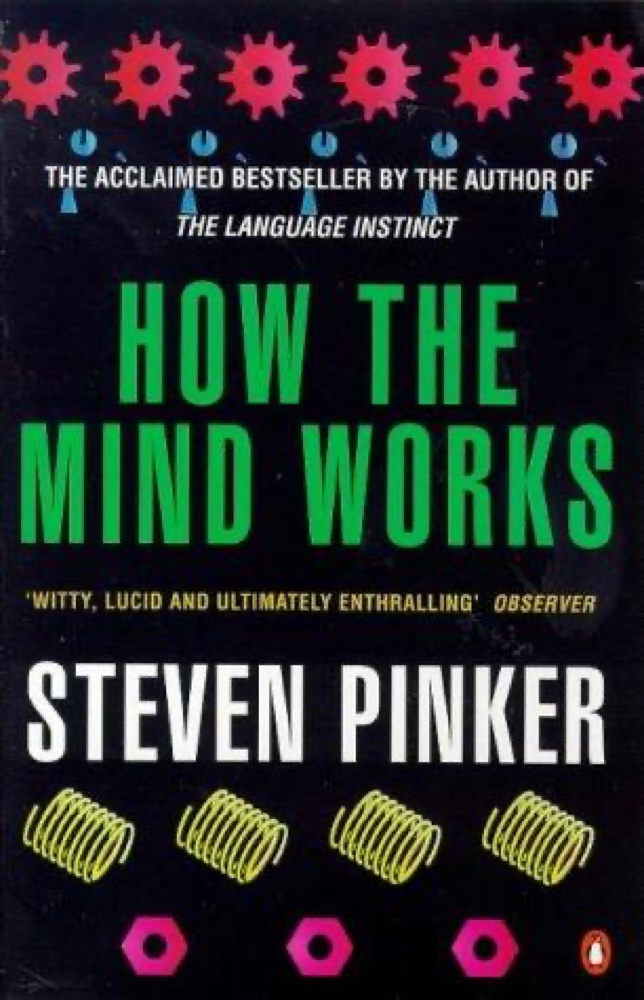 How the Mind Works
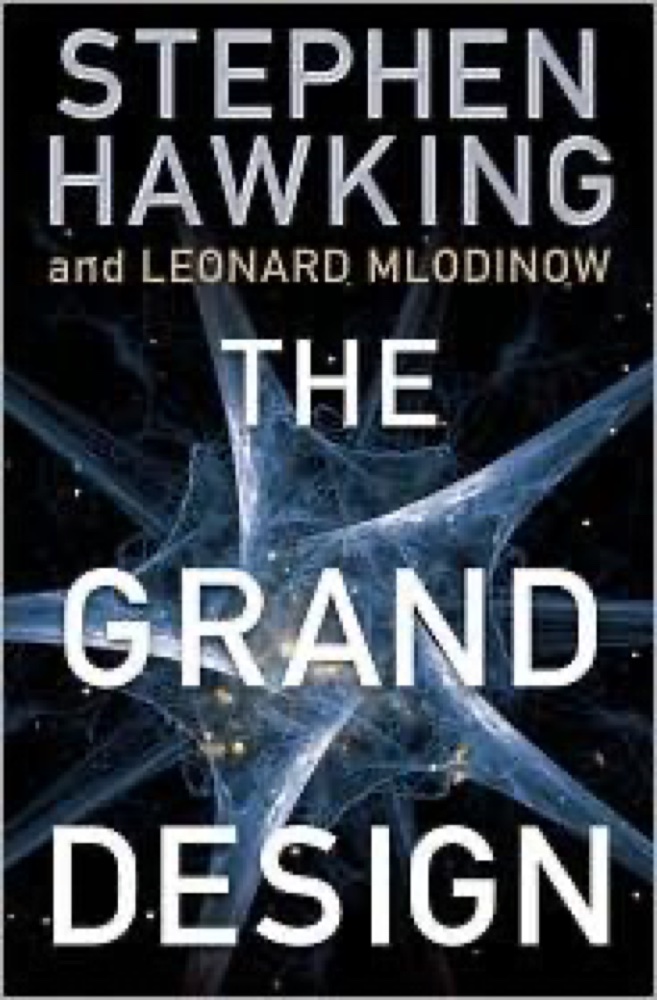 The Grand Design
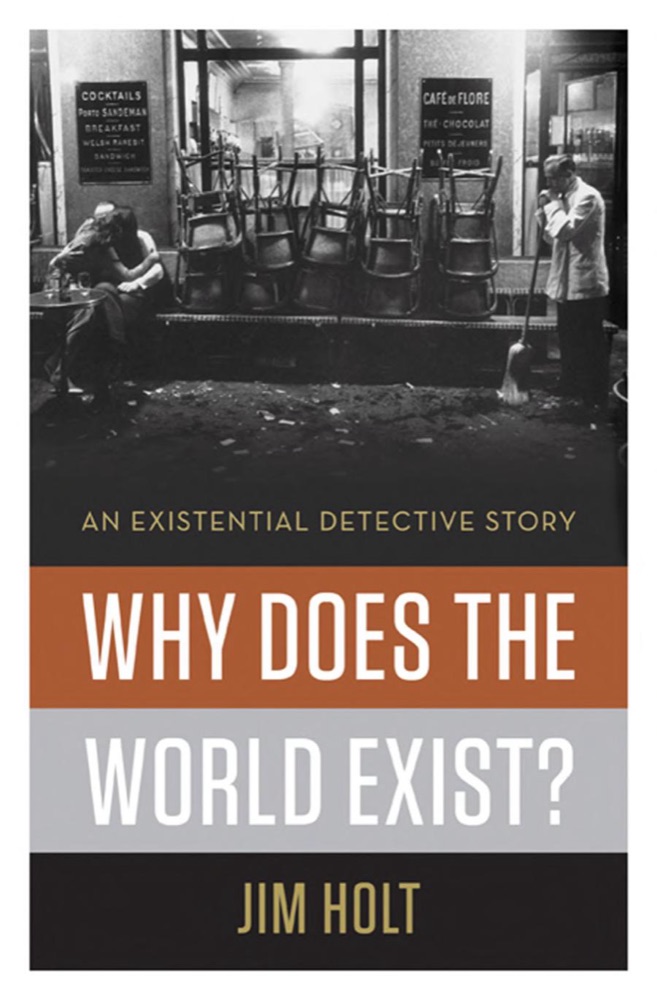 Why Does the World Exist?: An Existential Detective Story
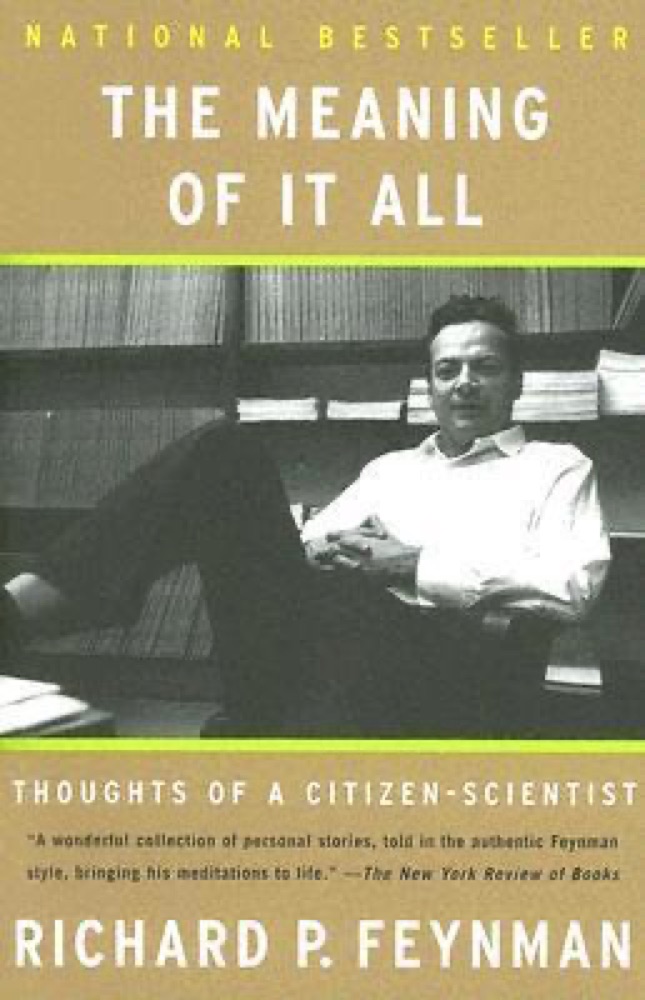 The Meaning of It All: Thoughts of a Citizen-Scientist
 Why People Believe Weird Things: Pseudoscience, Superstition, and Other Confusions of Our Time
 An Enquiry Concerning Human Understanding
 Foucault's Pendulum
 Intuition: Knowing Beyond Logic
 On Truth and Lies in a Nonmoral Sense
 The Most Human Human: What Talking with Computers Teaches Us About What It Means to Be Alive
 Maps of Meaning: The Architecture of Belief
 Chaos: Making a New Science
 Logicomix: An Epic Search for Truth
 Helgoland: Making Sense of the Quantum Revolution
 Tractatus Logico-Philosophicus
 The Mind of the Maker: Dorothy L. Sayers' Witty Classic on the Trinity, Christianity, and Human Creativity
 The Wisdom of Insecurity: A Message for an Age of Anxiety
 Finite and Infinite Games: A Vision of Life as Play and Possibility
 Eating the Dinosaur
 21 Lessons for the 21st Century
 Darwin's Dangerous Idea: Evolution and the Meanings of Life
 Zen and the Art of Motorcycle Maintenance
 Existential Physics: A Scientist's Guide to Life's Biggest Questions
 The Case Against Reality: Why Evolution Hid the Truth from Our Eyes
 Critique of Pure Reason
 Myths to Live By
 A Treatise of Human Nature
 The Information: A History, a Theory, a Flood
 The Wave in the Mind: Talks and Essays on the Writer, the Reader and the Imagination
 The Book: On the Taboo Against Knowing Who You Are
 Blindsight
 Genesis
 Echopraxia
 Freedom Evolves
 The Origin of Consciousness in the Breakdown of the Bicameral Mind
 The Universe Versus Alex Woods
 Permutation City
 Destination: Void
 Robots and Empire
 Exhalation
 A Language Older Than Words
 Gnomon
 The Perennial Philosophy
 Math with Bad Drawings
 Wired
Wired