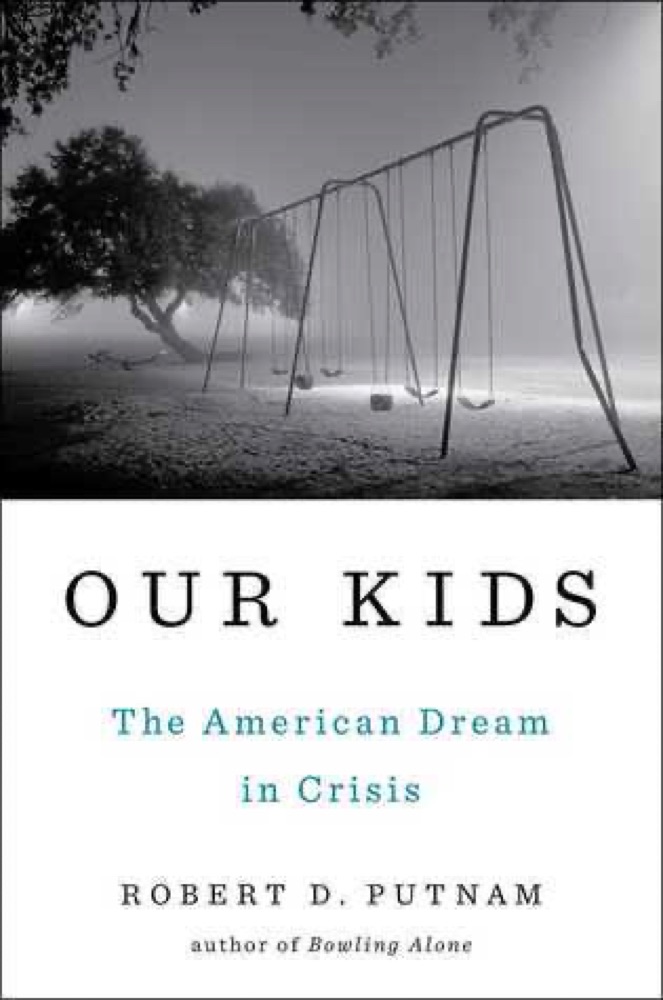
Quotes from the Book
Poor kids, through no fault of their own, are less prepared by their families, their schools, and their communities to develop their God-given talents as fully as rich kids. For economic productivity and growth, our country needs as much talent as we can find, and we certainly can’t afford to waste it. The opportunity gap imposes on all of us both real costs and what economists term “opportunity costs.
13
Parental wealth is especially important for social mobility, because it can provide informal insurance that allows kids to take more risks in search of more reward.
7
Schools themselves aren't creating the opportunity gap: the gap is already large by the time children enter kindergarten and does not grow as children progress through school. The gaps in cognitive achievement by level of maternal education that we observe at age 18-powerful predictors of who goes to college and who does not - are mostly present at age 6when children enter school. Schooling plays only a minor role in alleviating or creating test score gaps.
5
Many people have a stereotype of what it means to be poor. And it may be somebody they see on the street corner with a sign: “Will work for food.” And what they don’t think about is that person who’s struggling every day. Could be the person who waited on us, took our bank deposit, works in retail, but who is barely above the poverty line.
3
Upper-class parents enable their kids to form weak ties by exposing them more often to organized activities, professionals, and other adults. Working-class children, on the other hand, are more likely to interact regularly only with kin and neighborhood children, which limits their formation of valuable weak ties.
3
Contemporary discussion of inequality in America often conflates two related but distinct issues: • Equality of income and wealth. The distribution of income and wealth among adults in today’s America—framed by the Occupy movement as the 1 percent versus the 99 percent—has generated much partisan debate during the past several years. Historically, however, most Americans have not been greatly worried about that sort of inequality: we tend not to begrudge others their success or care how high the socioeconomic ladder is, assuming that everyone has an equal chance to climb it, given equal merit and energy. • Equality of opportunity and social mobility. The prospects for the next generation—that is, whether young people from different backgrounds are, in fact, getting onto the ladder at about the same place and, given equal merit and energy, are equally likely to scale it—pose an altogether more momentous problem in our national culture. Beginning with the “all men are created equal” premise of our national independence, Americans of all parties have historically been very concerned about this issue.
2
teacher flight from the challenges in such schools—violence and disorder, truancy, lower school readiness and English-language proficiency, less supportive home environments—means that students in these schools get a generally inferior education. Many teachers in poor schools today are doing a heroic job, driven by idealism, but in a market economy the most obvious way to attract more and better teachers to such demanding work is to improve the conditions of their employment.
1
Caring for kids was once a more widely shared, collective responsibility, but that ethic has faded in recent decades.
1
Stressful conditions from outside school are much more likely to intrude into the classroom in high poverty schools. Every one of ten stressors is two to three times more common in high poverty schools-- Student hunger, unstable housing, lack of medical and dental care, caring for family members, immigration issues, community violence and safety issues.
1
More plausible suspects in our mystery are the things that students collectively bring with them to school, ranging from(on the positive side of the ledger) academic encouragement at home and private funding for "extras" to (on the negative side) crime, drugs, and disorder. Whom you go to school with matters a lot.
1
Most fundamentally, school systems need to put higher quality teachers in poor schools under conditions in which they can actually teach and not just keep order.
Rehabilitate ex-prisoners, keeping in mind that the prison population is comprised of young men with very little education, poor job records, and frequent histories of mental illness and substance abuse.
High-quality national surveys of high school seniors confirm that kids from less educated homes are less knowledgeable about and interested in politics, less likely to trust the government, less likely to vote, and much less likely to be civically engaged in local affairs than their counterparts from college-educated homes.
Rich kids are more confident that they can influence government, and they are largely right about that.14 Not surprisingly, poor kids are less likely to try.
inequality of opportunity slows growth by keeping disadvantaged potential workers from developing their full capacity.
these costs total about $500 billion per year, or the equivalent of nearly 4 percent of gross domestic product (GDP). More specifically, we estimate that childhood poverty each year: (1) reduces productivity and economic output by an amount equal to 1.3 percent of GDP, (2) raises the costs of crime by 1.3 percent of GDP, and (3) raises health expenditures and reduces the value of health by 1.2 percent of GDP.
The U.S. educational system cannot be the sole cause of the waning educational stature of the U.S.
Our contemporary public debate recognizes this problem but assumes it is largely a “schools problem.” On the contrary, we have seen that most of the challenges facing poor kids are not caused by schools.
investment in poor kids raises the rate of growth for everyone, at the same time leveling the playing field in favor of poor kids.
The answer is that the destiny of poor kids in America has broad implications for our economy, our democracy, and our values.
They grew up in an era when public education and community support for kids from all backgrounds managed to boost a significant number of people up the ladder—in Bend, Beverly Hills, New York, Port Clinton, and even South Central LA. Those supportive institutions, public and private, no longer serve poorer kids so well.
As inequality has increased,” she writes, “debate about the extent of mobility in American society has heightened. As income gaps have widened, the opportunity that children have to do better than their parents is increasingly important. . . . Whether they do so at a faster or slower rate than they did in the past is not a settled question. But since the rungs of the ladder are further apart than they used to be, the effects of family background on one’s ultimate economic success are larger and may persist for a longer period of time.
Living in poor neighborhoods remains almost always a high-risk factor for disorder, suboptimal parenting, and adverse child development. Similarly, neighborhood poverty is known to have deleterious health effects. For example, obesity is systematically worse in poor neighborhoods.
parents in poor neighborhoods are more likely to experience depression, stress, and illness, which in turn “are associated with less warm and consistent parenting.
By contrast, almost all our richer kids said that (with some qualifications) they do trust other people. That comparison reflects not paranoia on the part of poor kids, but the malevolent social realities within which they live and the fact that people and institutions have so often failed them.
Neighborhood affluence and poverty have been shown repeatedly to influence many aspects of child and youth development, even after taking into account the characteristics of kids and their immediate families.
Here the question is whether growing up in a poor neighborhood imposes any additional handicaps. The answer is yes.
there’s no denying that rich and poor kids in this country attend vastly different schools nowadays, which seems hard to square with the notion that schools are innocent bystanders in the growing youth class gap.
Schooling—unequal as it is in America—plays only a minor role in alleviating or creating test score gaps.
Watch on YouTube
About Robert D. Putnam

We have collected 57 quotes from 2 books by Robert D. Putnam on BookQuoters.
More about the author →More by Robert D. Putnam
About the book
A groundbreaking examination of the growing inequality gap from the bestselling author of Bowling Alone: why fewer Americans today have the opportunity for upward mobility.It's the American dream: get a good education, work hard, buy a house, and achieve prosperity and success. This is the America we believe in a nation of opportunity, constrained only by ability and effort. But during the last twenty-five years we have seen a disturbing opportunity gap emerge. Americans have always believed in equality of opportunity, the idea that all kids, regardless of their family background, should have a decent chance to improve their lot in life. Now, this central tenet of the American dream seems no longer true or at the least, much less true than it was. Robert Putnam about whom The Economist said, "His scholarship is wide-ranging, his intelligence luminous, his tone modest, his prose unpretent
Book details
- First published
- 2015
- Author
- Robert D. Putnam
- Genre
- Nonfiction
- Goodreads rating
- 4.04 (4k ratings)
Keep reading
 Poverty, by America
 Wealth, Poverty and Politics: An International Perspective
 This Is What Inequality Looks Like
 Kids These Days: Human Capital and the Making of Millennials
 Coming Apart: The State of White America, 1960-2010
 Twilight of the Elites: America After Meritocracy
 Poor Economics: A Radical Rethinking of the Way to Fight Global Poverty
 Give People Money: The Simple Idea to Solve Inequality and Revolutionise Our Lives
 The Spirit Level: Why More Equal Societies Almost Always Do Better
 The Smartest Kids in the World: And How They Got That Way
 Free to Choose: A Personal Statement
 Evicted: Poverty and Profit in the American City
 The Shame of the Nation
 The Vanishing American Adult: Our Coming-of-Age Crisis—and How to Rebuild a Culture of Self-Reliance
 Utopia for Realists: How We Can Build the Ideal World
 Banker to the Poor: Micro-Lending and the Battle Against World Poverty
 How to Raise an Adult: Break Free of the Overparenting Trap and Prepare Your Kid for Success
 The Tyranny of Merit: What's Become of the Common Good?
 Nickel and Dimed: On (Not) Getting by in America
 The Collapse of Parenting: How We Hurt Our Kids When We Treat Them Like Grown-Ups
 Creative Schools: The Grassroots Revolution That's Transforming Education
 Troubled: A Memoir of Foster Care, Family, and Social Class
 The Gift of Failure: How the Best Parents Learn to Let Go So Their Children Can Succeed
 23 Things They Don't Tell You About Capitalism
 A Fighting Chance
 The Death and Life of the Great American School System: How Testing and Choice Are Undermining Education
 The View From Flyover Country: Essays by Sarah Kendzior
 Deschooling Society
 Dumbing Us Down: The Hidden Curriculum of Compulsory Education
 The Bell Curve: Intelligence and Class Structure in American Life
 The World Is Flat: A Brief History of the Twenty-first Century
 Naked Economics: Undressing the Dismal Science
 Excellent Sheep: The Miseducation of the American Elite and the Way to a Meaningful Life
 The Audacity of Hope: Thoughts on Reclaiming the American Dream
 David and Goliath: Underdogs, Misfits, and the Art of Battling Giants
 White Trash: The 400-Year Untold History of Class in America
 The Case Against Education: Why the Education System Is a Waste of Time and Money
 The System: Who Rigged It, How We Fix It
 The Core
 Capital and Ideology
 I Survived Capitalism and All I Got Was This Lousy T-Shirt: Everything I Wish I Never Had to Learn About Money
 The Truths We Hold: An American Journey
 NurtureShock: New Thinking About Children
 Capital in the Twenty-First Century
 The Nordic Theory of Everything: In Search of a Better Life
 Punished by Rewards: The Trouble with Gold Stars, Incentive Plans, A's, Praise and Other Bribes
 Of Boys and Men: Why the Modern Male Is Struggling, Why It Matters, and What to Do About It
 Where We Stand: Class Matters
 Stones Into Schools: Promoting Peace With Books, Not Bombs, in Afghanistan and Pakistan
 Freakonomics: A Rogue Economist Explores the Hidden Side of Everything
 United: Thoughts on Finding Common Ground and Advancing the Common Good
 iGen: Why Today’s Super-Connected Kids Are Growing Up Less Rebellious, More Tolerant, Less Happy--and Completely Unprepared for Adulthood--and What That Means for the Rest of Us
 The Life You Can Save: How to Do Your Part to End World Poverty
 Abundance: The Future Is Better Than You Think
 A Brief History of Equality
 Rich Dad Poor Dad
 The Anxious Generation: How the Great Rewiring of Childhood Caused an Epidemic of Mental Illness
 Pushout: The Criminalization of Black Girls in Schools