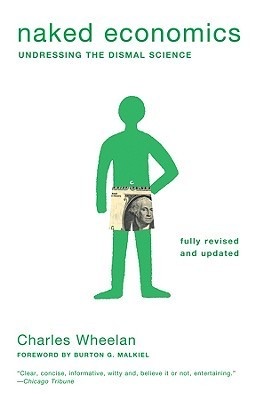
 Naked Economics: Undressing the Dismal Science
Quotes from the Book
Once you realize that trickle-down economics does not work, you will see the excessive tax cuts for the rich as what they are -- a simple upward redistribution of income, rather than a way to make all of us richer, as we were told.
143
Equality of opportunity is not enough. Unless we create an environment where everyone is guaranteed some minimum capabilities through some guarantee of minimum income, education, and healthcare, we cannot say that we have fair competition. When some people have to run a 100 metre race with sandbags on their legs, the fact that no one is allowed to have a head start does not make the race fair. Equality of opportunity is absolutely necessary but not sufficient in building a genuinely fair and efficient society.
107
People 'over-produce' pollution because they are not paying for the costs of dealing with it.
93
The best way to boost the economy is to redistribute wealth downward, as poorer people tend to spend a higher proportion of their income.
57
People who live in poor countries have to be entrepreneurial even just to survive.
27
If the world were full of the self-seeking individuals found in economics textbooks, it would grind to a halt because we would be spending most of our time cheating, trying to catch the cheaters, and punishing the caught. The world works as it does only because people are not the totally self seeking agents that free-market economics believes them to be. We need to design an economic system that, while acknowledging that people are often selfish, exploits other human motives to the full and gets the best out of people. The likelihood is that, if we assume the worst about people, we will get the worst out of them.
25
The widely accepted assertion that, only if you let markets be will everyone be paid correctly and thus fairly, according to his worth, is a myth. Only when we part with this myth and grasp the political nature of the market and the collective nature of individual productivity will we be able to build a more just society in which historical legacies and collective actions, and not just individual talents and efforts, are properly taken into account in deciding how to reward people.
23
In no country does the average income give the right picture of how people live but in a country with higher inequality it is likely to be particularly misleading. Given that the US has by far the most unequal distribution of income among the rich countries, we can safely guess that the US per capita income overstates the actual living standards of more of its citizens than in other countries....The much higher crime rate than in Europe or Japan -- in per capita terms, the US has eight times more people in prison than Europe and twelve times more than Japan -- shows that there is a far bigger underclass in the US.
16
A well-designed welfare state can actually encourage people to take chances with their jobs and be more, not less, open to changes.
15
Above a certain level of income, the relative value of material consumption vis-a-vis leisure time is diminished, so earning a higher income at the cost of working longer hours may reduce the quality of your life. More importantly, the fact that the citizens of a country work longer than others in comparable countries does not necessarily mean that they like working longer hours. They may be compelled to work long hours, even if they actually want to take longer holidays.
15
Running the company for the shareholders often reduces its long-term growth potential.
15
The top 10 per cent of the US population appropriated 91 per cent of income growth between 1989 and 2006, while the top 1 per cent took 59 per cent.
13
If we assume the worst about people, we will get the worst out of them.
11
Since the 1980s, we have given the rich a bigger slice of our pie in the belief that they would create more wealth, making the pie bigger than otherwise possible in the long run. The rich got the bigger slice of the pie all right, but they have actually reduced the pace at which the pie is growing.
10
Markets weed out inefficient practices, but only when no one has sufficient power to manipulate them.
8
Between the Great Depression and the 1970s, private business was viewed with suspicion even in most capitalist economies. Businesses were, so the story goes, seen as anti-social agents whose profit-seeking needed to be restrained for other, supposedly loftier, goals, such as justice, social harmony, protection of the weak and even national glory.
8
Sometimes it is in the long-run interest of the business sector to restrict the freedom of individual firms so that they do not destroy the common pool of resources that all of them need, such as natural resources or the labour force.
7
The free market doesn't exist. Every market has some rules and boundaries that restrict the freedom of choice. A market looks free only because we so unconditionally accept its underlying restrictions that we fail to see them. How 'free' a market is cannot be objectively defined. It is a political definition.
5
Breaking away from the illusion of market objectivity is the first step towards understanding capitalism.
4
When some people have to run a 100 metre race with sandbags on their legs, the fact that no one is allowed to have a head start does not make the race fair. Equality of opportunity is absolutely necessary but not sufficient in building a genuinely fair and efficient society.
3
95 per cent of economics is common sense made complicated,
2
The rich countries also contribute to the brain drain from developing countries by more willingly accepting people with higher skills. These are people who could have contributed more to the development of their own countries than unskilled immigrants, had they remained in their home countries.
1
the demands of a highly organized industrial society made people behave in more disciplined, calculating and cooperative ways.
1
Watch on YouTube
About Ha-Joon Chang
We have collected 23 quotes from 1 book by Ha-Joon Chang on BookQuoters.
More about the author →About the book
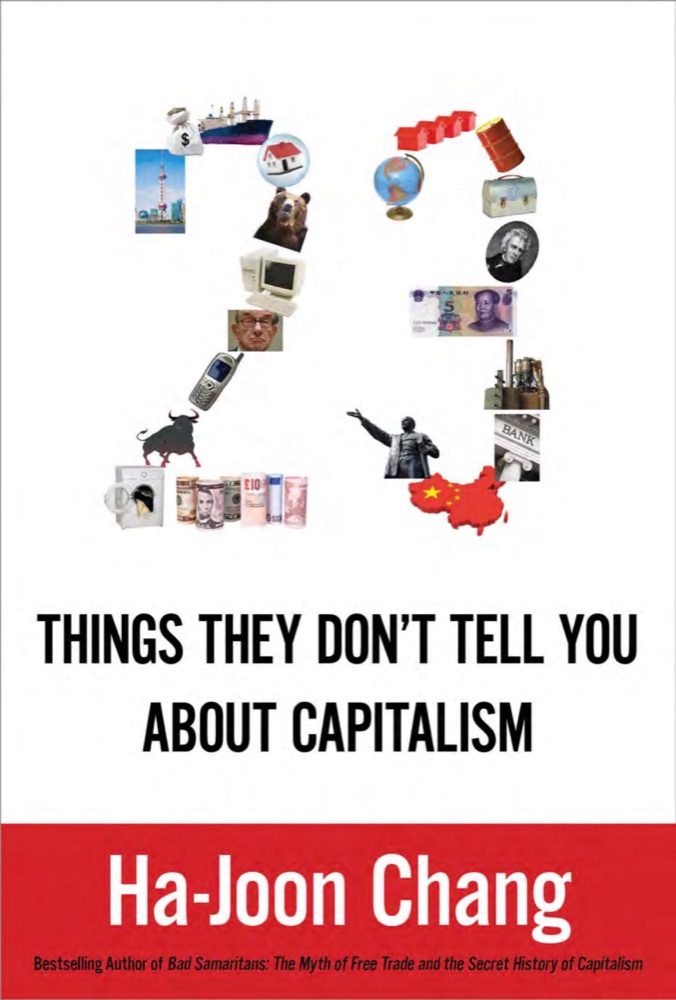
Thing 1: There is no such thing as the free market. Thing 4: The washing machine has changed the world more than the Internet. Thing 5: Assume the worst about people, and you get the worst. Thing 13: Making rich people richer doesn't make the rest of us richer.
If you've wondered how we did not see the economic collapse coming, Ha-Joon Chang knows the answer: We didn't ask what they didn't tell us about capitalism. This is a lighthearted book with a serious purpose: to question the assumptions behind the dogma and sheer hype that the dominant school of neoliberal economists - the apostles of the freemarket - have spun since the Age of Reagan.
Chang, the author of the international best seller Bad Samaritans, is one of the world's most respected economists, a voice of sanity - and wit - in the tradition of John Kenneth Galbraith and Joseph Stiglitz.
23 Things They Don't Tell Y
Book details
- First published
- 2010
- Author
- Ha-Joon Chang
- Genre
- Nonfiction
- Goodreads rating
- 3.96 (13k ratings)
Keep reading
Naked Economics: Undressing the Dismal Science
 Basic Economics: A Citizen's Guide to the Economy
 Economics in One Lesson
 Utopia for Realists: How We Can Build the Ideal World
 Poor Economics: A Radical Rethinking of the Way to Fight Global Poverty
 The System: Who Rigged It, How We Fix It
 Capital in the Twenty-First Century
 Talking to My Daughter About the Economy: or, How Capitalism Works—and How It Fails
 The Rational Optimist: How Prosperity Evolves
 Free to Choose: A Personal Statement
 Give People Money: The Simple Idea to Solve Inequality and Revolutionise Our Lives
 The Evolution of Everything: How New Ideas Emerge
 Human Action: A Treatise on Economics
 Occupy
 Banker to the Poor: Micro-Lending and the Battle Against World Poverty
 Wealth, Poverty and Politics: An International Perspective
 Capitalism and Freedom
 The Shock Doctrine: The Rise of Disaster Capitalism
 Small Is Beautiful: Economics as if People Mattered
 Vulture Capitalism: Corporate Crimes, Backdoor Bailouts, and the Death of Freedom
 The World Is Flat: A Brief History of the Twenty-first Century
 The Spirit Level: Why More Equal Societies Almost Always Do Better
 Capitalism, Socialism and Democracy
 Four Futures: Life After Capitalism
 Why Nations Fail: The Origins of Power, Prosperity, and Poverty
 Who Owns the Future?
 The Myth of the Rational Voter: Why Democracies Choose Bad Policies
 Poverty, by America
 Twilight of the Elites: America After Meritocracy
 SuperFreakonomics: Global Cooling, Patriotic Prostitutes And Why Suicide Bombers Should Buy Life Insurance
 The Creature from Jekyll Island: A Second Look at the Federal Reserve
 The Great Transformation: The Political and Economic Origins of Our Time
 Ill Fares the Land
 Principles for Dealing with the Changing World Order: Why Nations Succeed and Fail
 I Survived Capitalism and All I Got Was This Lousy T-Shirt: Everything I Wish I Never Had to Learn About Money
 Power and Progress: Our Thousand-Year Struggle Over Technology and Prosperity
 Freakonomics: A Rogue Economist Explores the Hidden Side of Everything
 The Tyranny of Merit: What's Become of the Common Good?
 The Road to Serfdom
 India Unbound: The Social and Economic Revolution from Independence to the Global Information Age
 Conscious Capitalism
 Capital and Ideology
 An Inquiry into the Nature and Causes of the Wealth of Nations
 The View From Flyover Country: Essays by Sarah Kendzior
 First As Tragedy, Then As Farce
 The Constitution of Liberty
 Capitalism: A Ghost Story
 The General Theory of Employment, Interest, and Money
 Kids These Days: Human Capital and the Making of Millennials
 Coming Apart: The State of White America, 1960-2010
 Socialism: An Economic and Sociological Analysis
 The Price of Tomorrow: Why Deflation is the Key to an Abundant Future
 Progress and Poverty
 This Is What Inequality Looks Like
 Griftopia: Bubble Machines, Vampire Squids, and the Long Con That Is Breaking America
 Nickel and Dimed: On (Not) Getting by in America
 Why Marx Was Right
 Capitalism: The Unknown Ideal
 Walkaway
 Predictably Irrational: The Hidden Forces That Shape Our Decisions