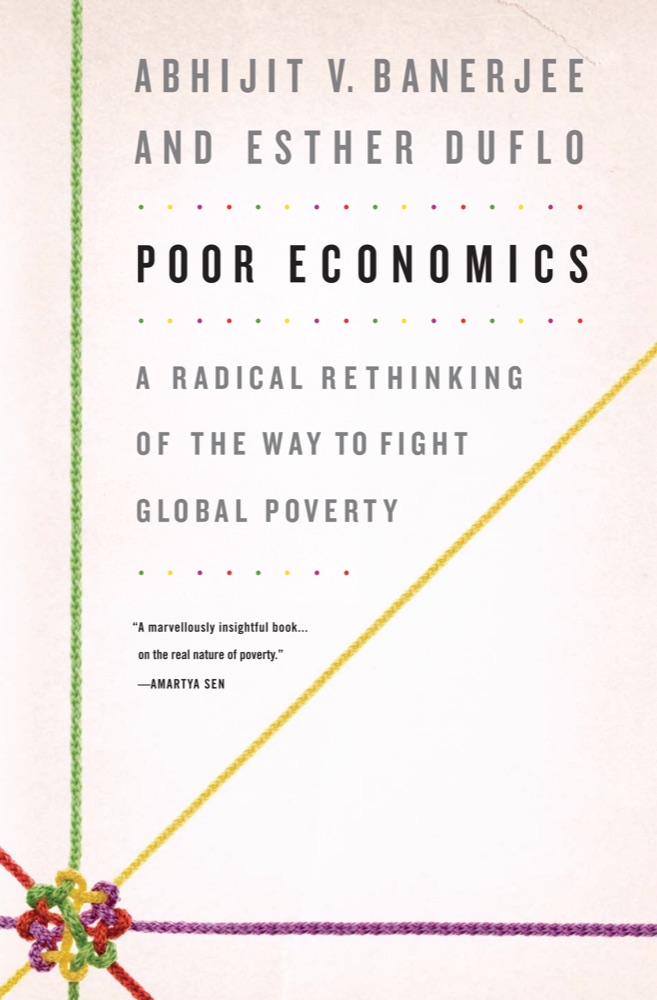
 Poor Economics: A Radical Rethinking of the Way to Fight Global Poverty
Quotes from the Book
When we want to help the poor, we usually offer them charity. Most often we use charity to avoid recognizing the problem and finding the solution for it. Charity becomes a way to shrug off our responsibility. But charity is no solution to poverty. Charity only perpetuates poverty by taking the initiative away from the poor. Charity allows us to go ahead with our own lives without worrying about the lives of the poor. Charity appeases our consciences.
135
People.. were poor not because they were stupid or lazy. They worked all day long, doing complex physical tasks. They were poor because the financial institution in the country did not help them widen their economic base.
92
If you go out into the real world, you cannot miss seeing that the poor are poor not because they are untrained or illiterate but because they cannot retain the returns of their labor. They have no control over capital, and it is the ability to control capital that gives people the power to rise out of poverty.
75
..things are never as complicated as they seem. It is only our arrogance that prompts us to find unnecessarily complicated answers to simple problems.
56
When a destitute mother starts earning an income, her dreams of success invariably center around her children. A woman's second priority is the household. She wants to buy utensils, build a stronger roof, or find a bed for herself and her family. A man has an entirely different set of priorities. When a destitute father earns extra income, he focuses more attention on himself. Thus money entering a household through a woman brings more benefits to the family as a whole.
41
The fact that the poor are alive is clear proof of their ability.
35
Even today we don't pay serious attention to the issue of poverty, because the powerful remain relatively untouched by it. Most people distance themselves from the issue by saying that if the poor worked harder, they wouldn't be poor.
29
Poverty does not belong in civilized human society. Its proper place is in a museum. That's where it will be.
20
Changes are products of intensive efforts.
16
What I did not know yet about hunger, but would find out over the next twenty-one years, was that brilliant theorists of economics do not find it worthwhile to spend time discussing issues of poverty and hunger. They believe that these will be resolved when general economic prosperity increases. These economists spend all their talents detailing the process of development and prosperity, but rarely reflect on the origin and development of poverty and hunger. A a result, poverty continues.
16
UN studies conducted in more than forty developing countries show that the birth rate falls as women gain equality... I believe income-earning opportunities that empower poor women ... will have more impact on curbing population growth that the current system of "encouraging" family planning practices through intimidation tactics.. Family planning should be left to the family.
13
...one cannot but wonder how an environment can make people despair and sit idle and then, by changing the conditions, one can transform the same people into matchless performers.
10
Th direct elimination of elimination of poverty should be the objective of all development aid. Development should be viewed as a human rights issue, not as a question of simply increasing the gross national product (GNP).
9
The challenge I set before anyone who condemns private-sector business is this: If you are a socially conscious person, why don't you run your business in a way that will help achieve social objectives?
9
In the United States I saw how the market liberates the individual and allows people to be free to make personal choices. But the biggest drawback was that the market always pushes things to the side of the powerful. I thought the poor should be able to take advantage of the system in order to improve their lot. Grameen is a private-sector self-help bank, and as its members gain personal wealth they acquire water-pumps, latrines, housing, education, access to health care, and so on. Another way to achieve this is to let abusiness earn profit that is then txed by the government, and the tax can be used to provide services to the poor. But in practice it never works that way. In real life, taxes only pay for a government bureaucracy that collects the tax and provides little or nothing to the poor. And since most government bureaucracies are not profit motivated, they have little incentive to increase their efficiency. In fact, they have a disincentive: governments often cannot cut social services without a public outcry, so the behemoth continues, blind and inefficient, year after year.
9
The system we have built refuses to recognize people. Only credit cards are recognized. Drivers' licenses are recognized. But not people. People haven't any use for faces anymore, it seems. They are busy looking at your credit card, your driver's licence, your social security number. If a driver's licence is more reliable than the face I wear, then why do I have a face?
8
The process of breaking down fear was always my greatest challenge and it was made easier by the careful work and gentle voices of my female workers.
8
I learned that things are never as complicated as we imagine them to be. It is only our arrogance which seeks to find complicated answers to simple problems.
7
I profoundly believer, as Grammen's experience over twenty years has shown, that personal gains is not the only possible fuel for free enterprise. Social goals can replace greed as a powerful motivational force. Social-consciousness-driven enterprises can be formidable competitors for the greed-based enterprises. I believe that if we play our cards right, social-consciousness-driven enterprises can do very well in the marketplace.
7
I believe that the emphasis on curbing population growth diverts attention from the more vital issue of pursuing policies that allow the population to take care of itself.
6
When you can hold the world in your palm and see it from a bird’s eye view, you tend to become arrogant – you do not realize that when looking from such a great distance, everything becomes blurred, and that you end up imagining rather than really seeing things.
5
A university should not be an island where academics attain higher and higher levels of knowledge without sharing any of this knowledge with its neighbours.
5
Nothing is quite as beautiful as farmers harvesting their rice.
3
I am not a capitalist in the simplistic left/right sense. But I do believe in the power of the global free-market economy and in using capitalist tools. I believe in the power of teh free market and the power of capital in the marketplace. I also believe that providing unemployment benefits is not the best way to address poverty. The able-bodied poor don't wan tor need charity. The dole only increases their misery, robs them of incentive and, more important, of self-respect.
3
Like navigation markings in unknown waters, definitions of poverty need to be distinctive and unambiguous. A definition that is not precise is as bad as no definition at all.
3
Yes, they will. They do. Unlike the rich, the poor can’t risk not repaying. This is the only chance they have.” The
2
Are you sure the poor will repay?” the governor asked. “Yes,
2
we learned the importance of picking fresh young people to run our branches. Surprisingly, people without previous work experience of any kind are often best suited for this. Previous work experience distracts new workers from the ideals and unique procedures of Grameen. Many
2
In Bangladesh, if a woman, even a rich woman, wants to borrow money from a bank, the manager will ask her, ‘Did you discuss this with your husband?’ And if she answers, ‘Yes,’ the manager will say, ‘Is he supportive of your proposal?’ If the answer is still, ‘Yes,’ he will say, ‘Would you please bring your husband along so that we can discuss it with him?’ But no manager would ever ask a prospective male borrower whether he has discussed the idea of a loan
2
The able-bodied poor don’t want or need charity. The dole only increases their misery, robs them of incentive and, more important, of self-respect.
2
Watch on YouTube
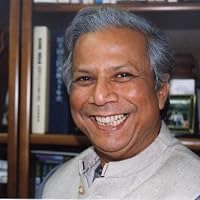
About Muhammad Yunus
We have collected 30 quotes from 1 book by Muhammad Yunus on BookQuoters.
More about the author →About the book
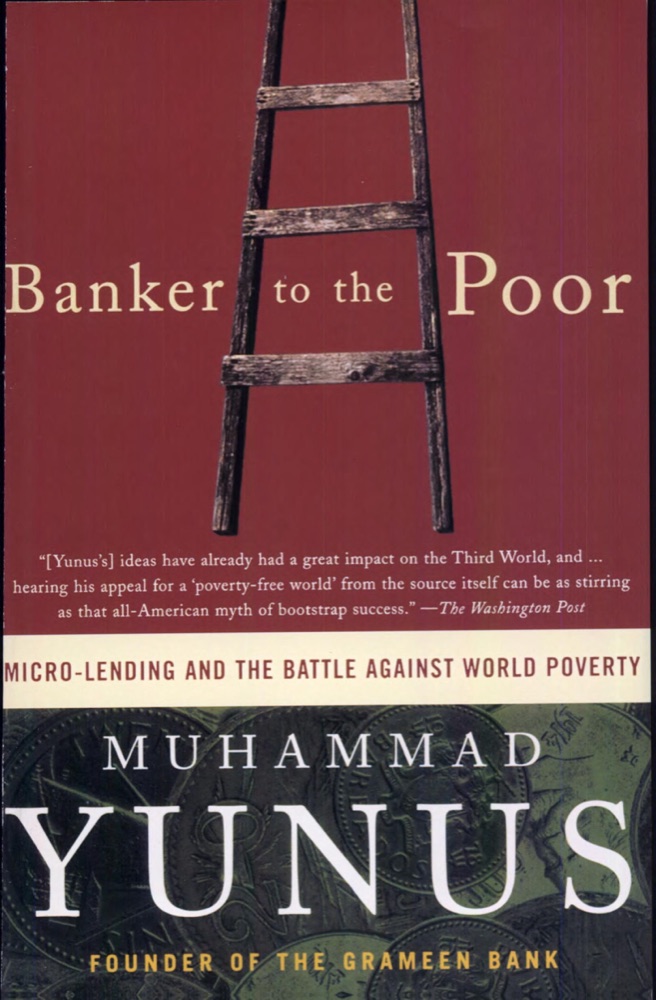
Muhammad Yunus is that rare thing: a bona fide visionary. His dream is the total eradication of poverty from the world. In 1983, against the advice of banking and government officials, Yunus established Grameen, a bank devoted to providing the poorest of Bangladesh with minuscule loans. Grameen Bank, based on the belief that credit is a basic human right, not the privilege of a fortunate few, now provides over 2.5 billion dollars of micro-loans to more than two million families in rural Bangladesh. Ninety-four percent of Yunus's clients are women, and repayment rates are near 100 percent. Around the world, micro-lending programs inspired by Grameen are blossoming, with more than three hundred programs established in the United States alone. Banker to the Poor is Muhammad Yunus's memoir of how he decided to change his life in order to help the world's poor. In it he traces the intellectua
Book details
- First published
- 1991
- Author
- Muhammad Yunus
- Genre
- Nonfiction
- Goodreads rating
- 4.12 (10k ratings)
Keep reading
Poor Economics: A Radical Rethinking of the Way to Fight Global Poverty
 Give People Money: The Simple Idea to Solve Inequality and Revolutionise Our Lives
 Utopia for Realists: How We Can Build the Ideal World
 Poverty, by America
 The Life You Can Save: How to Do Your Part to End World Poverty
 Talking to My Daughter About the Economy: or, How Capitalism Works—and How It Fails
 The Blue Sweater: Bridging the Gap Between Rich and Poor in an Interconnected World
 23 Things They Don't Tell You About Capitalism
 Naked Economics: Undressing the Dismal Science
 The World Is Flat: A Brief History of the Twenty-first Century
 Nickel and Dimed: On (Not) Getting by in America
 The View From Flyover Country: Essays by Sarah Kendzior
 Wealth, Poverty and Politics: An International Perspective
 Small Is Beautiful: Economics as if People Mattered
 Economics in One Lesson
 Beyond Civilization: Humanity's Next Great Adventure
 Human Action: A Treatise on Economics
 Evicted: Poverty and Profit in the American City
 Debt: The First 5,000 Years
 The Rational Optimist: How Prosperity Evolves
 Free to Choose: A Personal Statement
 Capitalism: A Ghost Story
 Confessions of an Economic Hit Man
 This Is What Inequality Looks Like
 Doing Good Better: How Effective Altruism Can Help You Make a Difference
 The Ministry for the Future
 Rich Dad Poor Dad
 Basic Economics: A Citizen's Guide to the Economy
 United: Thoughts on Finding Common Ground and Advancing the Common Good
 Walden Two
 The Truths We Hold: An American Journey
 The Spirit Level: Why More Equal Societies Almost Always Do Better
 I Survived Capitalism and All I Got Was This Lousy T-Shirt: Everything I Wish I Never Had to Learn About Money
 Sacred Economics: Money, Gift, and Society in the Age of Transition
 The Evolution of Everything: How New Ideas Emerge
 The Soul of Man Under Socialism
 Secrets of Jewish Wealth Revealed!
 Anthills of the Savannah
 Revolution
 Practical Ethics
 When Helping Hurts: How to Alleviate Poverty without Hurting the Poor...and Yourself
 Sex, Economy, Freedom, and Community: Eight Essays
 Occupy
 Progress and Poverty
 A Fighting Chance
 What Young India Wants
 Down and Out in Paris and London
 Behold a Pale Horse
 India Unbound: The Social and Economic Revolution from Independence to the Global Information Age
 Independent Study
 The Road to Serfdom
 Corpalism
 Coming Apart: The State of White America, 1960-2010
 The Man Who Quit Money
 SuperFreakonomics: Global Cooling, Patriotic Prostitutes And Why Suicide Bombers Should Buy Life Insurance
 Petals of Blood
 The Wretched of the Earth
 Endgame, Vol. 1: The Problem of Civilization
 Ill Fares the Land
 Abundance: The Future Is Better Than You Think