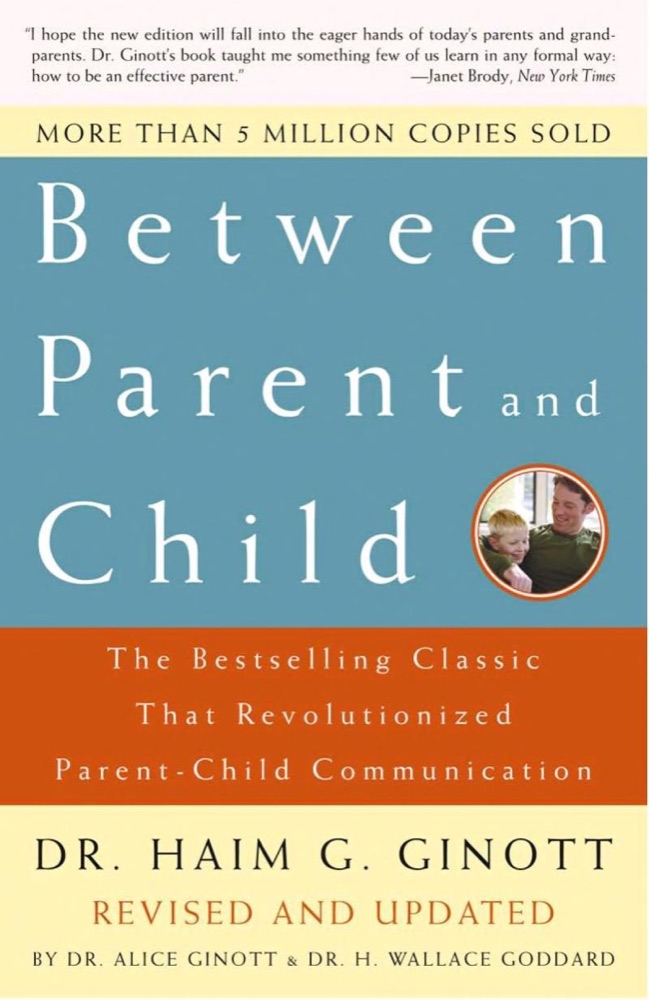

 Parent Effectiveness Training: The Proven Program for Raising Responsible Children
Quotes from the Book
What do we say to a guest who forgets her umbrella? Do we run after her and say "What is the matter with you? Every time you come to visit you forget something. If it's not one thing it's another. Why can't you be like your sister? When she comes to visit, she knows how to behave. You're forty-four years old! Will you never learn? I'm not a slave to pick up after you! I bet you'd forget your head if it weren't attached to your shoulders." That's not what we say to a guest. We say "Here's your umbrella, Alice," without adding "scatterbrain." Parents need to learn to respond to their children as they do to guests.
58
Parental criticism is unhelpful. It creates anger and resentment. Even worse, children who are regularly criticized learn to condemn themselves and others. They learn to doubt their own worth and to belittle the value of others. They learn to suspect people and to expect personal doom.
25
Children become frustrated and resentful when they view their parents as not being interested “in how they feel and in their point of view.
16
Provoked lies. Parents should not ask questions that are likely to cause defensive lying. Children resent being interrogated by a parent, especially when they suspect that the answers are already known. They hate questions that are traps, questions that force them to choose between an awkward lie and an embarrassing confession. Quentin,
14
Like a trained surgeon who is careful where he cuts, parents, too, need to become skilled in the use of words. Because words are like knives. They can inflict, if not physical, many painful emotional wounds.
14
Misbehavior and punishment are not opposites that cancel each other; on the contrary, they breed and reinforce each other. Punishment does not deter misconduct. It makes the offender more skillful in escaping detection. When children are punished they resolve to be more careful, not more obedient or responsible. Parents
12
Children do not yearn for equal shares of love: They need to be loved uniquely, not uniformly. The emphasis is on quality, not equality. We
11
Empathy, a parent's ability to understand what a child is feeling, is an important and valuable ingredient of child rearing.
11
It is a deep comfort to children to discover that their feelings are a normal part of the human experience. There is no better way to convey that than to understand them. When
10
What is the goal of parenting? It's to help a child grow up to be a decent human being, a mensch, a person with compassion, commitment, and caring.
8
The rule is that when we know the answer, we do not ask the question.
8
Why do children lie? Sometimes they lie because they are not allowed to tell the truth. Four-year-old
8
In criticism parents attack children's personality attributes and their character. In guidance we state the problem and a possible solution. We say nothing to the child about himself or herself. When
7
Unfortunately, when parents are confronted with children's misbehavior, they are unaware that usually disturbing feelings fuel that behavior. Feelings must be dealt with before behavior can be improved. As
6
A limit must be stated in a manner that is deliberately calculated to minimize resentment, and to save self-respect. The very process of limit-setting, of saying “no,” should convey authority, not insult. It should deal with a specific event, not with a developmental history.
5
Young children have genuine difficulty in coping with their socially unacceptable impulses. The parents must be an ally in the child's struggle for control of such impulses. By setting limits, the parent offers help to the child. Besides stopping dangerous conduct, the limit also conveys a silent message: You don't have to be afraid of your impulses. I won't let you go too far. It is safe. Techniques
5
Rewards are most helpful and more enjoyable when they are unannounced in advance, when they come as a surprise, when they represent recognition and appreciation. Promises:
5
Communication with children should be based on respect and on skill; it requires (a) that messages preserve the child's as well as the parent's self-respect; and (b) that statements of understanding precede statements of advice or instruction. Eric,
5
A limit should be so stated that it tells the child clearly (a) what constitutes unacceptable conduct; (b) what substitute will be accepted.
4
Responsibility in children starts with the parents' attitude and skills. The attitudes include a willingness to allow children to feel all their feelings; the skills include an ability to demonstrate to children acceptable ways of coping with feelings. The
4
Another way parents can prevent children from lying is to avoid the question “Why?” Once upon a time “why” was a term of inquiry. This meaning has long vanished. It was corrupted by the misuse of “why” as a coin of criticism. To children “why” stands for parental disapproval, disappointment, and displeasure. It elicits echoes of past blame. Even a simple “Why did you do that?” may suggest “Why in the world did you do something as stupid as that?” A
4
Anger should be expressed in a way that brings some relief to the parent, some insight to the child, and no harmful side effects to either of them.
4
When we genuinely acknowledge a child's plight and voice her disappointment, she often gathers the strength to face reality. Seven-year-old
4
There is a better way: description that details delight and admiration, words that convey recognition of effort, and statements that transmit respect and understanding. June,
3
It is essential that a child's life not be ruled by the adult's need for efficiency. Efficiency is the enemy of infancy. It is too costly in terms of the child's emotional economy. It drains the child's resources, prevents growth, stifles interests, and may lead to emotional meltdowns. Children need opportunities to experiment, struggle, and learn without being rushed or insulted. Anxiety
2
The main purpose of music education in childhood is to provide an effective outlet for feelings. A child's life is so full of restrictions, regulations, and frustrations that outlets of release become essential. Music is one of the best avenues of release: It gives sound to fury, shape to joy, and relief to tension. Parents
2
A warning serves as a challenge to the child's autonomy.
2
An empathic response that mirrors to children their upset feelings and expresses the parents' sympathy and understanding is effective in changing children's angry moods. The
2
The peaceful home, like the hoped-for peaceful world, does not depend on a sudden benevolent change in human nature. It does depend on deliberate procedures that methodically reduce tensions before they lead to explosions. Emotionally healthy parents are not saints. They're aware of their anger and respect it. They use their anger as a source of information, an indication of their caring. Their words are congruent with their feelings. They do not hide their feelings.
2
In psychotherapy, a child is never told, “You are a good little boy.” “You are great.” Judgmental and evaluative praise is avoided. Why? Because it is not helpful. It creates anxiety, invites dependency, and evokes defensiveness. It is not conducive to self-reliance, self-direction, and self-control, qualities that demand freedom from outside judgment. They require reliance on inner motivation and evaluation. Children need to be free from the pressure of evaluative praise so that others do not become their source of approval. Isn't
2
Watch on YouTube
About Haim G. Ginott
We have collected 30 quotes from 1 book by Haim G. Ginott on BookQuoters.
More about the author →About the book
Strengthen your relationship with your children with this revised edition of the book by renowned psychologist Dr. Haim Ginott that has helped millions of parents around the world.
In this revised edition, Dr. Alice Ginott, clinical psychologist and wife of the late Haim Ginott, and family relationship specialist Dr. H. Wallace Goddard usher this bestselling classic into the new century while retaining the book’s positive message and Haim Ginott’s warm, accessible voice. Based on the theory that parenting is a skill that can be learned, this indispensable handbook will show you how to: • Discipline without threats, bribes, sarcasm, and punishment • Criticize without demeaning, praise without judging, and express anger without hurting • Acknowledge rather than argue with children’s feelings, perceptions, and opinions • Respond so that children will learn to trust and develop self-confide
Book details
- First published
- 1965
- Author
- Haim G. Ginott
- Genre
- Nonfiction
- Goodreads rating
- 4.34 (3k ratings)
Keep reading
Parent Effectiveness Training: The Proven Program for Raising Responsible Children
![The Book You Wish Your Parents Had Read [and Your Children Will Be Glad That You Did]](/i/book/g/63/the-book-you-wish-your-parents-had-read-and-your-children-will-be-glad-that-you-did.jpg) The Book You Wish Your Parents Had Read [and Your Children Will Be Glad That You Did]
The Book You Wish Your Parents Had Read [and Your Children Will Be Glad That You Did]
 How to Talk So Kids Will Listen & Listen So Kids Will Talk
 How to Talk So Little Kids Will Listen: A Survival Guide to Life with Children Ages 2-7
 Boundaries with Kids: How Healthy Choices Grow Healthy Children
 The Collapse of Parenting: How We Hurt Our Kids When We Treat Them Like Grown-Ups
 The Danish Way of Parenting: What the Happiest People in the World Know About Raising Confident, Capable Kids
 Shepherding a Child's Heart
 The Gift of Failure: How the Best Parents Learn to Let Go So Their Children Can Succeed
 Scattered Minds: The Origins and Healing of Attention Deficit Disorder
 Toxic Parents: Overcoming Their Hurtful Legacy and Reclaiming Your Life
 The Awakened Family: A Revolution in Parenting
 The Blessing of a Skinned Knee: Using Jewish Teachings to Raise Self-Reliant Children
 Simplicity Parenting: Using the Extraordinary Power of Less to Raise Calmer, Happier, and More Secure Kids
 Running on Empty: Overcome Your Childhood Emotional Neglect
 The Conscious Parent: Transforming Ourselves, Empowering Our Children
 Momma Cusses
 For Your Own Good: Hidden Cruelty in Child-Rearing and the Roots of Violence
 Playful Parenting: An Exciting New Approach to Raising Children That Will Help You Nurture Close Connections, Solve Behavior Problems, and Encourage Confidence
 How to Raise an Adult: Break Free of the Overparenting Trap and Prepare Your Kid for Success
 Montessori from the Start: The Child at Home, from Birth to Age Three
 A Beautiful Day in the Neighborhood: The Poetry of Mister Rogers
 All Joy and No Fun: The Paradox of Modern Parenthood
 NurtureShock: New Thinking About Children
 Bringing Up Bébé: One American Mother Discovers the Wisdom of French Parenting
 Ten Things Every Child with Autism Wishes You Knew
 Hold On, But Don't Hold Still
 Dibs in Search of Self
 The Boy Who Was Raised as a Dog: And Other Stories from a Child Psychiatrist's Notebook
 Summerhill: A Radical Approach to Child Rearing
 Us: Getting Past You and Me to Build a More Loving Relationship
 The Drama of the Gifted Child: The Search for the True Self
 The Read-Aloud Family: Making Meaningful and Lasting Connections with Your Kids
 The Wild and Free Family: Forging Your Own Path to a Life Full of Wonder, Adventure, and Connection
 Adult Children of Emotionally Immature Parents: How to Heal from Distant, Rejecting, or Self-Involved Parents
 Loving the Little Years: Motherhood in the Trenches
 The Brave Learner: Finding Everyday Magic in Homeschool, Learning, and Life
 The Absorbent Mind
 Good Morning, Monster: A Therapist Shares Five Heroic Stories of Emotional Recovery
 Raising a Secure Child: How Circle of Security Parenting Can Help You Nurture Your Child's Attachment, Emotional Resilience, and Freedom to Explore
 Complex PTSD: From Surviving to Thriving
 All Is Not Forgotten
 Far from the Tree: Parents, Children, and the Search for Identity
 How Children Fail
 The Coddling of the American Mind: How Good Intentions and Bad Ideas Are Setting up a Generation for Failure
 How Children Learn
 Free to Learn: Why Unleashing the Instinct to Play Will Make Our Children Happier, More Self-Reliant, and Better Students for Life
 Fall Down 7 Times Get Up 8: A Young Man's Voice from the Silence of Autism
 The Relationship Cure: A 5 Step Guide to Strengthening Your Marriage, Family, and Friendships
 Drama Free: A Guide to Managing Unhealthy Family Relationships
 Punished by Rewards: The Trouble with Gold Stars, Incentive Plans, A's, Praise and Other Bribes
 Different, Not Less: A Neurodivergent's Guide to Embracing Your True Self and Finding Your Happily Ever After
 Nonviolent Communication: A Language of Life
 Cribsheet: A Data-Driven Guide to Better, More Relaxed Parenting, from Birth to Preschool
 House Rules
 The Anxious Generation: How the Great Rewiring of Childhood Caused an Epidemic of Mental Illness
 Mothers Who Can't Love: A Healing Guide for Daughters
 Difficult Conversations: How to Discuss What Matters Most