 Fall Down 7 Times Get Up 8: A Young Man's Voice from the Silence of Autism
Quotes from the Book
Society often accepts difference in children, but it’s not ‘acceptance’ so much as it is a confidence that those differences will fade.
10
why are we then determined to change the child, rather than the world around them? Why do we validate the wrong just because it’s normalised, and ostracise the right just because it’s not?
8
But walking a path alone for a while longer is better than sharing it with someone who’s going to make that path more difficult.
7
Our identities make us who we are, and all aspects of our identities are important, including (maybe even specifically) our disabilities.
4
Every night I left my bedroom window open on the off-chance Peter Pan would realise he’d forgotten a peculiar little girl, left her in the wrong universe, and come back, take her hand and whisk her away to a world of pirates, pixies and mermaids. Away from her own land, where life was as confusing and difficult as the hardest journey in any fairytale. Day after day, year after year, I sat, wishing, hoping, praying. But Peter didn’t come.
3
When you are sad, you don’t necessarily feel like you are also funny, and sharp, and clever, and kind. But you still are. You don’t have to feel like something to be it.
3
Listen to yourself, listen to your mind, listen to your body. What do you need? What do you need to stay away from? You’re the expert on yourself, and it’s important to surround yourself with things that will benefit you.
2
Functioning labels and Asperger’s syndrome both need to be erased entirely from diagnostic criteria and our vocabulary if we want any chance of a more equal future. They only serve to segregate, label and ultimately harm us.
2
Find love in things simply to be in love with them.
2
growing up you need more than someone who’s, like, mentally programmed to love you. You need your tribe, your people, your sidekicks, and I didn’t have them. I was the lion cub in the desert, the trapped Genie, the hidden-away Quasimodo, but I was without a sidekick to bring me through the middle chapters of my story.
2
We are expected to function, to go on with our lives, to carry on and repeat the exact same behaviours that got us into this rainbow-loading screen in the first place because 'everyone else can--so suck it up!' And we'll fall. And we'll crash. And we'll keep on crashing. We'll crash again and again and again as we're forced into these scenarios to be washed, rinsed, repeated and spat back out again. Until we can't anymore. Our bodies can only take so much, and after too long of too much, we can't continue anymore. We go into safe mode.
1
My need to self-regulate was left unattended and silenced. I firmly pushed away what my mind and body desperately needed to do for fear of being further bullied and ridiculed. However, instead of these needs disappearing and me magically becoming ‘normal’, as was so desired by those around me, they turned into pent-up anxiety, depression and dysregulation that would end up bubbling over to the point of meltdowns.
1
Stimming is not a bad thing.
1
As I've gotten older and realised that society's expectations are only as firm as we allow them to be, I've discovered that allowing myself to unmask and be my authentic autistic self--stims and all--has unleashed more ability than I ever had when I was locking myself away.
Taking away a child's stims doesn't take away their need to self-regulate; instead, it forces them into new habits that can cause long-term side effects and harm, including severe anxiety disorder, depression and emotional dysregulation. In 50 per cent of cases where therapy is used to stop an autistic child from stimming, the child has come out with symptoms that meet the criteria for post-traumatic stress disorder.
Our society has taught us that if we act in a way that is different to the social norm, we are considered low functioning, stupid, dumb, childish, loony. And the thing is, perhaps those fears are valid. No one wants to see their child ridiculed. But why are we then determined to change the child, rather than the world around them? Why do we validate the wrong just because it's normalised, and ostracise the right just because it's not?
If we continue to feed a society that doesn't value individuality and human beings as they are, we begin to destroy them.
However, it's not fair that the only options we currently have for children like me is to either have their parents give over their lives to homeschooling, or to suffer in an environment where every ounce of them is riduculed, ripped apart or forced to changed.
What I learned is that it does not matter what you do, or where you go, schools are all organised around the same basic system. It's a system that will never work for a neurodivergent person, no matter how hard they try, because it's entire foundation is built against us.
Society assumes that eventually we'll fade into an acceptance of what we should be, that we'll silence ourselves into a submission of the ideologies and expectations we've been taught. Divergent thoughts, ideas and emotions are pushed aside with the idea that eventually we'll learn to simply conform. We're taught that if a child thinks or acts out of the norm, don't worry, because they'll soon change their ways. Society often accepts difference in children, but it's not 'acceptance' so much as it is a confidence that those differences will fade.
Some people are better at hiding their differences, or society is better at embracing them. But just because society believes something, doesn't mean it's true, or that we don't have the power to change it. Because the thing is, different isn't a bad thing. I no longer care for society's opinions and have learned that we have the choice on what and whose opinions and views matter to us. (Hint: a culture created for the benefit of abled, typical, heteronormative, Caucasian, upper-class men will never be a culture that benefits me, so why should I allow it to matter to me?) I no longer fear the eyes of others, or feel that someone's judgment is my own personal problem, or is representative of who I am. I've taught myself that my mind, my differences, and my identity are valid, and important, and hold value. I've come to this realisation after years of being taught otherwise.
She doesn't care about social hierarchies, or social etiquette. If she disagrees with you, your friends or your family, you're likely to hear about it.
There are so many things that people half my age have been doing for years now, and there are things that I know I will struggle with and need extra support with for the rest of my life. But, there are things that I can do better than just about anyone.
Your life is exciting. Discovering your identity is exciting. And you should be in no rush to figure out this huge puzzle all at once; there's no time limit, no award for the first and the fastest. Take the time you need to discover and accept who you are, to discover what your story is. Give yourself the freedom to explore, to learn, to simply be in your own time, at your own pace. You deserve and need the time and the space and the opportunity to freely, openly, safely, whole-heartedly discover who you are and who you're supposed to be, free from fear, free from accusation, free from expectation.
How can we possibly find love and sanctuary in our identities when the entire world has taught us that these identities are unwanted?
After receiving a diagnosis, the minimal resources that we may be linked to (if we're lucky) are for the benefit of parents, carers and those who are third-party viewers, rather than for neurodivergent people. We're given books that have been created by doctors and psychologists and neurologists who may have studied our brains for a number of years and can spit out information until the cows come home. But, assuming they are neurotypical, they have never and will never experience or understand what it feels like to have our minds. We're given clinical books and clinical videos, and are taught as soon as the new label is attached to us that it's a cold, medical, distant thing, like our brains are no longer ours. And, when we try to rid ourselves of these views and do our own research in an attempt to find things that feel closer to home and less analytical and impersonal, we are led to articles, sob stories, and posts that highlight the disappointment, fear and sorrow that surround all aspects of us, making us feel further invalidated, segregated and alienated.
Daily, I get messages that invalidate me as a human because I'm autistic, with people asking me why I would ever be proud of something like that. Daily, I see, hear and experience people try to diminish my identity, and refuse to acknowledge the identity of their children, their patients, their students. When I look at the world around me, I'm reminded by the media, by politicians, by the very essence of our culture that my mind is wrong, that I'm not needed, that neurodivergence as a whole is indisputably delinquent, and that our identities are not considered important or whole.
Show them compassion, show them love, show them understanding. Protect them from the evils of the world, but don't hide them from it. Teach them to love and to be loved. Teach them to value and be valued. Teach them all that they are. Remind yourself and them that who they are is exactly who they're supposed to be. It's not the child who needs to change, it's the world.
Speak up for your child, but do not speak over your child.
Your child is neurodivergent. Nothing will ever change that (no, nothing). So, stop Googling it, stop asking your Facebook groups' opinions, stop trying fad diets and yoga stretches. What you can change is the way you perceive disability. These are the cards that you and your child have been dealt, so play them.
Watch on YouTube
About Chloé Hayden
About the book
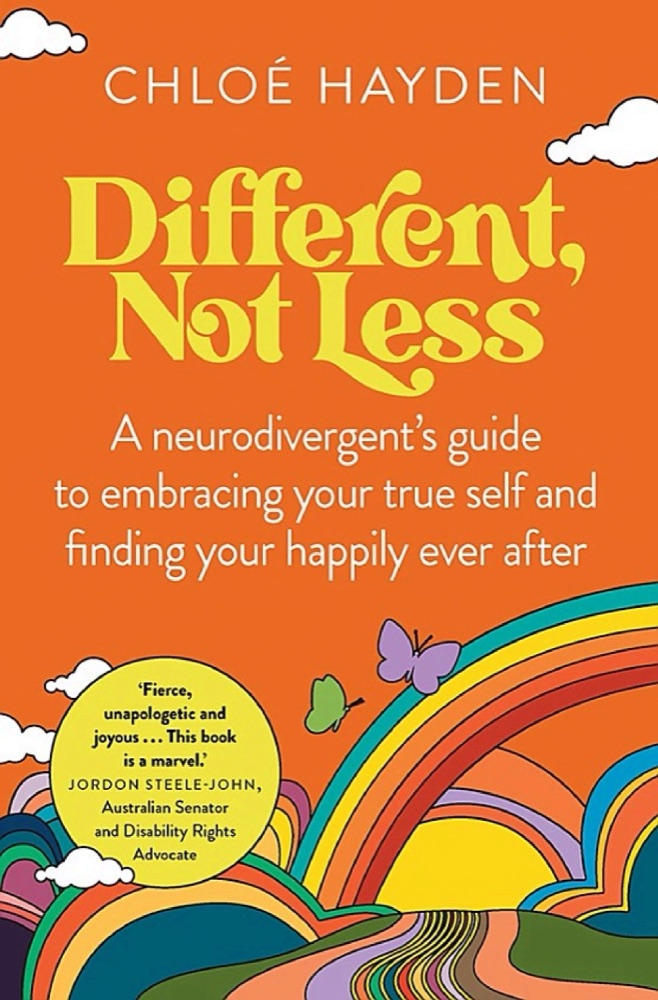
An empowering lived-experience guide to celebrating and supporting neurodivergence from 24-year-old actor, social media star and advocate Chloé Hayden.
Growing up, Chloé Hayden felt like she'd crash-landed on an alien planet where nothing made sense. Eye contact? Small talk? And WHY are you people so touch oriented? She moved between 10 schools in 8 years, struggling to become a person she believed society would accept, and was eventually diagnosed with autism and ADHD. It was only after a life-changing group of allies showed her that different did not mean less that she learned to celebrate her true voice and find her happily ever after.
Different, Not Less is a moving, at times funny story of how it feels to be neurodivergent as well as a practical guide, with insights on how autism and ADHD present differently in females, advice for living with meltdowns and shutdowns, tips for
Book details
- First published
- 2022
- Author
- Chloé Hayden
- Genre
- Nonfiction
- Goodreads rating
- 4.25 (5k ratings)
Keep reading
Fall Down 7 Times Get Up 8: A Young Man's Voice from the Silence of Autism
 A Kind of Spark
 Far from the Tree: Parents, Children, and the Search for Identity
 The Reason I Jump: The Inner Voice of a Thirteen-Year-Old Boy with Autism
 Paris: A Memoir for Young Women in the Age of Influencers
 Disability Visibility: First-Person Stories from the Twenty-first Century
![[Don't] Call Me Crazy](/i/book/g/b2/dont-call-me-crazy.jpg) [Don't] Call Me Crazy
[Don't] Call Me Crazy
 Unmasking Autism: Discovering the New Faces of Neurodiversity
 Ten Steps to Nanette
 Hold On, But Don't Hold Still
 Ten Things Every Child with Autism Wishes You Knew
 Notes on a Nervous Planet
 What I Mean When I Say I'm Autistic: Unpuzzling a Life on the Autism Spectrum
 Redefining Realness: My Path to Womanhood, Identity, Love & So Much More
 The Light We Carry: Overcoming in Uncertain Times
 All Is Not Forgotten
 It's Not Like It's a Secret
 The Art of Starving
 The 7 Habits Of Highly Effective Teens
 Adulting: How to Become a Grown-up in 468 Easy(ish) Steps
 101 Essays That Will Change The Way You Think
 The Danish Way of Parenting: What the Happiest People in the World Know About Raising Confident, Capable Kids
 The Boy Who Was Raised as a Dog: And Other Stories from a Child Psychiatrist's Notebook
![It's Not OK to Feel Blue [and other lies]](/i/book/g/ed/its-not-ok-to-feel-blue-and-other-lies.jpg) It's Not OK to Feel Blue [and other lies]
It's Not OK to Feel Blue [and other lies]
 A Room Called Earth
 Every Exquisite Thing
 Life Will Be the Death of Me: . . . and you too!
 Why Can't I Just Enjoy Things?: A Comedian's Guide to Autism
 Over the Top: A Raw Journey to Self-Love
 Untamed
 Selfie: How the West Became Self-Obsessed
 How to Stay Sane in an Age of Division
 Girl Wash your Face
 Walking Practice
 Keep Holding On
 If You Have to Cry, Go Outside: And Other Things Your Mother Never Told You
 Becoming
 Unbearable Lightness: A Story of Loss and Gain
 Tomorrow Will Be Different: Love, Loss, and the Fight for Trans Equality
 Atlas of the Heart: Mapping Meaningful Connection and the Language of Human Experience
 To Throw Away Unopened
 This Is How: Proven Aid in Overcoming Shyness, Molestation, Fatness, Spinsterhood, Grief, Disease, Lushery, Decrepitude & More. For Young and Old Alike.
 The Electricity of Every Living Thing
 The Center Cannot Hold: My Journey Through Madness
 A Work in Progress
 Simplicity Parenting: Using the Extraordinary Power of Less to Raise Calmer, Happier, and More Secure Kids
 I'll Have What She's Having
 Us: Getting Past You and Me to Build a More Loving Relationship
 I Miss You When I Blink: Essays
 The School of Life: An Emotional Education
 Symptoms of Being Human
 The Awakened Family: A Revolution in Parenting
 How to Raise an Adult: Break Free of the Overparenting Trap and Prepare Your Kid for Success
 Buffering: Unshared Tales of a Life Fully Loaded
 I Really Didn't Think This Through: Tales from My So-Called Adult Life
 Unfuck Your Brain: Using Science to Get Over Anxiety, Depression, Anger, Freak-Outs, and Triggers
 Believe Me: A Memoir of Love, Death, and Jazz Chickens
 Sissy: A Coming-of-Gender Story
 Words on Bathroom Walls
 Just Like Someone Without Mental Illness Only More So