
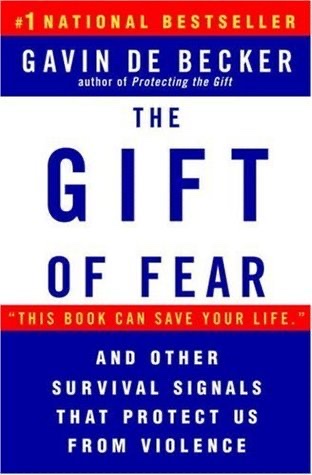
 The Gift of Fear: Survival Signals That Protect Us from Violence
Quotes from the Book
When dreaded outcomes are actually imminent we don't worry about themwe take action. Seeing lava from the local volcano make its way down the street toward our house does not cause worry it causes running. Also we don't usually choose imminent events as subjects for our worrying and thus emerges an ironic truth: Often the very fact that you are worrying about something means that it isn't likely to happen.
17
When a baby is born the mother in particular enters into a new larger relationship with the world. She has become connected to all people. She is part of keeping us on earthnot the "us" comprised of individuals but the species itself. By protecting this one baby this gift a mother accepts life's clearest responsibility.
13
For some parents, as with Jason’s father, the least popular feature of their children is defiance. Yet it is one of the most important for safety. If defiance is always met with discipline and never with discussion, that can handicap a child. The moment the two-year-old defiantly asserts his will for the first time may be cause for celebration, not castigation, for he is building the courage to resist. If your teenage daughter never tests her defiance on you, she may well be unable to use it on a predator.
10
While you may be able to keep your son Jimmy from owning [a gun], if you try to talk him out of wanting one, you are up against a pretty strong argument: You mean I shouldn't want a device that grants me power and identity, makes me feel dangerous and safe at the same time, instantly makes me the dominant male, and connects me to my evolutionary essence? Come on, Mom, get real!
8
The absence of adult males upsets the natural order in our species and in others. For example, game wardens in South Africa recently had to kill several teenage male elephants that had uncharacteristically become violent. These young elephants behaved like a contemporary street gang—and perhaps for the same reason: There were no adult males in their lives. To solve the problem, park officials imported adult male elephants from outside the area. Almost immediately, the remaining juveniles stopped misbehaving. Testosterone ungoverned by experience is dangerous, and older males temper the craving for dominance—merely by being dominant themselves.
6
Some parents have taught their small children, “Go to the manager,” but this poses the same problem of identification as with the policeman: That small name tag is several feet above the child’s eye-line. I don’t believe in teaching inflexible rules because it’s not possible to know they’ll apply in all situations. There is one, however, that reliably enhances safety: Teach children that if they are ever lost, Go to a Woman. Why? First, if your child selects a woman, it’s highly unlikely that the woman will be a sexual predator. Next, as Jan’s story illustrates, a woman approached by a lost child asking for help is likely to stop whatever she is doing, commit to that child, and not rest until the child is safe. A man approached by a small child might say, “Head over there to the manager’s desk,” whereas a woman will get involved and stay involved.
4
when a victim tells her story and people respond with You-should-have-this or You-should-never-have-that, they are often adding to the victimization.
2
Imagine Cara caring enough to make a police report about an abused child knowing the information will likely be unwelcome to the police, enraging to the parent, and unappreciated by the child, knowing nothing might happen, or worse, that the kid may be beaten for the trouble it causes—yet hoping this case is one where the child is actually helped. There’s nothing depressing about the heroism teachers show every day.
2
As parent and child advocate Anna McDonnell says, “To have a child is to have the chance to revisit your own childhood and self, and sometimes to make changes that have been needed for a long while.” Trained for decades to interact with men in ways that serve the patriarchy, the new mother must answer to no man if doing so might place her or her child at risk.
1
One of our closest relatives in nature, the Bonobo ape, long ago learned what these programs prove: that female alliances are the key to safety. When a female Bonobo is bullied by a male, other females will chase him off.
1
You cannot turn a decent man into a violent one by being momentarily rude, but you can present yourself as an ideal target by appearing too timid.
1
Just as rapport-building has a good reputation, explicitness applied by women in this culture has a terrible reputation. A woman who is clear and precise is viewed as cold, or a bitch, or both. A woman is expected, first and foremost, to respond to every communication from a man. And the response is expected to be one of willingness and attentiveness. Women are expected to be warm and open, and in the context of an approach from a male stranger, warmth lengthens the encounter, raises his expectations, increases his investment, and, at best, wastes time. At worst, it serves the man who has sinister intent by providing much of the information he will need to evaluate and then control his target.
1
seven key abilities human beings need to effectively manage life: the ability to motivate ourselves, to persist against frustration, to delay gratification, to regulate moods, to hope, to empathize, and to control impulse. Many
1
Men who will not harm you needn’t persuade you to trust them; they simply act appropriately from the moment you meet them and for as long as you know them. They
1
a good exercise when worrying is to ask yourself, What am I choosing not to see right now? Worry may well be distracting you from something important. For
1
through their families—and those families are important models for the rest of us
In Mr. Kaye’s crazy arms race, would we someday judge schools by comparing the ratio of armed students to armed teachers?
We may suppress an objectionable thought about a friend, but the only way to really banish a thought is to consider it.
It’s obvious that we need inexpensive and safe care for young Americans; this was clear to Congress nearly thirty years ago when it passed the Child Development Act of 1971. This act would have created a national network of child-care centers with parent fees set according to income. Here’s why I say would have: Though busy with the Watergate scandal and the impending loss of his job, President Nixon somehow found time to veto the Child Development Act.
The Unsolicited Promise When the man volunteered, “I promise we’ll look after him,” he gave one of the most reliable signals of trouble. Promises are used to convince us of an intention, but they are not guarantees. A guarantee offers some compensation if the speaker fails to deliver, but promises offer no such collateral. They are the very hollowest instruments of speech, showing nothing more than the speaker’s desire to convince you of something.
Here is a list of the PINS: Alcohol and drug abuse; Addiction to media products; Aimlessness; Fascination with weapons and violence; Experience with guns; Access to guns; Sullen, Angry, Depressed (SAD); Seeking status and worth through violence; Threats (of violence or suicide); Chronic anger; Rejection/humiliation; Media provocation.
Don’t think of persuasion as something someone does to us; persuasion is an internal process, not an external one. We persuade ourselves. A predator merely manipulates how things seem to us.
Sexual predators often start with nonsexual touch to desensitize their targets. It might be “accidental” touch, or hugs, pats, strokes, hair-brushing, holding. A
Your suspicion alone is more than enough justification for preventing time alone with your child. You
An unhappy child not getting comfort or support at home will look for it somewhere else. Next
(if you never make a decision, you can’t make a mistake). It
Those people we are willing to suspect are inherently less dangerous than those we refuse to suspect. We
The same way others become people we select for inclusion in our lives: We learn enough about them, they pass several of our tests, they lose their anonymity, and we discover an acceptable degree of shared values. The
Obviously, we cannot change or eliminate all the dangerous people in the world; what we can change is our ability to deal with them. That
NEWS: Nothing Educational or Worth Seeing. It
Watch on YouTube
About Gavin de Becker
We have collected 58 quotes from 2 books by Gavin de Becker on BookQuoters.
More about the author →More by Gavin de Becker
The Gift of Fear: Survival Signals That Protect Us from Violence
About the book
Safety skills for children outside the home Warning signs of sexual abuse How to screen baby-sitters and choose schools Strategies for keeping teenagers safe from violenceAll parents face the same challenges when it comes to their children's safety: whom to trust, whom to distrust, what to believe, what to doubt, what to fear, and what not to fear. In this empowering book, Gavin de Becker, the nation's leading expert on predicting violent behavior and author of the monumental bestseller The Gift of Fear, offers practical new steps to enhance children's safety at every age level, giving you the tools you need to allow your kids freedom without losing sleep yourself. With daring and compassion, he shatters the widely held myths about danger and safety and helps parents find some certainty about life's highest-stakes questions: How can I know a baby-sitter won't turn out to be someone who h
Book details
- First published
- 1999
- Author
- Gavin de Becker
- Genre
- Nonfiction
- Goodreads rating
- 4.32 (3k ratings)
Keep reading
The Gift of Fear: Survival Signals That Protect Us from Violence
 The Coddling of the American Mind: How Good Intentions and Bad Ideas Are Setting up a Generation for Failure
 How to Talk So Little Kids Will Listen: A Survival Guide to Life with Children Ages 2-7
 All Is Not Forgotten
 The Boy Who Was Raised as a Dog: And Other Stories from a Child Psychiatrist's Notebook
 The Laws of Human Nature
 Hold Tight
 Riding the Elephant: A Memoir of Altercations, Humiliations, Hallucinations, and Observations
 Born a Crime: Stories From a South African Childhood
 Becoming Bulletproof: Protect Yourself, Read People, Influence Situations, and Live Fearlessly
 Us: Getting Past You and Me to Build a More Loving Relationship
 Hunters of Dune
 The Art of Thinking Clearly
 The Danish Way of Parenting: What the Happiest People in the World Know About Raising Confident, Capable Kids
 Defending Jacob
![The Book You Wish Your Parents Had Read [and Your Children Will Be Glad That You Did]](/i/book/g/63/the-book-you-wish-your-parents-had-read-and-your-children-will-be-glad-that-you-did.jpg) The Book You Wish Your Parents Had Read [and Your Children Will Be Glad That You Did]
The Book You Wish Your Parents Had Read [and Your Children Will Be Glad That You Did]
 For Your Own Good: Hidden Cruelty in Child-Rearing and the Roots of Violence
 Disclosure
 David and Goliath: Underdogs, Misfits, and the Art of Battling Giants
 The Hangman's Replacement: Sprout of Disruption
 House Rules
 On Our Best Behavior: The Seven Deadly Sins and the Price Women Pay to Be Good
 The Collapse of Parenting: How We Hurt Our Kids When We Treat Them Like Grown-Ups
 Between Parent and Child
 Nonviolent Communication: A Language of Life
 In The Blood
 Simplicity Parenting: Using the Extraordinary Power of Less to Raise Calmer, Happier, and More Secure Kids
 Social Intelligence: The New Science of Human Relationships
 12 Rules for Life: An Antidote to Chaos
 The Fran Lebowitz Reader
 Over the Woodward Wall
 Good Morning, Monster: A Therapist Shares Five Heroic Stories of Emotional Recovery
 The 7 Habits Of Highly Effective Teens
 Antifragile: Things That Gain from Disorder
 Independent Study
 Suspect
 The Thursday Murder Club
 A Language Older Than Words
 Fool Me Once
 The 57 Bus
 Punished by Rewards: The Trouble with Gold Stars, Incentive Plans, A's, Praise and Other Bribes
 A Beautiful Day in the Neighborhood: The Poetry of Mister Rogers
 The Downstairs Girl
 A Higher Loyalty: Truth, Lies, and Leadership
 Peace Talks
 The Nix
 Scattered Minds: The Origins and Healing of Attention Deficit Disorder
 Drama Free: A Guide to Managing Unhealthy Family Relationships
 A Mother's Reckoning: Living in the Aftermath of Tragedy
 Some Assembly Required: A Journal of My Son's First Son
 The Truth: An Uncomfortable Book About Relationships
 The Anxious Generation: How the Great Rewiring of Childhood Caused an Epidemic of Mental Illness
 The Lucifer Effect: Understanding How Good People Turn Evil
 Beartown
 Dare to Lead
 The Power
 Parable of the Talents
 Walden Two
 Different, Not Less: A Neurodivergent's Guide to Embracing Your True Self and Finding Your Happily Ever After
 The Sociopath Next Door