 How Children Fail
Quotes from the Book
For a long time I have been interested in my own thoughts, feelings, and motives, eager to know as much as I can of the truth about myself. After many years, I think that at most I may know something about a very small part of what goes on in my own head. How preposterous to imagine that I can know what goes on in someone else's.
4
The person who really needs to know something does not need to be told many times, drilled, tested. Once is enough.
4
But the greatest difference between children and adults is that most of the children to whom I offer a turn on the cello accept it, while most adults, particularly if they have never played any other instrument, refuse it.
4
We think in terms of getting a skill first, and then finding useful and interesting things to do with it. The sensible way, the best way, is to start with something worth doing, and then, moved by a strong desire to do it, get whatever skills are needed.
3
If we try to make children fantasize, these fake fantasies, like the ready-made fantasies of TV, will in time drive out most of their true fantasies, the ones that come from their experience in the world and their need to make sense of it and become at home in it.
2
Words are not only a clumsy and ambiguous means of communication, they are extraordinarily slow.
1
The only thing to do was to turn off the questions and watch - like a child. Take it all in. See everything, worry about nothing.
1
There is more real learning in a good picture than in twenty workbooks.
1
How much people can learn at any moment depends on how they feel at that moment about the task and their ability to do the task.
1
Children. Nothing could be more simple—or more difficult. Difficult, because to trust children we must trust ourselves—and most of us were taught as children that we could not be trusted. And so we go on treating children as we ourselves were treated, calling this “reality,” or saying bitterly, “If I could put up with it, they can too.
1
look at children, patiently, repeatedly, respectfully, and to hold off making theories and judgments about them until they have in their minds what most of them do not now have—a reasonably accurate model of what children are like.
Children use fantasy not to get out of, but to get into, the real world.
If he didn't know what it was "supposed" to do, he wasn't going to try to make it do anything; it might do the wrong thing, and someone might think it was his fault.
With the bike right before them, they could not see how it was put together, or if they could, could not hold that knowledge in mind long enough to transfer it to paper. It seemed as if their schooling had been for so long so far removed from reality that they were no longer able to see reality, to grasp it, to come to grips with it.
Do they use the method because they are bright, or is it the use of the method that makes them bright?
Why do they do this? Because it gives them a license to act like tyrants and to feel like saints. “Do what I tell you!” roars the tyrant. “It’s for your own good, and one day you’ll be grateful,” says the saint. Few people, feeling themselves powerless in a world turned upside down, can or even wish to resist the temptation to play this benevolent despot.
Watch on YouTube
About John C. Holt
We have collected 34 quotes from 2 books by John C. Holt on BookQuoters.
More about the author →More by John C. Holt
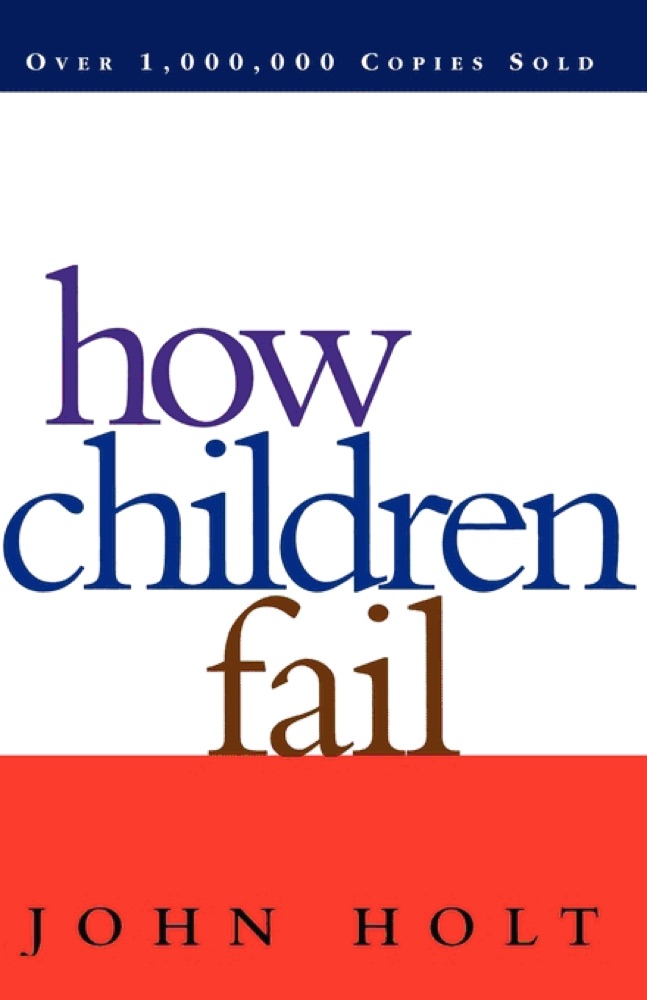
How Children Fail
About the book
This enduring classic of educational thought offers teachers and parents deep, original insight into the nature of early learning. John Holt was the first to make clear that, for small children, “learning is as natural as breathing.” In this delightful yet profound book, he looks at how we learn to talk, to read, to count, and to reason, and how we can nurture and encourage these natural abilities in our children.”
Book details
- First published
- 1967
- Author
- John C. Holt
- Genre
- Nonfiction
- Goodreads rating
- 4.18 (4k ratings)
Keep reading
How Children Fail
 Think Like a Freak
 The Element: How Finding Your Passion Changes Everything
 Emile or On Education
 A Beautiful Day in the Neighborhood: The Poetry of Mister Rogers
 The Social Animal: The Hidden Sources of Love, Character, and Achievement
 Free to Learn: Why Unleashing the Instinct to Play Will Make Our Children Happier, More Self-Reliant, and Better Students for Life
 What the Dog Saw and Other Adventures
 The Brave Learner: Finding Everyday Magic in Homeschool, Learning, and Life
 My Ishmael
 How to Talk So Little Kids Will Listen: A Survival Guide to Life with Children Ages 2-7
 Dibs in Search of Self
 Mastery
 Letters from an Astrophysicist
 Simplicity Parenting: Using the Extraordinary Power of Less to Raise Calmer, Happier, and More Secure Kids
 Blink: The Power of Thinking Without Thinking
 Children of Dune
 What Do You Care What Other People Think?
 Educating Esmé: Diary of a Teacher's First Year
 The 7 Habits of Highly Effective People: Personal Workbook
 The Vanishing American Adult: Our Coming-of-Age Crisis—and How to Rebuild a Culture of Self-Reliance
 The Game
 The Art of Thinking Clearly
 The Lifecycle of Software Objects
 Thinking, Fast and Slow
 Thief of Time
 Made to Stick: Why Some Ideas Survive and Others Die
 How to Talk So Kids Will Listen & Listen So Kids Will Talk
 All I Really Need to Know I Learned in Kindergarten
 Devil House
 The Read-Aloud Handbook
 The Absorbent Mind
 Independent Study
 Zen and the Art of Motorcycle Maintenance
 A Circle of Quiet
 The Core
 The Danish Way of Parenting: What the Happiest People in the World Know About Raising Confident, Capable Kids
 Montessori from the Start: The Child at Home, from Birth to Age Three
 Slow Learner
 Curious: The Desire to Know and Why Your Future Depends On It
 The Tao of Pooh
 You Learn by Living: Eleven Keys for a More Fulfilling Life
 Down Among the Sticks and Bones
 If I Understood You, Would I Have This Look on My Face?: My Adventures in the Art and Science of Relating and Communicating
 Excellent Advice for Living: Wisdom I Wish I'd Known Earlier
 Stumbling on Happiness
 The Republic
 Shop Class as Soulcraft: An Inquiry Into the Value of Work
 Walden Two
 How to Stay Sane
 Beginners: The Joy and Transformative Power of Lifelong Learning
 How to Read a Book: The Classic Guide to Intelligent Reading
 We Make the Road by Walking: Conversations on Education and Social Change
 God's Debris: A Thought Experiment
 Surely You're Joking, Mr. Feynman!
 Flaubert's Parrot
 Punished by Rewards: The Trouble with Gold Stars, Incentive Plans, A's, Praise and Other Bribes
 Shouldn't You Be in School?
 House Rules
 The Last Lecture