 The Upanishads
Quotes from the Book
In a world where nothing exists by itself, where every division of one thing from another is a misperception - or misconception - of the way things really are, there are no eyes, ears, nose, tongue, body, or mind. We cannot, for example, draw a line around the eyes that is not necessarily arbitrary. There is no point at which the eyes begin or end, either in time or in space or conceptually. The eye bone is connected to the face bone, and the face bone is connected to the head bone, and the head bone is connected to the neck bone, and so it goes down to the toe bone, the floor bone, the earth bone, the worm bone, the dreaming butterfly bone. Thus, what we call our eyes are so many bubbles in a sea of foam. This is not only true of our eyes but of our other powers of sensation as well, including the mind.
10
The Buddha asks us to see things as they really are. He does not ask us to cling to optimistic views of eternity or pessimistic views of annihilation but simply to examine our experience.
3
On the night of his Enlightenment, Shakyamuni asked himself what is the source of suffering and answered that it is old age and death. He then asked what is the origin of old age and death and answered that it is birth (jati), and the origin of birth is existence (bhava), and the origin of existence is attachment (upadana), and the origin of attachment is thirst (trishna), and the origin of thirst is sensation (vedana), and the origin of sensation is contact (sparsha), and the origin of contact is the abodes (ayatana), and the origin of the abodes is name and form (nama-rupa), and the origin of name and form is consciousness (vijnana), and the origin of consciousness is memory (sanskara), and the origin of memory is ignorance.
the use of prajna in the title tells us this is a text that goes beyond the analysis of reality into discrete, knowable entities, such as those used by the Sarvastivadins. Thus, Zen masters ask their students to show them their original face, their face before they were born.
Whatever is form is impermanent. And whatever is impermanent is suffering. And whatever is suffering is devoid of a self, devoid of a self and anything that might belong to a self. One who views things like this sees things as they really are. So, too, are sensation, perception, memory and consciousness impermanent. And being impermanent, they are suffering. And being suffering, they are devoid of a self and anything that might belong to a self. One who views things like this sees them as they really are. Those noble disciples who view things like this are repulsed by form and repulsed by sensation, perception, memory, and consciousness. And because they are repulsed by them, they do not delight in them. And because they do not delight in them, they are free of them.
Watch on YouTube
About Anonymous
More by Anonymous
All books by Anonymous →

About the book
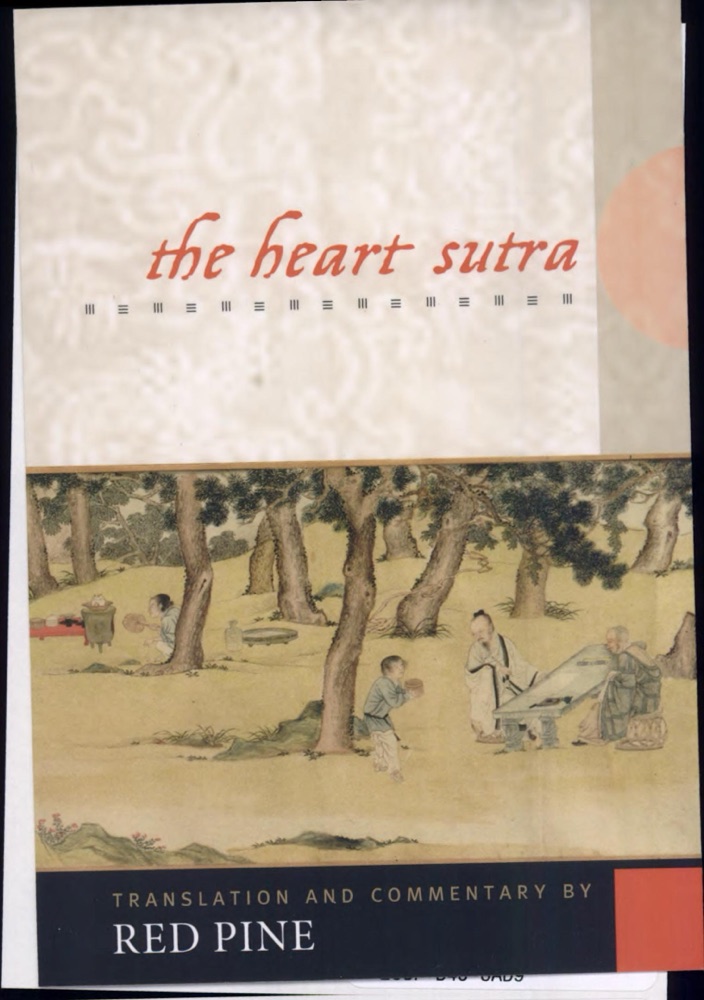
The short text of The Heart Sutra is Buddhism in a nutshell. It has had the most profound and wide-reaching influence of any text in Buddhism. Its full title, Prajna Paramita Hrdaya Sutra, "The Sutra of the Heart of the Perfection of Wisdom," explains that this sutra contains the essence of the Buddha’s teaching, the core of perfect enlightenment. It is the source of the famous and puzzling declaration, "form is emptiness, emptiness is form."
For this new translation into English, Red Pine, award-winning translator of Chinese poetry and religious texts, has utilized various Sanskrit and Chinese versions, refining the teachings of dozens of ancient teachers together with his own commentary to offer a profound word-for-word explication. The result is a wise book of deep teaching destined to become the standard edition of this timeless statement of Mahayana truth.
Book details
- First published
- 2001
- Author
- Anonymous
- Genre
- Philosophy
- Goodreads rating
- 4.37 (3k ratings)
Keep reading
 What the Buddha Taught
 Tibetan Book of the Dead
 The Yoga Sutras of Patanjali
The Upanishads
The Yoga Sutras of Patanjali
The Upanishads
 Confession of a Buddhist Atheist
 In Love with the World: A Monk's Journey Through the Bardos of Living and Dying
 The Book of Secrets
 Myths to Live By
 In the Buddha's Words: An Anthology of Discourses from the Pali Canon
 Buddhism Plain & Simple: The Practice of Being Aware, Right Now, Every Day
 The Yoga Sutras of Pantanjali
 An Introduction to Zen Buddhism
 The World's Religions
 The Book of Wisdom
 The Tibetan Book of Living and Dying
 Buddhism: A Very Short Introduction
 The Middle Length Discourses of the Buddha: A Translation of the Majjhima Nikaya
 No Death, No Fear: Comforting Wisdom for Life
 The Perennial Philosophy
 Thoughts Without A Thinker: Psychotherapy From A Buddhist Perspective
 The Way of Zen
 The Mustard Seed: The Gnostic Teachings of Jesus The Mystic
 Awakening the Buddha Within
 Bhagavad-Gita As It Is
 The Joy of Living: Unlocking the Secret and Science of Happiness
 Raja-Yoga
 The Book of Secrets: Unlocking the Hidden Dimensions of Your Life
 Cutting Through Spiritual Materialism
 Everyday Zen: Love & Work
 Zen Flesh, Zen Bones: A Collection of Zen and Pre-Zen Writings
 The Wise Heart: A Guide to the Universal Teachings of Buddhist Psychology
 The Book: On the Taboo Against Knowing Who You Are
 The Art Of Living
 Eastern Body, Western Mind: Psychology and the Chakra System as a Path to the Self
 The Psychedelic Experience: A Manual Based on the Tibetan Book of the Dead
 Seth Speaks: The Eternal Validity of the Soul
 The Power of Now: A Guide to Spiritual Enlightenment
 The Holy Science
 Ego and Archetype: Individuation and the Religious Function of the Psyche
 Living Buddha, Living Christ
 Total Freedom: The Essential Krishnamurti
 The Convoluted Universe, Book 1
 Chuang Tzu: Basic Writings
 Hardcore Zen: Punk Rock, Monster Movies and the Truth about Reality
 Twilight of the Idols/The Anti-Christ
 Man and His Symbols
 Phenomenology of Perception
 The Big Picture: On the Origins of Life, Meaning, and the Universe Itself
 Why Buddhism Is True: The Science and Philosophy of Meditation and Enlightenment
 My Gita
 Complete Works of Swami Vivekananda, 9 Vols.
 Maps of Meaning: The Architecture of Belief
 The Order of Time
 The Case Against Reality: Why Evolution Hid the Truth from Our Eyes
 Against the Stream: A Buddhist Manual for Spiritual Revolutionaries
 Basic Writings
 Comfortable with Uncertainty: 108 Teachings on Cultivating Fearlessness and Compassion