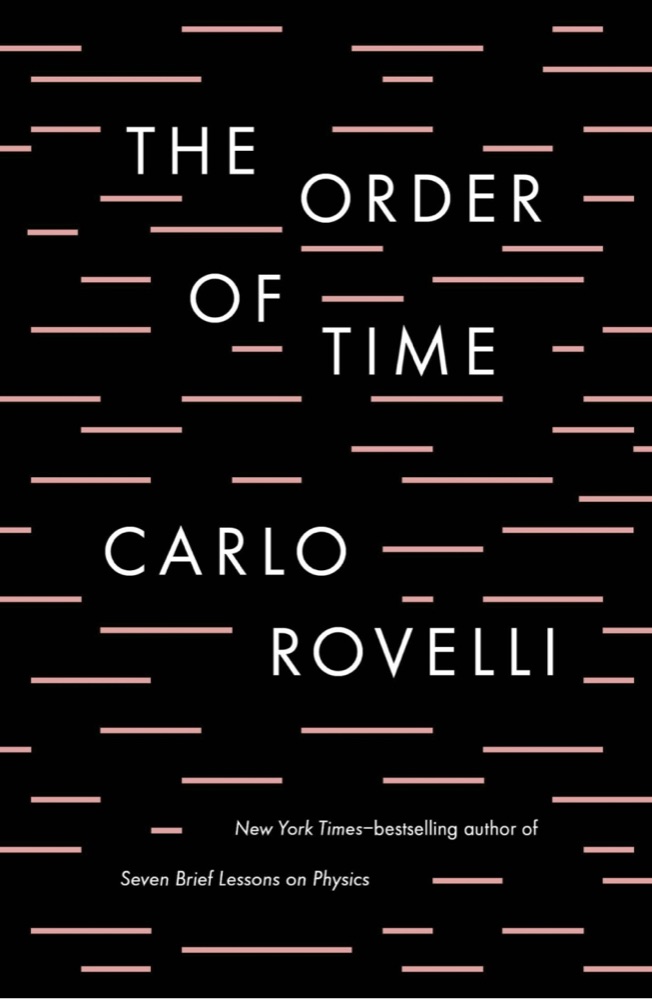
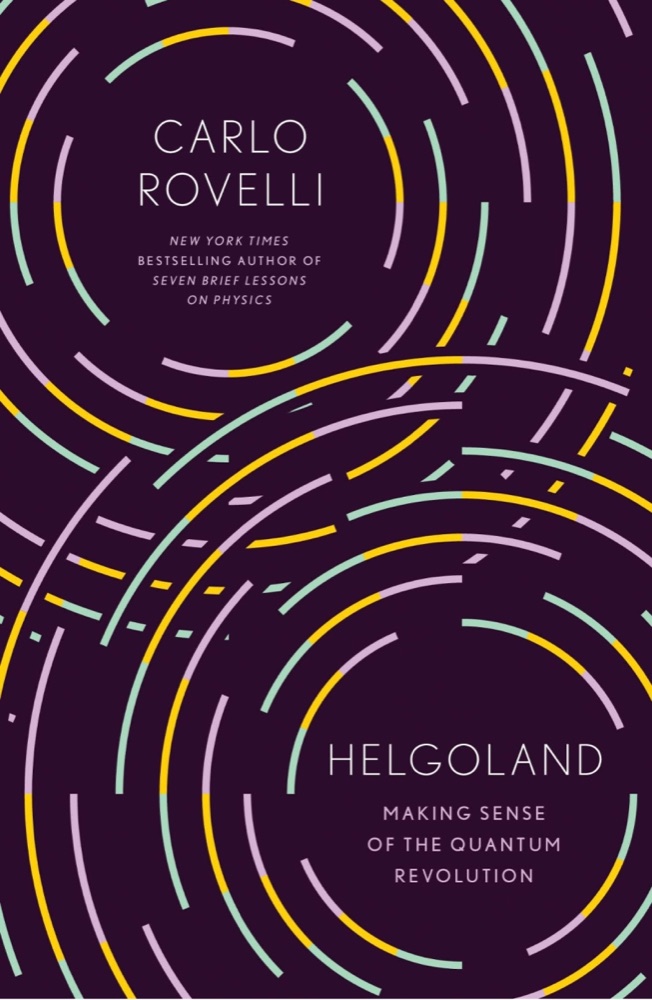
 Helgoland: Making Sense of the Quantum Revolution
Quotes from the Book
This is time for us. Memory. A nostalgia. The pain of absence. But it isn't absence that causes sorrow. It is affection and love. Without affection, without love, such absences would cause us no pain. For this reason, even the pain caused by absence is in the end something good and even beautiful. Because it feeds on that which gives meaning to life.
119
Because everything that begins must end. What causes us to suffer is not in the past or the future: it is here, now, in our memory, in our expectations. We long for timelessness, we endure the passing of time: we suffer time. Time is suffering.
68
We are stories, contained within the twenty complicated centimeters behind our eyes...
46
I am my mother’s caresses, and the serene kindness with which my father calmly guided me; I am my adolescent travels; I am what my reading has deposited in layers in my mind; I am my loves, my moments of despair, my friendships, what I’ve written, what I’ve heard; the faces engraved on my memory. I am, above all, the one who a minute ago made a cup of tea for himself. The one who a moment ago typed the word “memory” into his computer. The one who just composed the sentence that I am now completing. If all this disappeared, would I still exist? I am this long, ongoing novel. My life consists of it.
44
We understand the world in its becoming, not in its being.
36
If I ask whether two events—one on Earth and the other on Proxima b—are happening “at the same moment,” the correct answer would be: “It’s a question that doesn’t make sense, because there is no such thing as ‘the same moment’ definable in the universe.” The “present of the universe” is meaningless.
32
It is like the point where the rainbow touches the forest. We think that we can see it—but if we go to look for it, it isn’t there.
26
The ability to understand something before it’s observed is at the heart of scientific thinking.
25
I remember a little girl... But how can that be... Once I was that little Resi, and then one day I became an old woman? ...If God wills it so, why allow me to see it? Why doesn't he hide it from me? Everything is a mystery, such a deep mystery... I feel the fragility of things in time. From the bottom of my heart, I feel we should cling to nothing. Everything slips through our fingers. All that we seek to hold on to dissolves. Everything vanishes, like mist and dreams... Time is a strange thing. When we don't need it, it is nothing. Then, suddenly, there is nothing else. It is everywhere around us. Also within us. It seeps into our faces. It seeps into the mirror, runs through my temples... Between you and I it runs silently, like an hourglass. Oh, Quin Quin. Sometimes I feel it flowing inexorably. Sometimes I get up in the middle of the night and stop all the clocks...
23
All of the sons of Adam are part of one single body, They are of the same essence. When time afflicts us with pain In one part of that body All the other parts feel it too. If you fail to feel the pain of others You do not deserve the name of man.
23
As human beings, we live by emotions and thoughts. We exchange them when we are in the same place at the same time, talking to each other, looking into each other's eyes, brushing against each other's skin. We are nourished by this network of encounters and exchanges. But, in reality, we do not need to be in the same place and time to have such exchanges. Thoughts and emotions that create bonds of attachment between us have no difficulty in crossing seas and decades, sometimes even centuries, tied to thin sheets of paper or dancing between the microchips of a computer. We are part of a network that goes far beyond the few days of our lives and the few square meters that we tread. This book is also a part of that weave...
21
This is the disconcerting conclusion that emerges from Boltzmann’s work: the difference between the past and the future refers only to our own blurred vision of the world. It’s a conclusion that leaves us flabbergasted: is it really possible that a perception so vivid, basic, existential—my perception of the passage of time—depends on the fact that I cannot apprehend the world in all of its minute detail? On a kind of distortion that’s produced by myopia? Is it true that, if I could see exactly and take into consideration the actual dance of millions of molecules, then the future would be “just like” the past?
20
But it isn’t absence that causes sorrow. It is affection and love. Without affection, without love, such absences would cause us no pain. For this reason, even the pain caused by absence is, in the end, something good and even beautiful, because it feeds on that which gives meaning to life.
19
Past and future are different from each other. Cause precedes effect. Pain comes after a wound, not before it. The glass shatters into a thousand pieces, and the pieces do not re-form into a glass. We cannot change the past; we can have regrets, remorse, memories. The future instead is uncertainty, desire, anxiety, open space, destiny, perhaps. We can live toward it, shape it, because it does not yet exist. Everything is still possible... Time is not a line with two equal directions: it is an arrow with different extremities.
16
Before Newton, time for humanity was the way of counting how things changed. Before him, no one had thought it possible that a time independent of things could exist. Don't take your intuitions and ideas to be 'natural': they are often the products of the ideas of audacious thinkers who came before us.
13
It is entropy, not energy, that keeps stones on the ground and the world turning.
13
We can think of the world as made up of things. Of substances. Of entities. Of something that is. Or we can think of it as made up of events. Of happenings. Of processes. Of something that occurs. Something that does not last, and that undergoes continual transformation, that is not permanent in time.
11
We inhabit time as fish live in water. Our being is being in time.
11
I do not fear death. I fear suffering. And I fear old age, though less so now that I am witnessing the tranquil and pleasant old age of my father. I am afraid of frailty, and of the absence of love. But death does not alarm me. It did not scare me when I was young, and I thought at the time that this was because it was such a remote prospect. But now, at sixty, the fear has yet to arrive. I love life, but life is also struggle, suffering, pain. I think of death as akin to a well-earned rest.
11
Temporality is profoundly linked to blurring. The blurring is due to the fact that we are ignorant of the microscopic details of the world. The time of physics is, ultimately, the expression of our ignorance of the world. Time is ignorance.
10
Every moment of our existence is linked by a peculiar triple thread to our past—the most recent and the most distant—by memory. Our present swarms with traces of our past. We are histories of ourselves, narratives. I am not this momentary mass of flesh reclined on the sofa typing the letter a on my laptop; I am my thoughts full of the traces of the phrases that I am writing; I am my mother’s caresses, and the serene kindness with which my father calmly guided me; I am my adolescent travels; I am what my reading has deposited in layers in my mind; I am my loves, my moments of despair, my friendships, what I’ve written, what I’ve heard; the faces engraved on my memory. I am, above all, the one who a minute ago made a cup of tea for himself. The one who a moment ago typed the word “memory” into his computer. The one who just composed the sentence that I am now completing. If all this disappeared, would I still exist? I am this long, ongoing novel. My life consists of it.
10
A stone is a prototypical “thing”: we can ask ourselves where it will be tomorrow. Conversely, a kiss is an “event.” It makes no sense to ask where the kiss will be tomorrow. The world is made up of networks of kisses, not of stones.
7
If things fall, it is due to this slowing down of time. Where time passes uniformly, in interplanetary space, things do not fall. They float, without falling. Here on the surface of our planet, on the other hand, the movement of things inclines naturally toward where time passes more slowly, as when we run down the beach into the sea and the resistance of the water on our legs makes us fall headfirst into the waves. Things fall downward because, down there, time is slowed by the Earth.
6
Things” in themselves are only events that for a while are monotonous
5
O gentlemen, the time of life is short . . . And if we live, we live to tread on kings. Shakespeare, Henry IV, Part I (act 5, scene 2)
5
Children grow up and discover that the world is not as it seemed from within the four walls of their homes. Humankind as a whole does the same.
4
How long is forever?” asks Alice. “Sometimes, just one second,” replies the White Rabbit. There are dreams lasting an instant in which everything seems frozen for an eternity.
4
A moving object therefore experiences a shorter duration than a stationary one: a watch marks fewer seconds, a plant grows more slowly, a young man dreams less. For a moving object, time contracts.
4
Watch on YouTube
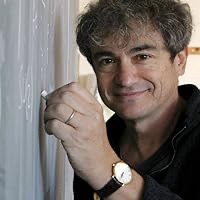
About Carlo Rovelli
We have collected 54 quotes from 2 books by Carlo Rovelli on BookQuoters.
More about the author →More by Carlo Rovelli
Helgoland: Making Sense of the Quantum Revolution
About the book
Time is a mystery that does not cease to puzzle us. Philosophers, artists and poets have long explored its meaning while scientists have found that its structure is different from the simple intuition we have of it. From Boltzmann to quantum theory, from Einstein to loop quantum gravity, our understanding of time has been undergoing radical transformations. Time flows at different speeds in different places, the past and the future differ far less than we might think and the very notion of the present evaporates in the vast universe.
With his extraordinary charm and sense of wonder, bringing together science, philosophy and art, Carlo Rovelli unravels this mystery, inviting us to imagine a world where time is in us and we are not in time.
Book details
- First published
- 2017
- Author
- Carlo Rovelli
- Genre
- Nonfiction
- Goodreads rating
- 4.12 (40k ratings)
The buzz
- The Washington PostReview in The Washington Postprofessional review (via Book Marks)
- The Wall Street JournalReview in The Wall Street Journalprofessional review (via Book Marks)
- The GuardianReview in The Guardianprofessional review (via Book Marks)
- NatureReview in Natureprofessional review (via Book Marks)
- The TimesReview in The Timesprofessional review (via Book Marks)
- Kirkus ReviewsReview in Kirkus Reviewsprofessional review (via Book Marks)
Keep reading
 The End of Time: The Next Revolution in Our Understanding of the Universe
 Einstein's Dreams
 The Big Picture: On the Origins of Life, Meaning, and the Universe Itself
 Until the End of Time: Mind, Matter, and Our Search for Meaning in an Evolving Universe
 Exhalation
 Borderliners
 Recursion
 The Accidental Universe: The World You Thought You Knew
 How to Stop Time
 Being and Time
 The Book of Form and Emptiness
 The Book of Lost Hours
 Toward Eternity
 Our Mathematical Universe: My Quest for the Ultimate Nature of Reality
 Hourglass: Time, Memory, Marriage
 The Power of Now: A Guide to Spiritual Enlightenment
 The Stone Gods
 Player One: What Is to Become of Us
 The Wisdom of Insecurity: A Message for an Age of Anxiety
 A Tale for the Time Being
 Autumn
 A Brief History of Time
 The Convoluted Universe, Book 1
 Kafka on the Shore
 Why Does the World Exist?: An Existential Detective Story
 The Stuff of Thought: Language as a Window into Human Nature
 From Eternity to Here: The Quest for the Ultimate Theory of Time
 The Grand Design
 Night Train to Lisbon
 No Death, No Fear: Comforting Wisdom for Life
 Uh-oh: Some Observations from Both Sides of the Refrigerator Door
 Poetry, Language, Thought
 The Paper Menagerie and Other Stories
 Stories of Your Life and Others
 Drive Your Plow Over the Bones of the Dead
 Jeremy Fink and the Meaning of Life
 The Gap of Time
Helgoland: Making Sense of the Quantum Revolution
The Gap of Time
Helgoland: Making Sense of the Quantum Revolution
 Buddhism Plain & Simple: The Practice of Being Aware, Right Now, Every Day
 The Year of Magical Thinking
 Arcadia
 We Spread
 The Book of Secrets: Unlocking the Hidden Dimensions of Your Life
 Night Side of the River
 Figuring
 The Island of the Day Before
 The Art Of Living
 Genesis
 The Invention of Solitude
 The Case Against Reality: Why Evolution Hid the Truth from Our Eyes
 The Time Machine
 Flights
 For Small Creatures Such as We: Rituals for Finding Meaning in Our Unlikely World
 The Book: On the Taboo Against Knowing Who You Are
 Myths to Live By
 Killing Commendatore
 Levels of Life
 A Fisherman of the Inland Sea
 Waterland