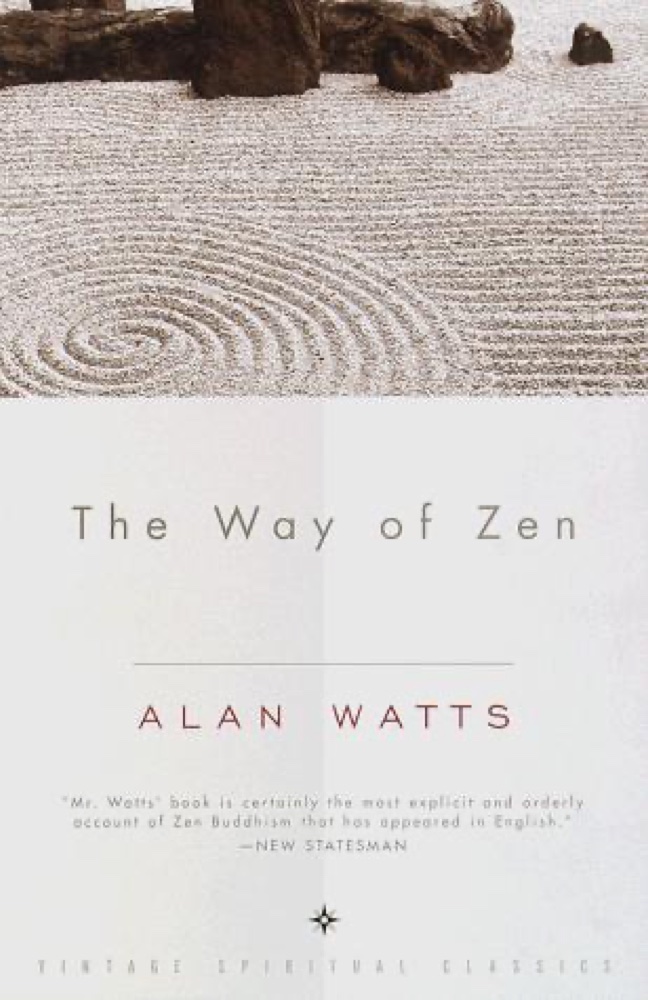
 The Way of Zen
Quotes from the Book
Everything is change. Nothing can be held on to. And if you go with the flux, you flow with it. However, if you resist the stream, it fights you. If you realize this, you swim with the flow—you go with it, and you’re at peace. This is particularly true when it comes to those moments when life really seems to be taking us away, and the stream of change is going to swallow us completely. And so at the moment of death, we withdraw and say, “No, no, no! Not that! Not yet!” But the whole problem is that we don’t realize that the only thing to do when that moment comes is to go over the waterfall—just as you go on from one day to the next, just as you go to sleep at night. When the moment comes, we should be absolutely willing to die.
23
I’m a philosopher. If you don’t argue with me, I don’t know what to think. So if we argue, I have to say “thank you,” because owing to the courtesy of your taking a different point of view, I understand what I think and mean. So I can’t get rid of you.
9
In Zen Buddhist texts they say, “You cannot nail a peg into the sky.” And so, to be a man of the sky, a man of the void, is also called ‘a man not depending on anything’. And when you’re not hung on anything you are the only thing that isn’t hung on anything – which is the universe. Which doesn’t hang, you see. Where would it hang? It has no place to fall on, even though it may be dropping; there will never be the crash of it landing on a concrete floor somewhere. But the reason for that is that it won’t crash below because it doesn’t hang above. And so there is a poem, in Chinese, which speaks of such a person as having above, not a tile to cover the head; below, not an inch of ground on which to stand.
4
If there was a big bang at the beginning of time, you are not something that is the result of that explosion at the end of the process. You are the process.
3
It’s the sort of snarl that self-consciousness can get into, and we call this anxiety. When I keep thinking over and over again, “Did I do the right thing?”—if I’m constantly aware of myself in a kind of anxious, critical way—my resonance becomes too high, and I get confused and jittery. But if you learn that self-consciousness has limits, that self-awareness cannot possibly enable you to be free of making mistakes, you can learn to be spontaneous in spite of being self-aware. And you can enjoy the echo.
3
The self pretends that things are getting serious, just like a great actor on the stage. Even though the audience knows that what they see on stage is only a play, the actor’s skill takes them in—they weep and laugh and sit on the edge of their seats with anticipation. They’re utterly involved in what they really know is just a play. So that’s what’s going on here. Brahman is a tremendous actor with absolutely superb technique, so much so that Brahman takes itself in and feels that the play is real. We are all the Brahman acting out our own parts and playing the human game so beautifully that Brahman is enchanted, and this is what enchantment means—under the influence of a chant, hypnotized, spellbound, fascinated. And that fascination is maya.
3
There is no way of wasting time. Because what is time for, except to be wasted?
3
Democracy as we have tried it started out on the wrong foot. We took the Christian scriptures that say that everybody is equal in the sight of God and made it to mean that everybody is inferior in the sight of God. And this is a parody of mysticism. Because originally, mysticism meant that, from the standpoint of God, all people are divine, which is a far different thing. So this is why all bureaucracies are rude, why police are rude, why you are made to wait in lines for everything, and why everyone is treated as some kind of crook. And a society like this, that views everybody as inferior, turns quickly into fascism because of its terror of the outsider.
2
This wave phenomenon is happening on ever so many scales—the fast wave of light, the slower waves of sound—and there are all sorts of other wave processes, such as the beat of the heart; the rhythm of breath, waking, sleeping; the movement of human life from birth to maturity to death. And the slower the wave goes, the more difficult it is to see that the crest and trough are inseparable, and this is how we become persuaded in the game of hide-and-seek. So we see the trough go down, down, down and think it keeps going forever—that it will never rise back up again into a crest. We forget that trough implies crest, and crest implies trough. There is no such thing as pure sound—sound is sound/silence. Light is light/darkness. Light is pulsation—between every light pulse there is the dark pulse.
1
Zen emphasizes immediate action. When anything is to be done, it should be done immediately without thinking it over in advance.
1
the relationship between the organism and the environment is transactional—the environment grows the organism, and the organism creates the environment. The organism turns the sun into light, but it requires an environment containing a sun in order to exist. It’s all one process. It isn’t that organisms came into this world by accident or chance—this world is the sort of environment that grows organisms. And it has been that way from the beginning. From the very first moment of the big bang—if that’s the way the whole thing started—organisms like you and me were involved.
1
when you forgive someone, you change the meaning of the past. Or when you’re reading a sentence in German or Latin where the verb awaits you at the very end, it’s only then that you find out what the sentence means. The present is always changing the past.
When one speaks of awakening, it means de-hypnotization – coming to your senses. But, of course, to do that, you have to go out of your mind.
We depend on each other. If you lean two sticks against each other, and they stand up because they support each other, and you take one stick away, and the other falls down, you clearly see how they interdepend. And this is exactly our situation. We and our environment and all of us together are interdependent systems.
If you say what it is that you see, you erect an image and an idol, and you misdirect people. So it’s better to destroy people’s beliefs than to give them beliefs. I know it hurts, but it’s true. It’s what cracks the eggshell and lets out the chick.
Buddhism does not deny the Self with a capital S—the great atman or whatnot. What it says is that if you make conceptions and doctrines about these things, you’re liable to become attached to them, and you’ll therefore start believing instead of knowing.
you can imitate unselfishness. You can go through all sorts of highly refined forms of unselfishness, but you are still tied to the wheel of becoming by the golden chains of your good deeds, just as obviously bad people are tied to it by the iron chains of their misbehaviors. This manifests in many ways—from spiritually proud people who believe they possess the one true teaching, to those who claim they are the most tolerant and inclusive and accepting, which is only a game called being more tolerant and inclusive and accepting than everybody else. The egocentric being is always in its own trap.
Look, if you play life on the supposition that you’re a helpless little puppet or that life is a frightful, serious risk, it will be an invariable drag. There’s no point in going on living unless you make the assumption that the situation of life is optimal, that — really and truly — we’re all in a state of total bliss and delight, but we’re all pretending otherwise, just for kicks. You play “non bliss” in order to really experience “bliss.” And you can really go as far out into the non bliss game as you want, because when you wake up from the game, it’ll be great. You can’t know black unless you know white, and you can’t know white without knowing black. This is simply fundamental.
Instead of thinking that you’re a victim of a mechanical world or an autocratic God, try this on — the life you’re living is what you have put yourself into. Only you won’t admit it because you want to play the game that it has happened to you. But instead of blaming your father for getting horny for your mother, and expecting both of them to take responsibility for your crummy life since they brought you into the world, try considering that you were the shiny gleam in your father’s eye when he approached your mother, and that it was your intention that led you to become deliberately involved in this particular existence. And even if you’ve had a terrible life — rife with syphilis and tuberculosis and the Siberian Itch — it has all, nevertheless, been a game. And isn’t that an optimal hypothesis?
Work is something serious. It’s what you do for a purpose, because you believe that you have to go on living. You have to work to survive, because you think you have to survive. But you don’t have to. And this whole thing doesn’t have to go on, which is why it does. I know that seems paradoxical, but think about it—life is full of examples of this. If I try to impress someone, I usually don’t. If you try too hard with anything, you usually make a mess of it.
When I do philosophy—like I’m doing now—I feel it is entertainment, but I hope it resembles listening to someone play beautiful music. I am not being serious, but I am being sincere. The difference between seriousness and sincerity is that seriousness is someone speaking in the context of the possibility of tragedy.
What does any group of people like to do when they don’t have to do anything? As far as I can tell, people get together and do something rhythmic—they dance, sing, and play games.
If we can see that the ego is purely fictitious—that it is merely an image of ourselves coupled with a sensation of muscular strain occasioned by trying to make this image an effective agent to control emotion and direct the nervous operations of our organism—then it becomes clear that what we have called ourselves isn’t able to do anything at all.
Also by Alan Watts The Spirit of Zen (1936) The Legacy of Asia and Western Man (1937) The Meaning of Happiness (1940) The Theologica Mystica of St. Dionysius (1944) (translation) Behold the Spirit (1948) Easter: Its Story and Meaning (1950) The Supreme Identity (1950) The Wisdom of Insecurity (1951) Myth and Ritual in Christianity (1953) The Way of Zen (1957) Nature, Man, and Woman (1958) “This Is It” and Other Essays on Zen and Spiritual Experience (1960) Psychotherapy East and West (1961) The Joyous Cosmology: Adventures in the Chemistry of Consciousness (1962) The Two Hands of God: The Myths of Polarity (1963) Beyond Theology: The Art of Godmanship (1964) The Book: On the Taboo Against Knowing Who You Are (1966) Nonsense (1967) Does It Matter?: Essays on Man’s Relation to Materiality (1970) Erotic Spirituality: The Vision of Konarak (1971) The Art of Contemplation (1972) In My Own Way: An Autobiography 1915–1965 (1972) Cloud-hidden, Whereabouts Unknown: A Mountain Journal (1973) Posthumous Publications Tao: The Watercourse Way (unfinished at the time of his death in 1973, published in 1975) The Essence of Alan Watts (1974) Essential Alan Watts (1976) Uncarved Block, Unbleached Silk: The Mystery of Life (1978) Om: Creative Meditations (1979) Play to Live (1982) Way of Liberation: Essays and Lectures on the Transformation of the Self (1983) Out of the Trap (1985) Diamond Web (1986) The Early Writings of Alan Watts (1987) The Modern Mystic: A New Collection of Early Writings (1990) Talking Zen (1994) Become Who You Are (1995) Buddhism: The Religion of No-Religion (1995) The Philosophies of Asia (1995) The Tao of Philosophy (1995) Myth and Religion (1996) Taoism: Way Beyond Seeking (1997) Zen and the Beat Way (1997) Culture of Counterculture (1998) Eastern Wisdom: What Is Zen?, What Is Tao?, An Introduction to Meditation (2000) Eastern Wisdom, Modern Life: Collected Talks: 1960–1969 (2006)
Watch on YouTube
About Alan W. Watts
We have collected 144 quotes from 6 books by Alan W. Watts on BookQuoters.
More about the author →
About the book
In order to come to your senses, Alan Watts often said, you sometimes need to go out of your mind. Perhaps more than any other teacher in the West, this celebrated author, former Anglican priest, and self-described spiritual entertainer was responsible for igniting the passion of countless wisdom seekers to the spiritual and philosophical delights of Asia and India. Now, with Out of Your Mind: Essential Listening from the Alan Watts Audio Archives, you are invited to immerse yourself in 12 of this legendary thinker's pinnacle teaching sessions about how to break through the limits of the rational mind, and begin expanding your awareness and appreciation for the Great Game unfolding all around us.Carefully selected from hundreds of recordings by Alan Watts' son and archivist, Mark Watts, Out of Your Mind brings you six complete seminars that capture the true scope of this brilliant teache
Book details
- First published
- 1998
- Author
- Alan W. Watts
- Genre
- Philosophy
- Goodreads rating
- 4.42 (5k ratings)
Keep reading
 The Book of Secrets
 The Book of Secrets: Unlocking the Hidden Dimensions of Your Life
 The Book of Wisdom
 Hardcore Zen: Punk Rock, Monster Movies and the Truth about Reality
 The Book: On the Taboo Against Knowing Who You Are
 The Power of Now: A Guide to Spiritual Enlightenment
 Living Untethered: Beyond the Human Predicament
 Seth Speaks: The Eternal Validity of the Soul
 Myths to Live By
 Buddhism Plain & Simple: The Practice of Being Aware, Right Now, Every Day
 Awareness: The Key to Living in Balance
 The Wisdom of Insecurity: A Message for an Age of Anxiety
 Total Freedom: The Essential Krishnamurti
 Cutting Through Spiritual Materialism
The Way of Zen
Cutting Through Spiritual Materialism
The Way of Zen
 Freedom from the Known
 Conversations with God: An Uncommon Dialogue, Book 1
 Everyday Zen: Love & Work
 Way of the Peaceful Warrior: A Book That Changes Lives
 The Yoga Sutras of Pantanjali
 Awareness: Conversations with the Masters
 The Art of Power
 The Convoluted Universe, Book 1
 Zen and the Art of Motorcycle Maintenance
 In Love with the World: A Monk's Journey Through the Bardos of Living and Dying
 The Fourth Way
 The Art Of Living
 Waking Up: A Guide to Spirituality Without Religion
 Be Here Now
 The Tibetan Book of Living and Dying
 The Heart of the Buddha's Teaching: Transforming Suffering into Peace, Joy, and Liberation
 Awakening the Buddha Within
 12 Rules for Life: An Antidote to Chaos
 The Disappearance of the Universe: Straight Talk about Illusions, Past Lives, Religion, Sex, Politics, and the Miracles of Forgiveness
 The Yoga Sutras of Patanjali
 The Seven Spiritual Laws of Success: A Practical Guide to the Fulfillment of Your Dreams
 The Perennial Philosophy
 Think on These Things
 Think: A Compelling Introduction to Philosophy
 Striking Thoughts: Bruce Lee's Wisdom for Daily Living
 A Joseph Campbell Companion: Reflections on the Art of Living
 Maps of Meaning: The Architecture of Belief
 Be Water, My Friend: The Teachings of Bruce Lee
 A Language Older Than Words
 The Path: What Chinese Philosophers Can Teach Us About the Good Life
 Nothing Special: A Zen Buddhist Guide to Awakening Through Daily Life's Feelings, Relationships, and Work
 What the Buddha Taught
 The Art of Living: The Classical Manual on Virtue, Happiness and Effectiveness
 Practicing the Power of Now: Essential Teachings, Meditations, and Exercises from the Power of Now
 The Book of Chuang Tzu
 The Tao of Wu
 The Things You Can See Only When You Slow Down: How to Be Calm in a Busy World
 The Shift: Taking Your Life from Ambition to Meaning
 The Wise Heart: A Guide to the Universal Teachings of Buddhist Psychology
 The Joy of Living: Unlocking the Secret and Science of Happiness
 No Self, No Problem: How Neuropsychology Is Catching Up to Buddhism
 The Art of Being
 Embers: One Ojibway's Meditations
 God's Debris: A Thought Experiment