
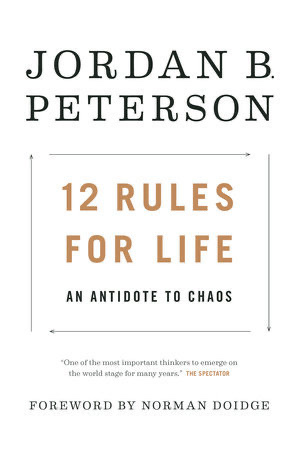
 12 Rules for Life: An Antidote to Chaos
Quotes from the Book
The purpose of life, as far as I can tell… is to find a mode of being that’s so meaningful that the fact that life is suffering is no longer relevant.
245
I dreamed I saw my maternal grandmother sitting by the bank of a swimming pool, that was also a river. In real life, she had been a victim of Alzheimer’s disease, and had regressed, before her death, to a semi-conscious state. In the dream, as well, she had lost her capacity for self-control. Her genital region was exposed, dimly; it had the appearance of a thick mat of hair. She was stroking herself, absent-mindedly. She walked over to me, with a handful of pubic hair, compacted into something resembling a large artist’s paint-brush. She pushed this at my face. I raised my arm, several times, to deflect her hand; finally, unwilling to hurt her, or interfere with her any farther, I let her have her way. She stroked my face with the brush, gently, and said, like a child, “isn’t it soft?” I looked at her ruined face and said, “yes, Grandma, it’s soft.
207
Of course, my socialist colleagues and I weren’t out to hurt anyone – quite the reverse. We were out to improve things – but we were going to start with other people. I came to see the temptation in this logic, the obvious flaw, the danger – but could also see that it did not exclusively characterize socialism. Anyone who was out to change the world by changing others was to be regarded with suspicion. The temptations of such a position were too great to be resisted.
86
The secret to your existence is right in front of you. It manifests itself as all those things you know you should do, but are avoiding.
69
We believe that in reducing the scope and importance of our errors, we are properly humble; in truth, we are merely unwilling to bear the weight of our true responsibility.
53
Rejection of the unknown is tantamount to “identification with the devil,” the mythological counterpart and eternal adversary of the world-creating exploratory hero. Such rejection and identification is a consequence of Luciferian pride, which states: all that I know is all that is necessary to know. This pride is totalitarian assumption of omniscience – is adoption of “God’s place” by “reason” – is something that inevitably generates a state of personal and social being indistinguishable from hell. This hell develops because creative exploration – impossible, without (humble) acknowledgment of the unknown – constitutes the process that constructs and maintains the protective adaptive structure that gives life much of its acceptable meaning
52
Our behavioral patterns are exceedingly complex, and psychology is a young science. The scope of our behavioral wisdom exceeds the breadth of our explicit interpretation. We act, even instruct, and yet do not understand. How can we do what we cannot explain?
26
The Great Mother aborts children, and is the dead fetus; breeds pestilence, and is the plague; she makes of the skull something gruesomely compelling, and is all skulls herself. To unveil her is to risk madness, to gaze over the abyss, to lose the way, to remember the repressed trauma. She is the molestor of children, the golem, the bogey-man, the monster in the swamp, the rotting cadaverous zombie who threatens the living. She is progenitor of the devil, the “strange son of chaos.” She is the serpent, and Eve, the temptress; she is the femme fatale, the insect in the ointment, the hidden cancer, the chronic sickness, the plague of locusts, the cause of drought, the poisoned water. She uses erotic pleasure as bait to keep the world alive and breeding; she is a gothic monster, who feeds on the blood of the living.
23
Life without law remains chaotic, effectively intolerable. Life that is pure law becomes sterile, equally unbearable. The domination of chaos or sterility equally breeds murderous resentment and hatred.
14
Something we cannot see protects us from something we do not understand. The thing we cannot see is culture, in its intrapsychic or internal manifestation. The thing we do not understand is the chaos that gave rise to culture. If the structure of culture is disrupted, unwittingly, chaos returns. We will do anything — anything — to defend ourselves against that return.
12
Anomalies manifest themselves on the border between chaos and order, so to speak, and have a threatening and promising aspect. The promising aspect dominates, when the contact is voluntary, when the exploring agent is up-to-date – when the individual has explored all previous anomalies, released the “information” they contained, and built a strong personality and steady “world” from that information. The threatening aspect dominates, when the contact is involuntary, when the exploring agent is not up-to-date – when the individual has run away from evidence of his previous errors, failed to extract the information “lurking behind” his mistakes, weakened his personality, and destabilised his “world.” The phenomenon of interest – that precursor to exploratory behaviour – signals the presence of a potentially “beneficial” anomaly. Interest manifests itself where an assimilable but novel phenomenon exists: where something new “hides,” in a partially comprehensible form. Devout adherence to the dictates of interest – assuming a suitably disciplined character – therefore insures stabilisation and renewal of personality and world. Interest is a spirit beckoning from the unknown – a spirit calling from outside the “walls” of society. Pursuit of individual interest means hearkening to this spirit’s call – means journeying outside the protective walls of childhood dependence and adolescent group identification; means also return to and rejuvenation of society. This means that pursuit of individual interest – development of true individuality – is equivalent to identification with the hero. Such identification renders the world bearable, despite its tragedies – and reduces unnecessary suffering, which most effectively destroys, to an absolute minimum. This is the message that everyone wants to hear. Risk your security. Face the unknown. Quit lying to yourself, and do what your heart truly tells you to do. You will be better for it, and so will the world.
11
Behavior is imitated, then abstracted into play, formalized into drama and story, crystallized into myth and codified into religion—and only then criticized in philosophy, and provided, post-hoc, with rational underpinnings
10
Anyway, the fervent hope of every undisciplined person (even an undisciplined genius) is that his current worthlessness and stupidity is someone else's fault. If—in the best of cases—it is society's fault, then society can be made to pay. This sleight-of-hand maneuver transforms the undisciplined into the admirable rebel, at least in his own eyes, and allows him to seek unjustified revenge in the disguise of the revolutionary hero. A more absurd parody of heroic behavior can hardly be imagined.
8
Every explorer is therefore, by necessity, a revolutionary, and every successful revolutionary is a peacemaker.
8
Alternatively, perfection might be regarded as the absence of all unnecessary things, and the pleasures of an ascetic life.
4
The Sumerians considered themselves destined to “clothe and feed” such gods, because they viewed themselves as the servants, in a sense, of what we would call instinctive forces, “elicited” by the “environment.” Such forces can be reasonably regarded as the Sumerians regarded them—as deities inhabiting a “supracelestial place,” extant prior to the dawn of humanity. Erotic attraction, for example—a powerful god—has a developmental history that predates the emergence of humanity, is associated with relatively “innate” releasing “stimuli” (those that characterize erotic beauty), is of terrible power, and has an existence “transcending” that of any individual who is currently “possessed.” Pan, the Greek god of nature, produced/represented fear (produced “panic”); Ares or the Roman Mars, warlike fury and aggression. We no longer personify such “instincts,” except for the purposes of literary embellishment, so we don't think of them “existing” in a “place” (like heaven, for example). But the idea that such instincts inhabit a space—and that wars occur in that space—is a metaphor of exceeding power and explanatory utility. Transpersonal motive forces do wage war with one another over vast spans of time; are each forced to come to terms with their powerful “opponents” in the intrapsychic hierarchy. The battles between the different “ways of life” (or different philosophies) that eternally characterize human societies can usefully be visualized as combat undertaken by different standards of value (and, therefore, by different hierarchies of motivation). The “forces” involved in such wars do not die, as they are “immortal”: the human beings acting as “pawns of the gods” during such times are not so fortunate.
4
The phenomenon of the "creative ilness", described in detail by Henri Ellenberger, in his massive study of the history of the unconsious, is alive and well in our own culture. Ellenberger described its characteristic elements: A creative illness succeeds a period of intense preoccupation with an idea and search for a certain truth. It is a polymorphous condition that can take the shape of depression, neurosis, psychomatic ailments, or even psychosis. Whatever the symptoms, they are felt as painful, if not agonizing by the subject, with alternating periods of allevation and worsening. Throughout the illness the subject never loses the thread of his dominating preoccupation. It is often compatible with normal, professional activity and family life. But even if he keeps to his social activities, he is almost entirely absorbed with himself. He suffers from feelings of utter isolation, even when he has a mentor who guides him through the ordeal (like the shaman apprentice with his master). The termination is often rapid and marked by a phase of exhilaration. The subject emerges from his ordeal with a permanent transformation in his personality and the conviction that he has discovered a great truth or a new spiritual world.
3
The world can be validly construed as a forum for action, as well as a place of things. We describe the world as a place of things, using the formal methods of science. The techniques of narrative, however – myth, literature, and drama – portray the world as a forum for action. The two forms of representation have been unnecessarily set at odds, because we have not yet formed a clear picture of their respective domains. The domain of the former is the 'objective world' – what is, from the perspective of intersubjective perception. The domain of the latter is 'the world of value' – what is and what should be, from the perspective of emotion and action. The world as forum for action is 'composed,' essentially, of three constituent elements, which tend to manifest themselves in typical patterns of metaphoric representation. First is unexplored territory – the Great Mother, nature, creative and destructive, source and final resting place of all determinate things. Second is explored territory – the Great Father, culture, protective and tyrannical, cumulative ancestral wisdom. Third is the process that mediates between unexplored and explored territory – the Divine Son, the archetypal individual, creative exploratory 'Word' and vengeful adversary. We are adapted to this 'world of divine characters,' much as the 'objective world.' The fact of this adaptation implies that the environment is in 'reality' a forum for action, as well as a place of things. Unprotected exposure to unexplored territory produces fear. The individual is protected from such fear as a consequence of 'ritual imitation of the Great Father' – as a consequence of the adoption of group identity, which restricts the meaning of things, and confers predictability on social interactions. When identification with the group is made absolute, however – when everything has to be controlled, when the unknown is no longer allowed to exist – the creative exploratory process that updates the group can no longer manifest itself. This 'restriction of adaptive capacity' dramatically increases the probability of social aggression and chaos. Rejection of the unknown is tantamount to 'identification with the devil,' the mythological counterpart and eternal adversary of the world-creating exploratory hero. Such rejection and identification is a consequence of Luciferian pride, which states: all that I know is all that is necessary to know. This pride is totalitarian assumption of omniscience – is adoption of 'God’s place' by 'reason' – is something that inevitably generates a state of personal and social being indistinguishable from hell. This hell develops because creative exploration – impossible, without (humble) acknowledgment of the unknown – constitutes the process that constructs and maintains the protective adaptive structure that gives life much of its acceptable meaning. 'Identification with the devil' amplifies the dangers inherent in group identification, which tends of its own accord towards pathological stultification. Loyalty to personal interest – subjective meaning – can serve as an antidote to the overwhelming temptation constantly posed by the possibility of denying anomaly. Personal interest – subjective meaning – reveals itself at the juncture of explored and unexplored territory, and is indicative of participation in the process that ensures continued healthy individual and societal adaptation. Loyalty to personal interest is equivalent to identification with the archetypal hero – the 'savior' – who upholds his association with the creative 'Word' in the face of death, and in spite of group pressure to conform. Identification with the hero serves to decrease the unbearable motivational valence of the unknown; furthermore, provides the individual with a standpoint that simultaneously transcends and maintains the group.
3
The modern mind, which regards itself as having transcended the domain of the magical, is nonetheless still endlessly capable of “irrational” (read motivated) reactions. We fall under the spell of experience whenever we attribute our frustration, aggression, devotion or lust to the person or situation that exists as the proximal “cause” of such agitation. We are not yet “objective,” even in our most clear-headed moments (and thank God for that).
3
In the most basic of situations-- when we know what we are doing, when we are engaged with the familiar-- these fundamental tendencies suffice. Our actual situations, however, are almost always more complex. If things or situations were straightforwardly or simply positive or negative, good or bad, we would not have to make judgements regarding them, would not have to think about our behavior, and how and when it should be modified-- indeed, would not have to think at all. We are faced, however, with the constant problem of ambivalence in meaning, which is to say that a thing or situation might be bad and good simultaneously (or good in two conflicting manners; or bad, in two conflicting manners).
3
Anything that interferes with such attainment (little old ladies with canes) will be experienced as threatening and/or punishing; anything that signifies increased likelihood of success (open stretches of sidewalk) will be experienced as promising or satisfying. It is for this reason that the Buddhists believe that everything is Maya, or illusion: the motivational significance of ongoing events is clearly determined by the nature of the goal toward which behavior is devoted
3
We don't like inconveniences [...] Ignored inconveniences accumulate, rather than disappear. When they accumulate in sufficient numbers, they produce a catastrophe—a self-induced catastrophe, to be sure, but one that may be indistinguishable from an “act of God.” Inconveniences interfere with the integrity of our plans—so we tend to pretend that they are not there. Catastrophes, by contrast, interfere with the integrity of our whole stories, and massively dysregulate our emotions. By their nature, they are harder to ignore—although that does not stop us from trying to do so. Inconveniences are common; unfortunately, so are catastrophes—self-induced and otherwise. We are adapted to catastrophes, like inconveniences, as constant environmental features. We can resolve catastrophe, just as we can cope with inconvenience—although at higher cost. As a consequence of this adaptation, this capacity for resolution, catastrophe can rejuvenate. It can also destroy. The more ignored inconveniences in a given catastrophe, the more likely it will destroy.”.
3
The “natural” human tendency to respond to the stranger, the strange idea and the creative individual with fear and aggression can be more easily comprehended, once it is understood that these diverse phenomena share categorical identity with the “natural disaster.
3
The Great Mother impels—pushes (with certainty of mortality) and pulls (with possibility of redemption)—development of consciousness and of self-consciousness.
3
What is known and what is unknown is always relative because what is unexpected depends entirely upon what we expect (desire)-- on what we had previously planned and presumed. The unexpected constantly occurs because it is impossible, in the absence of omniscience, to formulate an entirely accurate model of what actually is happening or of what should happen.
2
...At the same time, something odd was happening to my ability to converse. I had always enjoyed engaging in arguments, regardless of topic. I regarded them as a sort of game (not that this is in any way unique). Suddenly, however, I couldn't talk—more accurately, I couldn't stand listening to myself talk . I started to hear a “voice” inside my head, commenting on my opinions. Every time I said something, it said something— something critical. The voice employed a standard refrain, delivered in a somewhat bored and matter-of-fact tone: You don't believe that. That isn't true. You don't believe that. That isn't true. The “voice” applied such comments to almost every phrase I spoke. I couldn't understand what to make of this. I knew the source of the commentary was part of me, but this knowledge only increased my confusion. Which part, precisely, was me— the talking part or the criticizing part ? If it was the talking part, then what was the criticizing part? If it was the criticizing part—well, then: how could virtually everything I said be untrue? In my ignorance and confusion, I decided to experiment. I tried only to say things that my internal reviewer would pass unchallenged. This meant that I really had to listen to what I was saying, that I spoke much less often, and that I would frequently stop, midway through a sentence, feel embarrassed, and reformulate my thoughts. I soon noticed that I felt much less agitated and more confident when I only said things that the “voice” did not object to. This came as a definite relief. My experiment had been a success; I was the criticizing part. Nonetheless, it took me a long time to reconcile myself to the idea that almost all my thoughts weren't real, weren't true—or, at least, weren't mine. All the things I “believed” were things I thought sounded good, admirable, respectable, courageous. They weren't my things, however—I had stolen them. Most of them I had taken from books. Having “understood” them, abstractly, I presumed I had a right to them—presumed that I could adopt them, as if they were mine: presumed that they were me . My head was stuffed full of the ideas of others; stuffed full of arguments I could not logically refute. I did not know then that an irrefutable argument is not necessarily true, nor that the right to identify with certain ideas had to be earned.
1
Escogemos un camino u otro en cada punto de decisión de nuestra vida, y acabamos siendo la suma total de nuestras decisiones. Al rechazar nuestros errores, ganamos una seguridad a corto plazo, pero renunciamos a nuestra identidad con el proceso que nos permite transcender nuestras debilidades y tolerar nuestras vidas dolorosas y limitadas.
1
Watch on YouTube
About Jordan B. Peterson
We have collected 80 quotes from 3 books by Jordan B. Peterson on BookQuoters.
More about the author →More by Jordan B. Peterson
12 Rules for Life: An Antidote to Chaos
 We Who Wrestle with God: Perceptions of the Divine
About the book
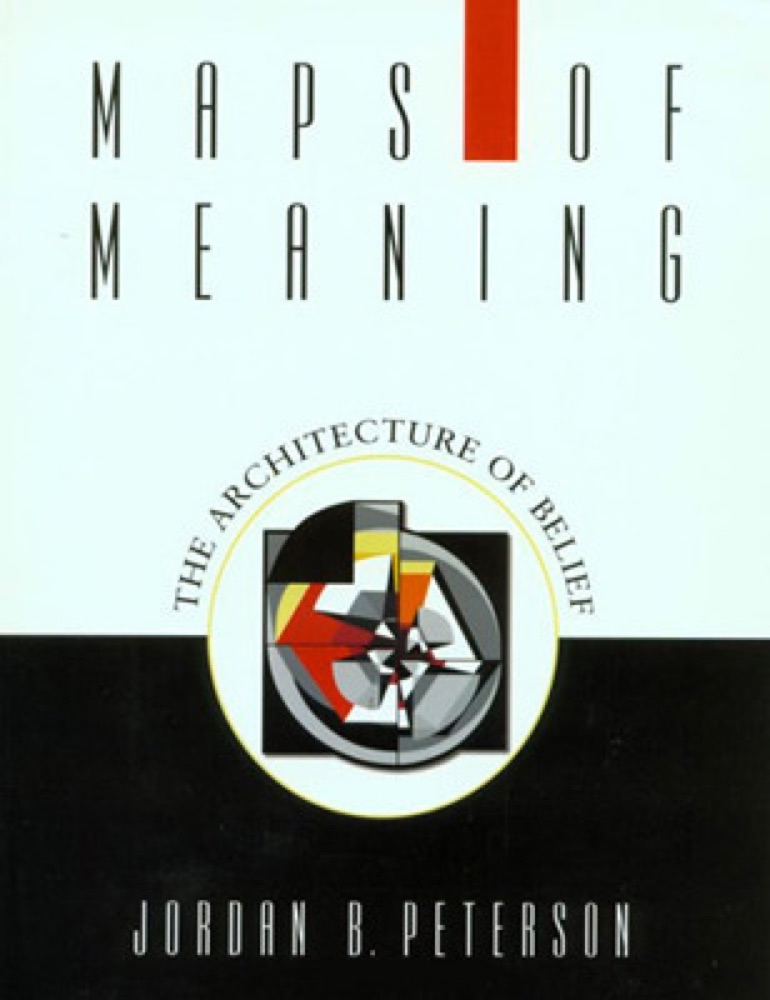
Why have people from different cultures and eras formulated myths and stories with similar structures? What does this similarity tell us about the mind, morality, and structure of the world itself? Jordan Peterson offers a provocative new hypothesis that explores the connection between what modern neuropsychology tells us about the brain and what rituals, myths, and religious stories have long narrated. A cutting-edge work that brings together neuropsychology, cognitive science, and Freudian and Jungian approaches to mythology and narrative, Maps of Meaning presents a rich theory that makes the wisdom and meaning of myth accessible to the critical modern mind.
Book details
- First published
- 1999
- Author
- Jordan B. Peterson
- Genre
- Nonfiction
- Goodreads rating
- 4.03 (7k ratings)
Keep reading
 Myths to Live By
 The Varieties of Religious Experience
 The Perennial Philosophy
 The Occult
 Man and His Symbols
 Daybreak: Thoughts on the Prejudices of Morality
 The Wisdom of Insecurity: A Message for an Age of Anxiety
 Finding Meaning in the Second Half of Life: How to Finally, Really Grow Up
 Think: A Compelling Introduction to Philosophy
 A Language Older Than Words
 The Doors of Perception & Heaven and Hell
 The Master and His Emissary: The Divided Brain and the Making of the Western World
 The Big Picture: On the Origins of Life, Meaning, and the Universe Itself
 The Book: On the Taboo Against Knowing Who You Are
 The Soul's Code: In Search of Character and Calling
 Stories of Your Life and Others
 Genesis
 The Consolations of Philosophy
 Twilight of the Idols/The Anti-Christ
12 Rules for Life: An Antidote to Chaos
Twilight of the Idols/The Anti-Christ
12 Rules for Life: An Antidote to Chaos
 Toward a Psychology of Being
 The Myth of Sisyphus
 Figuring
 The Will to Power
 Food of the Gods: The Search for the Original Tree of Knowledge
 Drive Your Plow Over the Bones of the Dead
 The Power of Myth
 Living with a Wild God: A Nonbeliever's Search for the Truth about Everything
 Ego and Archetype: Individuation and the Religious Function of the Psyche
 The World's Religions
 The Philosopher and the Wolf
 The Mind of the Maker: Dorothy L. Sayers' Witty Classic on the Trinity, Christianity, and Human Creativity
 The Politics of Experience/The Bird of Paradise
 The Convoluted Universe, Book 1
 Freedom from the Known
 The Social Animal: The Hidden Sources of Love, Character, and Achievement
 Why People Believe Weird Things: Pseudoscience, Superstition, and Other Confusions of Our Time
 The Origin of Consciousness in the Breakdown of the Bicameral Mind
 Love and Will
 Psych: The Story of the Human Mind
 The Blank Slate: The Modern Denial of Human Nature
 Breaking the Spell: Religion as a Natural Phenomenon
 Love's Executioner and Other Tales of Psychotherapy
 The Wise Heart: A Guide to the Universal Teachings of Buddhist Psychology
 The Hero's Journey: Joseph Campbell on His Life & Work
 The Conspiracy Against the Human Race
 Modern Man in Search of a Soul
 Beyond the Pleasure Principle
 The Age of Absurdity: Why Modern Life makes it Hard to be Happy
 The Glass Bead Game
 The Doors of Perception
 The God Who Weeps: How Mormonism Makes Sense of Life
 The Fifth Science
 The Fourth Way
 The Sane Society
 The Art of Being
 The World as Will and Representation, Vol 1
 The Courage to Create