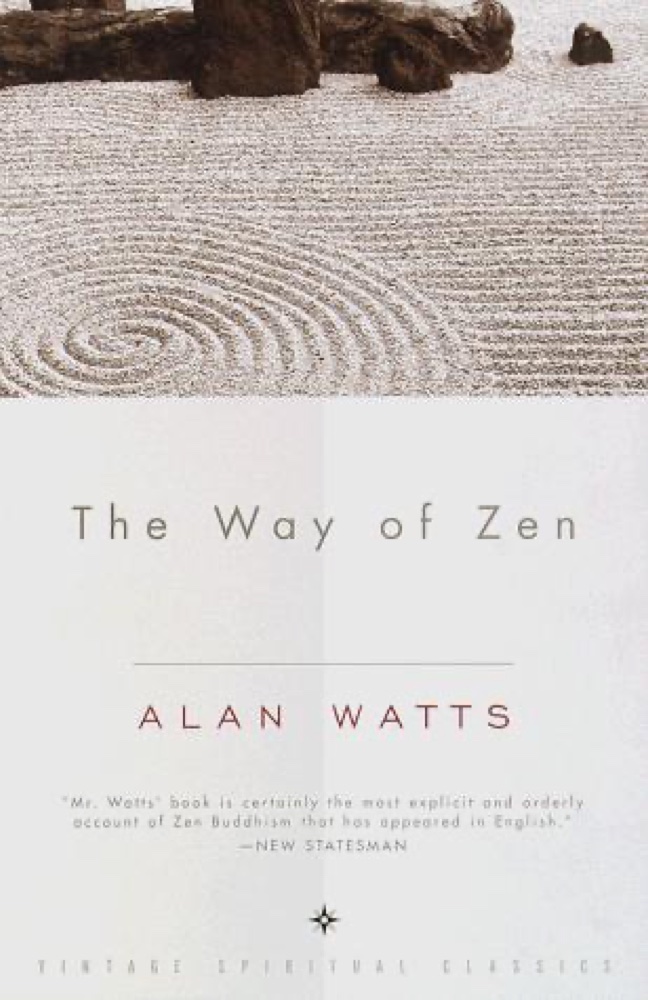
 The Way of Zen
Quotes from the Book
Problems that remain persistently insoluble should always be suspected as questions asked in the wrong way.
469
How is it possible that a being with such sensitive jewels as the eyes, such enchanted musical instruments as the ears, and such fabulous arabesque of nerves as the brain can experience itself anything less than a god.
207
Other people teach us who we are. Their attitudes to us are the mirror in which we learn to see ourselves, but the mirror is distorted. We are, perhaps, rather dimly aware of the immense power of our social enviornment.
203
We seldom realize, for example, that our most private thoughts and emotions are not actually our own. For we think in terms of languages and images which we did not invent, but which were given to us by our society. We copy emotional reactions from our parents, learning from them thatexcrement is supposed to have a disgusting smell and that vomiting is supposed to be an unpleasant sensation. The dread of death is also learned from their anxieties about sickness and from their attitudes to funerals and corpses. Our social environment has this power just because we do not exist apart from a society. Society is our extended mind and body. Yet the very society from which the individual is inseparable is using its whole irresistible force to persuade the individual that he is indeed separate! Society as we now know it is therefore playing a game with self-contradictory rules.
192
Irrevocable commitment to any religion is not only intellectual suicide; it is positive unfaith because it closes the mind to any new vision of the world. Faith is, above all, openness - an act of trust in the unknown.
174
Real travel requires a maximum of unscheduled wandering, for there is no other way of discovering surprises and marvels, which, as I see it, is the only good reason for not staying at home.
152
We do not "come into" this world; we come out of it, as leaves from a tree.
106
Just as true humor is laughter at oneself, true humanity is knowledge of oneself.
104
Peace can be made only by those who are peaceful, and love can be shown only by those who love. No work of love will flourish out of guilt, fear, or hollowness of heart, just as no valid plans for the future can be made by those who have no capacity for living now.
89
For if you know what you want, and will be content with it, you can be trusted. But if you do not know, your desires are limitless and no one can tell how to deal with you. Nothing satisfies an individual incapable of enjoyment.
83
This state of affairs is known technically as the "double-bind." A person is put in a double-bind by a command or request which contains a concealed contradiction... This is a damned-if-you-do and damned-if-you-don't situation which arises constantly in human (and especially family) relations... The social doublebind game can be phrased in several ways:The first rule of this game is that it is not a game. Everyone must play. You must love us. You must go on living. Be yourself, but play a consistent and acceptable role. Control yourself and be natural. Try to be sincere. Essentially, this game is a demand for spontaneous behavior of certain kinds. Living, loving, being natural or sincere—all these are spontaneous forms of behavior: they happen "of themselves" like digesting food or growing hair. As soon as they are forced they acquire that unnatural, contrived, and phony atmosphere which everyone deplores—weak and scentless like forced flowers and tasteless like forced fruit. Life and love generate effort, but effort will not generate them. Faith—in life, in other people, and in oneself—is the attitude of allowing the spontaneous to be spontaneous, in its own way and in its own time.
74
You have seen that the universe is at root a magical illusion and a fabulous game, and that there is no separate "you" to get something out of it, as if life were a bank to be robbed. The only real "you" is the one that comes and goes, manifests and withdraws itself eternally in and as every conscious being. For "you" is the universe looking at itself from billions of points of view, points that come and go so that the vision is forever new.
69
Suppressing the fear of death makes it all the stronger. The point is only to know, beyond any shadow of doubt, that "I" and all other "things" now present will vanish, until this knowledge compels you to release them - to know it now as surely as if you had just fallen off the rim of the Grand Canyon. Indeed you were kicked off the edge of a precipice when you were born, and it's no help to cling to the rocks falling with you. If you are afraid of death, be afraid. The point is to get with it, to let it take over - fear, ghosts, pains, transience, dissolution, and all. And then comes the hitherto unbelievable surprise; you don't die because you were never born. You had just forgotten who you are.
49
As it is, we are merely bolting our lives—gulping down undigested experiences as fast as we can stuff them in—because awareness of our own existence is so superficial and so narrow that nothing seems to us more boring than simple being. If I ask you what you did, saw, heard, smelled, touched and tasted yesterday, I am likely to get nothing more than the thin, sketchy outline of the few things that you noticed, and of those only what you thought worth remembering. Is it surprising that an existence so experienced seems so empty and bare that its hunger for an infinite future is insatiable? But suppose you could answer, “It would take me forever to tell you, and I am much too interested in what’s happening now.” How is it possible that a being with such sensitive jewels as the eyes, such enchanted musical instruments as the ears, and such a fabulous arabesque of nerves as the brain can experience itself as anything less than a god? And, when you consider that this incalculably subtle organism is inseparable from the still more marvelous patterns of its environment—from the minutest electrical designs to the whole company of the galaxies—how is it conceivable that this incarnation of all eternity can be bored with being?
42
For every individual is a unique manifestation of the Whole, as every branch is a particular outreaching of the tree. To manifest individuality, every branch must have a sensitive connection with the tree, just as our independently moving and differentiated fingers must have a sensitive connection with the whole body. The point, which can hardly be repeated too often, is that differentiation is not separation.
35
Genuine love comes from knowledge, not from a sense of duty or guilt.
30
What we see as death, empty space, or nothingness is only the trough between the crests of this endlessly waving ocean. It is all part of the illusion that there should seem to be something to be gained in the future, and that there is an urgent necessity to go on and on until we get it. Yet just as there is no time but the present, and no one except the all-and-everything, there is never anything to be gained—though the zest of the game is to pretend that there is.
30
God likes to play hide-and-seek, but because there is nothing outside of God, he has no one but himself to play with! But he gets over this difficulty by pretending that he is not himself. This is his way of hiding from himself. He pretends that he is you and I and all the people in the world, all the animals, plants, all the rocks, and all the stars. In this way he has strange and wonderful adventures, some of which are terrible and frightening. But these are just like bad dreams, for when he wakes up they will disappear. Now when God plays "hide" and pretends that he is you and I, he does it so well that it takes him a long time to remember where and how he hid himself! But that's the whole fun of it-just what he wanted to do. He doesn't want to find himself too quickly, for that would spoil the game. That is why it is so difficult for you and me to find out that we are God in disguise, pretending not to be himself. But- when the game has gone on long enough, all of us will WAKE UP, stop pretending, and REMEMBER that we are all one single Self- the God who is all that there is and who lives forever and ever. You may ask why God sometimes hides in the form of horrible people, or pretends to be people who suffer great disease and pain. Remember, first, that he isn't really doing this to anyone but himself. Remember too, that in almost all the stories you enjoy there have to be bad people as well as good people, for the thrill of the tale is to find out how the good people will get the better of the bad. It's the same as when we play cards. At the beginning of the game we shuffle them all into a mess, which is like the bad things in the world, but the point of the game put the mess into good order, and the one who does it best is the winner. Then we shuffle the cards and play again, and so it goes with the world.
29
For unless one is able to live fully in the present, the future is a hoax. There is no point whatever in making plans for a future which you will never be able to enjoy. When your plans mature, you will still be living for some other future beyond. You will never, never be able to sit back with full contentment and say, “Now, I’ve arrived!” Your entire education has deprived you of this capacity because it was preparing you for the future, instead of showing you how to be alive now.
29
Society is our extended mind and body.
28
Yet again, the more you strive for some kind of perfection or mastery—in morals, in art or in spirituality—the more you see that you are playing a rarified and lofty form of the old ego-game, and that your attainment of any height is apparent to yourself and to others only by contrast with someone else's depth or failure.
28
Nothing fails like success—because the self-imposed task of our society and all its members is a contradiction: to force things to happen which are acceptable only when they happen without force.
28
We suffer from a hallucination, from a false and distorted sensation of our own existence as living organisms. Most of us have the sensation that "I myself" is a separate center of feeling and action, living inside and bounded by the physical body—a center which "confronts" an "external" world of people and things, making contact through the senses with a universe both alien and strange. Everyday figures of speech reflect this illusion. "I came into this world." "You must face reality." "The conquest of nature." This feeling of being lonely and very temporary visitors in the universe is in flat contradiction to everything known about man (and all other living organisms) in the sciences. We do not "come into" this world; we come out of it, as leaves from a tree. As the ocean "waves," the universe "peoples." Every individual is an expression of the whole realm of nature, a unique action of the total universe. This fact is rarely, if ever, experienced by most individuals. Even those who know it to be true in theory do not sense or feel it, but continue to be aware of themselves as isolated "egos" inside bags of skin.
26
The startling truth is that our best efforts for civil rights, international peace, population control, conservation of natural resources, and assistance to the starving of the earth—urgent as they are—will destroy rather than help if made in the present spirit. For, as things stand, we have nothing to give. If our own riches and our own way of life are not enjoyed here, they will not be enjoyed anywhere else. Certainly they will supply the immediate jolt of energy and hope that methedrine, and similar drugs, give in extreme fatigue. But peace can be made only by those who are peaceful, and love can be shown only by those who love. No work of love will flourish out of guilt, fear, or hollowness of heart, just as no valid plans for the future can be made by those who have no capacity for living now.
26
We therefore work, not for the work's sake, but for money—and money is supposed to get us what we really want in our hours of leisure and play. In the United States even poor people have lots of money compared with the wretched and skinny millions of India, Africa, and China, while our middle andupper classes (or should we say "income groups") are as prosperous as princes. Yet, by and large, they have but slight taste for pleasure. Money alone cannot buy pleasure, though it can help. For enjoyment is an art and a skill for which we have little talent or energy.
21
every individual is a unique manifestation of the Whole, as every branch is a particular outreaching of the tree.
20
I am basically an eternal existence momentarily and perhaps needlessly terrified by one half of itself..
19
Man aspires to govern nature, but the more one studies ecology, the more absurd it seems to speak of any one feature of an organism, or of an organism/environment field, as governing or ruling others.
19
For eternally and always there is only now, one and the same now; the present is the only thing that has no end.
18
If the human race develops an electronic nervous system, outside the bodies of individual people, thus giving us all one mind and one global body, this is almost precisely what has happened in the organization of cells which compose our own bodies. We have already done it. [...] If all this ends with the human race leaving no more trace of itself in the universe than a system of electronic patterns, why should that trouble us? For that is exactly what we are now!
18
Watch on YouTube
About Alan W. Watts
We have collected 144 quotes from 6 books by Alan W. Watts on BookQuoters.
More about the author →More by Alan W. Watts
The Way of Zen
 The Wisdom of Insecurity: A Message for an Age of Anxiety
 Still the Mind: An Introduction to Meditation
 Tao: The Watercourse Way
About the book
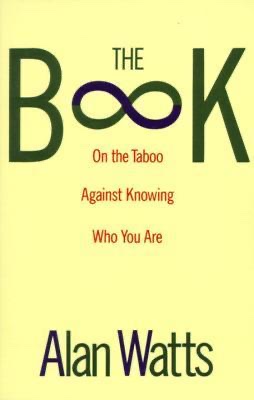
At the root of human conflict is our fundamental misunderstanding of who we are. The illusion that we are isolated beings, unconnected to the rest of the universe, has led us to view the “outside” world with hostility, and has fueled our misuse of technology and our violent and hostile subjugation of the natural world. To help us understand that the self is in fact the root and ground of the universe, Watts has crafted a revelatory primer on what it means to be human—and a mind-opening manual of initiation into the central mystery of existence.
In The Book, Alan Watts provides us with a much-needed answer to the problem of personal identity, distilling and adapting the Hindu philosophy of Vedanta.
A revelatory primer on what it means to be human, from "the perfect guide for a course correction in life" (Deepak Chopra)—and a mind-opening manual of initiation into the central myster
Book details
- First published
- 1966
- Author
- Alan W. Watts
- Genre
- Philosophy
- Goodreads rating
- 4.21 (25k ratings)
Keep reading
 Myths to Live By
The Wisdom of Insecurity: A Message for an Age of Anxiety
Myths to Live By
The Wisdom of Insecurity: A Message for an Age of Anxiety
 Buddhism Plain & Simple: The Practice of Being Aware, Right Now, Every Day
 Seth Speaks: The Eternal Validity of the Soul
 The Convoluted Universe, Book 1
 Freedom from the Known
 The Perennial Philosophy
 The Art of Being
 Total Freedom: The Essential Krishnamurti
 The Doors of Perception & Heaven and Hell
 Man and His Symbols
 Modern Man in Search of a Soul
 The Myth of Sisyphus
 The Conspiracy Against the Human Race
 Waking Up: A Guide to Spirituality Without Religion
 The Book of Secrets: Unlocking the Hidden Dimensions of Your Life
 A Joseph Campbell Companion: Reflections on the Art of Living
 The Power of Myth
The Way of Zen
The Power of Myth
The Way of Zen
 Untimely Meditations
 Finding Meaning in the Second Half of Life: How to Finally, Really Grow Up
 Immortality
 The Gay Science
 Demian
 A New Earth: Awakening to Your Life's Purpose
 The Book of Awakening: Having the Life You Want by Being Present to the Life You Have
 Daybreak: Thoughts on the Prejudices of Morality
 The Varieties of Religious Experience
 Maps of Meaning: The Architecture of Belief
 Conversations with God: An Uncommon Dialogue, Book 1
 Drive Your Plow Over the Bones of the Dead
 The Sane Society
 Finite and Infinite Games: A Vision of Life as Play and Possibility
 The Wise Heart: A Guide to the Universal Teachings of Buddhist Psychology
 In Love with the World: A Monk's Journey Through the Bardos of Living and Dying
 The World as Will and Representation, Vol 1
 The Wisdom of No Escape: How to Love Yourself and Your World
 No Death, No Fear: Comforting Wisdom for Life
 The Upanishads
 Genesis
 The Essential Writings of Ralph Waldo Emerson
 The Big Picture: On the Origins of Life, Meaning, and the Universe Itself
 365 Tao: A Study of Taoist Wisdom for Daily Life
 A Hidden Wholeness: The Journey Toward an Undivided Life : Welcoming the soul and weaving community in a wounded world
 The Art Of Living
 Existential Psychotherapy
 12 Rules for Life: An Antidote to Chaos
 When Nietzsche Wept
 Hippie
 At the Existentialist Café
 The Way to Love: The Last Meditations of Anthony de Mello
 Proof of Heaven: A Neurosurgeon's Journey into the Afterlife
 Many Lives, Many Masters: The True Story of a Prominent Psychiatrist, His Young Patient, and the Past Life Therapy That Changed Both Their Lives
 The Yoga Sutras of Patanjali
 The Doors of Perception
 How to See Yourself As You Really Are
 Cutting Through Spiritual Materialism
 The Fifth Science
 The Politics of Experience/The Bird of Paradise