 Entangled Life: How Fungi Make Our Worlds, Change Our Minds & Shape Our Futures
Quotes from the Book
I believe that mycelium is the neurological network of nature. Interlacing mosaics of mycelium infuse habitats with information-sharing membranes. These membranes are aware, react to change, and collectively have the long-term health of the host environment in mind. The mycelium stays in constant molecular communication with its environment, devising diverse enzymatic and chemical responses to complex challenges.
36
I see the mycelium as the Earth's natural Internet, a consciousness with which we might be able to communicate. Through cross-species interfacing, we may one day exchange information with these sentient cellular networks. Because these externalized neurological nets sense any impression upon them, from footsteps to falling tree branches, they could relay enormous amounts of data regarding the movements of all organisms through the landscape.
31
In Oregon, a far larger honey mushroom (Armillaria ostoyae) mycelial mat found on a mountaintop covers more than 2,400 acres and is possibly more than 2,200 years old
10
One of the Big Ideas in this book is that fungi, especially fungi from old-growth forests, may be sources of new medicines that are active against a range of germs, including HIV/AIDS and the causative agents of smallpox and anthrax, potential bioterrorist threats.
7
NASA considered the possibility of using fungi for interplanetary colonization. Now that we have landed rovers on Mars, NASA takes seriously the unknown consequences that our microbes will have on seeding other planets. Spores have no borders.
5
I wonder what would happen if there were a United Organization of Organisms (UOO, pronounced “uh-oh”), where each species gets one vote. Would we be voted off the planet? The answer is pretty clear.
5
The cascade of toxins and debris generated by humans destabilizes nutrient return cycles, causing crop failure, global warming, climate change and, in a worst-case scenario, quickening the pace towards ecocatastrophes of our own making. As ecological disrupters, humans challenge the immune systems of our environment beyond their limits. The rule of nature is that when a species exceeds the carrying capacity of its host environment, its food chains collapse and diseases emerge to devastate the population of the threatening organism. I believe we can come into balance with nature using mycelium to regulate the flow of nutrients. The age of mycological medicine is upon us. Now is the time to ensure the future of our planet and our species by partnering, or running, with mycelium.
4
Envisioning fungi as nanoconductors in mycocomputers, Gorman (2003) and his fellow researchers at Northwestern University have manipulated mycelia of Aspergillus niger to organize gold into its DNA, in effect creating mycelial conductors of electrical potentials. NASA reports that microbiologists at the University of Tennessee, led by Gary Sayler, have developed a rugged biological computer chip housing bacteria that glow upon sensing pollutants, from heavy metals to PCBs (Miller 2004). Such innovations hint at new microbiotechnologies on the near horizon. Working together, fungal networks and environmentally responsive bacteria could provide us with data about pH, detect nutrients and toxic waste, and even measure biological populations.
4
I believe that the mycelium operates at a level of complexity that exceeds the computational powers of our most advanced supercomputers. I see the myce-lium as the Earth’s natural Internet, a consciousness with which we might be able to communicate. Through cross-species interfacing, we may one day exchange information with these sentient cellular networks. Because these externalized neurological nets sense any impression upon them, from footsteps to falling tree branches, they could relay enormous amounts of data regarding the movements of all organisms through the landscape. A new bioneering science could be born, dedicated to programming myconeurological networks to monitor and respond to threats to environments. Mycelial webs could be used as information platforms for mycoengineered ecosystems.
4
Fungi marched onto land more than a billion years ago. Many fungi partnered with plants, which largely lacked these digestive juices. Mycologists believe that this alliance allowed plants to inhabit land around 700 million years ago. Many millions of years later, one evolutionary branch of fungi led to the development of animals
4
The branch of fungi leading to animals evolved to capture nutrients by surrounding their food with cellular sacs, essentially primitive stomachs. As species emerged from aquatic habitats, organisms adapted means to prevent moisture loss. In terrestrial creatures, skin composed of many layers of cells emerged as a barrier against infection. Taking a different evolutionary path, the mycelium retained its netlike form of interweaving chains of cells and went underground, forming a vast food web upon which life flourished.
3
If you were a tiny organism in a forest’s soil, you would be enmeshed in a carnival of activity, with mycelium constantly moving through subterranean landscapes like cellular waves, through dancing bacteria and swimming protozoa with nematodes racing like whales through a microcosmic sea of life.
2
Frank went on to tell me that much of the premise of Dune—the magic spice (spores) that allowed the bending of space (tripping), the giant worms (maggots digesting mushrooms), the eyes of the Freman (the cerulean blue of Psilocybe mushrooms), the mysticism of the female spiritual warriors, the Bene Gesserits (influenced by tales of Maria Sabina and the sacred mushroom cults of Mexico)—came from his perception of the fungal life cycle, and his imagination was stimulated through his experiences with the use of magic mushrooms.
2
Toxic fungicides like methyl bromide, once touted, not only harm targeted species but also nontargeted organisms and their food chains and threaten the ozone layer.
2
There are more species of fungi, bacteria, and protozoa in a single scoop of soil than there are species of plants and vertebrate animals in all of North America. And of these, fungi are the grand recyclers of our planet, the mycomagicians disassembling large organic molecules into simpler forms, which in turn nourish other members of the ecological community. Fungi are the interface organisms between life and death.
2
We face the possibility of being rejected by the biosphere as a virulent organism. But
1
Biological systems are influenced by the laws of physics, and it may be that mycelium exploits the natural momentum of matter, just like salmon take advantage of the tides.
NASA reports that microbiologists at the University of Tennessee, led by Gary Sayler, have developed a rugged biological computer chip housing bacteria that glow upon sensing pollutants, from heavy metals to PCBs (Miller 2004). Such innovations hint at new microbiotechnologies on the near horizon. Working together, fungal networks and environmentally responsive bacteria could provide us with data about pH, detect nutrients and toxic waste, and even measure biological populations.
Mycelium steers the course of ecosystems by favoring successions of species. Ultimately, mycelium prepares its immediate environment for its benefit by growing ecosystems that fuel its food chains.
Watch on YouTube
About Paul Stamets
We have collected 19 quotes from 1 book by Paul Stamets on BookQuoters.
More about the author →About the book
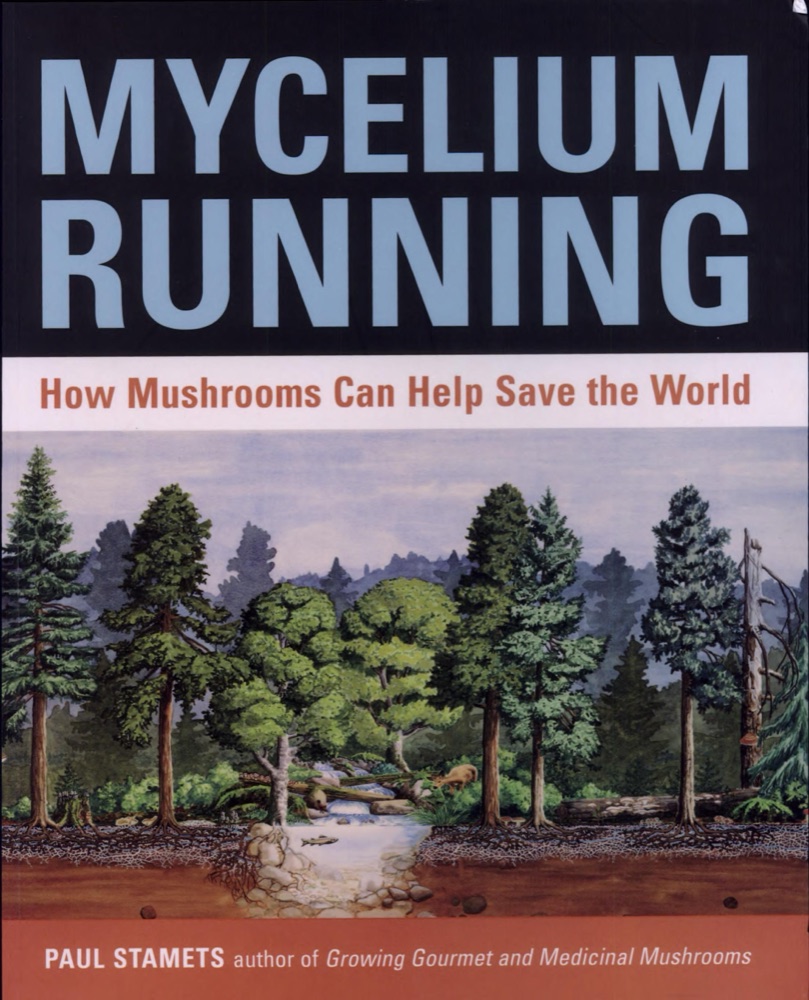
Mycelium Running is a manual for the mycological rescue of the planet. That’s right: growing more mushrooms may be the best thing we can do to save the environment, and in this groundbreaking text from mushroom expert Paul Stamets, you’ll find out how. The basic science goes like this: Microscopic cells called “mycelium”--the fruit of which are mushrooms--recycle carbon, nitrogen, and other essential elements as they break down plant and animal debris in the creation of rich new soil. What Stamets has discovered is that we can capitalize on mycelium’s digestive power and target it to decompose toxic wastes and pollutants (mycoremediation), catch and reduce silt from streambeds and pathogens from agricultural watersheds (mycofiltration), control insect populations (mycopesticides), and generally enhance the health of our forests and gardens (mycoforestry and myco-gardening). In this comp
Book details
- First published
- 2005
- Author
- Paul Stamets
- Genre
- Nonfiction
- Goodreads rating
- 4.40 (3k ratings)
Keep reading
Entangled Life: How Fungi Make Our Worlds, Change Our Minds & Shape Our Futures
 The Light Eaters: How the Unseen World of Plant Intelligence Offers a New Understanding of Life on Earth
 Regenesis: Feeding the World Without Devouring the Planet
 The Hidden Life of Trees: What They Feel, How They Communicate: Discoveries from a Secret World
 The Forest Unseen: A Year’s Watch in Nature
 The Earth Moved: On the Remarkable Achievements of Earthworms
 The Future of Humanity: Terraforming Mars, Interstellar Travel, Immortality and Our Destiny Beyond Earth
 A Life on Our Planet: My Witness Statement and a Vision for the Future
 The Lives of a Cell: Notes of a Biology Watcher
 The Mushroom at the End of the World: On the Possibility of Life in Capitalist Ruins
 Power, Sex, Suicide: Mitochondria and the Meaning of Life
 Underland: A Deep Time Journey
 The Song of the Cell: An Exploration of Medicine and the New Human
 Gathering Moss: A Natural and Cultural History of Mosses
 Your Inner Fish: A Journey Into the 3.5-Billion-Year History of the Human Body
 Under a White Sky: The Nature of the Future
 What a Plant Knows: A Field Guide to the Senses
 The Ancestor's Tale: A Pilgrimage to the Dawn of Evolution
 The World Without Us
 Other Minds
 Soonish: Ten Emerging Technologies That'll Improve and/or Ruin Everything
 The Secret Life of Plants: A Fascinating Account of the Physical, Emotional and Spiritual Relations Between Plants and Man
 The Sixth Extinction: An Unnatural History
 The Botany of Desire: A Plant's-Eye View of the World
 Vanishing Treasures: A Bestiary of Extraordinary Endangered Creatures
 Wilding
 The Secret Wisdom of Nature: Trees, Animals, and the Extraordinary Balance of All Living Things ― Stories from Science and Observation
 The Code Breaker: Jennifer Doudna, Gene Editing, and the Future of the Human Race
 Space Chronicles: Facing the Ultimate Frontier
 The Vegetarian Myth: Food, Justice, and Sustainability
 The Overstory
 Shadows of Forgotten Ancestors
 A Short History of Nearly Everything
 The Biology of Belief: Unleashing the Power of Consciousness, Matter and Miracles
 The Third Plate: Field Notes on the Future of Food
 Clean: The New Science of Skin
 Gut: The Inside Story of Our Body's Most Underrated Organ
 Feral: Rewilding the Land, the Sea and Human Life
 The Blind Watchmaker: Why the Evidence of Evolution Reveals a Universe Without Design
 Ways of Being: Animals, Plants, Machines: The Search for a Planetary Intelligence
 Bringing it to the Table: On Farming and Food
 Falter: Has the Human Game Begun to Play Itself Out?
 Spillover: Animal Infections and the Next Human Pandemic
 Life 3.0: Being Human in the Age of Artificial Intelligence
 The Last Days of the Dinosaurs: An Asteroid, Extinction, and the Beginning of Our World
 Darwin's Black Box: The Biochemical Challenge to Evolution
 The Origin of Species
 The Ends of the World
 The Wizard and the Prophet: Two Remarkable Scientists and Their Dueling Visions to Shape Tomorrow's World
 Silent Spring
 The One-Straw Revolution
 The Omnivore's Dilemma: A Natural History of Four Meals
 What Technology Wants
 The Nature Fix: Why Nature Makes Us Happier, Healthier, and More Creative
 Semiosis
 Undeniable: Evolution and the Science of Creation
 The Violinist's Thumb: And Other Lost Tales of Love, War, and Genius, as Written by Our Genetic Code
 Parasite Rex: Inside the Bizarre World of Nature's Most Dangerous Creatures
 The Soul of an Octopus: A Surprising Exploration into the Wonder of Consciousness