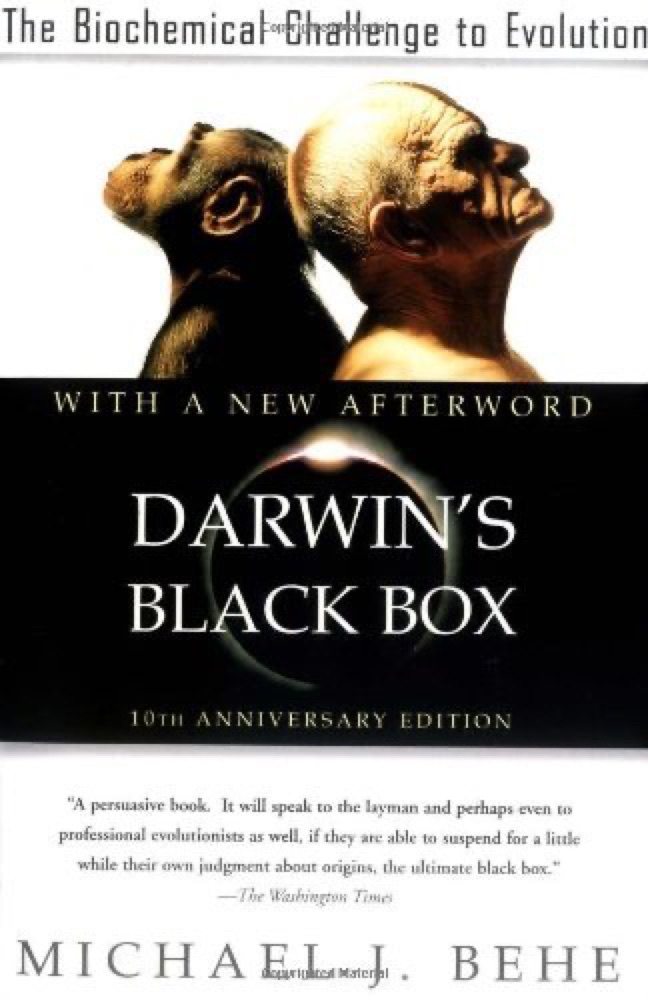

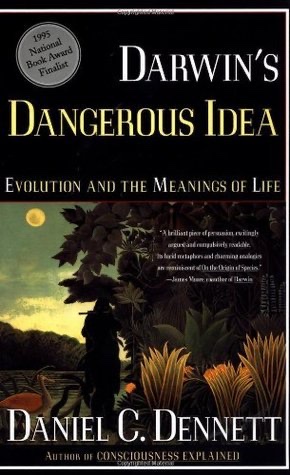
 Darwin's Dangerous Idea: Evolution and the Meanings of Life
Quotes from the Book
In the abstract, it might be tempting to imagine that irreducible complexity simply requires multiple simultaneous mutations - that evolution might be far chancier than we thought, but still possible. Such an appeal to brute luck can never be refuted... Luck is metaphysical speculation; scientific explanations invoke causes.
48
The conclusion of intelligent design flows naturally from the data itself—not from sacred books or sectarian beliefs. Inferring that biochemical systems were designed by an intelligent agent is a humdrum process that requires no new principles of logic or science. It comes simply from the hard work that biochemistry has done over the past forty years, combined with consideration of the way in which we reach conclusions of design every day.
32
The result of these cumulative efforts to investigate the cell—to investigate life at the molecular level—is a loud, clear, piercing cry of “design!” The result is so unambiguous and so significant that it must be ranked as one of the greatest achievements in the history of science. The discovery rivals those of Newton and Einstein, Lavoisier and Schrödinger, Pasteur, and Darwin.
12
A few years ago I read The Closing of the American Mind by Allan Bloom. I was startled by his claim that many modern American ideas actually have their roots in old European philosophies. In particular I was surprised that the song “Mack the Knife” was a translation of a German song, “Mackie Messer,” whose inspiration Bloom traces to a murderer’s “joy of the knife” that Nietzsche describes in Thus Spake Zarathrusta. Most of us like to think that our ideas are our own—or at least, if they were proposed by someone else, that we only agreed to them after conscious review and assent. It’s unnerving to think, as Bloom maintained, that many of our important ideas about the way the world works were simply picked up unreflectively from the cultural milieu in which we found ourselves.
The first way to know something is, of course, through personal experience. You know that your living room is painted green because you’ve been in your living room and saw that it was green. (I won’t worry here about things like how you know you aren’t dreaming or insane or such.) Similarly you know what a bird is, how gravity works (again, in an everyday sense), and how to get to the nearest shopping mall, all by direct experience. The second way to know things is by authority. That is, you rely on some source of information, believing it to be reliable, when you have no experience of your own. So almost every person who has gone to school believes that the earth goes around the sun, even though very few people would be able to tell you how anybody could even detect that motion. You are relying on authority if, when asked if you know the way to San Jose, you answer yes and pull out a map. You might be able to personally test the map’s reliability by using it to navigate to San Jose, but until you do you are relying on authority. Many people believe democracy is superior to other forms of government even though they haven’t lived under any other type. They rely on the authority of textbooks and politicians, and perhaps on verbal or pictorial descriptions of what it’s like in other societies. Of course other societies do the same, and most of their defenders rely on authority.
will discuss molecular machines that allow cells to swim, and you will see what is required for them to do so.
In fact, none of the papers published in the JME over the entire course of its life as a journal has ever proposed a detailed model by which a complex biochemical system might have been produced in a gradual, step-by-step Darwinian fashion. Although many scientists ask how sequences can change or how chemicals necessary for life might be produced in the absence of cells, no one has ever asked in the pages of JME such questions as the following: How did the photosynthetic reaction center develop? How did intramolecular transport start? . . . The very fact that none of these problems is even addressed, let alone solved, is a very strong indication that Darwinism is an inadequate framework for understanding the origin of complex biochemical systems.
The king of Siam once asked his wise men for a proverb that would be appropriate for any occasion. They suggested "This, too, shall pass". Well, in biochemistry an equally appropriate saying for all occasions is "Things are more complicated than they seem".
We are invited by Dawkins and Darwin to believe that the evolution of the eye proceeded step-by-step through a series of plausible intermediates in infinitesimal increments. But are they infinitesimal? Remember that the "light-sensitive spot" that Dawkins takes as his atarting point requires a cascade of factors, including 11-cis-retinal and rhodopsin, to function. Dawkins doesn't mention them. And where did the "little cup" come from? A ball of cells--from which the cup must be made--will tend to be rounded unless held in the correct shape by molecular supports. In fact, there are dozens of complex proteins involved in mantaining cell shape, and dozens more that control extracellular structure; in their absence, cells take the shape of so many soap bubbles. Do these structures represent single-step mutations? Dawkins did not tell us how the apparently simple "cup" shape came to be. And although he reassures us that any "translucent material" would be an improvement (recall that Haeckel mistakenly thought it would be easy to produce cells since they were certainly just "simple lumps"), we are not told how difficult it is to produce a "simple lens". In short, Dawkins's explanation is only addressed to the level of what is called gross anatomy.
It seems to be characteristic of the human mind that when it sees a black box in action, it imagines that the contents of the box are simple. A happy example is seen in the comic strip "Calvin and Hobbes". Calvin is always jumping in a box with his stuffed tiger, Hobbes, and travelling back in time, or "transmogrifying" himself into animal shapes, or using it as a "duplicator" and making clones of him-self. A little boy like Calvin easily imagines that a box can fly like an airplane (or something), because Calvin doesn't know how airplanes work. In some ways, grown-up scientists are just as prone to wishful thinking as little boys like Calvin. For example, centuries ago it was thought that insects and other small animals arose directly fom spoiled food. This was easy to believe, because small animals were thought to be very simple (before the invention of the microscope, naturalists thought that insects had no internal organs). But as biology progressed and careful experiments showed that protected food did not breed life, the theory of spontaneous generation retreated to the limits beyond which science detect what was really happening. (...) The key to persuading people was the portrayal of the cells as "simple". One of the chief advocates of the spontaneous generation during the middle of the nineteenth century was Ernst Haeckel, a great admirer of Darwin and an eager popularizer of Darwin's theory. From the limited view of cells that microscope provided, Haeckel believed that a cell was a "simple lump of albuminous combination of carbon" not much different from a piece of microscopic Jell-O. So it seemed to Haeckel that such simple life, with no internal organs, could be produced easily from inanimate material. Now, of course, we know better.
The relevant steps in biological processes occur ultimately at the molecular level, so a satisfacatory explanation of a biological phenomenon--such as sight, digestion, or immunity--must include its molecular explanation. Now that the black box of vision has been opened, it is no longer enough for an evolutionary explanation of that power to consider only the anatomical structures of whole eyes, as Darwin did in the nineteenth century (and as popularizers of evolution continue to do today). Each of the anatomical steps and structures that Darwin thought were so simple actually involves staggeringly complicated biochemical processes that cannot be papered over with rhetoric.
Watch on YouTube
About Michael J. Behe
We have collected 11 quotes from 1 book by Michael J. Behe on BookQuoters.
More about the author →About the book
In 1996, Darwin's Black Box helped to launch the intelligent design movement: the argument that nature exhibits evidence of design, beyond Darwinian randomness. It sparked a national debate on evolution, which continues to intensify across the country. From one end of the spectrum to the other, Darwin's Black Box has established itself as the key intelligent design text -- the one argument that must be addressed in order to determine whether Darwinian evolution is sufficient to explain life as we know it.
In a major new Afterword for this edition, Behe explains that the complexity discovered by microbiologists has dramatically increased since the book was first published. That complexity is a continuing challenge to Darwinism, and evolutionists have had no success at explaining it. Darwin's Black Box is more important today than ever.
Book details
- First published
- 1996
- Author
- Michael J. Behe
- Genre
- Nonfiction
- Goodreads rating
- 3.78 (4k ratings)
Keep reading
Darwin's Dangerous Idea: Evolution and the Meanings of Life
 The Blind Watchmaker: Why the Evidence of Evolution Reveals a Universe Without Design
 Why Evolution Is True
 Endless Forms Most Beautiful: The New Science of Evo Devo
 Life on the Edge: The Coming of Age of Quantum Biology
 The Greatest Show on Earth: The Evidence for Evolution
 The Lives of a Cell: Notes of a Biology Watcher
 The Tell-Tale Brain: A Neuroscientist's Quest for What Makes Us Human
 The Case for a Creator: A Journalist Investigates Scientific Evidence That Points Toward God
 The Big Picture: On the Origins of Life, Meaning, and the Universe Itself
 The Gene: An Intimate History
 The Song of the Cell: An Exploration of Medicine and the New Human
 The Ancestor's Tale: A Pilgrimage to the Dawn of Evolution
 How the Mind Works
 Undeniable: Evolution and the Science of Creation
 From Bacteria to Bach and Back: The Evolution of Minds
 Genome: the Autobiography of a Species in 23 Chapters
 The Social Conquest of Earth
 The Code Breaker: Jennifer Doudna, Gene Editing, and the Future of the Human Race
 Consilience: The Unity of Knowledge
 The Grand Design
 Chaos: Making a New Science
 The Case Against Reality: Why Evolution Hid the Truth from Our Eyes
 The Information: A History, a Theory, a Flood
 The Singularity is Near: When Humans Transcend Biology
 The Ascent of Man
 The Light Eaters: How the Unseen World of Plant Intelligence Offers a New Understanding of Life on Earth
 The Feynman Lectures on Physics
 Echopraxia
 The Accidental Universe: The World You Thought You Knew
 The Language of God: A Scientist Presents Evidence for Belief
 Death by Black Hole: And Other Cosmic Quandaries
 Until the End of Time: Mind, Matter, and Our Search for Meaning in an Evolving Universe
 The Cosmic Serpent: DNA and the Origins of Knowledge
 Dragons of Eden: Speculations on the Evolution of Human Intelligence
 The Biology of Belief: Unleashing the Power of Consciousness, Matter and Miracles
 Gödel, Escher, Bach: An Eternal Golden Braid
 Life 3.0: Being Human in the Age of Artificial Intelligence
 There Is a God: How the World's Most Notorious Atheist Changed His Mind
 Genome
 13 Things That Don't Make Sense: The Most Baffling Scientific Mysteries of Our Time
 Against Method
 The Origin of Species
 Astrophysics for People in a Hurry
 Your Inner Fish: A Journey Into the 3.5-Billion-Year History of the Human Body
 Helgoland: Making Sense of the Quantum Revolution
 What Technology Wants
 A Thousand Brains: A New Theory of Intelligence
 The Demon-Haunted World: Science as a Candle in the Dark
 Existential Physics: A Scientist's Guide to Life's Biggest Questions
 Superintelligence: Paths, Dangers, Strategies
 Space Chronicles: Facing the Ultimate Frontier
 Complexity: A Guided Tour
 The Future of Humanity: Terraforming Mars, Interstellar Travel, Immortality and Our Destiny Beyond Earth
 Jurassic Park
 The Character of Physical Law
 The Violinist's Thumb: And Other Lost Tales of Love, War, and Genius, as Written by Our Genetic Code
 A Short History of Nearly Everything
 The Varieties of Scientific Experience: A Personal View of the Search for God
 The Future of the Mind: The Scientific Quest to Understand, Enhance, and Empower the Mind